NCERT Solutions Class 11 Biology Chapter 3 - Plant Kingdom
Q1: What is the basis of classification of Algae?
Ans: Algae are classified into three main classes namely Chlorophyceae, Phaeophyceae, and Rhodophyceae.
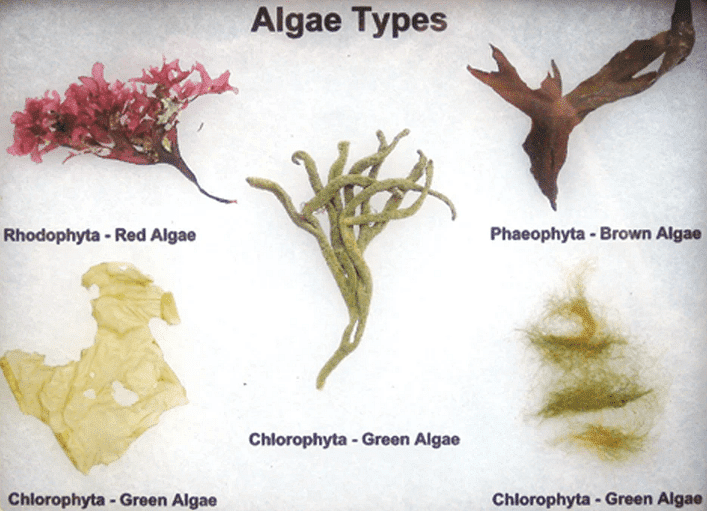
These divisions are based on the following factors
- Major photosynthetic pigments present
- Form of stored food
- Cell wall composition
- Number of flagella and position of insertion
(i) Chlorophyceae
- Common name: Green algae
- Major pigments: Chlorophylls a and b
- Stored food: Starch
- Cell wall composition: Cellulose
- Flagella number and position: 2-8; equal and apical
(ii) Phaeophyceae
- Common name: Brown algae
- Major pigments: Chlorophylls a and c, and fucoxanthin
- Stored food: Mannitol and laminarin
- Cell wall composition: Cellulose and algin
- Flagella number and position: 2; unequal and lateral
(iii) Rhodophyceae
- Common name: Red algae
- Major pigments: Chlorophylls a and d, and phycoerythrin
- Stored food: Floridean starch
- Cell wall: Cellulose, pectin, and polysulphate esters
- Flagella number: Absent
Q2: When and where does reduction division take place in the life cycle of a liverwort, a moss, a fern, a gymnosperm and an angiosperm?
Ans:
(i) Liverwort
- In liverworts, the main plant-body is haploid (gametophytic).
- It bears the male and female sex organs which produce gametes. These gametes fuse to form a zygote.
- The zygote develops on the gametophytic plant-body to form a sporophyte. The sporophyte is differentiated into the foot, seta, and capsule.
- Many haploid spores are produced as a result of the reduction division taking place inside the capsule.
(ii) Moss
- In mosses, the primary protonema (developed in the first stage) develops into the secondary protonema. Both these stages are haploid or gametophytic.
- The secondary protonema bears the sex organs which produce gametes. These gametes fuse to form a zygote.
- The zygote develops into a sporophyte. Many spores are formed as a result of the reduction division taking place in the capsule of this sporophyte.
(iii) Fern
- In ferns, the main plant body is sporophytic. Its leaves are known as sporophylls and these bear the sporangia.
- Reduction division takes place in these sporangia, thereby producing many spores.
(iv) Gymnosperm
- In gymnosperms, the main plant body is sporophytic. They bear two types of leaves - microsporophylls and megasporophylls.
- Reduction division takes place in the microsporangia present on the microsporophylls (producing pollen grains) and on the megasporangia present on the megasporophylls (producing megaspores).
(v) Angiosperm
- In angiosperms, the main plant-body is sporophytic and bears flowers.
- The male sex organ in the flower is the stamen, while the female sex organ is the pistil.
- Reduction division takes place in the anthers of the stamen (producing haploid pollen grains) and in the ovary of the pistil (producing eggs).
Q3: Name three groups of plants that bear archegonia. Briefly describe the life cycle of any one of them.
Ans: Archegonium is the female sex organ that produces the female gamete or egg. It is present in the life cycles of bryophytes, pteridophytes, and gymnosperms.
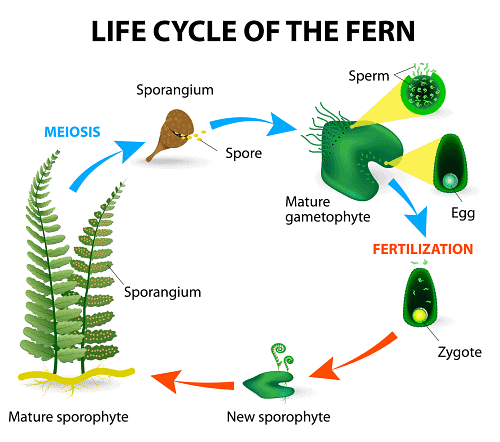
Life cycle of a fern (Dryopteris)
- Dryopteris is a common fern with pinnately-compound leaves. The main plant body is sporophytic. Many sporangia are borne on the lower surfaces of its mature leaves.

- Each sporangium has spore mother cells that undergo meiosis to produce haploid spores. On maturing, these spores dehisce and germinate to give rise to a heart-shaped gametophyte called prothallus.
- The prothallus bears the male and female sex organs called antheridia and archegonia respectively. The antheridia produce sperms that swim in water to reach the archegonia. The egg is produced by archegonia.
- As a result of fertilisation, a zygote is formed. The zygote forms an embryo, which in turn develops into a new sporophyte. The young plant comes out of the archegonium of the parent gametophyte.
Q4: Mention the ploidy of the following:
protonemal cell of a moss; primary endosperm nucleus in dicot, leaf cell of a moss; prothallus cell of a ferm; gemma cell in Marchantia; meristem cell of monocot, ovum of a liverwort, and zygote of a fern.
Ans: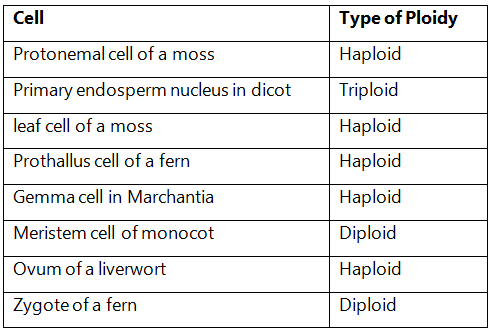
Q5: Write a note on economic importance of algae and gymnosperms.
Ans:
(i) Economic Importance of Algae
Algae have diverse economic uses. They perform half of the total carbon dioxide fixation on earth by photosynthesis, acting as the primary producers in aquatic habitats.
- Food source: Many species of marine algae such as Porphyra, Sargassum, and Laminaria are edible. Chlorella and Spirulina are rich in proteins. Thus, they are used as food supplements.
- Commercial importance: Agar is used in the preparation of jellies and ice-cream. It is obtained from Gelidium and Gracilaria. Carrageenan is used as an emulsifier in chocolates, paints, and toothpastes. It is obtained from the red algae.
- Medicines: Many red algae such as Corallina are used in treating worm infections.
(ii) Economic importance of Gymnosperms
- Construction purposes: Many conifers such as pine, cedar, etc., are sources of the soft wood used in construction and packing.
- Medicinal uses: An anticancer drug Taxol is obtained from Taxus. Many species of Ephedra produce ephedrine, which can be used in the treatment of asthma and bronchitis.
- Food source: The seeds of Pinus gerardiana (known as chilgoza) are edible.
- Source of resins: Resins are used commercially for manufacturing sealing waxes and water-proof paints. A type of resin known as turpentine is obtained from various species of Pinus.
Q6: Both gymnosperms and angiosperms bear seeds, then why are they classified separately?
Ans:
- Gymnosperms and angiosperms are seed-producing plants with diplontic life cycles.
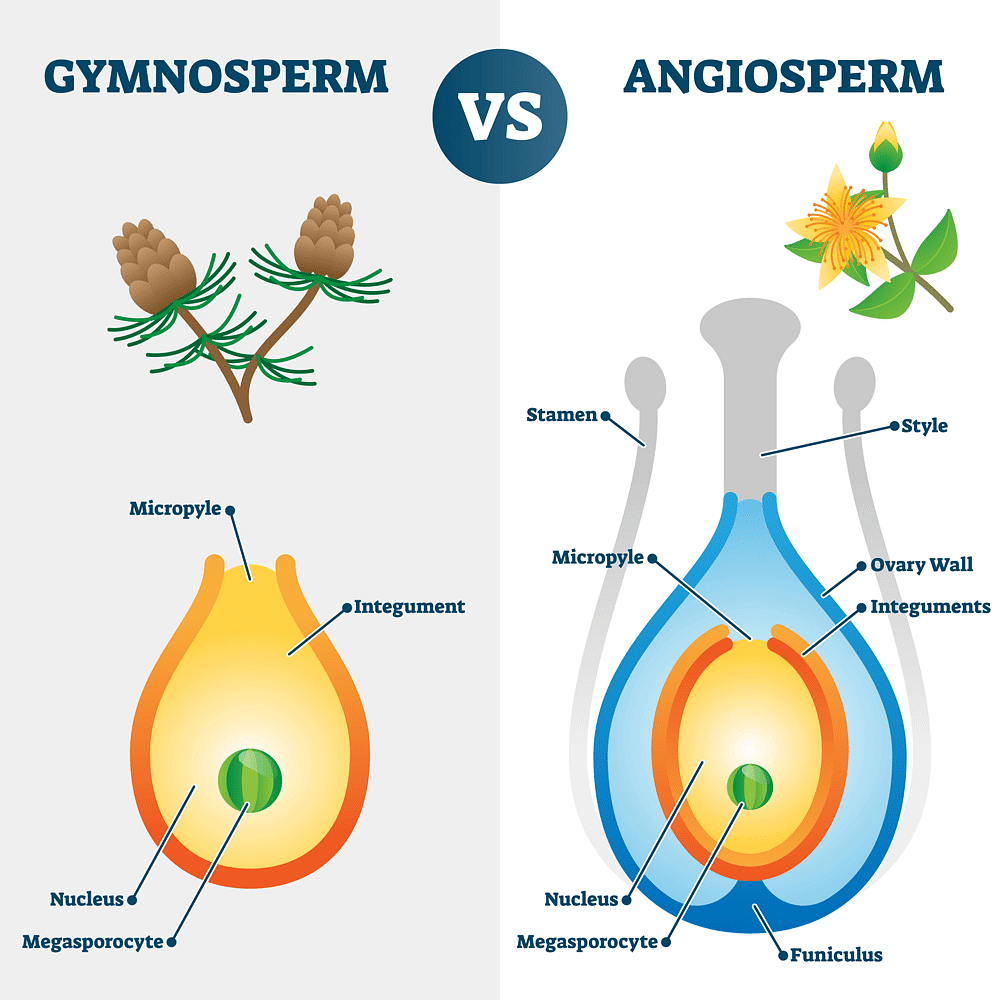
- In gymnosperms, the sporophylls are aggregated to form compact cones. The microsporophylls are broad and are not distinguished into filaments and anthers.
- The megasporophylls are woody and lack the ovary, style, and stigma, because of which the ovules lie exposed. The female gametophyte consists of archegonia.
- The fertilisation process involves the fusion of a male gamete with a female gamete. Their endosperm is haploid. The produced seeds are naked as there is no fruit formation.
- Angiosperms are also known as flowering plants. They have sporophylls that aggregate to form flowers with the perianth.
- The microsporophylls consist of stamens containing pollen sacs. These sacs bear the male gametes called pollen grains. The megasporophylls are delicate and rolled, forming carpels that contain the ovary, style, and stigma.
- The ovules are present inside the ovary. The archegonium is replaced by an egg apparatus. Two male gametes enter the egg apparatus at the time of fertilisation. One male gamete fertilises the egg and the other fuses with the diploid secondary nucleus to form endosperm.
- The resulting endosperm is thus triploid. In addition, in angiosperms, the development of seeds takes place inside the fruits.
Q7: What is heterospory? Briefly comment on its significance. Give two examples.
Ans:
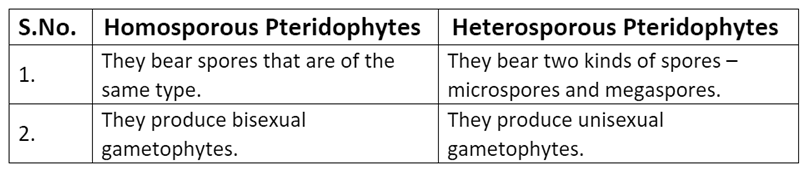
- Heterospory is a phenomenon in which two kinds of spores are borne by the same plant. These spores differ in size. The smaller one is known as microspore and the larger one is known as megaspore.
- The microspore germinates to form the male gametophyte and the megaspore germinates to form the female gametophyte. The male gametophyte releases the male gametes and these reach the female gametophyte to fuse with the egg.
- The development of the zygote takes place inside the female gametophyte. This retention and germination of the megaspore within the megasporangium ensures proper development of the zygote. The zygote develops into the future sporophyte. The evolution of the seed habit is related to the retention of the megaspore.
- Heterospory is thus considered an important step in evolution as it is a precursor to the seed habit. Heterospory evolved first in pteridophytes such as Selaginella and Salvinia.
Q8: Explain briefly the following terms with suitable examples:
(i) protonema
(ii) antheridium
(iii) archegonium
(iv) diplontic
(v) sporophyll
(vi) isogamy
Ans.:
(i) Protonema: It is the first stage in the life cycle of a moss, developing directly from the spore. It consists of creeping, green, branched, and often filamentous structures.
(ii) Antheridium: It is the male sex organ present in bryophytes and pteridophytes and is surrounded by a jacket of sterile cells. It encloses the sperm mother cells, which give rise to the male gametes.
(iii) Archegonium: It is the female sex organ present in bryophytes, pteridophytes, and gymnosperms. In bryophytes and pteridophytes, it generally has a swollen venter and a tubular neck, and contains the female gamete called the egg.
(iv) Diplontic: It is the term used for the life cycles of seed-bearing plants (gymnosperms and angiosperms). In these plants, the diploid sporophyte is dominant, photosynthetic, and independent. The gametophyte is represented by a single-celled (or a few-celled) structure.
(v) Sporophyll: In pteridophytes, the sporophytic plant body bears sporangia. These sporangia are subtended by leaf-like appendages known as sporophylls. In gymnosperms, microsporophylls and megasporophylls are found. These bear microspores and megaspores respectively.
(vi) Isogamy: It is a type of sexual reproduction involving the fusion of morphologically similar gametes. This means that the gametes are of the same size, but perform different functions. This type of reproduction is commonly observed in Spirogyra.
Q9: Differentiate between the following:
(i) red algae and brown algae
(ii) liverworts and moss
(iii) homosporous and heterosporous pteridophyte
Ans:
(i) Red algae and Brown algae
(ii) Liverworts and Moss

(iii) Homosporous and Heterosporous Pteridophyte
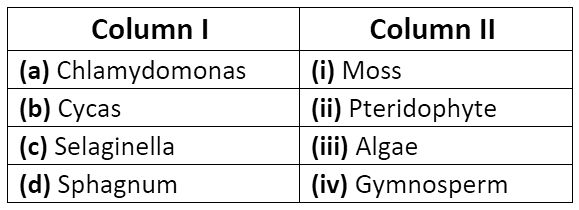
Q10: Match the followings (column I with column II)
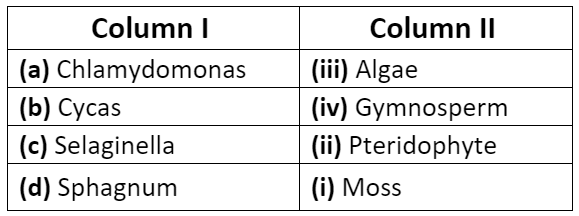
Ans:
Q11: Describe the important characteristics of gymnosperms.
Ans: Important features of gymnosperms are:
- The term gymnosperm refers to plants with naked seeds (gymnos - naked, sperma - seeds), i.e., the seeds of these plants are not enclosed in fruits.
- The plant body ranges from medium to tall trees and shrubs. The giant redwood tree Sequoia is one of the tallest trees in the world.
- The root system consists of tap roots. The coralloid roots present in Cycas are associated with nitrogen-fixing cyanobacteria.
- The stem can be branched (as in Pinus and Cedrus) or un-branched (as in Cycas).
- The leaves can be simple (as in Pinus) or compound (pinnate in Cycas). The leaves are needle-like, with a thick cuticle and sunken stomata. These help in preventing water loss.
- Gymnosperms are heterosporous. They bear two kinds of spores – microspores and megaspores.
- Flowers are absent. The microsporophylls and megasporophylls are arranged to form compact male and female cones.
- Pollination occurs mostly through wind and pollen grains reach the pollen chamber of the ovule through the micropyle.
- The male and female gametophytes are dependent on the sporophyte.
- The seeds contain haploid endosperms and remain uncovered.
|
181 videos|360 docs|149 tests
|
FAQs on NCERT Solutions Class 11 Biology Chapter 3 - Plant Kingdom
| 1. What are the different groups of plants classified in the Plant Kingdom? |  |
| 2. What are the main characteristics of Bryophytes? | |
| 3. How do Gymnosperms differ from Angiosperms? | |
| 4. What is the significance of Algae in the Plant Kingdom? | |
| 5. How do plants in the Plant Kingdom reproduce? | |

|
11.1K Views |

|
4.95/5 Rating |

|
Dec 18, 2024 Last updated |

|
Explore Courses for NEET exam
|

|
ppt
,Summary
,Important questions
,practice quizzes
,Exam
,NCERT Solutions Class 11 Biology Chapter 3 - Plant Kingdom
,Previous Year Questions with Solutions
,study material
,video lectures
,past year papers
,Free
,MCQs
,Semester Notes
,NCERT Solutions Class 11 Biology Chapter 3 - Plant Kingdom
,Extra Questions
,shortcuts and tricks
,NCERT Solutions Class 11 Biology Chapter 3 - Plant Kingdom
,Viva Questions
,Objective type Questions
,Sample Paper
,mock tests for examination
;


NCERT Solutions: Plant Kingdom Free PDF Download
Importance of NCERT Solutions: Plant Kingdom
NCERT Solutions: Plant Kingdom Notes
NCERT Solutions: Plant Kingdom NEET Questions
Study NCERT Solutions: Plant Kingdom on the App
|
© EduRev
|
Education Revolution
|


Follow Us
|


