NCERT Solutions: Reproductive Health

Q1: What do you think is the significance of reproductive health in a society?
Ans: Reproductive health means complete physical, mental and social well-being in all matters relating to the reproductive system and its functions. It implies that people are able to have a responsible, satisfying and safe sex life and that they have the capability to reproduce and the freedom to decide if, when and how often to do so.
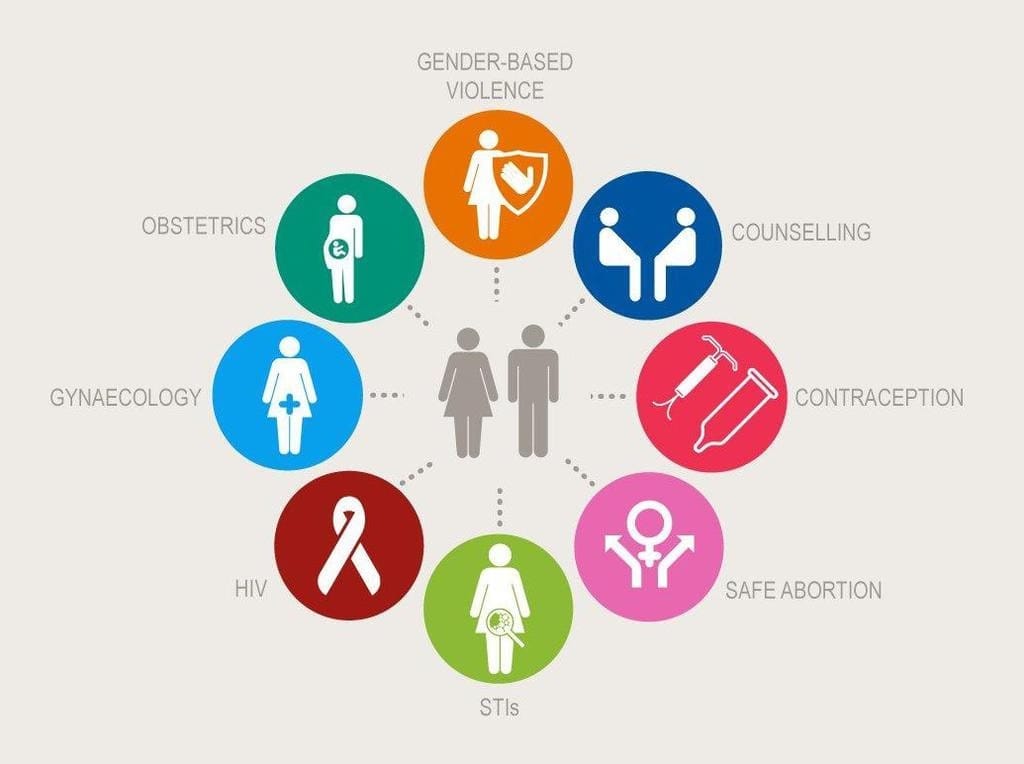
- Sexually transmitted diseases (STDs) such as AIDS and gonorrhoea are transmitted through sexual contact. Good reproductive health reduces the spread of STDs by promoting safe sexual practices and early diagnosis and treatment.
- Awareness and access to contraception reduce unwanted pregnancies and unsafe abortions. This protects the health of women and reduces maternal mortality.
- Education about reproductive health helps young people make informed decisions, protects them from myths and exploitation and promotes gender equality.
- Controlling uncontrolled population growth by enabling couples to plan families contributes to better allocation of resources, improved maternal and child health and stronger social and economic development.
Q2: Suggest the aspects of reproductive health which need to be given special attention in the present scenario.
Ans: Reproductive health refers to total well-being in all aspects of reproduction. In the present scenario, the following aspects need special attention:
- Creating awareness and providing correct information about reproductive organs, adolescence and related changes.
- Introduction of sex education in schools to discourage myths and misconceptions related to sex.
- Education about safe and hygienic sexual practices and prevention of sexually transmitted infections (STIs), including AIDS.
- Counselling and awareness regarding available birth control methods and family planning.
- Proper care of pregnant women, safe delivery practices, and post-natal care of the mother and child.
- Providing adequate medical facilities and professional support for problems related to pregnancy, childbirth, contraception, infertility, abortions and STIs.
- Creating awareness about problems of uncontrolled population growth, sex abuse and sex-related crimes to build a socially responsible and healthy society.
Q3: Is sex education necessary in schools? Why?
Ans:
- Yes. Introducing sex education in schools is necessary because it gives young people correct information at the right time about reproductive organs, puberty, changes in adolescence, safe sexual behaviour and STDs.
- Accurate education reduces myths and misconceptions, helps prevent abuse and exploitation, promotes healthy relationships and encourages responsible choices. It also complements guidance from parents and health services.
Q4: Do you think that reproductive health in our country has improved in the past 50 years? If yes, mention some such areas of improvement.
Ans: Yes, reproductive health in India has improved appreciably over the last 50 years.
The areas of improvement are as follows:
- Mass immunisation of children has reduced many infectious diseases and lowered infant mortality.
- Better antenatal and postnatal care and increased institutional deliveries have contributed to a fall in maternal and infant mortality rates.
- Family planning programmes and wider availability of contraceptives have helped many couples to choose smaller families.
- Improved access to contraception and information has reduced unintended pregnancies and helped prevent some STDs through barrier methods.
Q5: What are the suggested reasons for population explosion?
Ans: The human population is increasing rapidly, leading to a population explosion.
It is because of the following three major reasons:
- Rapid decline in death rate
- Decline in MMR and IMR
- Increase in number of people in reproductive age
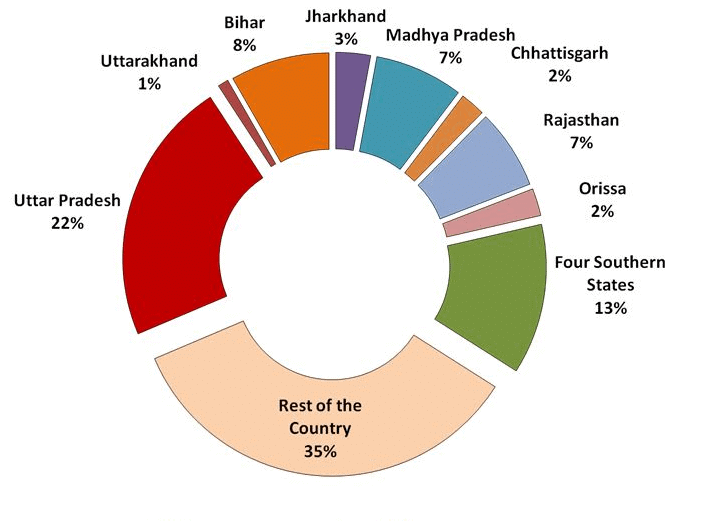 Population Explosion
The fall in death rate over the past decades is due to better control of infectious diseases, widespread immunisation, improved medical facilities, better nutrition and public health measures. These factors, together with increased life expectancy and in some areas continued high fertility or early marriage, have contributed to rapid population growth.
Q6: Is the use of contraceptives justified? Give reasons.
Ans: Yes. The use of contraceptives is justified for several reasons:
- They help couples plan and space pregnancies, which improves the health of mothers and children.
- By reducing unintended pregnancies, contraceptives contribute to checking population growth and easing pressure on resources.
- Barrier methods such as condoms reduce the risk of many sexually transmitted infections.
- Most contraceptive methods are reversible and allow individuals to decide the timing and number of children, supporting reproductive rights and well-being.
Q7: Removal of gonads cannot be considered as a contraceptive option. Why?
Ans:
- Contraceptive methods are meant to prevent fertilisation while preserving overall health and, where possible, fertility for the future.
- Complete removal of gonads (gonadectomy) causes permanent infertility and eliminates important sex hormones needed for normal bodily functions and secondary sexual characteristics. It would therefore be an extreme and harmful measure rather than an acceptable contraceptive option.
Q8: Amniocentesis for sex determination is banned in our country. Is this ban necessary? Comment.
Ans: Amniocentesis is a prenatal diagnostic technique used to detect chromosomal or metabolic disorders and, technically, can show the sex of the foetus.
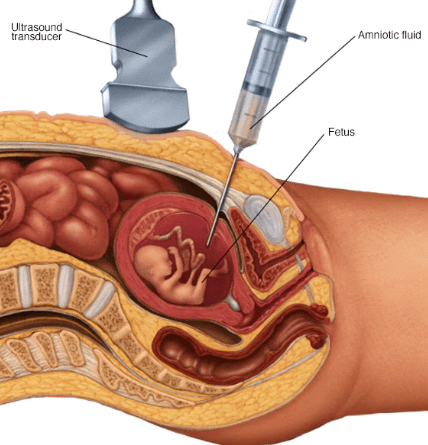 Amniocentesis
 This technique was developed to identify genetic disorders so that appropriate medical decisions may be taken. However, its misuse for determining the sex of the foetus has led to sex-selective abortions and a decline in the female population in some areas. To prevent female foeticide and protect the rights of the unborn child, it is necessary to ban use of amniocentesis for sex determination. Prenatal diagnostic techniques remain available for legitimate medical reasons under strict regulation.
Q9: Suggest some methods to assist infertile couples to have children.
Ans: Infertility is the inability of a couple to produce a baby even after regular unprotected intercourse. It may be due to problems in either partner. The techniques used to assist infertile couples are as follows:
- Test tube babies: Also called in-vitro fertilisation (IVF). Eggs and sperm are brought together outside the body to form an embryo. The embryo is then transferred into the uterus for development.
- Gamete intrafallopian transfer (GIFT): Gametes (eggs and sperm) are placed into the fallopian tube of the recipient so that fertilisation can occur inside the body. This can be useful when the woman can provide a suitable environment for embryo development but fertilisation has been difficult.
- Intra cytoplasmic sperm injection (ICSI): A single sperm is injected directly into an egg in the laboratory to form an embryo. This is particularly helpful in cases of very low sperm count or poor sperm motility.
- Artificial insemination: Semen from a partner or donor is placed into the female reproductive tract (vagina or uterus) to achieve pregnancy. This is used when the male cannot inseminate naturally or has low sperm numbers.
Q.10: What are the measures one has to take to prevent contracting STDs?
Ans:
- Educate adolescents and young adults about modes of transmission, symptoms and consequences of STDs so they can recognise risks and seek timely care.
- Use barrier methods such as condoms consistently and correctly to reduce the risk of infection.
- Avoid sex with unknown or multiple partners and seek medical advice promptly if symptoms occur. Regular screening and early treatment reduce complications and further spread.
Q11: State True/False with explanation
(a) Abortions could happen spontaneously too. (True/False)
(b) Infertility is defined as the inability to produce a viable offspring and is always due to abnormalities/defects in the female partner. (True/False)
(c) Complete lactation could help as a natural method of contraception. (True/False)
(d) Creating awareness about sex-related aspects is an effective method to improve people's reproductive health. (True/False)
Ans:
(a) Abortions could happen spontaneously too. True
(b) Infertility is defined as the inability to produce a viable offspring and is always due to abnormalities/defects in the female partner. False
(c) Complete lactation could help as a natural method of contraception. True
(d) Creating awareness about sex-related aspects is an effective method to improve people's reproductive health. True
Explanation:
(a) Some pregnancies end naturally because of problems in early development or maternal health; these are spontaneous abortions (miscarriages).
(b) Infertility affects couples and may be caused by problems in the male, the female or both partners; it is not always due to female defects.
(c) Exclusive breastfeeding (lactational amenorrhoea) can act as a temporary natural contraceptive for some women, especially in the first six months after birth, provided breastfeeding is frequent and exclusive.
(d) Accurate information and awareness reduce risky behaviour, help early detection and treatment of disorders and enable better family planning; these all improve reproductive health.
Q12: Correct the following statements:
(a) Surgical methods of contraception prevent gamete formation.
(b) All sexually transmitted diseases are completely curable.
(c) Oral pills are very popular contraceptives among the rural women.
(d) In E. T. techniques, embryos are always transferred into the uterus.
Ans:
(a) Surgical methods of contraception prevent gamete formation.
Correction: Surgical methods of contraception prevent the union or transport of gametes during intercourse (for example, vasectomy blocks sperm transport and tubectomy blocks the egg/sperm pathway) rather than preventing gamete formation itself.
(b) All sexually transmitted diseases are completely curable.
Correction: Some sexually transmitted diseases are curable if detected early and treated correctly (for example, many bacterial infections). However, others, such as HIV/AIDS, are not yet curable and require long-term management.
(c) Oral pills are very popular contraceptives among rural women.
Correction: Oral pills tend to be more popular among urban women who have easier access to medical advice and regular supplies. In rural areas, use of long-acting methods or condoms may be more common where access to daily medication and follow-up is difficult.
(d) In E. T. techniques, embryos are always transferred into the uterus.
Correction: In embryo transfer techniques, early embryos such as 8-celled embryos may be transferred into the fallopian tube while more developed embryos are transferred into the uterus; the site depends on the stage of embryo development and clinical judgement.
FAQs on NCERT Solutions: Reproductive Health
| 1. What are the common reproductive health issues faced by women? |  |
| 2. How can one prevent sexually transmitted infections (STIs)? | |
| 3. What are the factors that can affect male reproductive health? | |
| 4. How does contraception play a role in reproductive health? | |
| 5. What are the challenges faced in ensuring reproductive health services for all individuals? | |





