Lichens & Mycorrhiza - NEET PDF Download
| Table of contents |

|
| Lichens |
|
| Structure of Lichens |
|
| Habitat of Lichens |
|
| Different Forms of Lichens |
|
| Mycorrhiza |
|
| Types of Mycorrhiza |
|
Lichens can be found on approximately 6-8% of the Earth's surface and thrive in diverse environments, ranging from high mountain regions to sea-level areas. They are commonly found on surfaces like tree bark, moss, rocks, roofs, leaves, and even on other lichens.
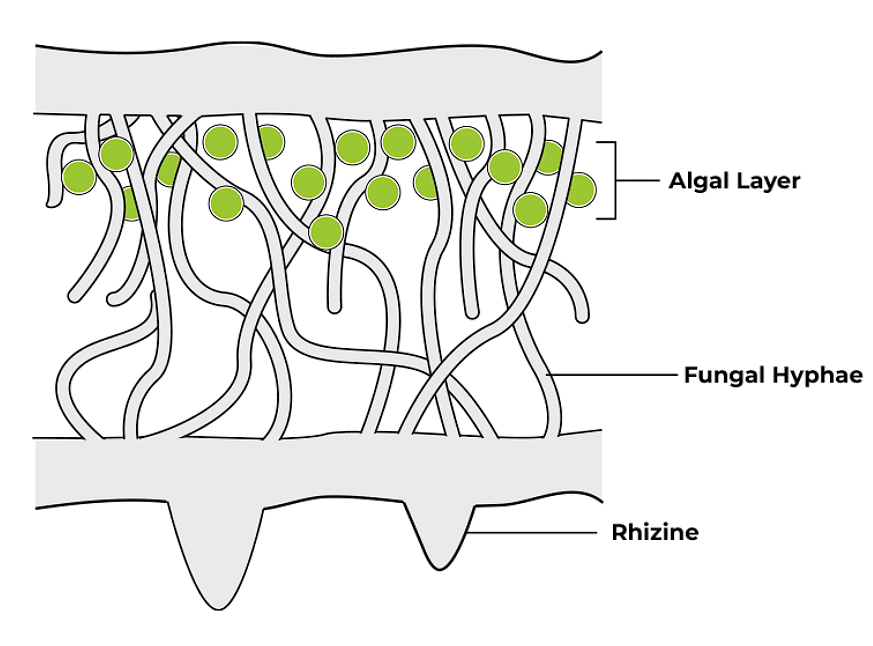 Lichens
Lichens
Lichens are symbiotic (Mutual) relationship between algae and fungi in which algae prepare food and fungi provides shelter. In this relationship, algae are known as photobionts, and fungi are known as mycobionts. Lichens have properties different from those of their component organisms.
The study of lichen is called lichenology.
Note: Mosses, as well as lichens, are the initial living things to grow on rocks, and this makes them very important in the environment.
Structure of Lichens
Lichens have a specific structure. The part we usually see is the thread-like strands of the fungus, while the algae part is beneath these fungal strands and is separate. The thick fungal strands help lichens cling to their surroundings.
The types of fungi found in lichens are usually Ascomycetes or Basidiomycetes. These lichens often team up with green algae from the Chlorophyta group or blue-green bacteria from the Cyanophyceae family. Normally, the fungal partners in lichens can't survive on their own without their algal companions, but the algae can usually live independently in water or damp soil. Some lichens can grow as large as 3 feet, although most are much smaller, typically just a few centimeters. They come in various colors, ranging from yellow to green and even black shades.

Habitat of Lichens
- The lichens are mostly perennial, aerial, slow-growing and long-lived plant.
- Lichens are cosmopolitan. Lichens are even in areas which appear unsuitable for a normal plant like bare hard rock and cold arctic region.
- Lichens are most sensitive to air pollution specially SO2-pollution.
- In India lichen are most common in eastern Himalaya as compare to western Himalaya Lichens are absent in planes.
Different Forms of Lichens
- Crustose lichens spread over surfaces.
- Foliose lichens resemble flat, leaf-like sheets and aren't closely attached.
- Squamulose lichens are closely grouped, looking like flat pebble units.
- Fruticose lichens have a bushy, branching appearance.
- Some lichens have a gelatinous or jelly-like look.
- Leprose lichens have a powdery appearance.
- Lichens can also be found in various colors, such as yellow, orange, red, and brown. These colors are because of a special pigment called usnic acid. Without this pigment, lichens are usually olive-gray or green.
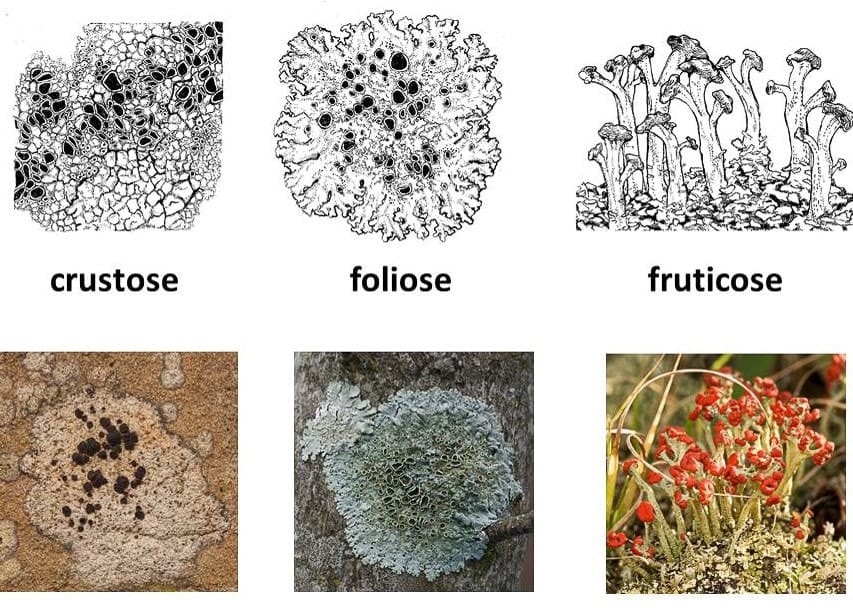 Types of Lichens on the basis of Thallus
 |
Download the notes
Lichens & Mycorrhiza
|
Download as PDF |
Mycorrhiza
- Mycorrhiza is the symbiotic relationship between the roots of higher plants (Seed plant) and fungus.
- Mycorrhiza is an example of symbiosis. The fungus obtains food and shelter from the root and it helps in the absorption of water & minerals.
- Mycorrhiza name was given by "Frank" (1885).
 |
Take a Practice Test
Test yourself on topics from NEET exam
|
Practice Now |
Types of Mycorrhiza
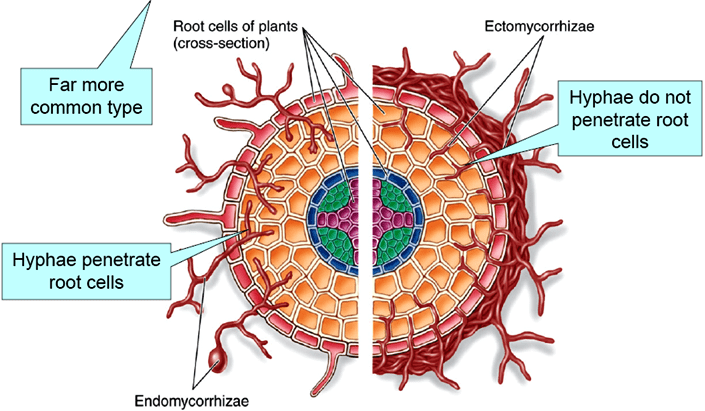
(a) Ectomycorrhiza
- In this type of mycorrhiza surface of the root completely covered by the pseudo parenchymatous sheath formed by fungal hyphae.
- Fungal hyphae enter intercellularly in the cortical cell of the root.
- Fungal hyphae arises from pseudo parenchymatous sheath limited up to the outer cortical cell and form a net called "Hartig net".
- Ectomycorrhiza occurs in Pinus, Fagus, Abies, Oak, Eucalyptus etc.
- Fungus mainly members of class basidiomycetes.Examples: Clavatia, Amanita, etc.
- Root hair is absent on the root.
- Fungus is helpful in the absorption of water and minerals.
- Due to the presence of fungus absorptive surface of the root increases. In return, the fungus gets carbohydrates from the root.
(b) Endomycorrhiza
- This type of mycorrhiza fungus does not form a pseudo parenchymatous sheath.
- Some fungal hyphae enter intracellularly in cortical cells of the root. Intracellular fungal hyphae form unbranched knob-like structures called a vesicle, and form branched tree-like structures in cortical cells, called "arbuscule". So the endomycorrhiza is called Vesicular arbuscular mycorrhiza (VAM).
- VAM is useful for phosphate nutrition.
- Endomycorrhiza occurs in orchids.
- Endomycorrhizal fungi are mainly member of class "zygomycetes". Example: Corticium, Rhizoctonia
FAQs on Lichens & Mycorrhiza - NEET
| 1. What is a lichen? |  |
| 2. How do lichens obtain nutrients? | |
| 3. What is mycorrhiza? | |
| 4. How do mycorrhizal fungi benefit plants? | |
| 5. What is the significance of lichens and mycorrhizae in ecosystems? | |




Previous Year Questions with Solutions
,past year papers
,MCQs
,study material
,Important questions
,Objective type Questions
,Summary
,ppt
,Lichens & Mycorrhiza - NEET
,Exam
,Lichens & Mycorrhiza - NEET
,Sample Paper
,video lectures
,shortcuts and tricks
,Lichens & Mycorrhiza - NEET
,Free
,Semester Notes
,practice quizzes
,Extra Questions
,mock tests for examination
,Viva Questions
;




Lichens & Mycorrhiza Free PDF Download
Importance of Lichens & Mycorrhiza
Lichens & Mycorrhiza Notes
Lichens & Mycorrhiza NEET Questions
Study Lichens & Mycorrhiza on the App
|
© EduRev
|
Education Revolution
|


|




