JEE Exam > JEE Notes > Mathematics (Maths) Class 12 > NCERT Solutions Exercise 4.3: Determinants
NCERT Solutions Exercise 4.3: Determinants

Q1: Write Minors and Cofactors of the elements of following determinants:
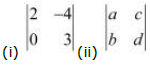
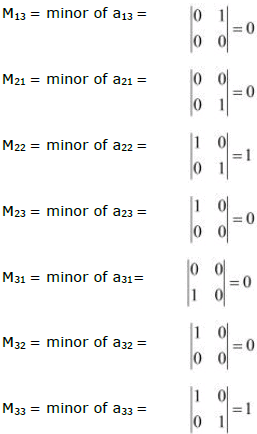
Ans: (i) The given determinant is

Minor of element aij is Mij.
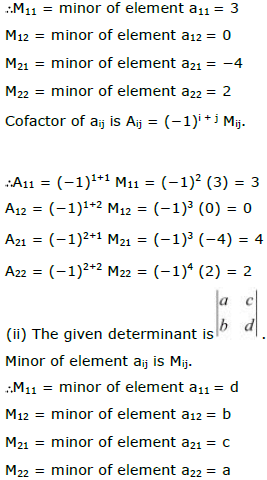
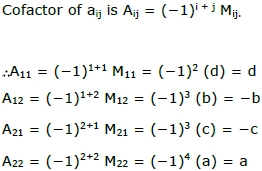
Explanation:
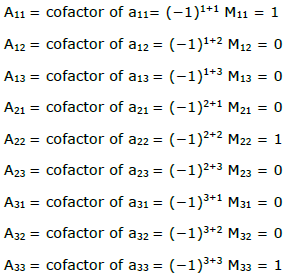
For any element aij of a determinant, its minor Mij is the determinant obtained by deleting the i-th row and j-th column. The corresponding cofactor Aij is given by Aij = (-1)i+jMij.
The results of these deletions and the computed minors and cofactors are shown in the images above (
and ). Use the sign factor (-1)i+j to obtain each cofactor from the corresponding minor.Q2:

Ans:
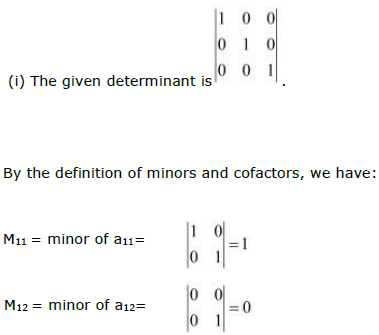
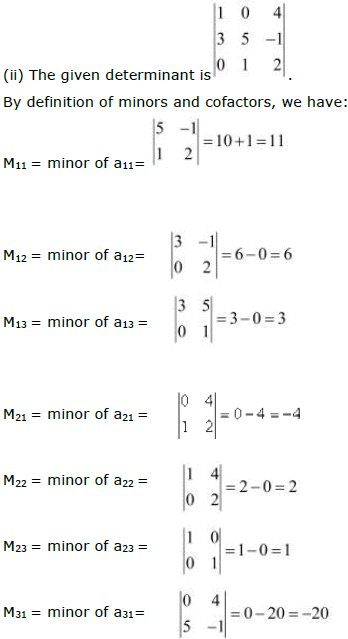
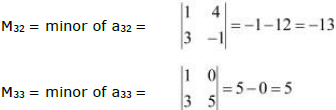
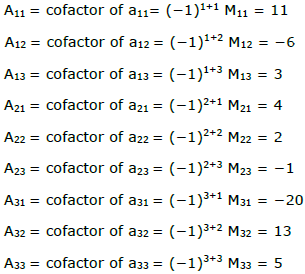
Explanation:
The minors and cofactors for the given determinant are obtained by deleting the appropriate row and column for each element and then applying the sign (-1)i+j to the computed minor to get the cofactor. The intermediate minors and the final cofactors are displayed in the images
through . Follow the same rule for every element: compute the 2×2 determinant after deletion, then multiply by (-1)i+j.Q3: Using Cofactors of elements of second row, evaluate Δ =

Ans: The given determinant is

We have:
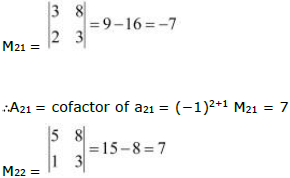
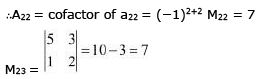

We know that ∆ is equal to the sum of the product of the elements of the second row with their corresponding cofactors.
Solution:
Expanding along the second row,
∆ = a21A21 + a22A22 + a23A23.
From the determinant (see images), the second row elements and their cofactors are:
a21 = 2, A21 = 7
a22 = 0, A22 = 7
a23 = 1, A23 = -7
Therefore,
∆ = 2 × 7 + 0 × 7 + 1 × (-7) = 14 - 7 = 7.
Q4: Using Cofactors of elements of third column, evaluate Δ=

Ans: The given determinant is

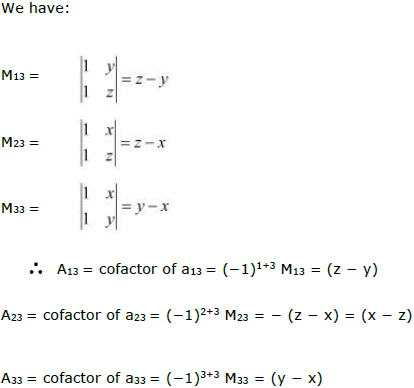
We know that Δ is equal to the sum of the product of the elements of the second row
with their corresponding cofactors.
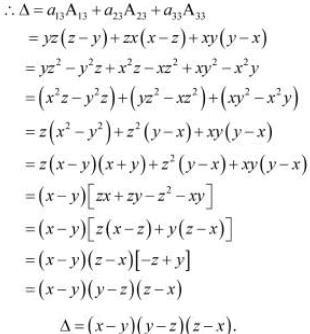
Hence,
Clarification and Correction:
To evaluate Δ by expanding along the third column, use the formula
Δ = a13A13 + a23A23 + a33A33.
The necessary minors and cofactors for the third column and the numerical substitution are provided in the images
-. The final computed value of Δ is shown in .Q5: If ∆ =
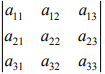
(A) a11 A31+ a12 A32 + a13 A33
(B) a11 A11 + a12 A21 + a13 A31
(C) a21 A11 + a22 A12 + a23 A13
(D) a11 A11+ a21 A21 + a31 A31
Ans: D
Given : Δ =
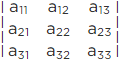
Δ = Sum of products of elements of row (or column) with their corresponding cofactors.
Δ=a11 A11+ a21 A21 + a31 A31
So, option D is correct.MCQ (Mathematical) - Finalised solution:
Ans: (D)
Sol:
The determinant ∆ can be expanded along any column. Expanding along the first column gives
∆ = a11A11 + a21A21 + a31A31,
which matches option (D). Hence (D) is correct.
Old NCERT Questions
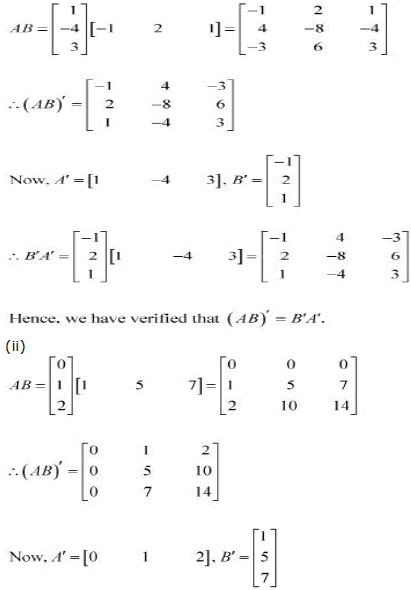
Q1: For the matrices A and B, verify that (AB)′ = B'A' where
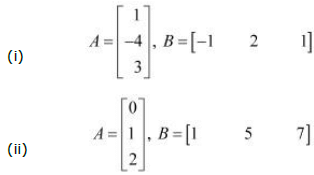
Ans:

Hence,
Explanation:
The transpose of a product satisfies the rule (AB)' = B'A'. A brief index-wise justification is:
((AB)')ij = (AB)ji = Σk AjkBki = (B'A')ij.
The explicit multiplication and transposition carried out for the given matrices are displayed in the images
and , which verify the equality.Q2: Examine the consistency of the system of equations.
x + 2y = 2
2x + 3y = 3
Ans:
The given system of equations is:
x + 2y = 2
2x + 3y = 3
The given system of equations can be written in the form of AX = B, where
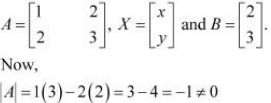

Therefore, A-1 exists.
Hence, the given system of equations is consistent.
Explanation:
Form A and compute det(A) (see
). Since det(A) ≠ 0, matrix A is invertible and a unique solution X = A-1B exists. Thus the system is consistent with a unique solution.Q3: Examine the consistency of the system of equations.
2x - y = 5 x
+ y = 4
Ans: The given system of equations is:
2x - y = 5 x
+ y = 4
The given system of equations can be written in the form of AX = B, where
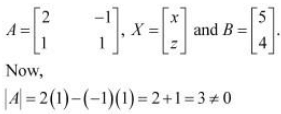

Therefore, A-1 exists.
Hence, the given system of equations is consistent.
Explanation:
Write A and compute its determinant (refer
). As det(A) ≠ 0, A is invertible and the system has a unique solution X = A-1B. Hence the system is consistent.Q4: Examine the consistency of the system of equations.
x + 3y = 5
2x + 6y = 8
Ans: The given system of equations is:
x + 3y = 5
2x + 6y = 8
The given system of equations can be written in the form of AX = B, where
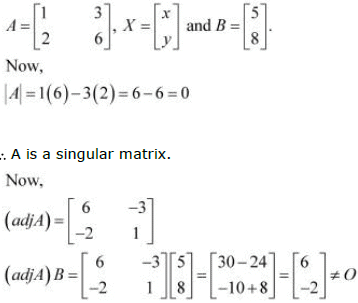
Thus, the solution of the given system of equations does not exist. Hence, the system of equations is inconsistent.
Explanation:
The second equation is 2 times the left-hand side of the first equation, but the right-hand side is 8 rather than 10. That is, the coefficient rows are proportional while the constants are not proportional. Therefore the equations are inconsistent - there is no common solution.
Q5: Examine the consistency of the system of equations.
x + y + z = 1
2x + 3y + 2z = 2
ax + ay + 2az = 4
Ans: The given system of equations is:
x + y + z = 1 2x
+ 3y + 2z = 2 ax
+ ay + 2az = 4
This system of equations can be written in the form AX = B, where
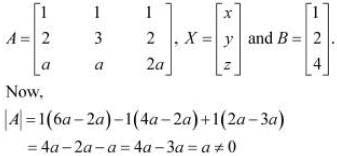

Therefore, A-1 exists.
Hence, the given system of equations is consistent.
Explanation:
Form the coefficient matrix A and compute det(A) (shown in
). Since det(A) ≠ 0 for the given value(s) of parameter a (as computed), A is invertible and the system has a unique solution. Thus it is consistent.Q6: Examine the consistency of the system of equations.
3x - y - 2z = 2
2y - z = -1
3x - 5y = 3
Ans: The given system of equations is:
3x - y - 2z = 2
2y - z = -1
3x - 5y = 3
This system of equations can be written in the form of AX = B, where
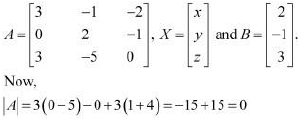
A is a singular matrix.
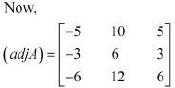
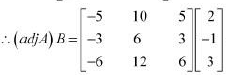
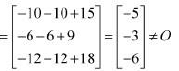
Thus, the solution of the given system of equations does not exist. Hence, the system of equations is inconsistent.
Explanation:
The determinant of the coefficient matrix A is zero (see
), so A is singular. Comparing the ranks of the coefficient matrix and the augmented matrix (shown in and ) shows that the augmented matrix has a larger rank. Hence the system is inconsistent - there is no solution.Q7: Examine the consistency of the system of equations.
5x - y + 4z = 5
2x + 3y + 5z = 2
5x - 2y + 6z = -1
Ans: The given system of equations is:
5x - y + 4z = 5
2x + 3y + 5z = 2
5x - 2y + 6z = -1
This system of equations can be written in the form of AX = B, where
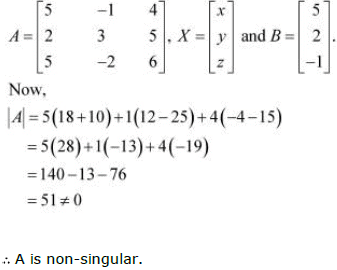
Therefore, A-1 exists.
Hence, the given system of equations is consistent.
Explanation:
Determinant det(A) ≠ 0 (see
), so A is invertible and the unique solution X = A-1B exists. Thus the system is consistent.Q8: Solve system of linear equations, using matrix method.

Ans: The given system of equations can be written in the form of AX = B, where
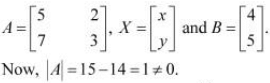
Thus, A is non-singular. Therefore, its inverse exists.
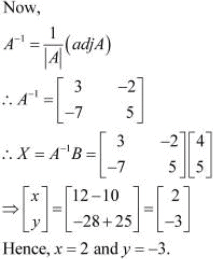
Solution Outline:
Write the system as AX = B. Compute A-1 (shown in
) and then multiply to get X = A-1B. The detailed arithmetic steps and final values are displayed in the images.Q9: Solve system of linear equations, using matrix method.

Ans:The given system of equations can be written in the form of AX = B, where
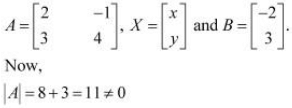
Thus, A is non-singular. Therefore, its inverse exists.
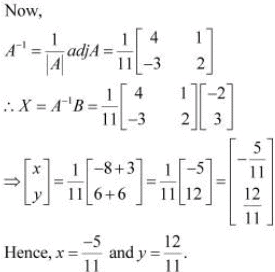
Solution Outline:
As before, compute X = A-1B. The inverse and multiplication steps are carried out in
to produce the solution vector.Q10: Solve system of linear equations, using matrix method.

Ans: The given system of equations can be written in the form of AX = B, where
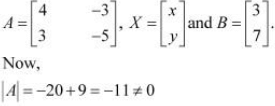
Thus, A is non-singular. Therefore, its inverse exists.
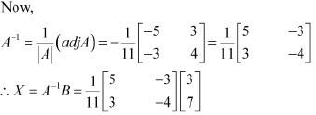
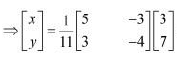
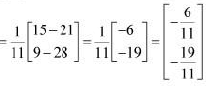
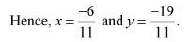
Solution Outline:
Compute A-1 and then X = A-1B. The intermediate calculations and the final solution are presented in the shown images
-.Q11: Solve system of linear equations, using matrix method.
5x + 2y = 3
3x + 2y = 5
Ans: The given system of equations can be written in the form of AX = B, where
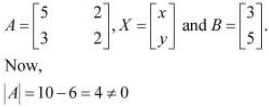
Thus, A is non-singular. Therefore, its inverse exists.
Solution Outline:
For a 2×2 system, compute det(A) and A-1 = (1/det(A)) adj(A). Then X = A-1B. The computations and the final numeric values are shown in
.Q12: Solve system of linear equations, using matrix method.
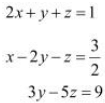
Ans: The given system of equations can be written in the form of AX = B, where
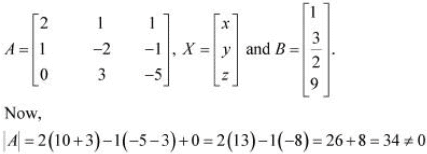
Thus, A is non-singular. Therefore, its inverse exists.
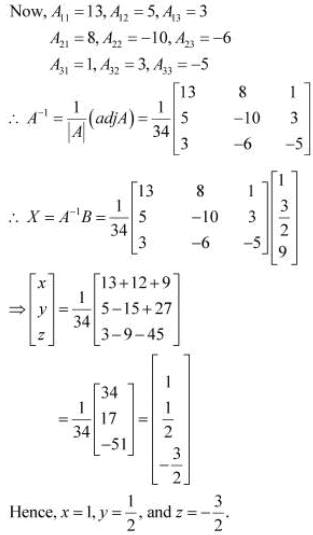
Solution Outline:
Compute A-1 and then X = A-1B. The detailed steps and result are provided in the images.
Q13: Solve system of linear equations, using matrix method.
x - y + z = 4
2x + y - 3z = 0
x + y + z = 2
Ans: The given system of equations can be written in the form of AX = B, where
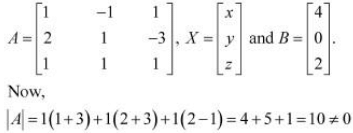
Thus, A is non-singular. Therefore, its inverse exists.
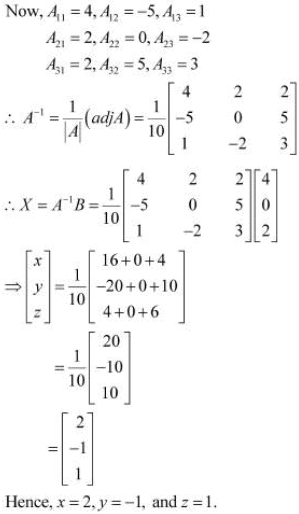
Solution Outline:
Compute A-1 (shown in
) and multiply by B to obtain the solution vector X.Q14: Solve system of linear equations, using matrix method.
2x + 3y + 3z = 5
x - 2y + z = -4
3x - y - 2z = 3
Ans: The given system of equations can be written in the form of AX = B, where
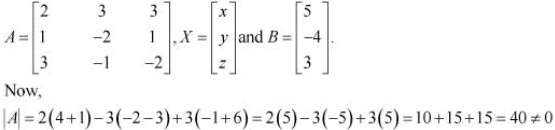
Thus, A is non-singular. Therefore, its inverse exists.
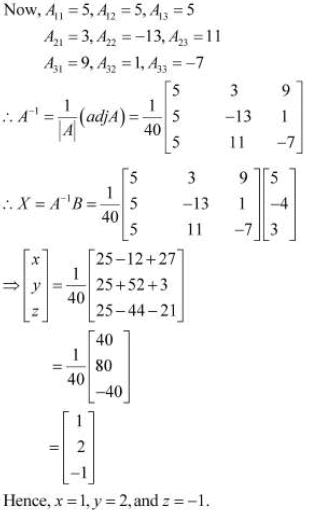
Solution Outline:
Find A-1 and compute X = A-1B. The computational details are presented in
.Q15: Solve system of linear equations, using matrix method.
x - y + 2z = 7
3x + 4y - 5z = -5
2x - y + 3z = 12
Ans: The given system of equations can be written in the form of AX = B, where
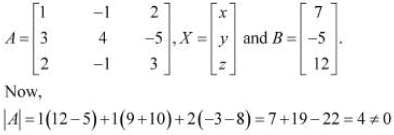
Thus, A is non-singular. Therefore, its inverse exists.
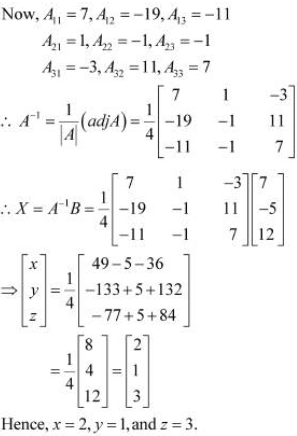
Solution Outline:
Compute A-1 and multiply by B. The inverse and multiplication steps are shown in
yielding the solution.Q16: If
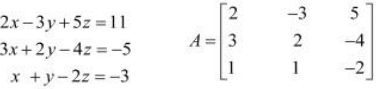
Ans:
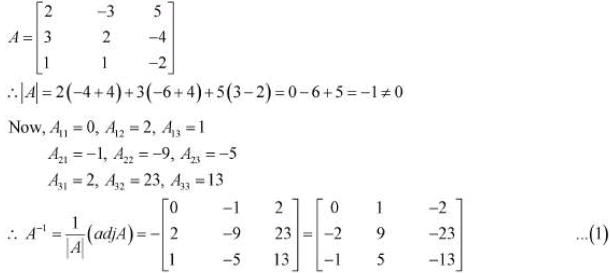
Now, the given system of equations can be written in the form of AX = B, where
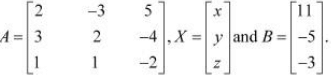
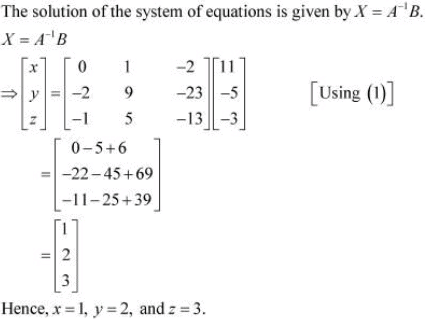
Solution Outline:
Compute A-1 as shown in
. Then use X = A-1B (with A-1 and B given in and ) to find the unknowns. The numeric steps are provided in the images.Q17: The cost of 4 kg onion, 3 kg wheat and 2 kg rice is Rs 60. The cost of 2 kg onion, 4 kg wheat and 6 kg rice is Rs 90. The cost of 6 kg onion 2 kg wheat and 3 kg rice is Rs 70. Find cost of each item per kg by matrix method.
Ans: Let the cost of onions, wheat, and rice per kg be Rs x, Rs y,and Rs z respectively.
Then, the given situation can be represented by a system of equations as:
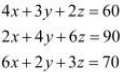
This system of equations can be written in the form of AX = B, where
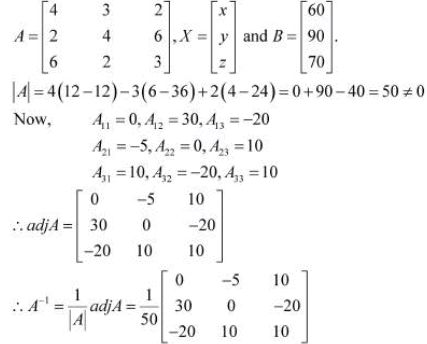
Now,
X = A-1 B
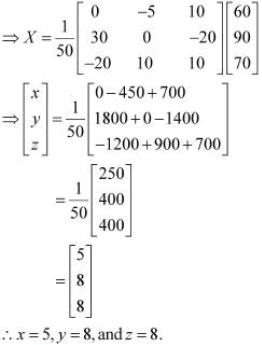
Hence, the cost of onions is Rs 5 per kg, the cost of wheat is Rs 8 per kg, and the cost of rice is Rs 8 per kg.Explanation (final):
Set up the coefficient matrix A and constant vector B from the given information. Compute A-1 and then X = A-1B. The inverse and multiplication steps are shown in
, yielding x = 5, y = 8, z = 8 (Rs per kg).The document NCERT Solutions Exercise 4.3: Determinants is a part of the JEE Course Mathematics (Maths) Class 12.
All you need of JEE at this link: JEE
FAQs on NCERT Solutions Exercise 4.3: Determinants
| 1. What is a determinant in mathematics? |  |
Ans. A determinant in mathematics is a scalar value that can be calculated from the elements of a square matrix. It provides important information about the matrix, such as whether the matrix is invertible or singular.
| 2. How is the determinant of a 2x2 matrix calculated? | |
Ans. The determinant of a 2x2 matrix [a b; c d] is calculated as ad - bc.
| 3. What is the significance of the determinant of a matrix? | |
Ans. The determinant of a matrix is significant because it helps determine if the matrix is invertible. A matrix is invertible if and only if its determinant is non-zero.
| 4. Can determinants be negative? | |
Ans. Yes, determinants can be negative, positive, or zero, depending on the values of the matrix elements. The sign of the determinant does not affect its significance in terms of invertibility.
| 5. How are determinants used in solving systems of linear equations? | |
Ans. Determinants are used to solve systems of linear equations by representing the coefficients of the equations in matrix form and then using the determinant to determine whether a unique solution exists.
About this Document

2K Views

4.94/5 Rating

Apr 21, 2026 Last updated
Document Description: NCERT Solutions Exercise 4.3: Determinants for JEE 2026 is part of Mathematics (Maths) Class 12 preparation. The notes and questions for NCERT Solutions Exercise 4.3: Determinants have been prepared according to the JEE exam syllabus. Information about NCERT Solutions Exercise 4.3: Determinants covers topics like and NCERT Solutions Exercise 4.3: Determinants Example, for JEE 2026 Exam. Find important definitions, questions, notes, meanings, examples, exercises and tests below for NCERT Solutions Exercise 4.3: Determinants.
Introduction of NCERT Solutions Exercise 4.3: Determinants in English is available as part of our Mathematics (Maths) Class 12 for JEE & NCERT Solutions Exercise 4.3: Determinants in Hindi for Mathematics (Maths) Class 12 course. Download more important topics related with notes, lectures and mock test series for JEE Exam by signing up for free. JEE: NCERT Solutions Exercise 4.3: Determinants
Description
NCERT Solutions Exercise 4.3: Determinants of Maths Class 12 provides all the questions of NCERT textbook with detailed solutions. Download free PDF from EduRev.
Information about NCERT Solutions Exercise 4.3: Determinants
In this doc you can find the meaning of NCERT Solutions Exercise 4.3: Determinants defined & explained in the simplest way possible. Besides explaining types of NCERT Solutions Exercise 4.3: Determinants theory, EduRev gives you an ample number of questions to practice NCERT Solutions Exercise 4.3: Determinants tests, examples and also practice JEE tests



Related Searches
NCERT Solutions Exercise 4.3: Determinants, mock tests for examination, study material, ppt, Extra Questions, pdf , practice quizzes, shortcuts and tricks, Important questions, Semester Notes, NCERT Solutions Exercise 4.3: Determinants, MCQs, Summary, Free, Viva Questions, Exam, past year papers, Previous Year Questions with Solutions, NCERT Solutions Exercise 4.3: Determinants, Sample Paper, Objective type Questions, video lectures;