Chapter Notes: Simple Equations


A Mind-Reading Game!
Let's begin with the introduction of a new topic in mathematics: Simple Equations. Three students - Appu, Sarita and Ameena - present a mind-reading game to the class. The game uses simple arithmetic operations that lead to forming equations. It shows how a few operations on an unknown number produce a known result, and how we can work backwards to find the original number.
Ameena's Game:
- Ameena asks Sarita to think of a number, multiply it by 4, and add 5 to the product. Sarita's final answer is 65.
- Ameena quickly guesses that the number Sarita thought of was 15.
Appu's Game:
- Appu asks Balu to think of a number, multiply it by 10, and subtract 20 from the product. Balu's result is 50.
- Appu accurately guesses that Balu's number was 7.
These examples introduce the concept of equations, where specific operations on a number result in a known outcome, and the goal is to determine the original number.
Setting Up an Equation
To see how Ameena and Appu guessed the numbers, we translate their word instructions into algebraic expressions and form equations.

Ameena's example
- Let the unknown number Sarita thought of be x.
- Sarita multiplies x by 4 to get 4x, then adds 5 to get 4x + 5.
- Sarita's final result is 65. This gives the equation 4x + 5 = 65.
- Solving this equation finds the original number
Appu's example
- Let the unknown number Balu thought of be y.
- Balu multiplies y by 10 to get 10y, then subtracts 20 to get 10y - 20.
- Balu's final result is 50. This gives the equation 10y - 20 = 50.
- Solving this equation finds the original number y = 7.
What is an Equation?
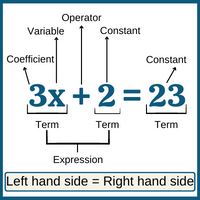
An equation is like a balance scale. It has an equal sign "=" in the middle, which shows that the value on the left side is the same as the value on the right side. The part on the left of = is the LHS (left-hand side) and the part on the right is the RHS (right-hand side).
Examples:
- 4x + 5 = 65
- 10y - 20 = 50
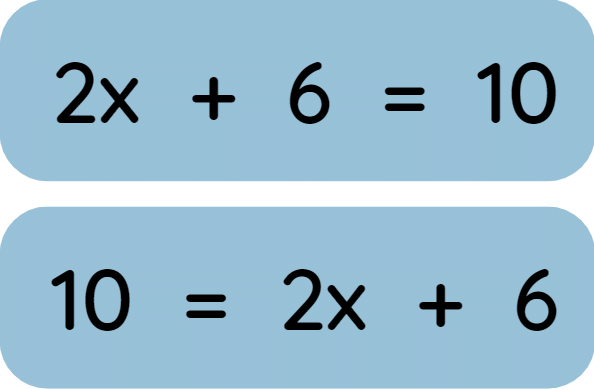 Both the above equations are the same.
- In 4x + 5 = 65, the LHS is 4x + 5 and the RHS is 65.
- In 10y - 20 = 50, the LHS is 10y - 20 and the RHS is 50.
Try yourself: Which is not an equation?
Interchangeability
- An equation remains true if LHS and RHS are interchanged.
- For example, 4x + 5 = 65 is the same statement as 65 = 4x + 5.
Not equations
- If there is a sign other than the equality sign between the LHS and RHS, it is not an equation.
- Example: and are not equations because they do not express equality.
Variable on both sides
- Sometimes both sides contain the variable. Example: 4x + 5 = 6x - 25.
How to form Equations from Statements
Translating a statement into an equation means identifying the unknown, choosing a variable, and converting words into mathematical operations.
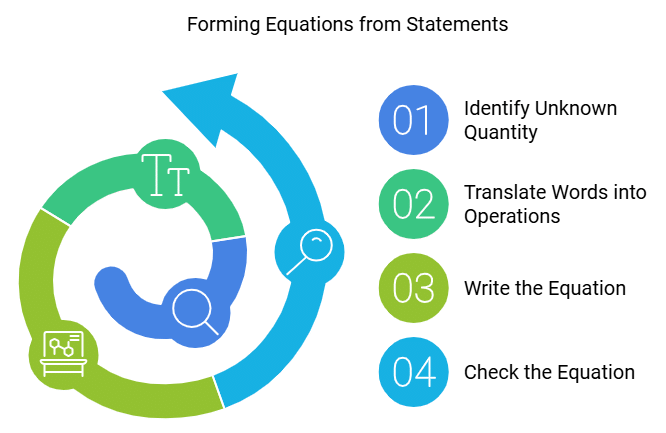
Steps to form an equation from a statement
1. Identify the unknown quantity: Read the statement carefully to identify the unknown quantity. Represent it using a variable (like x, y, etc.). Example: "A number increased by 5 is 12."
Here, the unknown number can be represented as x.
2. Translate words into operations: Convert phrases like "increased by", "decreased by", "times", "half of" into +, -, ×, ÷, etc. Example: "A number increased by 5 is 12" becomes: x + 5 = 12.
3. Write the equation: Combine the variable and operations and use = where the statement indicates equality. Example: The statement "A number decreased by 3 is equal to 7" becomes: x - 3 = 7.
4. Check the equation: Read the equation aloud to ensure it matches the original statement.
Here are some example statements:
Example 1: The sum of four times x and 12 is equal to 35.
4x+12 = 35
Example 2: Half of a number is 3 more than 8.
1/2x = 3 + 8
Example 3: Write the following statements in the form of equations:
(i) The sum of four times x and 12 is 38.
(ii) If you subtract 4 from 6 times a number, you get 8
(iii) One third of m is 6 more than 9.
(iv) One fourth of a number plus 7 is 10.
Solution:
(i) Four times x is 4x.
Sum of 4x and 12 is 4x + 12. The sum is 38.
The equation is 4x + 12 = 38.
(ii) Let us say the number is z; z multiplied by 6 is 6z.
Subtracting 4 from 6z, one gets 6z - 4. The result is 8.
The equation is 6z - 4 = 8
(iii) One third of m is m / 3. It is greater than 9 by 6.
This means the difference ( m / 3 - 9) is 6.
The equation is (m / 3) = 6 + 9
(iv) Take the number to be n. One fourth of n is n / 4. This one-fourth plus 7 is (n/4) + 7. It is 10. The equation is (n / 4) + 7 = 10
Example 4: A store sells apples in two types of bags, one small and one large. A large bag contains as many as 6 small bags plus 3 loose apples. Set up an equation to find the number of apples in each small bag. The number of apples in a large bag is given to be 75.
Solution:
Let a small bag contain 'a' number of apples.
A large bag contains 3 more than 6 times 'a', that is, 6a + 3 apples.
But this is given to be 75. Thus, 6a + 3 = 75.
You can determine the number of apples in a small bag by solving this equation.
Example 5: Write the following statements in the form of equations:
(i) The sum of three times x and 11 is 32.
(ii) If you subtract 5 from 6 times a number, you get 7.
Solution:
(i) Three times x is 3x.
Sum of 3x and 11 is 3x + 11.
The sum is 32.
The equation is 3x + 11 = 32.
(ii) Let us say the number is z;
z multiplied by 6 is 6z.
Subtracting 5 from 6z, one gets 6z - 5.
The result is 7.
The equation is 6z - 5 = 7
Try yourself: Write the following statement in the form of an equation:
The sum of three times x and 10 is 13.
How to convert an Equation into a Statement
To convert an equation into words, identify the variable and each operation, then describe them in simple language.
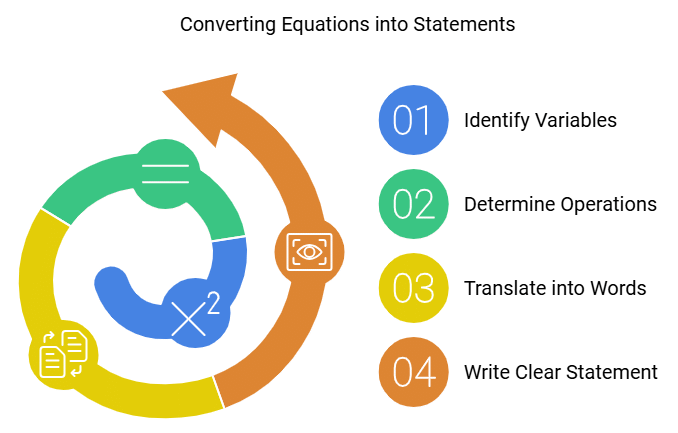
Steps
- Identify variables (letters such as x, y, a).
- Recognise operations (+, -, ×, ÷).
- Translate each part into words and assemble a clear sentence.
Examples to convert:
- (i) x + 3 = 7 → Adding 3 to x gives 7.
- (ii) 4y = 16 → Four times a number y is equal to 16.
- (iii) 2a - 5 = 9 → Subtracting 5 from twice a number a gives 9.
- (iv) 7b + 3 = 24 → Adding 3 to seven times a number b results in 24.
Checking solutions
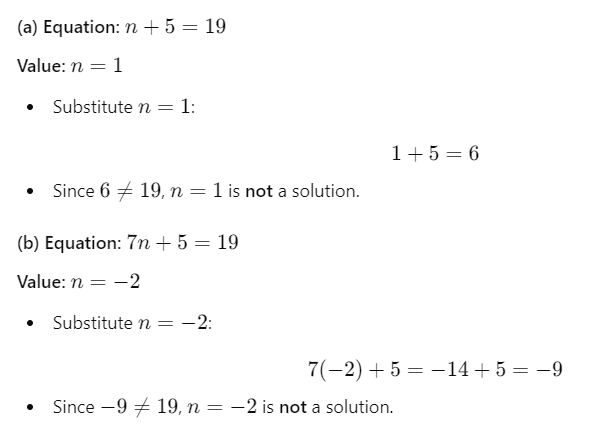
Example: Check whether the given value is a solution.
- (a) n + 5 = 19 with n = 1.
- (b) 7n + 5 = 19 with n = -2.
Solution
To check a candidate value, substitute it into the equation and verify equality.
Solving an Equation
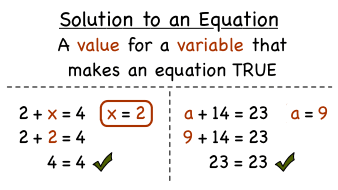
Any value of the variable that makes the equation true is a solution of the equation.
1. Understanding equality
Example: 8 - 3 = 4 + 1. Both sides evaluate to 5, so the equality is valid.
2. By adding or subtracting the same number to both sides
Example: Solve x + 11 = 35.
Solution:
Subtract 11 from both sides.
x + 11 - 11 = 35 - 11
x = 24
Thus x = 24 is the solution.
3. By multiplying or dividing both sides by the same non-zero number to both sides of the equation.
Example: Solve 25y = 125.
Solution:
Divide both sides by 25.
y = 5

4. What Happens if Operations Differ on Both Sides?
If different operations or numbers are applied to each side, the equality does not hold. Example:
- Add 2 to LHS and 3 to RHS:
New LHS=8-3+2=7, New RHS=4+1+3=8 - The equality is lost since
5. Weighing Balance analogy
An equation is like a balance scale. If the same weights (numbers) are added or removed from both sides, the scale remains balanced (equality holds).
6. Choosing correct operations
To find the variable, remove the other terms step by step. Move numbers to the other side of the equation by changing their sign, and divide or multiply to remove the number attached to the variable.
Example problems
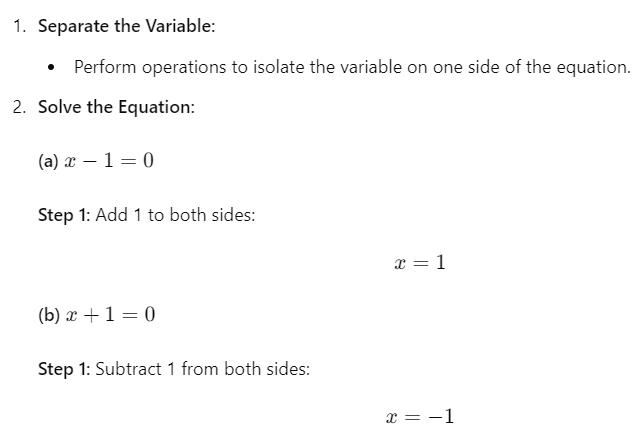
Example 10: Give the step to separate the variable and then solve:
- (a) x - 1 = 0
- (b) x + 1 = 0
Solutions:
More Equations - Transposing Method
Transposing means moving a term from one side of an equation to the other. When a term is transposed, its sign changes: positive becomes negative and negative becomes positive. Use transposing to collect all variable terms on one side and constants on the other.
Example
Solve x + 11 = 35.
Solution
Transpose 11 to the RHS; its sign reverses.
x = 35 - 11
x = 24
Example: Solve 20y + y - 18 = 10y + 2y.
Solution
Combine like terms on each side.
21y - 18 = 12y.
Bring variable terms to one side: 21y - 12y = 18.
9y = 18
Divide both sides by 9.
y = 2
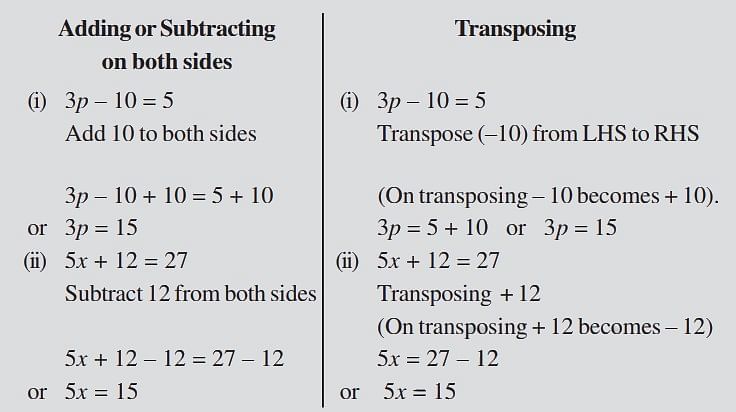 Add/Subtract on both sides Vs Transposing
Applications of Simple Equations to Practical Situations
Equations help translate real life information into mathematics and solve for unknowns. From a known solution we can also create many different equations that have the same solution.
Example: Ages (Sara and John)
Problem: Sara is twice as old as her brother John. Five years ago Sara was three times as old as John. How old is Sara now?
Solution
Let John's current age be x years.
Sara's current age is 2x years.
Five years ago Sara's age was 2x - 5.
Five years ago John's age was x - 5.
According to the statement, five years ago Sara was three times John.
So the equation is 2x - 5 = 3(x - 5).
Expand the RHS.
2x - 5 = 3x - 15
Bring variable terms to one side by subtracting 3x from both sides.
2x - 3x - 5 = -15
-x - 5 = -15
Add 5 to both sides.
-x = -10
Multiply both sides by -1.
x = 10
John is 10 years old.
Sara is twice John, so Sara = 2 × 10 = 20 years.
Try yourself: 18 is taken away from 8 times of a number is 30. Find the number.
Word Problems
Example :
Problem: Shikha's mother's age is 5 years more than three times Shikha's age. If the mother is 44 years old, find Shikha's age.
Solution
Let Shikha's age be y years.
Mother's age is 3y + 5.
Given 3y + 5 = 44.
Transpose 5: 3y = 44 - 5
3y = 39
Divide both sides by 3: y = 13
Shikha's age = 13 years.
Example 17
Problem: A number consists of two digits. The digit in the tens place is twice the digit in the units place. If 18 is subtracted from the number, the digits are reversed. Find the number.
Solution
Let the units digit be y.
The tens digit is 2y.
The original number = 10 × (2y) + y = 20y + y = 21y.
When 18 is subtracted, the digits reverse, giving the number with tens digit y and units digit 2y, i.e. 10y + 2y = 12y.
So the equation is 21y - 18 = 12y.
Bring variable terms together: 21y - 12y = 18.
9y = 18
y = 2
Tens digit = 2y = 4. Units digit = y = 2.
The number is 42.
FAQs on Chapter Notes: Simple Equations
| 1. How do I solve simple equations with variables on both sides? |  |
| 2. What's the difference between an equation and an expression in simple equations? | |
| 3. Why do I have to do the same operation on both sides of an equation? | |
| 4. How can I check if my answer is correct after solving a simple equation? | |
| 5. What are the most common mistakes students make when solving linear equations? | |