Blood Relations with Examples | General Test Preparation for CUET UG - CUET Commerce PDF Download
| Table of contents |

|
| Blood relations |
|
| Family Tree |
|
| Important Terms in Blood Relations |
|
| How to Draw a Family Diagram (Important Symbols) |
|
| Solved Examples |
|

Blood relations
Blood relations, also known as family relationships, form an essential part of logical reasoning and analytical thinking tests. These questions are designed to assess your ability to deduce familial connections based on given information about relationships among family members.
Simply, blood relations means blood relationship among members of the family.
Family Tree
A family tree, also known as a genealogical tree or pedigree chart, is a graphical representation that depicts the familial relationships and ancestry of individuals within a family.
- It typically includes information about direct ancestors, descendants, siblings, and other relatives, illustrating how individuals are connected through blood relationships or marriage.
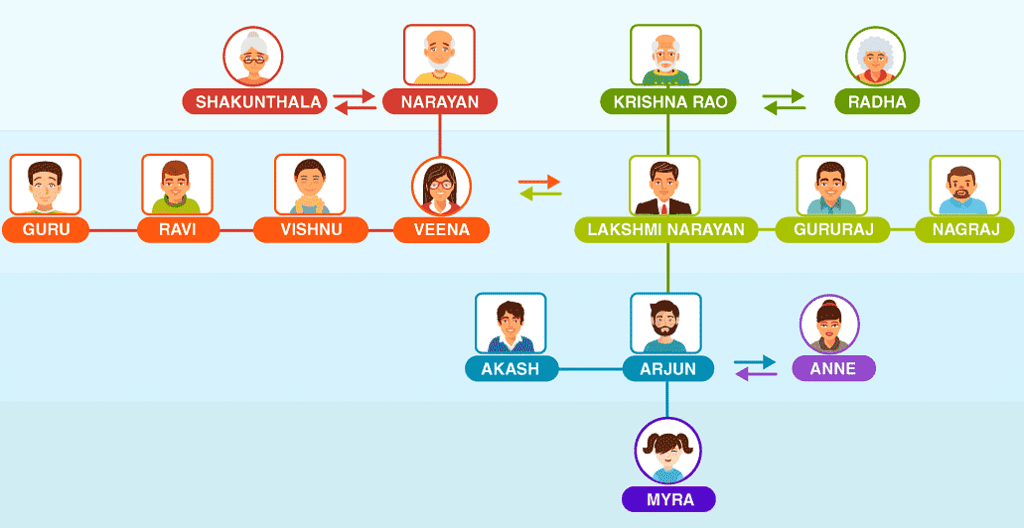
Observations from the family tree
- Akash and Arjun are brothers, and Anne is the wife of Arjun.
- Myra is the daughter of Arjun and Anne.
- Veena is the mother of Akash, and she has three brothers: Vishnu, Ravi, and Guru.
- Lakshmi Narayan is the father of Arjun and the son of Krishna Rao and Radha.
- Narayan and Shakuntala are husband and wife and are the parents of Veena.
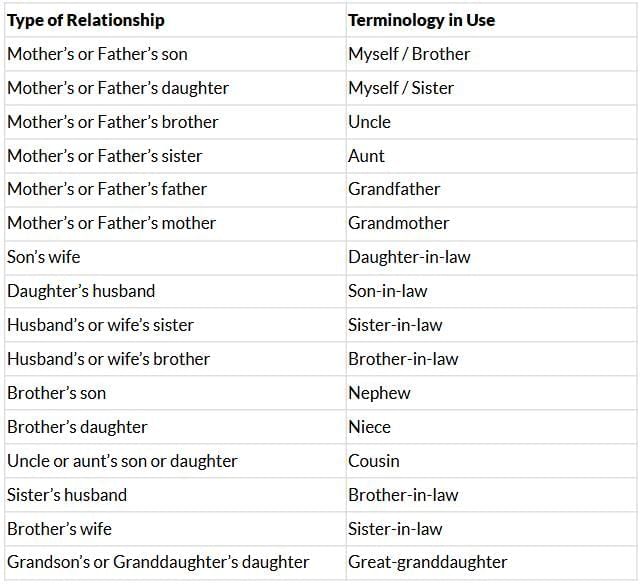
Important Terms in Blood Relations
How to Draw a Family Diagram (Important Symbols)
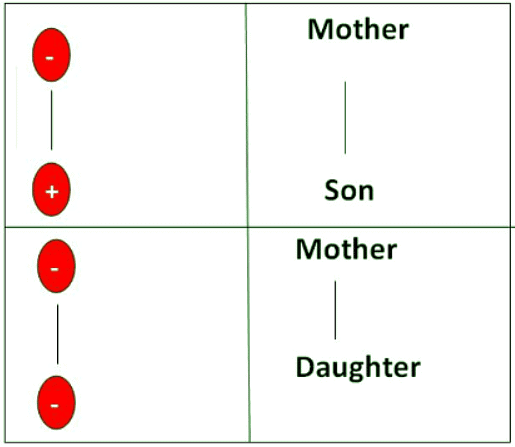
Below are some basic important symbols used to represent family relationships easily. Based on the following diagram, you can identify any blood relationship quickly and accurately.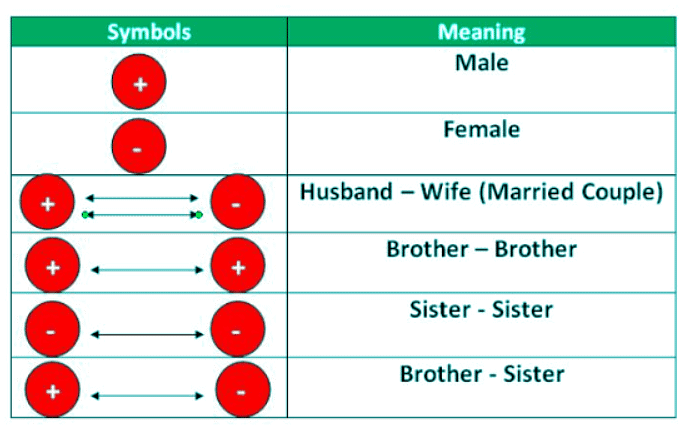
Some basic important blood relationships are shown below through diagrams.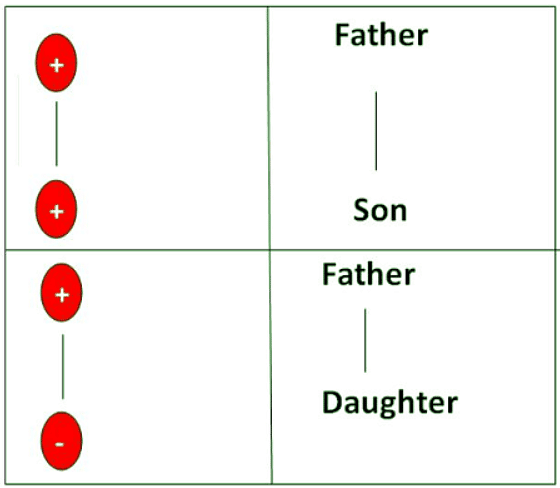
Solved Examples
Example 1: In a family, there are seven persons, comprising two married couples. T is the son of M and the grandson of K. M is a widower. M and R are brothers and W is the daughter-in-law of J, who is the mother of R and the grandmother of D. How is D related to M?
(a) Son
(b) Son-in-Law
(c) Nephew or Niece
(d) Brother
Ans: (c)
Explanation: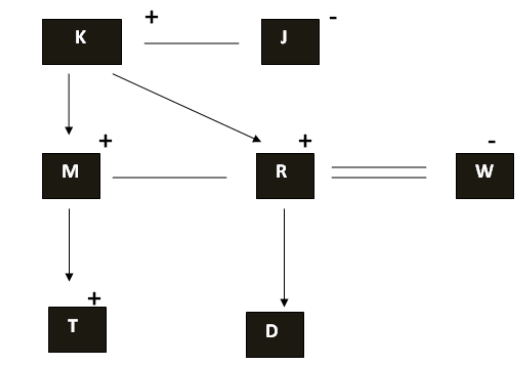 D is nephew or niece of M because the gender of D is not specified in the question.
Example 2: Arti and Saurabh are the children of Mr and Mrs Shah. Ritu and Shakti are the children of Mr and Mrs Mehra. Saurabh and Ritu are married to each other and two daughters Mukti and Shruti are born to them. Shakti is married to Rina and two children Subhash and Reshma are born to them. How is Arti related to Shruti?
(a) Mother
(b) Mother-in-Law
(c) Sister
(d) Aunt
Ans: (d)
Explanation: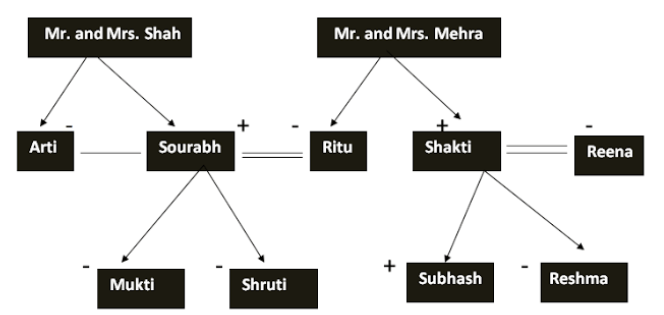 Arti is aunt of Shruti. It can be seen clearly from the above diagram.
Example 3: T, S and R are three brothers. T's son Q is married to K and they have one child Rahul. M, the son of S, is married to H and this couple is blessed with a daughter Madhvi. R has a daughter N who is married to P. This couple has one daughter Karuna born to them. How is Madhvi related to S?
(a) Daughter
(b) Niece
(c) Granddaughter
(d) None of The Above
Ans: (c)
Explanation: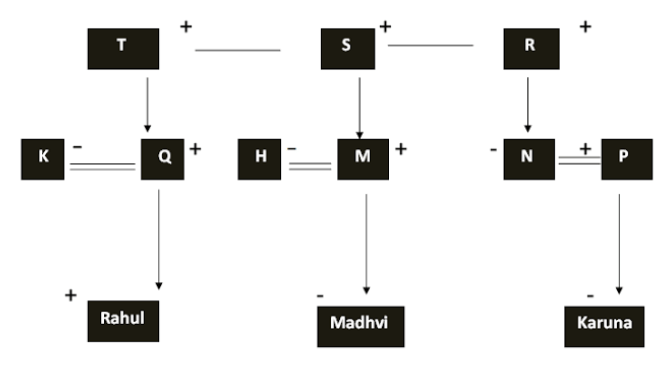 In the above diagram, it clearly shows that Madhvi is the granddaughter of S.
Example 4: Mohan is the son of Arun's father's sister. Prakash is the son of Reva, who is the mother of Vikas and grandmother of Arun. Pranab is the father of Neela and the grandfather of Mohan. Reva is the wife of Pranab. How is the wife of Vikas related to Neela?
(a) Sister
(b) Sister-in-Law
(c) Niece
(d) None of The Above
Ans: (b)
Explanation: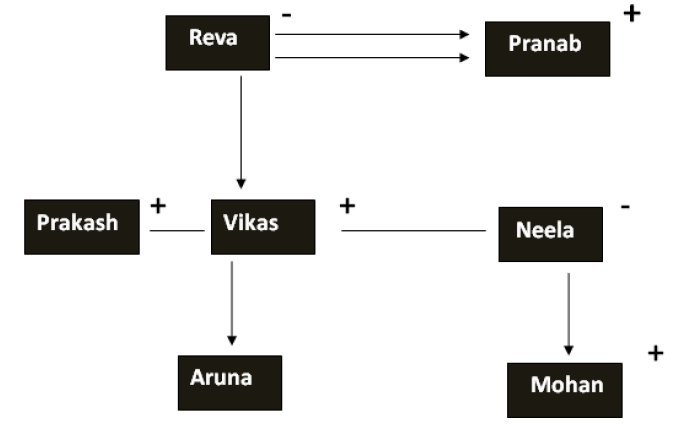 As the diagram shows, Vikas is Neela's brother, so the wife of Vikas will be Neela's sister-in-law.
Example 5: Pinky, who is Victor's daughter, says to Lucy, "Your mother Rosy is the younger sister of my father, who is the third child of Joseph." How is Joseph related to Lucy?
(a) Father-in-Law
(b) Father
(c) Maternal Uncle
(d) Grandfather
Ans: (d)
Explanation: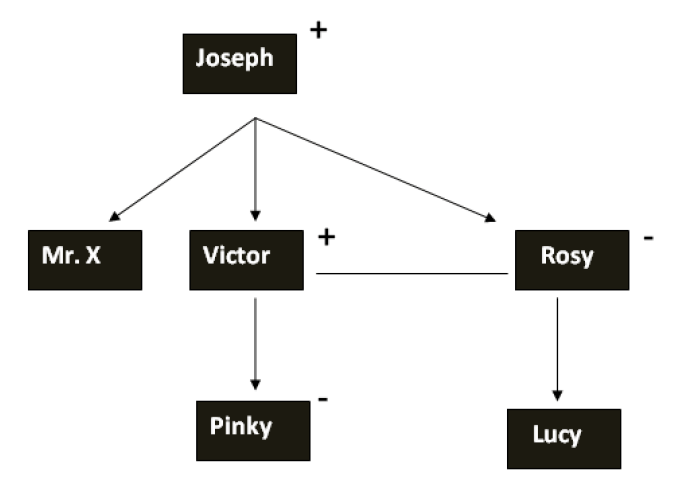 Joseph has three children: one is X, second is Victor, and third is Rosy. It is not clear whether X is male or female. Rosy is the mother of Lucy, so Joseph is the grandfather of Lucy, as clearly shown in the above diagram.
|
164 videos|800 docs|1160 tests
|
FAQs on Blood Relations with Examples - General Test Preparation for CUET UG - CUET Commerce
| 1. What is the meaning of blood relations in family tree diagrams? |  |
| 2. What are some important terms used in blood relations? | |
| 3. How can you draw a family diagram for blood relations? | |
| 4. Can you explain the structure of different blood relations in a family tree? | |
| 5. What are some shortcut tricks for solving blood relation questions in bank exams? | |




Semester Notes
,study material
,ppt
,Viva Questions
,Extra Questions
,Blood Relations with Examples | General Test Preparation for CUET UG - CUET Commerce
,video lectures
,Blood Relations with Examples | General Test Preparation for CUET UG - CUET Commerce
,MCQs
,past year papers
,shortcuts and tricks
,Important questions
,Blood Relations with Examples | General Test Preparation for CUET UG - CUET Commerce
,Exam
,Objective type Questions
,mock tests for examination
,Sample Paper
,practice quizzes
,Summary
,Previous Year Questions with Solutions
,Free
;




Blood Relations with Examples Free PDF Download
Importance of Blood Relations with Examples
Blood Relations with Examples Notes
Blood Relations with Examples CUET Commerce Questions
Study Blood Relations with Examples on the App
|
© EduRev
|
Education Revolution
|


|




