Boats and Streams - Examples (with Solutions), Logical Reasoning | Quantitative Aptitude (Quant) - CAT PDF Download

1. A man's speed with the current is 15 km/hr and the speed of the current is 2.5 km/hr. The man's speed against the current is:
A. 8.5 km/hr
B. 10 km/hr.
C. 12.5 km/hr
D. 9 km/hr
Answer: Option B
Explanation:
Man's speed with the current = 15 km/hr
=> speed of the man + speed of the current = 15 km/hr
speed of the current is 2.5 km/hr
Hence, speed of the man = 15 - 2.5 = 12.5 km/hr
man's speed against the current = speed of the man - speed of the current
= 12.5 - 2.5 = 10 km/hr
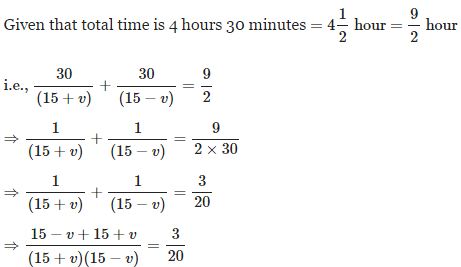
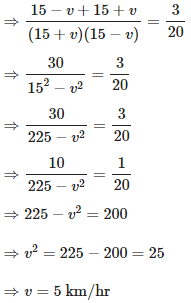
2. A motorboat, whose speed in 15 km/hr in still water goes 30 km downstream and comes back in a total of 4 hours 30 minutes. The speed of the stream (in km/hr) is:
A. 10
B. 6
C. 5
D. 4
Answer: Option C
Explanation:
Speed of the motor boat =15 km/hr
Let speed of the stream =v
Speed downstream =(15+v) km/hr
Speed upstream =(15−v) km/hr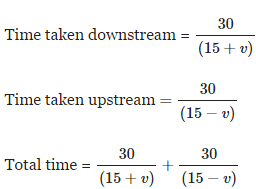
3. In one hour, a boat goes 14 km/hr along the stream and 8 km/hr against the stream. The speed of the boat in still water (in km/hr) is:
A. 12 km/hr
B. 11 km/hr
C. 10 km/hr
D. 8 km/hr
Answer: Option B
Explanation:
Let speed of the boat in still water = a and speed of the stream = b
Then
a + b = 14
a - b = 8
Adding these two equations, we get 2a = 22
=> a = 11
ie, speed of boat in still water = 11 km/hr
4. A man rows to a place 48 km distant and come back in 14 hours. He finds that he can row 4 km with the stream in the same time as 3 km against the stream. The rate of the stream is:
A. 1 km/hr.
B. 2 km/hr.
C. 1.5 km/hr.
D. 2.5 km/hr.
Answer: Option A
Explanation:
Assume that he moves 4 km downstream in x hours
Given that he can row 4 km with the stream in the same time as 3 km against the stream
i.e., speed upstream =3/4 of speed downstream
=> speed upstream = 3x km/hr
He rows to a place 48 km distant and comes back in 14 hours
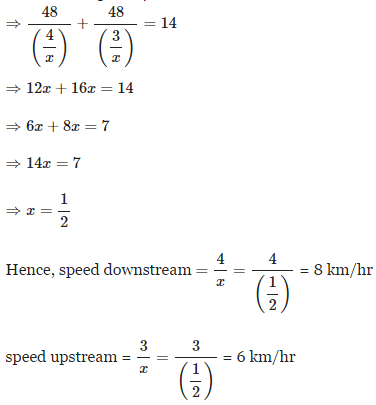
Now we can use the below formula to find the rate of the stream
Hence, rate of the stream = 1/2(8−6) = 1km/hr
5. A boatman goes 2 km against the current of the stream in 2 hour and goes 1 km along the current in 20 minutes. How long will it take to go 5 km in stationary water?
A. 2 hr 30 min
B. 2 hr
C. 4 hr
D. 1 hr 15 min
Answer: Option A
Explanation:
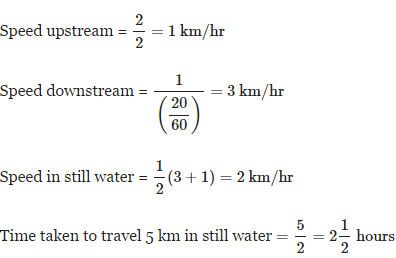
= 2 hour 30 minutes
|
167 videos|229 docs|95 tests
|
FAQs on Boats and Streams - Examples (with Solutions), Logical Reasoning - Quantitative Aptitude (Quant) - CAT
| 1. What are boats and streams in the context of logical reasoning? |  |
| 2. How can boats and streams problems be solved? | |
| 3. Can you provide an example of a boats and streams problem and its solution? | |
| 4. Are there any shortcuts or formulas to solve boats and streams problems? | |
| 5. Can boats and streams problems be solved without using formulas? | |





shortcuts and tricks
,mock tests for examination
,Free
,MCQs
,Important questions
,practice quizzes
,Boats and Streams - Examples (with Solutions)
,Logical Reasoning | Quantitative Aptitude (Quant) - CAT
,study material
,Boats and Streams - Examples (with Solutions)
,video lectures
,Extra Questions
,ppt
,Logical Reasoning | Quantitative Aptitude (Quant) - CAT
,Summary
,Previous Year Questions with Solutions
,Logical Reasoning | Quantitative Aptitude (Quant) - CAT
,Objective type Questions
,past year papers
,Exam
,Sample Paper
,Semester Notes
,Viva Questions
,Boats and Streams - Examples (with Solutions)
;




Boats and Streams - Examples (with Solutions), Logical Reasoning Free PDF Download
Importance of Boats and Streams - Examples (with Solutions), Logical Reasoning
Boats and Streams - Examples (with Solutions), Logical Reasoning Notes
Boats and Streams - Examples (with Solutions), Logical Reasoning CAT Questions
Study Boats and Streams - Examples (with Solutions), Logical Reasoning on the App
|
© EduRev
|
Education Revolution
|


|




