

Best Study Material for Class 7 Exam
Class 7 Exam > Class 7 Notes > Mathematics (Maths) Class 7 > NCERT Solutions: Fractions & Decimals
NCERT Solutions for Class 7 Maths - Fractions and Decimals (Exercise 2.1)
| Table of contents |

|
| Exercise 2.1 |
|
| Exercise 2.2 |
|
| Exercise 2.3 |
|
| Exercise 2.4 |
|
| Exercise 2.5 |
|
Exercise 2.1
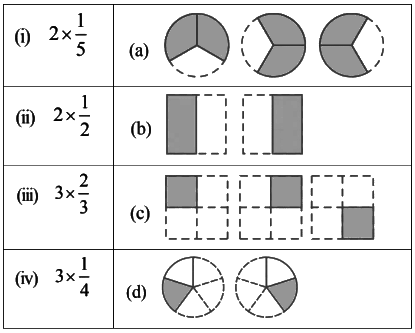
Q1: Which of the drawings (a) to (d) show:
Ans:
(i) 2 × (1/5) represents the addition of 2 figures, each represents 1 shaded part out of the given 5 equal parts.
∴ 2 × (1/5) is represented by fig (d).
(ii) 2 × ½ represents the addition of 2 figures, each represents 1 shaded part out of the given 2 equal parts.
∴ 2 × ½ is represented by fig (b).
(iii) 3 × (2/3) represents the addition of 3 figures, each representing 2 shaded parts out of the given 3 equal parts.
∴ 3 × (2/3) is represented by fig (a).
(iii) 3 × ¼ represents the addition of 3 figures, each represents 1 shaded part out of the given 4 equal parts.
∴ 3 × ¼ is represented by fig (c).
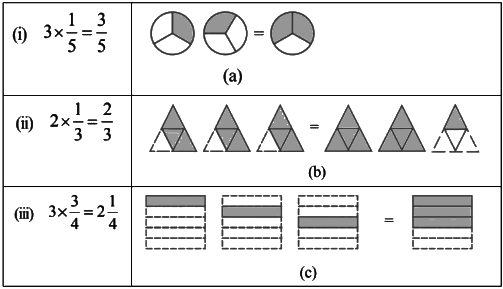
Q2: Some pictures (a) to (c) are given below. Tell which of them show:
Ans:
(i) 3 × (1/5) represents the addition of 3 figures, each represents 1 shaded part out of the given 5 equal parts and (3/5) represents 3 shaded parts out of 5 equal parts.
∴ 3 × (1/5) = (3/5) is represented by fig (c).
(ii) 2 × (1/3) represents the addition of 2 figures, each represents 1 shaded part out of the given 3 equal parts and (2/3) represents 2 shaded parts out of 3 equal parts.
∴ 2 × (1/3) = (2/3) is represented by fig (a).
(iii) 3 × (3/4) represents the addition of 3 figures, each represents 3 shaded part out of the given 4 equal parts and 2 ¼ represents 2 fully and 1 figure having 1 part as shaded out of 4 equal parts.
∴ 3 × (3/4) = 2 ¼ is represented by fig (b)
Q3: Multiply and reduce to lowest form and convert into a mixed fraction:
(i) 
Ans: By the rule Multiplication of fraction,
Product of fraction = (product of numerator)/ (product of denominator)
Then,
= (7/1) × (3/5)
= (7 × 3)/ (1 × 5)
= (21/5)
= 
(ii) 
Ans: By the rule Multiplication of fraction,
Product of fraction = (product of numerator)/ (product of denominator)
Then,
= (4/1) × (1/3)
= (4 × 1)/ (1 × 3)
= (4/3)
= 
(iii)
Ans: By the rule Multiplication of fraction,
Product of fraction = (product of numerator)/ (product of denominator)
Then,
= (2/1) × (6/7)
= (2 × 6)/ (1 × 7)
= (12/7)
= 
(iv) 
Ans: By the rule Multiplication of fraction,
Product of fraction = (product of numerator)/ (product of denominator)
Then,
= (5/1) × (2/9)
= (5 × 2)/ (1 × 9)
= (10/9)
= 
(v) 
Ans: By the rule Multiplication of fraction,
Product of fraction = (product of numerator)/ (product of denominator)
Then,
= (2/3) × (4/1)
= (2 × 4)/ (3 × 1)
= (8/3)
= 
(vi) 
Ans: By the rule Multiplication of fraction,
Product of fraction = (product of numerator)/ (product of denominator)
Then,
= (5/2) × (6/1)
= (5 × 6)/ (2 × 1)
= (30/2)
= 15
(vii) 
By the rule Multiplication of fraction,
Product of fraction = (product of numerator)/ (product of denominator)
Then,
= (11/1) × (4/7)
= (11 × 4)/ (1 × 7)
= (44/7)
= 
(viii) 
Ans: By the rule Multiplication of fraction,
Product of fraction = (product of numerator)/ (product of denominator)
Then,
= (20/1) × (4/5)
= (20 × 4)/ (1 × 5)
= (80/5)
= 16
(ix) 
Ans: By the rule Multiplication of fraction,
Product of fraction = (product of numerator)/ (product of denominator)
Then,
= (13/1) × (1/3)
= (13 × 1)/ (1 × 3)
= (13/3)
= 
(x) 
Ans: By the rule Multiplication of fraction,
Product of fraction = (product of numerator)/ (product of denominator)
Then,
= (15/1) × (3/5)
= (15 × 3)/ (1 × 5)
= (45/5)
= 9
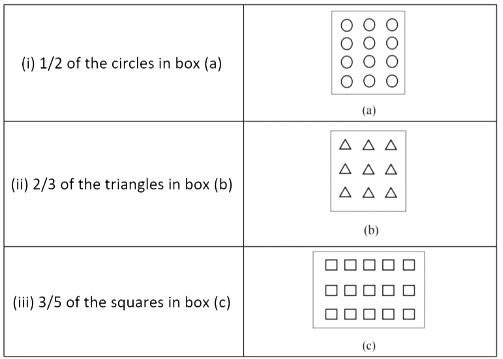
Q4: Shade:
Ans: (i) From the question,
We may observe that there are 12 circles in the given box. So, we have to shade ½ of the circles in the box.
∴ 12 × ½ = 12/2
= 6
So we have to shade any 6 circles in the box.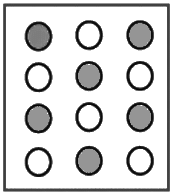
(ii) From the question,
We may observe that there are 9 triangles in the given box. So, we have to shade 2/3 of the triangles in the box.
∴ 9 × (2/3) = 18/3
= 6
So we have to shade any 6 triangles in the box.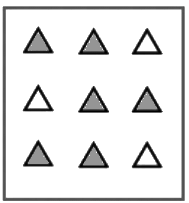
(iii) From the question,
We may observe that there are 15 squares in the given box. So, we have to shade 3/5 of the squares in the box.
∴ 15 × (3/5) = 45/5
= 9
So we have to shade any 9 squares in the box.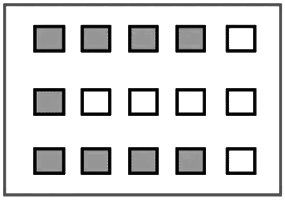
Q5: Find:
(a) 1/2 of (i) 24 (ii) 46
Ans: (i) 24
We have,
= ½ × 24
= 24/2
= 12
(ii) 46
We have,
= ½ × 46
= 46/2
= 23
(b) 2/3 of (i) 18 (ii) 27
Ans: (i) 18
We have,
= 2/3 × 18
= 2 × 6
= 12
(ii) 27
We have,
= 2/3 × 27
= 2 × 9
= 18
(c) 3/4 of (i) 16 (ii) 36
Ans: (i) 16
We have,
= ¾ × 16
= 3 × 4
= 12
(ii) 36
We have
= ¾ × 36
= 3 × 9
= 27
(d) 4/5 of (i) 20 (ii) 35
Ans: (i) 20
We have,
= 4/5 × 20
= 4 × 4
= 16
(ii) 35
We have,
= 4/5 × 35
= 4 × 7
= 28
Q6: Multiply and express as a mixed fraction: 
Ans: First convert the given mixed fraction into improper fraction.
=  = 26/5
Now,= 3 × (26/5)
= 78/5
= 

Ans: First convert the given mixed fraction into improper fraction.
= 6 ¾ = 27/4
Now,
= 5 × (27/4)
= 135/4
= 33 ¾

Ans: First convert the given mixed fraction into improper fraction.
= 2 ¼ = 9/4
Now,
= 7 × (9/4)
= 63/4
= 15 ¾

Ans: First convert the given mixed fraction into improper fraction.
=  = 19/3
Now,
= 4 × (19/3)
= 76/3
= 

Ans: First convert the given mixed fraction into improper fraction.
= 3 ¼ = 13/4
Now,
= (13/4) × 6
= (13/2) × 3
= 39/2
= 19 ½

Ans: First convert the given mixed fraction into improper fraction.
=  = 17/5
Now,
= (17/5) × 8
= 136/5
= 
Q7: Find: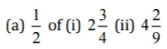
Ans: (i) First convert the given mixed fraction into an improper fraction.
= 2 ¾ = 11/4
Now,
= ½ × 11/4
By the rule Multiplication of fraction,
Product of fraction = (product of numerator)/ (product of denominator)
Then,
= ½ × (11/4)
= (1 × 11)/ (2 × 4)
= (11/8)
= 
(ii) First convert the given mixed fraction into improper fraction.
=  = 38/9
Now,
= ½ × (38/9)
By the rule Multiplication of fraction,
Product of fraction = (product of numerator)/ (product of denominator)
Then,
= ½ × (38/9)
= (1 × 38)/ (2 × 9)
= (38/18)
= 19/9
= 
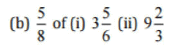
Ans: (i) First convert the given mixed fraction into an improper fraction.
=  = 23/6
Now,
= (5/8) × (23/6)
By the rule Multiplication of fraction,
Product of fraction = (product of numerator)/ (product of denominator)
Then,
= (5/8) × (23/6)
= (5 × 23)/ (8 × 6)
= (115/48)
= 
(ii) First convert the given mixed fraction into improper fraction.
=  = 29/3
Now,
= (5/8) × (29/3)
By the rule Multiplication of fraction,
Product of fraction = (product of numerator)/ (product of denominator)
Then,
= (5/8) × (29/3)
= (5 × 29)/ (8 × 3)
= (145/24)
= 
Q8: Vidya and Pratap went for a picnic. Their mother gave them a water bottle that contained 5 litres of water. Vidya consumed 2/5 of the water. Pratap consumed the remaining water.
(i) How much water did Vidya drink?
(ii) What fraction of the total quantity of water did Pratap drink?
Ans: (i) From the question, it is given that,
Amount of water in the water bottle = 5 liters
Amount of water consumed by Vidya = 2/5 of 5 liters
= (2/5) × 5
= 2 liters
So, the total amount of water drank by Vidya is 2 liters
(ii) From the question, it is given that,
Amount of water in the water bottle = 5 liters
Then,
Amount of water consumed by Pratap = (1 – water consumed by Vidya)
= (1 – (2/5))
= (5-2)/5
= 3/5
∴ Total amount of water consumed by Pratap = 3/5 of 5 liters
= (3/5) × 5
= 3 liters
So, the total amount of water drank by Pratap is 3 liters
Exercise 2.2
 Fractions and Decimals
Q1: Find:
(i) 1/4 of
(a) 1/4
(b) 3/5
(c) 4/3
(ii) 1/7 of
(a) 2/9
(b) 6/5
(c) 3/10
Ans:
By the rule Multiplication of fractions,
Product of fraction = (product of numerator)/ (product of denominator)
(i)
(a) 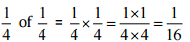
(b) 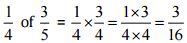
(c) 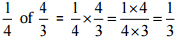
(ii)
(a) 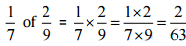
(b) 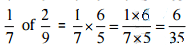
(c) 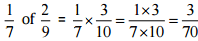
Q2: Multiply and reduce to lowest form (if possible):
(i) 
(ii) 
(iii)
(iv)
(v) 
(vi)
(vii)
Ans:
(i) First, convert the given mixed fraction into an improper fraction.
= = 8/3,
By the rule Multiplication of fraction,
Product of fraction = (product of numerator)/ (product of denominator)
Then,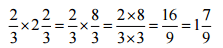
(ii) By the rule Multiplication of fraction,
Product of fraction = (product of numerator)/ (product of denominator)
Then,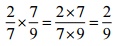
(iii) By the rule Multiplication of fraction,
Product of fraction = (product of numerator)/ (product of denominator)
Then,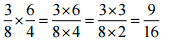
(iv) By the rule Multiplication of fractions,
Product of fraction = (product of numerator)/ (product of denominator)
Then,
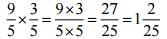
(v) By the rule Multiplication of fractions,
Product of fraction = (product of numerator)/ (product of denominator)
Then,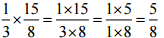
(vi) By the rule Multiplication of fractions,
Product of fraction = (product of numerator)/ (product of denominator)
Then,
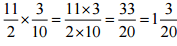
(vii) By the rule Multiplication of fractions,
Product of fraction = (product of numerator)/ (product of denominator)
Then,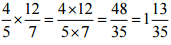
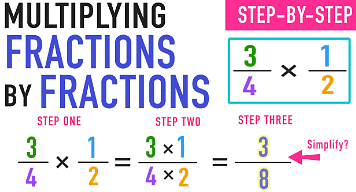 Multiplying FractionQ3: Multiply the following fractions:
(i) 
(ii) 
(iii) 
(iv) 
(v) 
(vi) 
(vii) 
Ans:
(i) First convert the given mixed fraction into improper fraction.
= 5 ¼ = 21/4
Now,
= (2/5) × (21/4)
By the rule Multiplication of fraction,
Product of fraction = (product of numerator)/ (product of denominator)
Then,
(ii) First, convert the given mixed fraction into an improper fraction.
= = 32/5Now,= (32/5) × (7/9)
By the rule Multiplication of fractions,
Product of fraction = (product of numerator)/ (product of denominator)
Then, 
(iii) First, convert the given mixed fraction into an improper fraction.
= = 16/3
Now,
= (3/2) × (16/3)
By the rule Multiplication of fractions,
Product of fraction = (product of numerator)/ (product of denominator)
Then,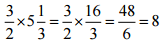
(iv) First convert the given mixed fraction into an improper fraction.
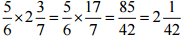
= = 17/7
Now,
= (5/6) × (17/7)
By the rule Multiplication of fractions,
Product of fraction = (product of numerator)/ (product of denominator)
Then,
(v) First convert the given mixed fraction into improper fraction.
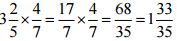
= = 17/5
Now,
= (17/5) × (4/7)
By the rule Multiplication of fraction,
Product of fraction = (product of numerator)/ (product of denominator)
Then,
(vi) First convert the given mixed fraction into improper fraction.
= = 13/5
Now,
= (13/5) × (3/1)
By the rule Multiplication of fraction,
Product of fraction = (product of numerator)/ (product of denominator)
Then,

(vii) First convert the given mixed fraction into improper fraction.
= = 25/7
Now,
= (25/7) × (3/5)
By the rule Multiplication of fraction,
Product of fraction = (product of numerator)/ (product of denominator)
Then, 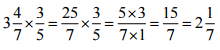
Q4: Which is greater:
(i) 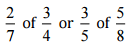
(ii) 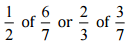
Ans:
(i)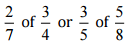
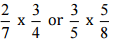
⇒ 
⇒ 
⇒ 
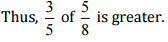
(ii)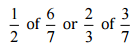
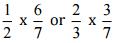
⇒
⇒
⇒
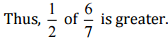
Q5: Saili plants 4 saplings, in a row, in her garden. The distance between two adjacent saplings is 3/4 m. Find the distance between the first and the last sapling.
Ans: The distance between two adjacent saplings = 3/4 m
Saili planted 4 saplings in a row, then number of gap in saplings = 3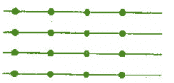
Therefore,
The distance between the first and the last saplings 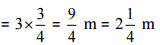
Thus the distance between the first and the last saplings is 
Q6: Lipika reads a book for hours every day. She reads the entire book in 6 days. How many hours in ail were required by her to read the book?
Ans: Time is taken by Lipika to read a book = hours
She reads the entire book in 6 days.
Now, the total hours are taken by her to read the entire book 
Thus, 10 hours were required by her to read the book. 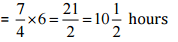
Q7: A car runs 16 km using 1 litre of petrol. How much distance will it cover using  of petrol?
Ans: In 1 litre of petrol, car covers the distance = 16 km
In litres of petrol, car covers the distance = 
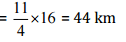
Thus, the car will cover 44 km distance.
Q8: (a)
(i) Provide the number in the box 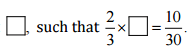
(ii) The simplest form of the number obtained in 
(b)
(i) Provide the number in the box
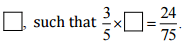
(ii) The simplest form of the number obtained in 
Ans:
(a)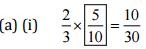
(ii) The simplest form 
(b)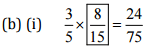
(ii) The simplest form 
Exercise 2.3
Q1:
Find:
(i) 
(ii) 
(iii) 
(iv) 
(v) 
(vi) 
Ans:
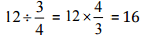
(i) We have,
= 12 × reciprocal of ¾
(ii) We have,
= 14 × reciprocal of (5/6)
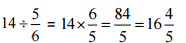
(iii) We have,
= 8× reciprocal of (7/3)
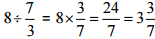
(iv) We have,
= 4 × reciprocal of (8/3)
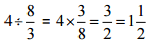
(v) While dividing a whole number by a mixed fraction, first convert the mixed fraction into improper fraction We have,
= = 7/3
= 7/3
Then,
= 3 ÷ (7/3)
= 3 × reciprocal of (7/3)
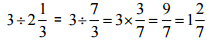
(vi) While dividing a whole number by a mixed fraction, first convert the mixed fraction into improper fraction We have,
= = 25/7
Then,
= 5 ÷ (25/7)
= 5 × reciprocal of (25/7) 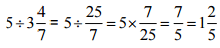
Q2: Find the reciprocal of each of the following fractions. Classify the reciprocals as proper fractions, improper fractions and whole numbers.
(i) 3/7
Ans: Reciprocal of (3/7) is (7/3) [∵ ((3/7) × (7/3)) = 1]
So, it is an improper fraction.
Improper fraction is that fraction in which numerator is greater than its denominator.
(ii) 5/8
Ans: Reciprocal of (5/8) is (8/5) [∵ ((5/8) × (8/5)) = 1]
So, it is an improper fraction.
Improper fraction is that fraction in which numerator is greater than its denominator.
(iii) 9/7
Ans: Reciprocal of (9/7) is (7/9) [∵ ((9/7) × (7/9)) = 1]
So, it is a proper fraction.
A proper fraction is that fraction in which denominator is greater than the numerator of the fraction.
(iv) 6/5
Ans: Reciprocal of (6/5) is (5/6) [∵ ((6/5) × (5/6)) = 1]
So, it is a proper fraction.
A proper fraction is that fraction in which denominator is greater than the numerator of the fraction.
(v) 12/7
Ans: Reciprocal of (12/7) is (7/12) [∵ ((12/7) × (7/12)) = 1]
So, it is a proper fraction.
A proper fraction is that fraction in which denominator is greater than the numerator of the fraction.
(vi) 1/8
Ans: Reciprocal of (1/8) is (8/1) or 8 [∵ ((1/8) × (8/1)) = 1]
So, it is a whole number.
Whole numbers are collection of all positive integers including 0.
(vii) 1/11
Ans: Reciprocal of (1/11) is (11/1) or 11 [∵ ((1/11) × (11/1)) = 1]
So, it is a whole number.
Whole numbers are collection of all positive integers including 0.
Q3: Find:
(i)
(ii) 
(iii)
(iv)
(v) 
(vi)
Ans:
(i) We have,
= (7/3) × reciprocal of 2
= (7/3) × (1/2)
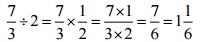
(ii) We have,
= (4/9) × reciprocal of 5
= (4/9) × (1/5)
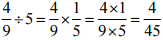
(iii) We have,
= (6/13) × reciprocal of 7
= (6/13) × (1/7)
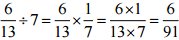
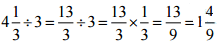
(iv) First convert the mixed fraction into improper fraction. We have,
= = 13/3 Then,
= (13/3) × reciprocal of 3
(v) First convert the mixed fraction into improper fraction.
We have,
= 3 ½ = 7/2
Then,
= (7/2) × reciprocal of 4

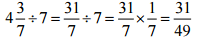
(vi) First convert the mixed fraction into improper fraction.
We have,
= = 31/7
Then,
= (31/7) × reciprocal of 7
Q4: Find
(i) 
(ii) 
(iii) 
(iv) 
(v) 
(vi) 
(vii) 
(viii) 
Ans:
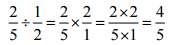
(i) We have,
= (2/5) × reciprocal of ½
= (2/5) × (2/1)
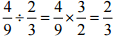
(ii) We have,
= (4/9) × reciprocal of (2/3)
= (4/9) × (3/2)
(iii) We have,
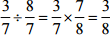
= (3/7) × reciprocal of (8/7)
= (3/7) × (7/8)
(iv) First convert the mixed fraction into improper fraction.
We have,
= = 7/3
= 7/3
Then,
= (7/3) × reciprocal of (3/5)

(v) First convert the mixed fraction into improper fraction.
We have,
= 3 ½ = 7/2
Then,
= (7/2) × reciprocal of (8/3)
= (7/2) × (3/8)

(vi) First convert the mixed fraction into improper fraction.
We have,
= 1 ½ = 3/2
Then,
= (2/5) × reciprocal of (3/2)
= (2/5) × (2/3)
(vii) First convert the mixed fraction into improper fraction.
We have,
= = 16/5
= = 5/3Then,= (16/5) × reciprocal of (5/3)= (16/5) × (3/5)

(viii) First convert the mixed fraction into improper fraction.
We have,
= = 11/5
= = 6/5
= 6/5
Then,
= (11/5) × reciprocal of (6/5)
= (11/5) × (5/6)

 |
Download the notes
NCERT Solutions: Fractions & Decimals
|
Download as PDF |
Download as PDF
Exercise 2.4
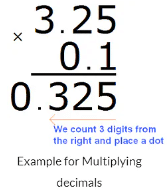
Q1:
Find:
(i) 0.2 x 6
(ii) 8 x 4.6
(iii) 2.71 x 5
(iv) 20.1 x 4
(v) 0.05 x 7
(vi) 211.02 x 4
(vii) 2 x 0.86
Ans:
(i) 0.2 x 6 = 1.2
(ii) 8 x 4.6 = 36.8
(iii) 2.71 x 5 = 13.55
(iv) 20.1 x 4 = 80.4
(v) 0.05 x 7 = 0.35
(vi) 211.02 x 4 = 844.08
(vii) 2 x 0.86 = 1.72
Q2: Find the area of rectangle whose length is 5.7 cm and breadth is 3 cm.
Ans: Given: Length of rectangle = 5.7 cm and
Breadth of rectangle = 3 cm
Area of rectangle = Length x Breadth = 5.7 x 3 = 17.1 cm2
Thus, the area of rectangle is 17.1 cm2.
Q3: Find:
(i) 1.3 x 10
(ii) 36.8 x 10
(iii) 153.7 x 10
(iv) 168.07 x 10
(v) 31.1 x 100
(vi) 156.1 x 100
(vii) 3.62 x 100
(viii) 43.07 x 100
(ix) 0.5 x 10
(x) 0.08 x 10
(xi) 0.9 x 100
(xii) 0.03 x 1000
Ans:
(i) 1.3 x 10 = 13.0
(ii) 36.8 x 10 = 368.0
(iii) 153.7 x 10 = 1537.0
(iv) 168.07 x 10 = 1680.7
(v) 31.1 x 100 = 3110.0
(vi) 156.1 x 100 = 15610.0
(vii) 3.62 x 100 = 362.0
(viii) 43.07 x 100 = 4307.0
(ix) 0.5 x 10 = 5.0
(x) 0.08 x 10 = 0.80
(xi) 0.9 x 100 = 90.0
(xii) 0.03 x 1000 = 30.0
Q4: A two-wheeler covers a distance of 55.3 km in one litre of petrol. How much distance will it cover in 10 litres of petrol?
Ans: ∵ In one litre, a two-wheeler covers a distance = 55.3 km
∴ In 10 litres, a two- wheeler covers a distance = 55.3x10 = 553.0 km
Thus, 553 km distance will be covered by it in 10 litres of petrol.
Q5: Find:
(i) 2.5 x 0.3
(ii) 0.1 x 51.7
(iii) 0.2 x 316.8
(iv) 1.3 x 3.1
(v) 0.5 x 0.05
(vi) 11.2 x 0.15
(vii) 1.07 x 0.02
(viii) 10.05 x 1.05
(ix) 101.01 x 0.01
(x) 100.01 x 1.1
Ans:
(i) 2.5 x 0.3 = 0.75
(ii) 0.1 x 51.7 = 5.17
(iii) 0.2 x 316.8 = 63.36
(iv) 1.3 x 3.1=4.03
(v) 0.5 x 0.05 =0.025
(vi) 11.2 x 0.15 = 1.680
(vii) 1.07 x 0.02 = 0.0214
(viii) 10.05 x 1.05 = 10.5525
(ix) 101.01 x 0.01 = 1.0101
(x) 100.01 x1.1=110.11
 |
Take a Practice Test
Test yourself on topics from Class 7 exam
|
Practice Now |
Practice Now
Exercise 2.5
Q1: Find:
(i) 0.4 ÷ 2
(ii) 0.35 ÷ 5
(iii) 2.48 ÷ 4
(iv) 65.4 ÷ 6
(v) 651.2 ÷ 4
(v) 14.49 ÷ 7
(vii) 3.96 ÷ 4
(viii) 0.80 ÷ 5
Ans:
(i) 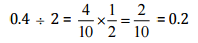
(ii) 
(iii) 
(iv) 
(v) 
(vi) 
(vii) 
(viii)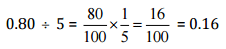
Q2: Find:
(i) 4.8 ÷ 10
(ii) 52.5 ÷ 10
(iii) 0.7 ÷ 10
(iv) 33.1 ÷ 10
(v) 272.23 ÷ 10
(vi) 0.56 ÷ 10
(vii) 3.97 ÷ 10
Ans:
(i)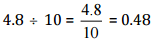
(ii) 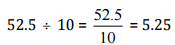
(iii) 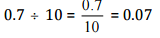
(iv) 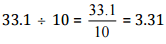
(v) 
(vi)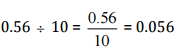
(vii) 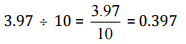
Q3: Find:
(i) 2.7 ÷ 100
(ii) 0.3 ÷ 100
(iii) 0.78 ÷ 100
(iv) 432.6 ÷ 100
(v) 23.6 ÷ 100
(vi) 98.53 ÷ 100
Ans:
(i)
(ii) 
(iii) 
(iv) 
(v) 
(vi) 
Q4: Find:
(i) 7.9 ÷ 1000
(ii) 26.3 ÷ 1000
(iii) 38.53 ÷ 1000
(iv) 128.9 ÷ 1000
(v) 0.5 ÷ 1000
Ans:
(i)
(ii) 
(iii) 
(iv)
(v)
Q5: Find:
(i) 7÷ 3.5
(ii) 36 ÷ 0.2
(iii) 3.25 ÷ 0.5
(iv) 30.94 ÷ 0.7
(v) 0.5 ÷ 0.25
(vi) 7.75 ÷ 0.25
(vii) 76.5 ÷ 0.15
(viii) 37.8 ÷1.4
(ix) 2.73 ÷ 1.3
Ans:
(i)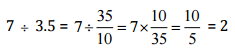
(ii) 
(iii) 
(iv) 
(v) 
(vi) 
(vii) 
(viii) 
(ix) 
Q6: A vehicle covers a distance of 43.2 km in 2.4 litres of petrol. How much distance will it cover in one litre petrol?
Ans:
∵ In 2.4 litres of petrol, distance covered by the vehicle = 43.2 km
∴ In 1 litre of petrol, distance covered by the vehicle = 43.2 ÷2.4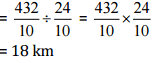
Thus, it covered 18 km distance in one litre of petrol.
The document NCERT Solutions for Class 7 Maths - Fractions and Decimals (Exercise 2.1) is a part of the Class 7 Course Mathematics (Maths) Class 7.
All you need of Class 7 at this link: Class 7
|
77 videos|373 docs|39 tests
|



FAQs on NCERT Solutions for Class 7 Maths - Fractions and Decimals (Exercise 2.1)
| 1. What are fractions and how are they represented? |  |
| 2. How do you convert a fraction to a decimal? | |
Ans. To convert a fraction to a decimal, you divide the numerator by the denominator. For example, to convert the fraction 1/4 to a decimal, you divide 1 by 4, which equals 0.25. This means that 1/4 is equivalent to 0.25 in decimal form.
| 3. What is the difference between proper and improper fractions? | |
Ans. A proper fraction is a fraction where the numerator is less than the denominator, such as 2/5. An improper fraction, on the other hand, has a numerator that is greater than or equal to the denominator, like 5/3 or 4/4. Improper fractions can also be expressed as mixed numbers, which combine a whole number and a proper fraction.
| 4. How can you add or subtract fractions? | |
Ans. To add or subtract fractions, you need a common denominator. If the denominators are the same, you simply add or subtract the numerators and keep the denominator the same. If the denominators are different, find the least common multiple (LCM) of the denominators, convert the fractions to have this common denominator, and then add or subtract the numerators.
| 5. What are some real-life applications of fractions and decimals? | |
Ans. Fractions and decimals are used in many real-life situations, such as cooking (measuring ingredients), shopping (calculating discounts), and construction (measuring lengths). For example, if a recipe calls for 1/2 cup of sugar, that is a fraction. Similarly, if an item costs $5.75, that is a decimal. Understanding how to work with fractions and decimals helps in making accurate calculations in everyday tasks.
Related Exams
About this Document

70.1K Views

4.89/5
Rating

Mar 15, 2025
Last updated
Document Description: NCERT Solutions: Fractions & Decimals for Class 7 2025 is part of Mathematics (Maths) Class 7 preparation.
The notes and questions for NCERT Solutions: Fractions & Decimals have been prepared according to the Class 7 exam syllabus. Information about NCERT Solutions: Fractions & Decimals covers topics
like Exercise 2.1, Exercise 2.2, Exercise 2.3 , Exercise 2.4 , Exercise 2.5 and NCERT Solutions: Fractions & Decimals Example, for Class 7 2025 Exam. Find important definitions, questions, notes, meanings, examples, exercises and tests below for NCERT Solutions: Fractions & Decimals.
Introduction of NCERT Solutions: Fractions & Decimals in English is available as part of our Mathematics (Maths) Class 7
for Class 7 & NCERT Solutions: Fractions & Decimals in Hindi for Mathematics (Maths) Class 7 course.
Download more important topics related with notes, lectures and mock test series for Class 7
Exam by signing up for free. Class 7: NCERT Solutions for Class 7 Maths - Fractions and Decimals (Exercise 2.1)
Description
Full syllabus notes, lecture & questions for NCERT Solutions for Class 7 Maths - Fractions and Decimals (Exercise 2.1) - Class 7 | Plus excerises question with solution to help you revise complete syllabus for Mathematics (Maths) Class 7 | Best notes, free PDF download
Information about NCERT Solutions: Fractions & Decimals
In this doc you can find the meaning of NCERT Solutions: Fractions & Decimals defined & explained in the simplest way possible. Besides explaining types of
NCERT Solutions: Fractions & Decimals theory, EduRev gives you an ample number of questions to practice NCERT Solutions: Fractions & Decimals tests, examples and also practice Class 7
tests

Related Searches
Summary
,NCERT Solutions for Class 7 Maths - Fractions and Decimals (Exercise 2.1)
,Sample Paper
,Viva Questions
,NCERT Solutions for Class 7 Maths - Fractions and Decimals (Exercise 2.1)
,NCERT Solutions for Class 7 Maths - Fractions and Decimals (Exercise 2.1)
,MCQs
,mock tests for examination
,Free
,practice quizzes
,shortcuts and tricks
,study material
,Semester Notes
,Previous Year Questions with Solutions
,ppt
,Important questions
,video lectures
,Objective type Questions
,past year papers
,Exam
,Extra Questions
;



Additional Information about NCERT Solutions: Fractions & Decimals for Class 7 Preparation
NCERT Solutions: Fractions & Decimals Free PDF Download
The NCERT Solutions: Fractions & Decimals is an invaluable resource that delves deep into the core of the Class 7 exam.
These study notes are curated by experts and cover all the essential topics and concepts, making your preparation more efficient and effective.
With the help of these notes, you can grasp complex subjects quickly, revise important points easily,
and reinforce your understanding of key concepts. The study notes are presented in a concise and easy-to-understand manner,
allowing you to optimize your learning process. Whether you're looking for best-recommended books, sample papers, study material,
or toppers' notes, this PDF has got you covered. Download the NCERT Solutions: Fractions & Decimals now and kickstart your journey towards success in the Class 7 exam.
Importance of NCERT Solutions: Fractions & Decimals
The importance of NCERT Solutions: Fractions & Decimals cannot be overstated, especially for Class 7 aspirants.
This document holds the key to success in the Class 7 exam.
It offers a detailed understanding of the concept, providing invaluable insights into the topic.
By knowing the concepts well in advance, students can plan their preparation effectively.
Utilize this indispensable guide for a well-rounded preparation and achieve your desired results.
NCERT Solutions: Fractions & Decimals Notes
NCERT Solutions: Fractions & Decimals Notes offer in-depth insights into the specific topic to help you master it with ease.
This comprehensive document covers all aspects related to NCERT Solutions: Fractions & Decimals.
It includes detailed information about the exam syllabus, recommended books, and study materials for a well-rounded preparation.
Practice papers and question papers enable you to assess your progress effectively.
Additionally, the paper analysis provides valuable tips for tackling the exam strategically.
Access to Toppers' notes gives you an edge in understanding complex concepts.
Whether you're a beginner or aiming for advanced proficiency, NCERT Solutions: Fractions & Decimals Notes on EduRev are your ultimate resource for success.
NCERT Solutions: Fractions & Decimals Class 7 Questions
The "NCERT Solutions: Fractions & Decimals Class 7 Questions" guide is a valuable resource for all aspiring students preparing for the
Class 7 exam. It focuses on providing a wide range of practice questions to help students gauge
their understanding of the exam topics. These questions cover the entire syllabus, ensuring comprehensive preparation.
The guide includes previous years' question papers for students to familiarize themselves with the exam's format and difficulty level.
Additionally, it offers subject-specific question banks, allowing students to focus on weak areas and improve their performance.
Study NCERT Solutions: Fractions & Decimals on the App
Students of Class 7 can study NCERT Solutions: Fractions & Decimals alongwith tests & analysis from the EduRev app,
which will help them while preparing for their exam. Apart from the NCERT Solutions: Fractions & Decimals,
students can also utilize the EduRev App for other study materials such as previous year question papers, syllabus, important questions, etc.
The EduRev App will make your learning easier as you can access it from anywhere you want.
The content of NCERT Solutions: Fractions & Decimals is prepared as per the latest Class 7 syllabus.
|
© EduRev
|
Education Revolution
|


|








Signup to see your scores
go up
within 7 days!
within 7 days!
Takes less than 10 seconds to signup