Summary - Deep Water

Key Points of the Story
- Deep Water is an autobiographical excerpt by the American jurist William O. Douglas taken from his book Of Men and Mountains.
- The passage describes the author's long struggle with a powerful and persistent fear of water, and his gradual, determined attempt to overcome it.
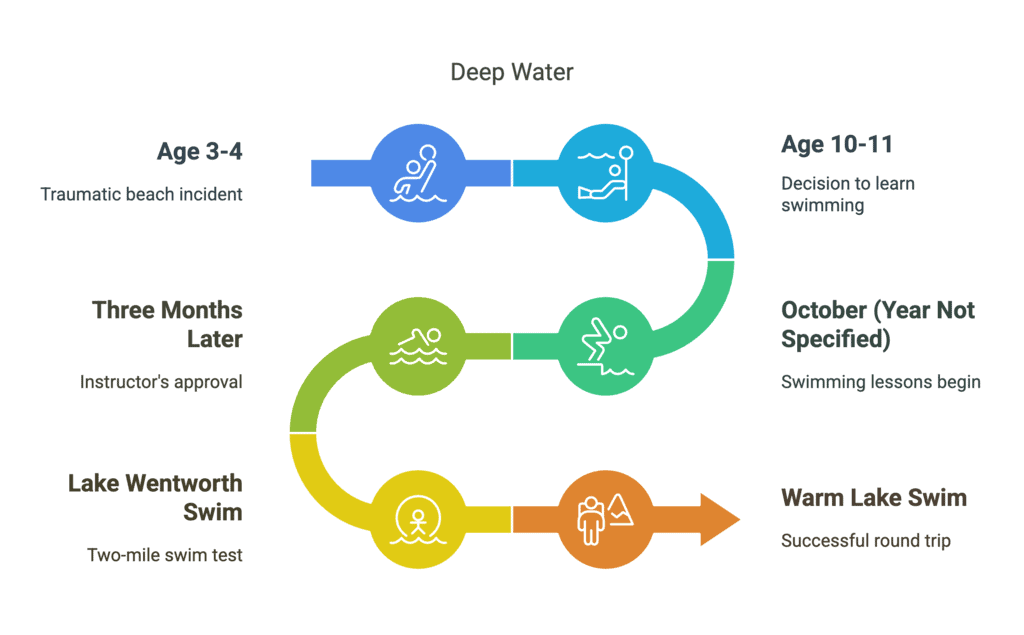
- The fear originates in a childhood mishap at a California beach when the author was about three or four years old and was knocked down by the surf.
- As a boy of about ten or eleven he chose to learn swimming at the Y.M.C.A. pool rather than in the treacherous Yakima river, because the pool seemed safer.
- A subsequent near-drowning episode at the pool - when an older boy bullied him and threw him into deep water - intensified the fear and left a physical and psychological scar.
- Years later the author undertakes systematic swimming lessons, practises with safety measures such as a rope, and gradually builds confidence until he is able to swim long distances, including crossing Lake Wentworth and Warm Lake.
- The narrative traces a journey from panic and handicap to resolution and mastery; it underlines the central idea that fear itself is the most dangerous obstacle to overcome.
Detailed Summary
The passage is told in the first person and recounts a life-long battle against an intense fear of water. The seed of that fear was planted at a very early age. When the author was about three or four years old, he was taken to a California beach where a wave knocked him down and he was carried under. The experience left him with a vivid terror of the sea and of deep water.
When he was about ten or eleven, the author decided to learn to swim. He chose the Y.M.C.A. pool because it seemed controlled and safe compared with the treacherous flow of the Yakima river near his home. His initial attempts were tentative: he used inflatable water wings and copied other boys at the pool, practising cautiously and staying near the shallow end.
One day, while waiting at the pool without his companions, an older, muscular eighteen-year-old boy arrived. This boy bullied him and, as a "joke", seized him and threw him into deep water. Immediately the author began to flounder. He kicked and flailed, tried to keep his head above water, and, in panic, reached down to the pool floor to hold on. The pool floor felt like a refuge, but when he pushed off it to rise, his ascent was painfully slow. Each attempt to come up for air seemed to be surrendered to the water; he could not scream, and the panic only increased his helplessness.
Exhaustion and the overwhelming force of his fear caused him to sink into a state close to unconsciousness. Bystanders and swimmers rescued him and pulled him out. The older boy claimed his action was only a joke, but other witnesses recognised that the author had been in serious danger. The incident left him physically weakened and mentally scarred; the fear of water deepened rather than diminished.
For many years afterwards, whenever he faced water he felt paralysed; his legs would not obey and his heart pounded with fright. He made attempts to conquer this dread but they failed because his panic response was intense and automatic. Later, resolved to master his fear, he took formal lessons. The instructor worked with him gradually and carefully. At first the author practised with a safety rope tied around him so that he could be supported while trying strokes and learning how to breathe in the water. His practice was methodical: learning to control breath, to kick properly, and to trust the water rather than fight it.
After months of disciplined practice he reached a stage where the instructor considered him ready to swim freely. Still uncertain of his own courage, he continued to test himself in increasingly demanding situations. He swam two miles across Lake Wentworth, and during that crossing he experienced fear only once, when he found himself submerged in the middle of the lake for a brief moment. To be doubly sure of his victory over fear, he swam across and back in Warm Lake, finding he could do so without any panic. This sustained effort, repeated practice, and willingness to face frightening situations gradually removed the crippling panic that had once ruled him.
In the final reflection the author describes the emotional change as profound: the sensation that once dominated his life was no longer able to control him. He quotes the famous line attributed to Franklin D. Roosevelt: "The only thing we have to fear is fear itself," to underline the central insight of his experience - that fear, if allowed to grow, is more destructive than the external danger it pretends to guard against.
Theme / Message
The central theme is the psychological victory over fear. The passage argues that fear can become an internal barrier more dangerous than the external situation which caused it. Through perseverance, systematic practice, and courageous facing of situations that once caused panic, a person can reduce or remove a phobia. The author's final thought - reinforced by the Roosevelt quotation - is that the paralysis caused by fear is often a greater enemy than the real hazard. Thus, the moral is about fortitude, disciplined effort, and the importance of confronting one's fears rather than avoiding them.
Difficult Words
- Treacherous: Dangerous, Unpredictable
- Subdued: Lowered, Reduced
- Misadventure : Accident, Bad luck
- Aversion: Dislike, Hatred
- Overpowering: Powerful to overcome
- Oblivion: Unconscious, Forgetfulness
- Residual: Remaining, Left over
- Vestiges: Remainder, Trace
- Haunting: Unforgettable, Coming to memory repeatedly
- Exertion: Stress, Tiredness
- Flailed: Repeatedly moved hands and legs
- Thrash: Beat, Move violently
- Cascades: Series of small waterfalls
- Handicap: Disadvantage
- Curtain of life fell: Life ended, Death
FAQs on Summary - Deep Water
| 1. What is the main theme of Deep Water by William Douglas? |  |
| 2. How did Douglas's childhood accident shape his relationship with water? | |
| 3. Why did Douglas eventually decide to learn swimming as an adult? | |
| 4. What role does self-awareness play in Douglas's journey to overcome his aquaphobia? | |
| 5. How does Deep Water illustrate the connection between physical and mental courage for CBSE Class 12 students? | |