Class 7 History Chapter 1 Notes - Tracing Changes Through a Thousand Years 1


"Change is the only constant" applies perfectly to history. By studying it, we see how things have shifted over time and how we reached our present state. In this chapter, we’ll explore key changes over a thousand years, examining how societies, cultures, and politics evolved and shaped the world we know today.
Historical Maps of the Indian Subcontinent
The maps by Arab geographer Al-Idrisi (1154) and French cartographer (1720) gave a large sketch of the Indian subcontinent in earlier times.
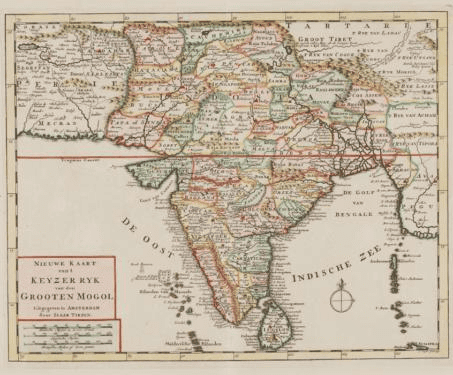 Early Maps of India
- Historians need to be aware of the different historical contexts when studying maps.
- The maps from different times reflect changes in knowledge and cartographic techniques.
Cartography: The art and science of making maps. A person who makes maps is known as a cartographer.
Map 1: Al-Idrisi's Map (1154 CE)
- Created by the Arab geographer Al-Idrisi.
- Shows a sketch of the Indian subcontinent from a larger world map.
- Depicts South India as North India and places Sri Lanka at the top.
- Place names are in Arabic, including Kanauj (Qanauj) in Uttar Pradesh.
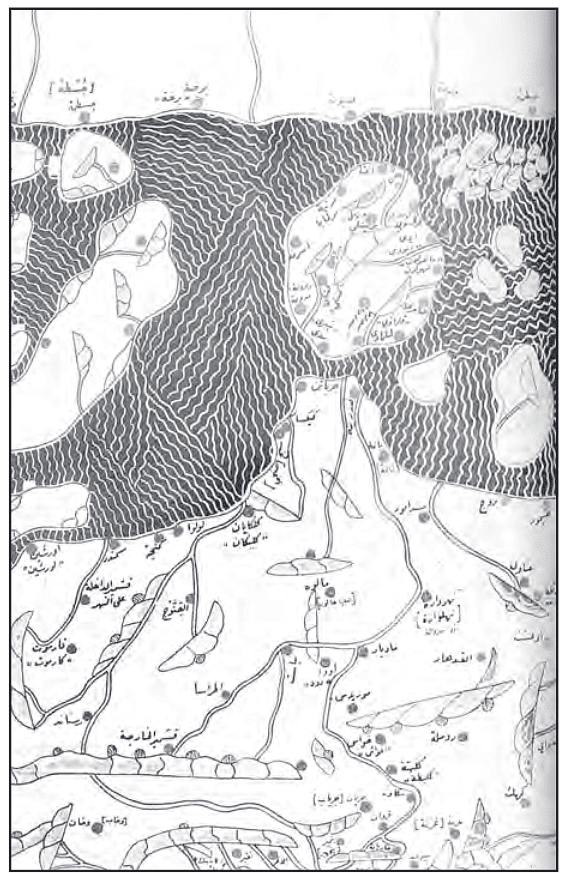 Al-Idrisi's Map
- Created by a French cartographer.
- Represents the same area but with notable differences.
- More familiar and detailed, especially along the coastlines.
- Used by European sailors and merchants.
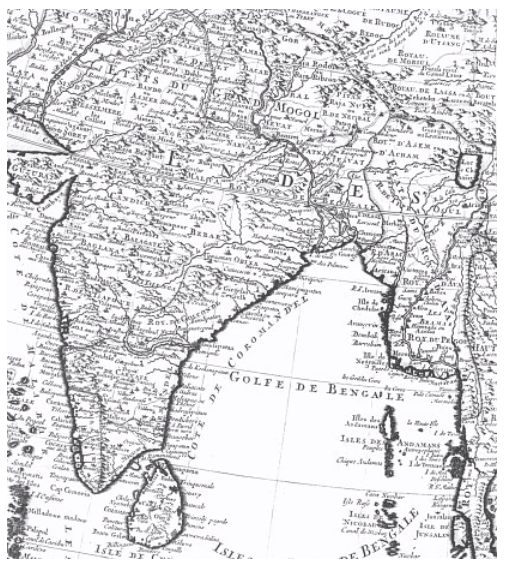 French Cartographer's Map
Table depicting Features of Map by Al-Idrisi and Map of French Cartographer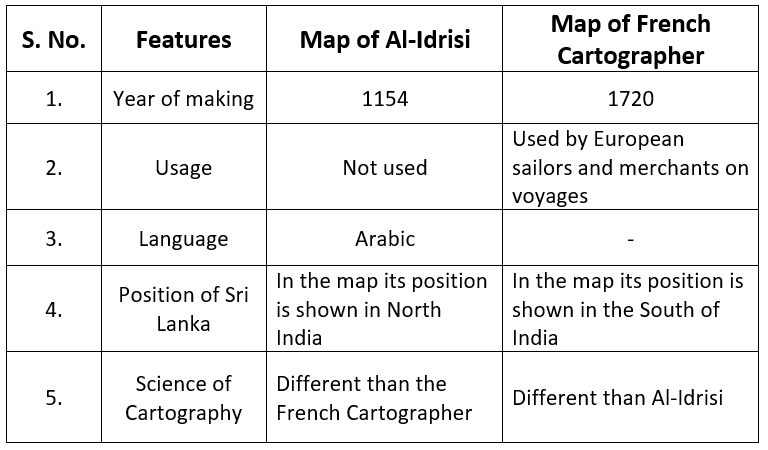 Historians need to be aware of the different historical contexts when studying maps. The maps from different times reflect changes in knowledge and cartographic techniques.
New and Old Terminologies
The term used to refer to India has changed over time. The term “Hindustan”, is known as “India,” the modern nation-state today.
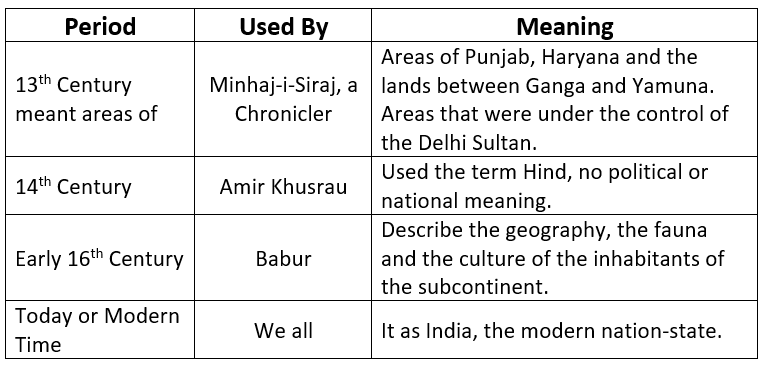 Table depicts the History of Word Hindustan
- 13th Century: The term was first used in the 13th century by Minhaj-i-Siraj, a chronicler who wrote in Persian and contains the areas of Punjab, Haryana and the lands between the Ganga and Yamuna.
- 14th & 16th Century: In the early 16th century, Babur used Hindustan to describe the geography, the fauna and the culture of the inhabitants of the subcontinent, same as how 14th century poet Amir Khusrau used the word “Hind”.
- Changing Language and Terms: Over time, language evolves and so do the meanings of words. For instance, "foreigner" today means someone from another country, but in the medieval period, it referred to any stranger from outside the local community.
Historians and their Sources
Historians rely on various sources to study the past, and these sources vary depending on the period being examined. For instance, to explore the Gupta dynasty or Harshavardhana, historians use coins, inscriptions, architecture, and textual records. The period from approximately 700 to 1750 saw significant changes in the types and availability of textual records.

1. Types of Sources:
- Coins: Provide information about economic and political changes.
- Inscriptions: Offer details about rulers, events, and societal norms.
- Architecture: Reveals technological and artistic achievements.
- Textual Records: Include manuscripts which contain holy texts, royal chronicles, letters, teachings of saints, petitions, judicial records, and financial accounts.
2. Changes Over Time: Paper became cheaper and more widely available over time. For example:
- In the 13th century, paper was so scarce that a scholar reused old paper by washing off the previous writing.
- By the 14th century, paper was more commonly available, even used to wrap food in markets.
3. Manuscripts and Their Challenges:
- Creation and Copying: Before the printing press, scribes copied manuscripts by hand. This process introduced small changes—such as altered words or sentences—that accumulated over time, leading to differences between versions.
- Archives: Manuscripts and documents were collected by wealthy individuals, rulers, monasteries, and temples, and stored in libraries and archives. Archives are places where documents and manuscripts are preserved.
4. Miniature Paintings:
- Miniature paintings were sometimes used to illustrate manuscripts. These paintings were often so beautiful that collectors later removed and sold them separately from the manuscript.
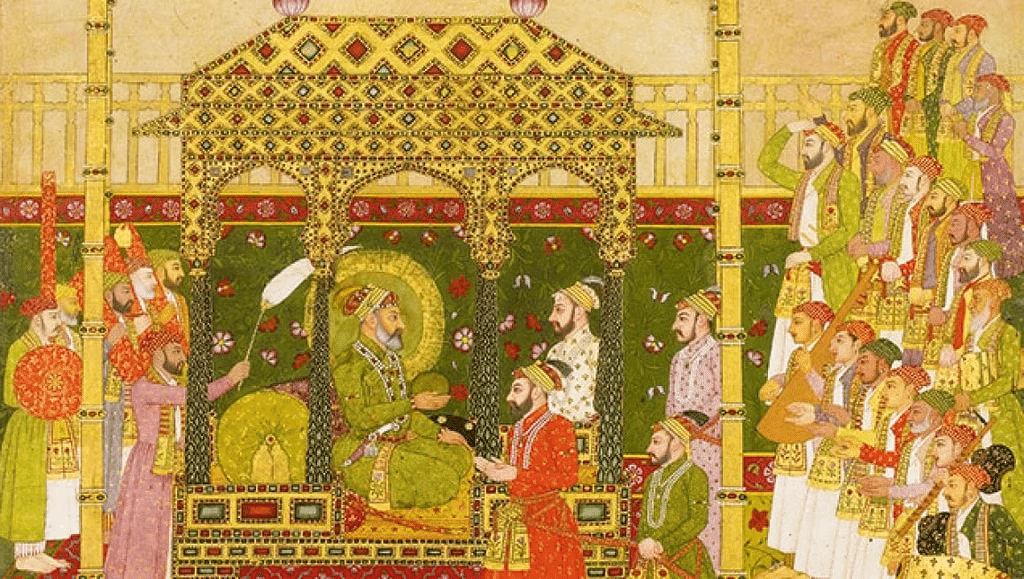 Miniature Painting
New Social and Political Groups
The period between 700 and 1750 was marked by significant social and political changes in the Indian subcontinent. Historians face the challenge of studying this era due to the scale and variety of developments that occurred.
Here are some key aspects of this period:
1. Technological and Agricultural Innovations:
- Introduction of the Persian wheel for irrigation and the spinning wheel for weaving.
- Introduction of potatoes, corn, chillies, tea, and coffee to the subcontinent.
- These innovations came with new groups of people who brought different ideas and practices, leading to widespread economic, political, social, and cultural changes.
2. Social Mobility and New Groups:
- Rajputs: The term "Rajput" means "son of a ruler" (Rajaputra) and was used for a group of warriors claiming Kshatriya status. Roles Included rulers, chieftains, soldiers, and commanders serving various monarchs. They were known for their chivalry, extreme valor, and loyalty, as celebrated by poets and bards.
- Kayasthas: A caste of scribes and secretaries who became politically significant during this period.

3. Changes in Land Use and Society:
- Expansion of agriculture led to the clearing of forests.
- Forest-dwellers migrated or took up farming, becoming peasants.
- New peasant groups emerged, contributing to economic and social differentiation.
4. Economic and Social Structure:
- Peasants had to pay taxes and provide goods and services to local lords.
- Jatis were social groups based on occupation and background, each with its own rules and regulations.
- Jati Panchayat were assemblies of elders that enforced jati rules and village regulations.
Several villages were governed by a chieftain.
5. Social Hierarchy: Social ranks and statuses varied from region to region, reflecting complex and differentiated societies.
Quick Summary: Clearing of the forests → Development of Agriculture → Forest dwellers migrate due to forest cutting → Some became farmers → Difference in land, so status difference → Division in jatis or sub-castes on the basis of backgrounds and occupations → Ranks were not fixed permanently
Region and Empire
Large empires like those of the Cholas, Tughluqs, and Mughals claimed vast territories across the subcontinent.

- Empire Expansion and Claims: A prashasti (praise) of Delhi Sultan Ghiyasuddin Balban described his rule extending from Bengal (Gauda) in the east to Ghazni (Gajjana) in Afghanistan in the west, covering all of South India (Dravida). Historians often regard these as exaggerated claims but also study why rulers made such assertions of control over vast regions.
- Language and Regional Identity: In 1318, poet Amir Khusrau noted that each region had its own distinct language. Khusrau highlighted that Sanskrit was the only language not tied to a specific region and was primarily understood by Brahmanas, not common people.
- Regional Development: By 700 AD, many regions had developed distinct geographical and cultural characteristics, with their own languages and traditions. The Cholas, Khaljis, Tughluqs, and Mughals built pan-regional empires that spanned diverse areas, although not all were equally stable or successful.
- Legacy of Regional States: The decline of the Mughal Empire in the 18th century led to the re-emergence of regional states across the subcontinent. These regional states retained legacies from previous empires, influencing governance, economy, elite cultures, and languages. Throughout the period from 700 to 1750, regions developed under the influence of larger empires, integrating into broader pan-regional forces while maintaining their distinct identities.
Old and New Religions
During this period, religion played a significant role in shaping societies, influencing social structures, and introducing new beliefs and practices across India.

- Religion and Society: Religion was deeply connected to the social and economic structure of local communities during this period. Significant changes occurred in Hinduism, including: The worship of new deities. The construction of temples by royalty. The increased importance of Brahmanas (priests), who gained respect through their knowledge of Sanskrit.
- Bhakti Movement: A new religious idea, Bhakti, emerged, emphasizing devotion to a loving, personal deity. This concept allowed devotees to connect with God directly, without the need for priests or elaborate rituals.
- Introduction of Islam: Islam was introduced to India by merchants and migrants in the 7th century. Muslims follow the teachings of the Holy Quran, which is regarded as their sacred text. They believe in the sovereignty of one God, Allah, who shows love, mercy, and bounty to all believers, regardless of their social background.
- Islamic Influence and Diversity: Many rulers during this period were patrons of Islam and supported the ulama (learned theologians and jurists). There were differences within Islam, particularly between various schools of law (such as Hanafi and Shafi’i) and in theological and mystical traditions.
Thinking about Time and Historical Periods
History is not just about dates and events; it’s about understanding how societies, economies, and beliefs have evolved over time. In this topic, we will explore how historians divide the past into different periods to make sense of these changes.

Concept of Time: Historians view time not just as the passage of hours or years but as a reflection of changes in society, economy, ideas, and beliefs.
Dividing History into Periods: To study history more effectively, historians divide the past into periods that share common characteristics.
British Division of Indian History: British historians divided Indian history into three periods: Hindu, Muslim, and British. This division was based on the idea that the religion of the rulers was the most significant historical change.
Modern Historical Perspective: Most modern historians focus on economic and social factors to define different historical periods rather than just the religion of rulers.
Periods in History:
Early Societies: Includes the life of hunter-gatherers, early farmers, and the formation of early empires.
Medieval Period: Marked by the growth of imperial states, the rise of Hinduism and Islam, and the arrival of European trading companies.
Modern Period: Associated with material progress, intellectual development, and the onset of modernity.
Important Dates
1154 – Map of the Indian Subcontinent made by al-ldrisi.
1266-1287 – Reign of the Delhi Sultan Ghiyasuddin Balban.
1356 – Ziyauddin Barani wrote his first chronicle. He wrote another version two years later.
|
63 videos|552 docs|46 tests
|
FAQs on Class 7 History Chapter 1 Notes - Tracing Changes Through a Thousand Years 1
| 1. What are some examples of new and old terminologies used by historians? |  |
| 2. How do historians source their information for studying the past? | |
| 3. What role did new social and political groups play in shaping history? | |
| 4. How did the concept of region and empire change over time? | |
| 5. Why is it important to think about time and historical periods when studying history? | |




video lectures
,shortcuts and tricks
,Extra Questions
,Viva Questions
,study material
,practice quizzes
,Class 7 History Chapter 1 Notes - Tracing Changes Through a Thousand Years 1
,Class 7 History Chapter 1 Notes - Tracing Changes Through a Thousand Years 1
,Semester Notes
,Objective type Questions
,ppt
,Free
,Important questions
,Exam
,Class 7 History Chapter 1 Notes - Tracing Changes Through a Thousand Years 1
,mock tests for examination
,Summary
,past year papers
,Sample Paper
,Previous Year Questions with Solutions
,MCQs
;



Chapter Notes - Tracing Changes Through a Thousand Years Free PDF Download
Importance of Chapter Notes - Tracing Changes Through a Thousand Years
Chapter Notes - Tracing Changes Through a Thousand Years
Chapter Notes - Tracing Changes Through a Thousand Years Class 7 Questions
Study Chapter Notes - Tracing Changes Through a Thousand Years on the App
|
© EduRev
|
Education Revolution
|


|




within 7 days!