Syllabus - Computer Science and Information Technology, GATE 2025 PDF Download
- Graduate Aptitude Test in Engineering (GATE) is a National-Level postgraduate engineering entrance exam for engineering graduate students. Usually, this is conducted by Indian Institute of Science, Bangalore and 7 other Indian Institute of Technology (IIT) located across India. This time it is IIT Kanpur that is going to conduct the GATE 2023.
- It is conducted every year in the month of February and dates of examination for all the 29 subjects for 2023 are: Saturday 4th, Sunday 5th , Saturday11 th and Sunday12 th February, 2023. There are two sessions (forenoon and afternoon) each day.
- IIT Kanpur has released the syllabus for GATE Computer Science and Information Technology 2023. Along with the GATE syllabus for Computer Science and Information Technology, the candidates are also advised to check the exam pattern of GATE 2023 for preparation purposes.
Here is the list of topics that needs to be covered for the GATE 2023 Computer Science and Information Technology Exam. Make sure the candidates get to know the following sections:
Digital Logic
Candidates who are preparing for GATE 2023 Computer Science and Information Technology Exam can check the syllabus given below before you start the preparation.
Latest GATE Exam Pattern
Students who appear in the exam should understand the GATE exam pattern. The exam will be held as a single paper of 3 hours duration consisting of questions from aptitude and the respective subject.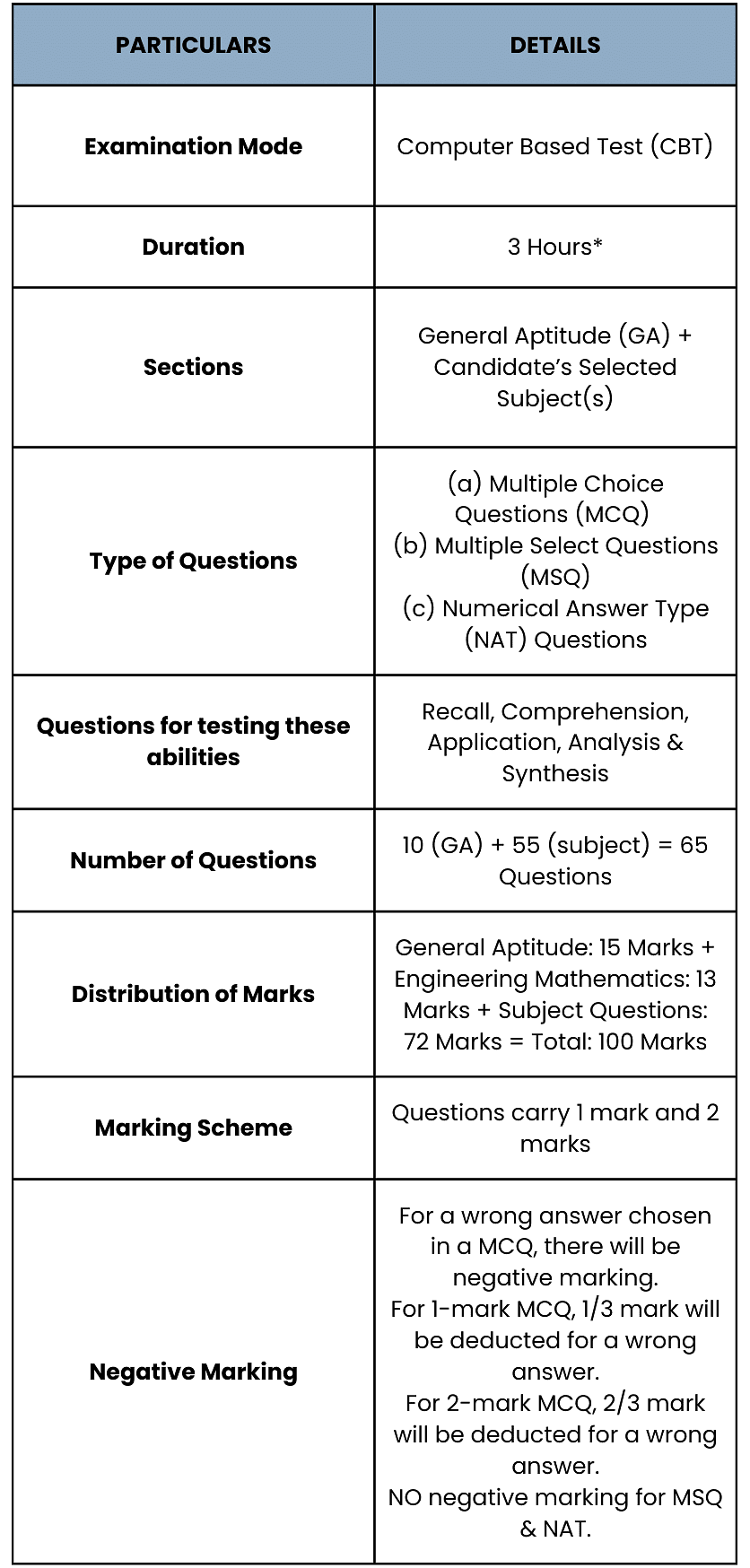
*PwD candidates with benchmark disability are eligible for the compensatory time of 20 minutes per hour. Thus, they will get one hour extra for a three hours examination.
The detailed latest exam pattern of GATE CS and IT is given below:
Computer Science and Information Technology - Basic Info
- It is one of the popular streams among engineering aspirants. It focuses on the basic elements of computer programming and networking.
- Before appearing in the exam, candidates must be well aware of the syllabus and GATE Exam Pattern. As per GATE's latest pattern, 72% of exams have Core Engineering Syllabus or subject syllabus, 13% of Engineering Mathematics, and 15% of General Aptitude.
- Candidates can go through the syllabus given below to get an idea about the GATE syllabus.
Syllabus for Technical Subject: Computer Science and Information Technology
Section 1:
Engineering Mathematics
- Discrete Mathematics: Propositional and first order logic. Sets, relations, functions, partial orders and lattices. Monoids, Groups. Graphs: connectivity, matching, coloring. Combinatorics: counting, recurrence relations, generating functions.
- Linear Algebra: Matrices, determinants, system of linear equations, eigenvalues and eigenvectors, LU decomposition.
- Calculus: Limits, continuity and differentiability. Maxima and minima. Mean value theorem. Integration.
- Probability and Statistics: Random variables. Uniform, normal, exponential, poisson and binomial distributions. Mean, median, mode and standard deviation. Conditional probability and Bayes theorem.
Section 2: Digital Logic
- Boolean Algebra.
- Combinational and Sequential Circuits.
- Minimization.
- Number Representations and Computer Arithmetic (fixed and floating-point).
Section 3: Computer Organization and Architecture
- Machine Instructions and Addressing Modes.
- ALU, Data‐Path and Control Unit.
- Instruction pipelining, pipeline hazards
- Memory Hierarchy: Cache, Main Memory and Secondary Storage; I/O interface (interrupt and DMA mode).
Section 4: Programming and Data Structures
- Programming in C.
- Recursion.
- Arrays, Stacks, Queues, Linked Lists, Trees, Binary Search Trees, Binary Heaps, Graphs.
Section 5: Algorithms
- Searching, Sorting, Hashing.
- Asymptotic Worst-Case Time and Space Complexity.
- Algorithm Design Techniques: Greedy, Dynamic Programming and Divide‐and‐Conquer. Graph traversals, minimum spanning trees, shortest paths.
Section 6: Theory of Computation
- Regular Expressions and Finite Automata.
- Context-Free Grammars and Push-Down Automata.
- Regular and Contex-Free Languages, Pumping Lemma.
- Turing Machines and Undecidability.
Section 7: Compiler Design
- Lexical Analysis
- Parsing
- Syntax-Directed Translation.
- Runtime Environments.
- Intermediate code generation.
- Local optimisation
- Data flow analyses: constant propagation, liveness analysis, common subexpression
elimination.
Section 8: Operating System
- System calls
- Processes.
- Threads.
- Inter‐Process Communication.
- Concurrency and Synchronization.
- Deadlock.
- CPU Scheduling.
- Memory Management
- Virtual Memory.
- File Systems.
Section 9: Databases
- ER‐Model.
- Relational Model: Relational Algebra, Tuple Calculus, SQL.
- Integrity Constraints, Normal Forms.
- File Organization, Indexing (e.g., B and B+ trees).
- Transactions and Concurrency Control.
Section 10: Computer Networks
- Concept of layering: OSI and TCP/IP Protocol Stacks; Basics of packet, circuit and virtual circuit-switching;
- Datalink layer: framing, error detection, Medium Access Control, Ethernet bridging;
- Routing protocols: shortest path, flooding, distance vector and link state routing; Fragmentation and IP addressing, IPv4, CIDR notation, Basics of IP support protocols (ARP, DHCP, ICMP), Network Address Translation (NAT);
- Transport layer: flow control and congestion control, UDP, TCP, sockets;
- Application layer protocols: DNS, SMTP, HTTP, FTP, Email.
Syllabus for General Aptitude (GA) (Common to all Papers)
1. Verbal Aptitude
- Basic English grammar: tenses, articles, adjectives, prepositions, conjunctions, verb-noun agreement, and other parts of speech.
- Basic vocabulary: words, idioms, and phrases in context.
- Reading Comprehension
- Narrative Sequencing
2. Quantitative Aptitude
- Data interpretation: data graphs (bar graphs, pie charts, and other graphs representing data), 2- and 3-dimensional plots, maps, and tables.
- Numerical computation and estimation: ratios, percentages, powers, exponents and logarithms, permutations and combinations, and series.
- Mensuration and Geometry
- Elementary Statistics and Probability
3. Analytical Aptitude
- Logic: deduction and induction.
- Analogy
- Numerical Relations and Reasoning
4. Spatial Aptitude
- Transformation of shapes: translation, rotation, scaling, mirroring, assembling, and grouping.
- Paper folding, cutting, and patterns in 2 and 3 dimensions.
FAQs on Syllabus - Computer Science and Information Technology, GATE 2025
| 1. What is the latest exam pattern for GATE in Computer Science and Information Technology? |  |
| 2. What is the syllabus for the technical subject in GATE Computer Science and Information Technology? | |
| 3. What is the syllabus for the General Aptitude section in GATE Computer Science and Information Technology? | |
| 4. How much weightage does the technical subject carry in GATE Computer Science and Information Technology? | |
| 5. Can I find the GATE exam pattern and syllabus for Computer Science and Information Technology online? | |

|
27.8K Views |

|
4.81/5 Rating |

|
Dec 22, 2024 Last updated |

|
Explore Courses for GATE exam
|

|
shortcuts and tricks
,video lectures
,Semester Notes
,Extra Questions
,GATE 2025
,Syllabus - Computer Science and Information Technology
,mock tests for examination
,ppt
,Syllabus - Computer Science and Information Technology
,past year papers
,study material
,Previous Year Questions with Solutions
,Syllabus - Computer Science and Information Technology
,GATE 2025
,Free
,Viva Questions
,practice quizzes
,GATE 2025
,Important questions
,Exam
,MCQs
,Sample Paper
,Summary
,Objective type Questions
;




Syllabus - Computer Science and Information Technology, GATE 2025 Free PDF Download
Importance of Syllabus - Computer Science and Information Technology, GATE 2025
Syllabus - Computer Science and Information Technology, GATE 2025 Notes
Syllabus - Computer Science and Information Technology, GATE 2025 GATE Questions
Study Syllabus - Computer Science and Information Technology, GATE 2025 on the App
|
© EduRev
|
Education Revolution
|


|


