NCERT Solutions: Neural Control & Coordination

Q1: Briefly describe the structure of the Brain
Ans: Brain: The brain is the main coordinating centre of the nervous system. It controls, integrates and monitors the activity of the whole body. The brain is protected by three cranial meninges - an outer tough layer called dura mater, a middle delicate arachnoid and an inner thin pia mater.
Structurally the brain is divided into three major regions - forebrain, midbrain and hindbrain. Each region has specialised centres and functions.
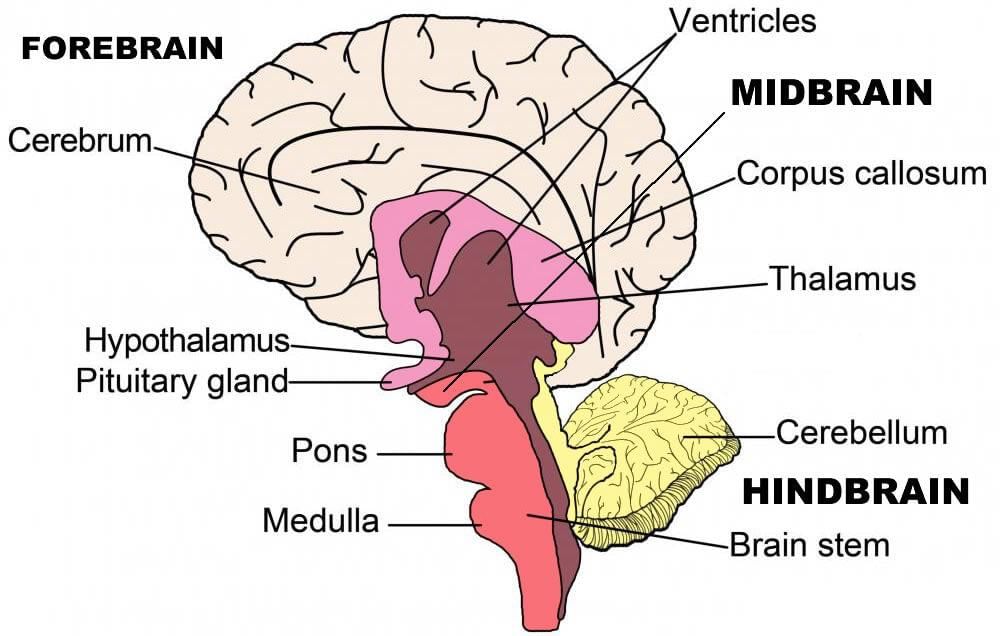 Fig: Structure of Brain
Forebrain: The forebrain is the major centre for thinking and higher mental functions. It consists of the cerebrum, thalamus and hypothalamus.
(a) Cerebrum: The cerebrum is the largest part of the brain, making up about four-fifths of its mass. It is split into two cerebral hemispheres by a deep longitudinal fissure. The two hemispheres are connected by a bundle of nerve fibres called the corpus callosum. The surface of each hemisphere is covered by a thin layer of neuronal cell bodies called the cerebral cortex (grey matter). Beneath the cortex lies white matter composed of myelinated nerve fibres. The cerebrum contains sensory (association) areas that receive and interpret sensory input, and motor areas that control voluntary movements.
(b) Thalamus: The thalamus lies deep within the forebrain and acts as a major relay and coordination centre for sensory and motor signals travelling to the cerebral cortex. It filters and directs incoming sensory information.
(c) Hypothalamus: The hypothalamus lies below the thalamus and controls many homeostatic functions such as body temperature, hunger, thirst and certain emotional responses. It also links the nervous system with the endocrine system and helps regulate sleep-wake cycles and sexual behaviour.
Midbrain: Situated between the thalamus and the pons, the midbrain contains structures on its dorsal surface called the corpora quadrigemina (superior and inferior colliculi). A small channel called the cerebral aqueduct passes through the midbrain. The midbrain is involved in basic visual and auditory reflexes.
Hindbrain: The hindbrain comprises the pons, cerebellum and medulla oblongata.
(a) Pons: A band of transverse nerve fibres that links the two halves of the cerebellum and connects the medulla to the midbrain; it assists in regulating respiration and relays signals between cerebrum and cerebellum.
(b) Cerebellum: A well-developed structure lying below the posterior parts of the cerebral hemispheres and above the medulla. The cerebellum is essential for maintaining posture, balance and coordination of voluntary movements.
(c) Medulla oblongata: The posterior most and simplest part of the brain, located beneath the cerebellum. It contains vital centres that control respiration, heart rate and other autonomic functions. The medulla continues downward as the spinal cord and exits the skull via the foramen magnum.
Q2: Compare the following:
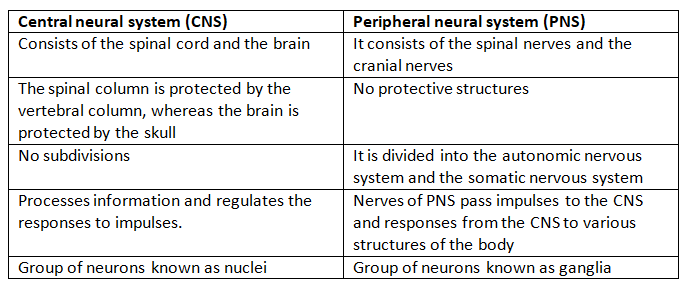
(a) Central neural system (CNS) and Peripheral neural system (PNS)
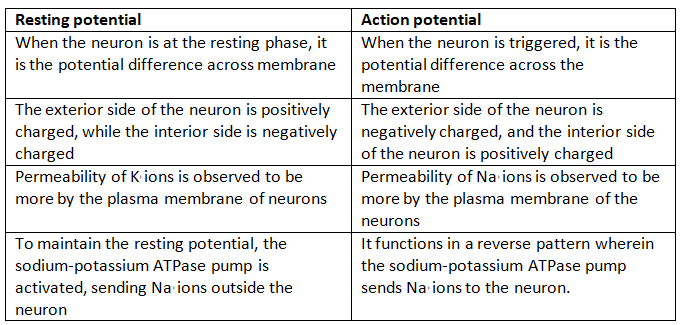
(b) Resting potential and action potential
Ans: (a)
(b) Resting potential and action potential
Q3: Explain the following processes:
(a) Polarisation of the membrane of a nerve fibre
(b) Depolarisation of the membrane of a nerve fibre
(c) Transmission of a nerve impulse across a chemical synapse
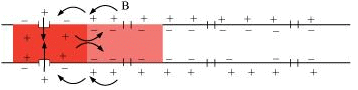
Ans: (a) Polarisation of the membrane of a nerve fibre: When a nerve fibre is at rest it maintains a stable difference in electric potential across its membrane known as the resting membrane potential. This arises because potassium ions (K+) are more concentrated inside the axoplasm while sodium ions (Na+) are more concentrated outside. The membrane is selectively permeable and, at rest, allows more K+ to leak out than Na+ to enter. As a result the outside of the membrane is comparatively positive and the inside is negative - this state is called polarisation.
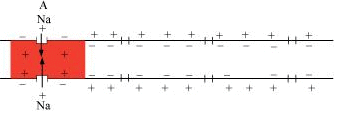
(b) Depolarisation of the membrane of a nerve fibre: When a stimulus reaches threshold, the membrane permeability changes so that sodium channels open and Na+ ions flow rapidly into the axon. The influx of positively charged Na+ reduces and then reverses the membrane potential so that the inside becomes positive relative to the outside. This change from the resting negative potential to a positive potential is called depolarisation and, if large enough, produces an action potential.
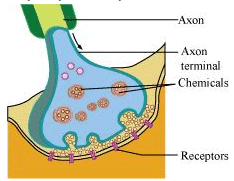
(c) Transmission of a nerve impulse across a chemical synapse: A chemical synapse is the junction between the axon terminal of one neuron (presynaptic neuron) and the dendrite or cell body of the next neuron (postsynaptic neuron); the two are separated by a small gap called the synaptic cleft. The sequence of events is:
1. An action potential arrives at the presynaptic terminal.
2. Voltage-gated calcium channels open and Ca2+ ions enter the presynaptic terminal.
3. The increase in Ca2+ concentration triggers synaptic vesicles to fuse with the presynaptic membrane and release neurotransmitter (for example, acetylcholine) into the synaptic cleft.
4. The neurotransmitter diffuses across the cleft and binds to specific receptors on the postsynaptic membrane, causing ion channels to open and changing the membrane potential of the postsynaptic neuron.
5. If the postsynaptic depolarisation reaches threshold, a new action potential is generated in the next neuron.
6. The neurotransmitter is then removed or inactivated (for acetylcholine, by the enzyme acetylcholinesterase) so that the synapse is ready for the next signal. Removal of the transmitter also allows the postsynaptic membrane to repolarise.
Q4: Draw labelled diagrams of the following:
(a) Neuron
(b) Brain
Ans: (a) Neuron
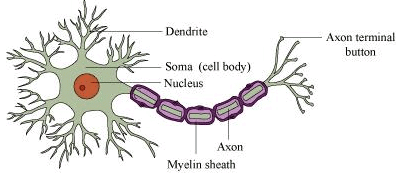 Fig: Structure of Neuron
(b) Brain
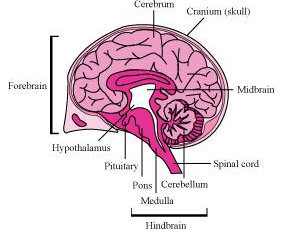 Fig: Structure of Brain
Q5: Write short notes on the following:
(a) Neural coordination
(b) Forebrain
(c) Midbrain
(d) Hindbrain
(e) Synapse
Ans: (a) Neural coordination: The nervous system provides rapid and precise coordination between organs by transmitting electrical impulses. Neural responses are usually fast and short lived, allowing immediate adjustments - for example, during exercise the nervous system increases heart and breathing rate to supply more oxygen to muscles. Neural coordination works closely with the endocrine system for longer-term regulation of bodily functions.
(b) Forebrain: The forebrain contains the cerebrum, thalamus and hypothalamus and is responsible for higher mental functions, sensory perception and regulation of body homeostasis.
(i) Cerebrum: The cerebrum is the largest part of the brain. It is divided into two hemispheres connected by the corpus callosum. The outer cortex (grey matter) contains association and motor areas, while the inner white matter contains connecting fibres.
(ii) Thalamus:The thalamus acts as a relay centre, directing sensory and motor signals to appropriate regions of the cerebrum.
(iii) Hypothalamus:The hypothalamus controls body temperature, hunger, thirst, circadian rhythms and many autonomic functions; it also influences emotional behaviour and links to the endocrine system.
(c) Midbrain: The midbrain lies between the forebrain and hindbrain and contains reflex centres for vision and hearing (corpora quadrigemina). It also contains pathways that connect higher and lower brain regions.
(d) Hindbrain: The hindbrain includes the pons, cerebellum and medulla oblongata and is chiefly involved in balance, posture, coordination and vital autonomic functions.
(i) Pons: connects the two cerebellar hemispheres and relays signals between forebrain and cerebellum.
(ii) Cerebellum: maintains posture, balance and smooth coordination of voluntary movements.
(iii) Medulla oblongata: controls vital reflex centres such as breathing and heartbeat and connects to the spinal cord.
(e) Synapse: A synapse is the specialised junction between neurons where information is transmitted either chemically (via neurotransmitters across a synaptic cleft) or electrically (direct current flow between closely apposed membranes). Chemical synapses are more common and allow modulation of the signal; electrical synapses are faster and permit direct current flow.
There are two types of synapses:
- In electrical synapses, the pre- and postsynaptic membranes are very close and connected by gap junctions, allowing the impulse to pass directly and rapidly from one cell to another.
- In chemical synapses, the two membranes are separated by a synaptic cleft. Transmission is carried out by neurotransmitters released from the presynaptic cell and detected by receptors on the postsynaptic cell.
Q6: Give a brief account of Mechanism of synaptic transmission
Ans: Mechanism of synaptic transmission: A synapse is the junction between the axon terminal of one neuron and the dendrite or cell body of another, separated by a synaptic cleft. Synaptic transmission occurs in two principal ways:
- Chemical transmission: When an action potential reaches the presynaptic terminal, voltage-gated Ca2+ channels open and Ca2+ enters. This triggers synaptic vesicles to fuse with the presynaptic membrane and release neurotransmitter (for example acetylcholine) into the synaptic cleft. The transmitter diffuses across, binds to receptors on the postsynaptic membrane and opens ion channels, producing a postsynaptic potential. Enzymes (such as acetylcholinesterase for acetylcholine) or uptake mechanisms remove the transmitter to terminate the signal.
- Electrical transmission: Here, neurons are joined by gap junctions that permit direct ionic currents to flow from one cell to another. This allows extremely fast, often bidirectional transmission but with less opportunity for modulation compared with chemical synapses.
Q7: Explain the role of Na+ in the generation of action potential.
Ans: Na+ ions are crucial for the depolarisation phase of the action potential. At rest the membrane is more permeable to K+ than to Na+. When a stimulus reaches threshold, voltage-gated Na+ channels open and Na+ rushes into the axon down its electrochemical gradient. The rapid influx of positive charge reverses the membrane polarity (inside becomes positive), producing the action potential. After a short time Na+ channels inactivate and K+ channels open to repolarise the membrane, restoring the resting state.
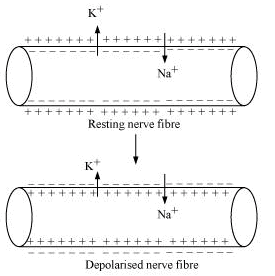 Fig: Nerve Fibre
Q8: Differentiate between:
(a) Myelinated and non-myelinated axons
(b) Dendrites and axons
(c) Thalamus and Hypothalamus
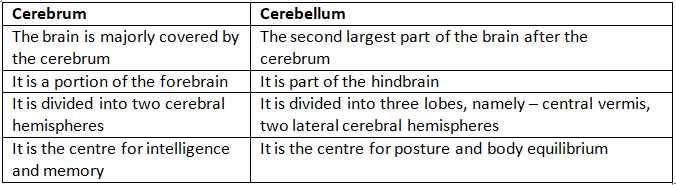
(d) Cerebrum and Cerebellum
Ans:
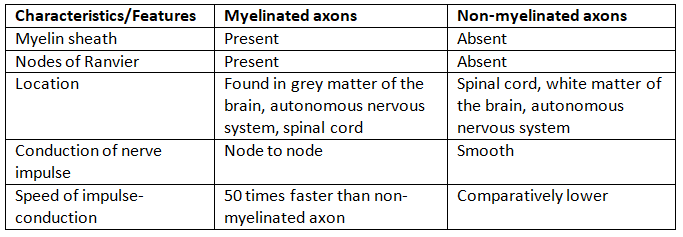
(a) Myelinated and non-myelinated axons
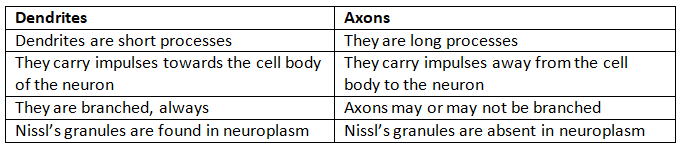
(b) Dendrites and axons
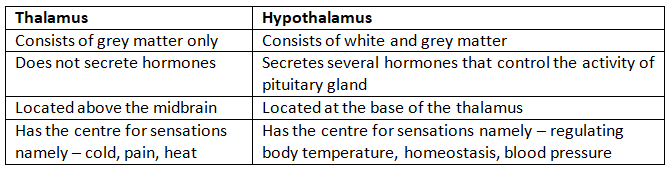
(c) Thalamus and Hypothalamus
(d) Cerebrum and Cerebellum
Q9: Answer the following:
(a) Which part of the ear determines the pitch of a sound?
(b) Which part of our central neural system acts as a master clock?
Ans: (a) Cochlea determines the pitch of a sound.
(b) Hypothalamus acts as the body's master clock, helping to regulate circadian rhythms.
Q10: Distinguish between:
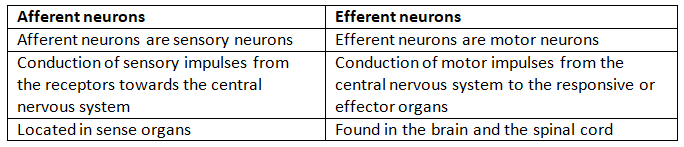
(a) afferent neurons and efferent neurons
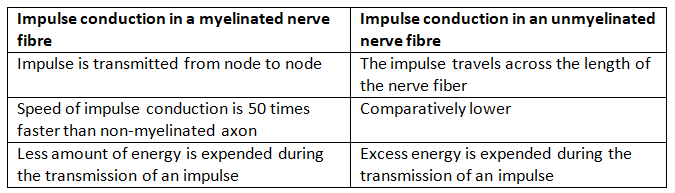
(b) impulse conduction in a myelinated nerve fibre and unmyelinated nerve fibre
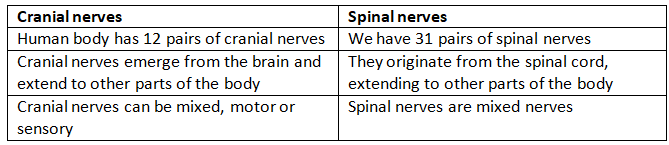
(c) cranial nerves and spinal nerves.
Ans: (a) Afferent neurons and efferent neurons
(b) Impulse conduction in a myelinated nerve fibre and an unmyelinated nerve fibre
(c) Cranial nerves and spinal nerves
FAQs on NCERT Solutions: Neural Control & Coordination
| 1. How does the nervous system control and coordinate different activities in the body? |  |
| 2. What are the different types of neurons present in the nervous system? | |
| 3. How do reflex actions work in the human body? | |
| 4. What is the role of the brain in neural control and coordination? | |
| 5. How do hormones and the endocrine system interact with the nervous system for control and coordination? | |





