Air Pollution | Civil Engineering SSC JE (Technical) - Civil Engineering (CE) PDF Download
Chapter 8
Air Pollution
Air pollution is the transfer of harmful materials into the atmosphere as a direct or indirect consequences of human activity.
- Atmosphere: It is a mixture of gases that forms a layer of about 500Km thick around the earth. Transfer of harmful materials into the atmosphere as a direct or indirect consequences of human activity.
- Atmosphere: It is a mixture of gases that forms a layer of about 500Km thick around the earth.
Composition of air: 78% nitrogen, 21% oxygen, 1% CO2, H2O & other gases.
Atmosphere is divided into four zones:
1. Troposphere: 11km to 16km thick Temperature Lapse rate: 5º C/km. 0 to -80ºC
Aeroplanes fly in this zone
Vapour, clouds, storms present
About ¾ of total weight of atmosphere lies in this zone
2. Stratosphere: Temperature slightly increases in this zone.– 80ºC to 0ºC The increase in temperature is due to absorption of U.V. radiation in stratosphere. Ozone concentration 5 ppm.
3. Mesosphere: temperature decreases from 0ºC to – 110º C atmosphere is windy and turbulent. Too little water vapour for clouds to form.
4. Thermosphere: Temperature increases indefinitely.
Sources of Air Pollution:
1. Natural sources: volcano, forest fire, dust storms.
2. Human beings
3. Stationary sources: power plants, residential heating coal, gas, oil.
4. Mobile sources: vehicles
Types of Air Pollutants:
- Primary air pollutants: Materials that when released pore health risks in their unmodified forms or those emitted directly from identifiable sources. CO, SO2, NOx, hydrocarbons and particulate matter are primary air pollutants.
- Secondary air pollutants: Primary pollutants interact with one another, sunlight or natural gases to produce new, harmful compounds, sunlight or natural gases to produce new, harmful compounds. Ozone, PAN (Peroxy acetyl nitrate), photochemical mog, Aerosols and mists are important secondary pollutants.
Primary Pollutants:
1. CO:
Produced by burning of organic material. Automobiles are biggest source. Cigarette smoke is another major source. It is toxic because it binds to hemoglobin, reduces oxygen in blood. It is not a persistent pollutant, it combines with oxygen to from CO2.
2. SO2:
Produced by burning sulfur containing fossil fuels, coal burning power plants are major source. Reacts in atmosphere to produce acids. It is one of the major components of acid rain when inhaled, can be very corrosive to lung tissue. Main culprit for Asthma.
3. NOx : Produced from burning of fossil fuels. Contributes to acid rain, mog. Automobile engine is main source New engine technology has helped to reduce but still needs to improve.
4. Hydrocarbons: These are compounds with hydrogen and carbon. These are from incomplete burning or evaporated from fuel supplies. Major source is automobiles, but some from industry. Contribute to mog.
Improvements in engine design have helped to reduce.
5. Particulates: Small pieces of solid materials & liquid droplets. Ex. Ash, asbestos, dust etc. can accumulate in lungs and interfere with ability of lungs to exchange gases. Some are carcinogens. Those working in dusty conditions at highest risk. RSPM respirable suspended particulate matter PM-1 having size <= 1 mm effect alveoli PM- 2.5 effects trachea, PM-10 effects nasal part only
Secondary Pollutants:
1. Ozone: Ozone ( O3) is highly reactive gas composed of tree oxygen atoms. It is both a natural and a manmade product that occurs in the earth’s upper atmosphere (the stratosphere) and lower atmosphere (the troposphere). Tropospheric ozone what we breathe is formed primarily from photochemical reactions between two major classes of air pollutants, volatile organic components (VOC) and nitrogen oxide (NOx)
2. PAN (Peroxy Acetyl nitrate): Smog is caused by the interaction of some hydrocarbons and oxidants under the influence of sunlight giving rise to dangerous PAN
3. Photochemical Smog: It is a mixture of pollutants which includes particulates, nitrogen oxide, ozone, aldehydes, PAN, unreacted hydrocarbons etc. The smog often has a brown haze due to presence of nitrogen dioxide. It causes painful eyes.
4. Aerosols and mists: Aerosols and mists are very fine liquid droplets that cannot be effectively removed using traditional packed scrubbers. These droplets can be formed from gas phase hydrolysis of halogenated acids (HCl, HF, HBr), metal halides, organ halides, sulphur trioxide ( SO3) and phosphorous pentoxide ( P2O5)
Air pollution effects: 1. CO: Headaches, reduced mental alertness, heart attack.
2. SO2: Eye irritation, wheezing, lung damage.
3. NO2 : Respiratory infections.
4.O3 : Eye and throat irritation, asthma, lung damage.
5. Lead: Anemia, high BP, brain and kidney damage, cancer.
6. Particulate matter: Eye irritation, asthma, lung damage.
Air Pollution Control:
1. Source control technology: Air quality management sets the tools to control air pollutant emissions control measurements describe the equipment, processes or actions used to reduce air pollution. The extent of pollution reduction varies among technologies and measures. The selection of control technologies depends on environmental, engineering, economic factors and pollutant type.
2. Settling chambers: Settling chambers use the force of gravity to remove solid particles. The gas stream enters a chamber where the velocity of the gas is reduced. Large particles drop out the gas and are collected in happens. Because settling chambers are effective in removing only larger particles they are used in conjunction with a more efficient control device.
3. Cyclones: The general principle of inertia separation is that the particulate. Laden gas is forced to change direction.
As gas changes direction, the inertia of the particles causes them continue in the original direction and be separated from the gas stream. The walls of the cyclone narrow toward the bottom of the unit, allowing the particles to be collected in a hopper. The cleaner air leaves the cyclone through the top of the chamber, flowing upward in a spiral vortex, formed within a downward moving spiral. Cyclones are efficient in removing large particles but are not as efficient with smaller particles. For this reason they are used with other particulate control devices.
4. Venturi scrubbers: Venturi scrubbers use a liquid stream to remove solid particles. The air and water are allowed to pass through a venture kind of narrow tube so the velocity increase and particulate matter mixed with water and at end they will drop because of less velocity. There are effective in removing small particles with efficiency of up to 99%.
5. Electrostatic precipitators: An ESP is a particle control device that uses electrical forces to move the particles out of the flowing gas stream and onto collector plates. The ESP places electrical charges on the particles, causing them to be attracted to oppositely charge mental plates located in the precipitator. The particles are removed from the plates by rapping and collected in a hopper located below the unit.
6. Fabric filters: They remove dust from a gas stream by passing the stream through a porous fabric. The fabric filter is efficient at removing fine particles and can exceed efficiencies of 99%.
Control of gaseous pollutants: 1. Absorption 2. Adsorption 3. Condensation 4. Incineration
1. Absorption: It is a process in which a gaseous pollutant is dissolved in a liquid.
2. Adsorption: When a gas or vapour is brought into contact with a solid, Part of it is taken by the solid. The molecules that disappear from the gas either enter the inside of the solid, or remain on the outside attached to the surface.
The former phenomenon is termed as absorption (Dissolution) and the latter adsorption.
3. Condensation: Condensation is the process of converting a gas or vapour to liquid.
4. Incineration: Incineration also known as combustion is most used to control the emissions of organic compounds from process industries.
Air pollution meteorology: Lapse rate: In troposphere the temperature of ambient air normally decreases with an increase in height.
The rate of change of temperature is called lapse rate. It differs from place to place and time to time. The prevailing large rate at a place at particular time is called environmental lapse rate (ELR) Adiabatic lapse rate: As the air parcel moves up, its temperature decreases as its own heat energy is expanded due to increase in the volume of the air parcel. Using the law of conservation of energy and gas laws, it has been possible to calculate the rate of decrease of temperature with height, called adiabatic lapse rate (ALR) Depending upon the relative positions of two lines ALR and ELR on the graph sheet, the stability of the environment is determined.
(A)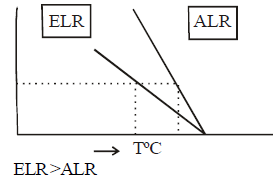
The rising parcel is always warmer then Atmosphere and it accelerate in going up.
Similarly descending parcel is always cooler than surrounding air and this also accelerate in coming down. The environment is unstable and dispersion of pollutants will be rapid. The prevailing ELR is called super adiabatic lapse rate.
(B)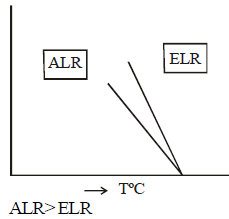
In this case environment is said to be stable and the prevailing ELR is called sub-adiabatic lapse rate.
(C) ALR= ELR: The environment in such a case is neutral Negative lapse rate: In an unusual case, when the temperature of the environment increases with height, then lapse rate becomes negative from its normal state. Such a temperature inversions represents a highly stable environment.
There are two types of inversions: 1. Radiation inversion 2. Subsidence inversion
1. Radiation inversion: It happens when earth cools more rapidly than the air.
2. Subsidence inversion: It is associated with high pressure system and is caused by sinking of air in a high pressure area surrounded by low pressure area (anti-cyclone)
Plume types: Plume types are important because they help us understand under what conditions there will be higher concentrations of contaminants at ground level.
1. Looping plume: It has a wavy character and occurs in super adiabatic environment, which produce highly unstable atmosphere, because of rapid mixing.
2. Neutral plume: It is upward vertical rise of plume from stock. It occurs when ELR=ALR.
3. Coning plume: The neutral plume tends to cone when the wind velocity greater than 32Km/hr and it also occurs under sub adiabatic conditions.
4. Fanning plume: Occurs under large negative lapse rate. Extremely stable environment. The emission will spread only horizontally.
5. Lofting plume: They are created when atmospheric conditions are unstable above and stable below.
Pollutants go up into environment. Favorable plume.
6. Fumigating plume: Most dangerous plume. Contaminants are all coming down to ground level.
They are created when atmosphere conditions are stable above the plume and unstable below.
7. Tapping: Inversion is above and below the plume. Stable above and below.
National Ambient air quality standards: Pollutants Annual average daily average
| Pollutants | Annual average | daily average |
| 1. SO2 | 60 mg/m3 | 80mg/m3 |
| 2. NO2 | 60 mg/m3 | 80mg/m3 |
| 3. SPM | 1400 mg/m3 | 200mg/m3 |
| 4. Lead | 0.75 mg/m3 | 1.0mg/m3 |
| 5. CO | 2.0 mg/m3 | 84.0mg/m3 |
| 6. RPM | 60 mg/m3 | 100mg/m3 |
|
2 videos|122 docs|55 tests
|
FAQs on Air Pollution - Civil Engineering SSC JE (Technical) - Civil Engineering (CE)
| 1. What are the main sources of air pollution? |  |
| 2. How does air pollution affect human health? | |
| 3. What are the environmental consequences of air pollution? | |
| 4. How can we reduce air pollution? | |
| 5. What are the short-term and long-term solutions to tackle air pollution? | |

|
1.9K Views |

|
4.80/5 Rating |

|
Nov 24, 2024 Last updated |
|
2 videos|122 docs|55 tests
|

|
Explore Courses for Civil Engineering (CE) exam
|

|
Free
,MCQs
,past year papers
,ppt
,Important questions
,shortcuts and tricks
,mock tests for examination
,Semester Notes
,Previous Year Questions with Solutions
,practice quizzes
,Air Pollution | Civil Engineering SSC JE (Technical) - Civil Engineering (CE)
,Summary
,Sample Paper
,Air Pollution | Civil Engineering SSC JE (Technical) - Civil Engineering (CE)
,video lectures
,study material
,Exam
,Viva Questions
,Objective type Questions
,Air Pollution | Civil Engineering SSC JE (Technical) - Civil Engineering (CE)
,Extra Questions
;





Air Pollution Free PDF Download
Importance of Air Pollution
Air Pollution Notes
Air Pollution Civil Engineering (CE) Questions
Study Air Pollution on the App
|
© EduRev
|
Education Revolution
|


Follow Us
|