Highway Materials | Civil Engineering SSC JE (Technical) - Civil Engineering (CE) PDF Download

Chapter 4
HIGHWAY MATERIALS
FOLLOWING ARE THE MATERIALS TO DEAL WITH
- Soil characteristics
- Stone characteristics
- Bituminous materials
SOIL CHARACTERISTICS
Desirable properties of soil are :
1. Stability
2. Incompressibility
3. Permanency of strength
4. Minimum change in volume and stability under adverse condition of weather and ground water
5. Good drainage
6. Ease of compaction
IMPORTANT TERMS
1. Field Moisture Equivalent
- It is the moisture content at which the demands for absorbed water are fully satisfied.
- The centrifuge moisture content retained against a force of 1000 times gravity for one hour.
2. Group Index of Soil (GI)
- G.I. was introduced by HRB to classify the soils. G.I. is function of percentage material passing 200 mesh sieve (74 µm), L.L., and P.I. of soil.
- Value of G.I. vary between 0 to 20.
- Higher the value of G.I., poorer is the soil as a subgrade material.
- G.I. = 0.2a + 0.005a.c + 0.01 b.d Here,
a = that portion of material passing 0.074 mm sieve, greater than 35 and not exceeding 75 percent (expressed as a whole number from 0 to 40) = (P – 35) 40
b = that portion of material passing 0.074 mm sieve greater than 15 and not exceeding 35 percent (expressed as a whole number form 0 to 40) = (P – 15) 40
c = that value of liquid limit in excess of 40 and less than 60 (expressed as a whole number from 0 to 20) = (wL – 40) 20
d = that value of plasticity index exceeding 10 and not more than 30 (expressed as a whole number from 0 to 20) = (IP – 10) 20
- HRB have classified soils into 7 groups A-1 to A-7 and their sub classification is done on the basis of G.I.
- A-1, A-2 and A-3 soils are granular soils and % passing 74 µm sieve being less than 35.
- A-4, A-5, A-6 and A-7 soils are fine grained and % passing 74 µm sieve being higher than 35.
- A-1 Þ Well graded stones and gravels A-2 Þ Granular soils. G.I. value of these soils is 0 to 4.
A-3 Þ These consist mainly uniformly graded sand similar to beach sand and desert sand.
A-4 Þ These are silty soils ad have P.I. < 10% and L.L. < 40% A-5 Þ These are also silty soils and have P.I. < 10% but L.L. > 40% A-6 Þ These are plastic clays. P.I. > 10% L.L. < 40%. They have high volume change properties.
A-7 Þ Clays with L.L. > 40% and P.I. > 10%
| Soil Group | Group Index |
| A 2 | 0 to 4 |
| A 4 | Up to 8 |
| A 5 | Up to12 |
| A 6 | Up to16 |
| A 7 | Up to 20 |
Do you know ?
Group index is represented in brackets such as A-6(4). This means A-6 soil has group index value of 4. It means A-6(4) soil is superior than A6(16) soil.
FACTORS ON WHICH STRENGTH OF SOIL DEPENDS
1. Soil type
2. Moisture content
3. Dry density
4. Internal structure of the soil
5. Type and mode of stress application.
Evaluation of Soil Strength
1. Shear tests
2. Bearing tests
3. Penetration tests.
- Shear tests are usually carried out for small samples at laboratory.
- Bearing tests are loading tests & are carried out at the field with a load bearing area.
- Penetration tests are small scale bearing tests.
They can be carried out in the field or in the laboratory.
Plate Bearing Test
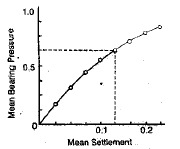
- It is used to find supporting power of subgrade using relatively large diameter plates.
- It was first time used by Wester guard for determining modulus of subgrade reaction (k) which may be defined as “The pressure sustained per unit deformation of subgrade at specified deformation using specified plate size”.
- The standard plate size for finding k is 75 cm diameter but in some tests a smaller plate of 30 cm diameter is also used.
- The pressure p corresponding to a settlement of 0.125 cm is read and the k value is calculated by the relation.

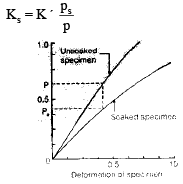
- For consolidated and soaked specimen ps required for same deformation Δ is noted then the modulus of subgrade reaction Ks for the soaked condition is s
Correction for size of plate When the load is not adequate to cause 0.125 cm deflection of 75 cm plate, then smaller plate may be used. The corrected k value is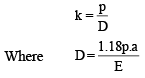
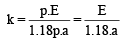
or k1a1 = k2a2
Where a is the radius of plate; E = Modulus of elasticity (kg/cm2)
CBR TEST (CALOFORNIA BEARING RATIO TEST)
- This is penetration test developed for evaluating the stability of soil subgrade and other flexible pavement materials.
- The test consist of a cylinderical plunger of 50 mm diameter to penetrate material at 1.25 mm/ minute.
- The standard load values obtained from tests on crushed stones are 1370kg (70 kg/cm2) and 2055 kg (105 kg/cm2) at 2.5 and 5.0 mm penetration respectively by 50 mm dia plunger.
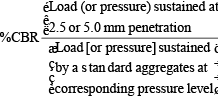
- Normally CBR value at 2.5 mm penetration is higher than at 5.0 mm penetration and higher one is reported. However if CBR at 5.0 mm penetration is higher, then test is repeated for check, but finally higher one is reported.
- Presence of coarse grained material gives poor results. Material passing 20 mm sieve only is used in the test.
STONE CHARACTERISTICS
Desirable Properties
1. Strength : They should be strong to withstand stressed due to traffic wheel load.
2. Hardness : They should be hard enough to resist wear and tear due to abrasive action. The mutual rubbing of stones is called attrition, which also may cause a little wear in the aggregates; however attrition will be negligible or absent in most of the pavement layers.
3. Toughness : Resistance to impact due to moving wheel loads.
4. Durability : The property of stones to withstand the adverse action of weather may be called soundness.
Do you know?
The aggregates are subjected to the physical and chemical action of rain and ground water, the impurities there in and that of atmosphere. Hence it is desirable that the road stones used in the construction should be sound enough to withstand the weathering action.
1. Shape of aggregates : Flaky and elongated particles have less strength than cubical and angular or rounded particles.
- Rounded aggregates may be preferred in cement concrete mix due to low specific surface area and better workability. However rounded particles are not preferred in granular base course.
- WBM and Bituminous construction provide better stability with angular particles than rounded particles.
6. Adhesion with Bitumen : The aggregates used in bituminous pavements should have less affinity with water when compared with bituminous materials; otherwise the bituminious coating on the aggregate will be stripped off in presence of water.
Tests for Road Aggregates (a) Crushing test (b) Abrasion test (c) Soundness test (d) Impact test (e) Shape test (f) Sp. gravity and water absorption test (g) Bituminous adhesion test
1. Crushing Test
- Aggregates possessing resistance to crushing under gradually applied crushing load or having low aggregate crushing value are preferred.
- Dry aggregates passing 12.5 mm I.S. Sieve and retained on 10 mm sieve is filled in cylindrical vessel filled in 3 equal layers. A crushing load of 40 tonnes is applied at a rate of 4 tonnes/minutes and the crushed aggregate is sieved on 2.30 mm I.S. sieve.
- % Aggregate crushing value

Where, W2 = Crushed material passed 2.36 mm sieve.
W1 = Sample materia.
- The crushing value for surface course should be less than 30% and should not exceed 45% for base course.
2. Abrasion Test Carried out to test the hardness of stones.
Tests are of following type
1. Los Angeles abrasion test
2. Devel abrasion test
3. Dorry abrasion test.
Los Angeles Abrasion Test
- It, is based on the rubbing action between the aggregates and steel balls.
- The machine is rotated at 30-33 rpm for 500 to 1000 revolutions.
- The abrasion value of good aggregates for highh quality pavement materials should be less than 30%. However for base course in WBM it may be 50%.
- The abrasion value is expressed as the percentage loss in weight due to abrasion.
- Coefficient of hardness Loss of Weight in gm

3. Impact Test
- Used to evaluate the toughness of stone or resistance of fracture under repeated impacts.
- A metal hammer of weight 13.5 to 14.0 kg having a free fall from a height of 38 cm is dropped through vertical guides. Hammer is given free fall 15 blows and crushed aggregate is sieved on 2.36 mm sieve.
- Aggregates should have size between 12.5 mm to 10 mm and are filled in 3 layers.
- Total impact energy = 15 × 38 × 14 = 7980 kg-cm.
- The impact value should not normally exceed 30% for wearing surface. Maximum permissible value is 35% for bituminous macadam and 40% for WBM base course.
4. Soundness Test
- Used to study resistance to weathering action.
The resistance to disintegration of aggregate is determined by using saturated solution of sodium sulphate and magnesium sulphate. Dry aggregate is immersed in above solution for 16 to 18 hrs. Then the specimen is dried in an oven at 105-110°C to constant weight thus making one cycle of immersion and drying.
- The average loss in weight of aggregates to be used in pavement construction after 10 cycles should not exceed 12% when tested with sodium sulphate and 18% when tested with magnesium sulphate.
5. Shape Tests (a) Flakiness Index
- The flakines s index of aggregate is the percentage by weight of aggregate particles whose least dimension is less than three fifths or 0.6 times of their mean dimension. The test is applicable to size larger than 6.3 mm only.
- It is desirable that the flakiness index of aggregates used in road construction is less than the 15% and normally does not exceed 25%.
(b) Elongation Index
- The elongation index of an aggregate is percentage by weight of particles whose greatest dimension or length is greater than one and (5/4) th or 1.8 times their mean dimension. The elongation test is not applicable for sizes smaller than 6.3 mm.
- Flakiness index and elongation index values in excess of 15% are undesirable.
(c) Angularity Number
- This represents the degree of packing.
Angularity no. = 67 – % solid volume
- 67 represents the volume of solids (in %) of most rounded gravels in a well compacted state, which would have 33% voids. Thus the angularity no. measures the voids in excess of 33%. Higher the angularity number, more angular is the aggregate.
- The range of angularity No. for aggregates used for construction is 0 to 11.
Angularity No. =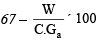
W = weight of aggregate in a cylinder
C = Weight of water in same cylinder
Ga = Sp. gravity of aggregate.
6. Water Absorption Test
- Rock specimens having more than 0.6% water absorption are considered unsatisfactory.
7. Bitumen Adhesion Test
- Aggregates which are electronegative such as silica are water liking and are called hydrophillic Basic elements like lime stones have dislike for water and greater attraction to bitumen as they have positive surface charge, these aggregates are called hydrophobic.
- Stripping of binders from coated aggregates is main problem. This is more predominant in bituminous mixtures which are permeable to water.
- IRC has specified that stripping value of aggregate should not exceed 25% for use in bituminous surface, when aggregate coated with bitumen is immersed in water bath at 40°C for 24 hrs.
BITUMINOUS MATERIALS
Bituminous materials are mainly of two types 1. Bitumen and 2. Tar Bitumen may be petroleum asphalt (bitumen) or native asphalt.
Do you know?
Native asphalts which are associated with a large proportion of mineral matter are called rock asphalts. The viscosity of bitumen is reduced some times by a volatile diluent; this material is called cutback. When bitumen is supsended in a finely divided condition in an aqueous medium and stabilized with an emulsifier, the material is known as emulsion.
General Requirements of Bitumen
1. Adequate viscosity at the time of mixing
2. Low susceptibility to temperature.
3. It should not strip off from aggregate.
Tests on Bitumen 1. Penetration test 2. Ductility test 3. Viscosity test 4. Float test 5. Specific gravity test
6. Softening point test 7. Flash and fire test 8. Solubility test 9. Spot test 10. Loss on heating test 11. Water content test.
1. Penetration Test
- Penetration test determines the hardness or softness (consistency) of bitumen by measuring depth in tenths of a millimeter to which a standard loaded needle will penetrate vertically in 5 seconds. The sample is maintained at 25°C.
- The penetrometer consist s of a needle assembly of 100 gm.
- (80/100) reading means needle penetrates 80-100
of (1/10) of 1 mm i.e., 8 to 10 mm at 25°C.
Do you know?
The penetration values of various types of bitumen used in pavement construction in this country range between 20 and 225, 30/40 and 80/100 grade bitumen are more commonly used. Tars are soft and penetration test is not used.
2. Ductility Test
- The ductility is expressed as the distance in centimeters to which a standard briquette of bitumen can be stretched before the thread breaks. The cross-section of specimen is 10 mm × 10 mm.
- The test is conducted at 37°C and at a rate of pull of 50 mm per minute.
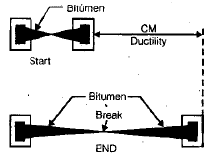
- ISI has recommended a minimum ductility value of 75 cm for grades of 45 and above.
- The minimum ductility value specified is 15 cm for the bitumen grades A-65 to 200 for use in certain regions.
- The minimum ductility value may be 50 cm for grades S35. 3. Viscosity Test
- Viscosity test is the measure of resistance to flow.
- Orifice type viscometer is commonly used.
- Viscosity is measured by determining the time taken by 50 ml of the material to flow from a cup through a specified orifice under standard test conditions.
- Furol viscosity is standardized test which is used only to measure the viscosity of liquid bituminous materials.
4. Float Test
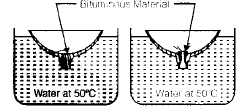
- Consistency of the materials for which penetration test and viscometer are not suitable is measured by float test.
- The test s pecimen is first cooled to a temperature of 0.5°C. The float assembly is floated in water bath at 50°C and the time required in seconds for water to force its way through the bitumen plug is noted as the float test value. Higher the float test value, the stiffer is the material.
5. Specific Gravity Test
- Specific gravity of pure bitumen is in the range of 0.97 to 1.02 where as Tars have specific gravity ranging from 1.10 to 1.25.
6. Softening Point Test
- Softening point is the temperature at which the substance attains a particular degree of softening : This test is called Ring and Ball test.
Generally higher softening point Indicate lower temperature
- Susceptibility and is pretered in warm climate.
- A steel ball is placed upon the bitumen sample in ring which is kept in liquid medium and then entire assembly is heated at a rate of 5°C per minute. The temperature at which ball passes the ring is noted.
- The softening point of various bitumen grades used in paving jobs vary between 35°C to 70°C.
7. Flash and Fire point Test
- Flash point : The flash point of a material is the lowest temperature at which the vapour of a substance momentarily takes fire in the form of a flash under specified condition of test.
- Fire Point : The fire point is the lowest temperature at which the material gets ignited and burns under specified conditions of test.
- Pensky-marten’s closed cup apparatus can be used for conducting these tests.
- The minimum specified flash point of bitumen used in pavement construction in Penskymartens closed type test is 175°C.
8.Solubility Test
- Pure bitumen is completely soluble in solvents like carbon disulphide and carbon tetra chloride. Insoluble material should be less than 1%.
- A material is said to be crakced if solubility is more than 0.5%. The minimum proportional of bitumen soluble in carbon disulphide is specified
9. Spot Test
- This test is conducted for detecting over heating or cracked bitumen.
- About 2 gm bitumen is dissolved in 10 ml of naptha. A drop of this solution is taken out and placed on a filter paper, if strain of the spot on the paper is uniform in colour, the bitumen is accepted as uncracked. The dark and brown circle in centre with an annular ring of lighter colour outside will represent over heated or cracked bitumen.
- This test is more sensitive than solubility test.
10. Loss on Heating Test
- Sample is hated at 163°C for 5 hours and loss of weight is expressed as % by weight.
- The loss in bitumen for pavement mixes should not exceed 1%. For bitumen of penetration values 150-200 up to 2% loss may be allowed.
- The heated residue should not have reduction in penetration values more than 40%.
11. Water Content Test
- The maximum water content in bitumen should not exceed 0.2% by weight.
Cutback Bitumen
- Cutback bitumen is defined as the bitumen, the viscosity of which has been reduced by a volatile diluent. These are of three types : 1. Rapid Curing (RC) 2. Medium Curing (MC) 3. Slow Curing (SC)
- The cutbacks are designated by numerical representing progressively thicker or viscous cutback. For example RC-2 is more thick than RC-1 but RC-2, and SC-2 have same viscosity.
- RC-0 and SC-0 may have 45% solvent and 55% bitument where as RC-5 and MC-5 may contain 15% solvent and 85% bitumen. RC-Cutback : eg., petroleum such as naptha or gasoline, have penetration value of 80 to 120.
MC-Cutback : eg., kerosene and light diesel oil They have good wetting properties
SC-cutback : These can be obtained by blending bitumen with high boiling point gas oil or by controlling the rate of flow and temperatures of crude during the first cylce of refining.
Various tests carried out of cut-back bitumen are :
(a) Viscosity tests at specified temperature using specified size of orifice.
(b) Distillation test to find distillation fractions, up to specified temperature and to find the residue from distilation up to 360°C.
(c) Penetration test, ductility test and test for water soluble in carbon disulphide on residue from distillation up to 360°C.
(d) Flash point test on cutback using Pensky Martens closed type apparatus.
Bituminous Emulsion
- A bitumen emulsion is liquid product in which a substantial amount of bitumen is suspended in a finely divided condition in an aqueous medium and stabilized by means of one or more suitable materials.
- Emulsion is a two phase system consisting two immiscible liquids.
- The bitumen/tar content in emulsion range from 40 to 60% and the remaining portion is water.
- The average diameter of globules of bitumen portion is about 2 mm.
- Emulsion are used especially in maintenance and patch repair works. The main advantage of emulsion is that is can be used in wet weather even when it is raining. Emulsions can be used for soil stabilization in deserts.
TAR
Tar can be produced in 3 stages
1. Carbonization of coal to produce crude tar.
2. Refining or distillation of crude tar.
3. Blending of distillation residue with distillate oil fraction to give desired road tar.
The various tests that are carried out on road tars are listed below :
(i) Specified gravity test
(ii) Viscosity test on standard tar viscometer
(iii) Equiviscous temperature (EVT)
(iv) Softening point
(v) Softening point of residue
(vi) Float test
(vii) Water content
(viii)Distillation fraction on distillation upto 200°C, 200°C to 270°C and 270°C to 330°C.
(ix) Phenols, percent by volume
(x) Naphthalene, percent by weight
(xi) Matter insoluble in toluene, percent by weight,
RT-1 has the lowest viscosity and is used for surface painting under exceptionally cold weather as this has very low viscosity. RT-2 is recommended for standard surface painting under normal Indian Climatic Conditions. RT-3 may be used for surface painting, renewal coasts and premixing chips for to course and light cerpets. RT-4 is generally used for premixing tar macadam in base course.
For grouting purposes RT-% may be adopted, which has the highest viscosity among the road tars.
COMPARISON OF TAR AND BITUMEN
- Bitumen is a petroleum product where as tar is produced by the destructive distillation of coal or wood.
- Bitumen is soluble in ‘carbon disulphide’ and ‘carbon tetra chloride’ but tar is soluble in only toluene.
- Bitumen is more resistant to water than tar.
- Tar is more temperature susceptible resulting in great variation in viscosity with temperature.
- The free carbon content is more in tar as seen from the solubility test.
|
2 videos|133 docs|55 tests
|
FAQs on Highway Materials - Civil Engineering SSC JE (Technical) - Civil Engineering (CE)
| 1. What are highway materials? |  |
| 2. What are the common types of aggregates used in highway construction? | |
| 3. What is the role of asphalt in highway construction? | |
| 4. How is concrete used in highway construction? | |
| 5. What are the factors to consider when selecting highway materials? | |





Important questions
,Sample Paper
,MCQs
,practice quizzes
,Semester Notes
,Objective type Questions
,shortcuts and tricks
,past year papers
,Summary
,mock tests for examination
,ppt
,video lectures
,study material
,Free
,Extra Questions
,Viva Questions
,Exam
,Previous Year Questions with Solutions
,Highway Materials | Civil Engineering SSC JE (Technical) - Civil Engineering (CE)
,Highway Materials | Civil Engineering SSC JE (Technical) - Civil Engineering (CE)
,Highway Materials | Civil Engineering SSC JE (Technical) - Civil Engineering (CE)
;



Highway Materials Free PDF Download
Importance of Highway Materials
Highway Materials Notes
Highway Materials Civil Engineering (CE) Questions
Study Highway Materials on the App
|
© EduRev
|
Education Revolution
|


|




