Class 9 Exam > Class 9 Notes > English Class 9 > NCERT Solutions - In the Kingdom of Fools
NCERT Solutions for Class 9 English Moments Chapter 4 - In the Kingdom of Fools

Q1. What are the two strange things the guru and his disciple find in the Kingdom of Fools?
Ans: The guru and his disciple noticed two unusual things in the Kingdom of Fools:
- People slept during the daytime and carried out their work and daily activities at night.
- All items were sold at the same price—one duddu (or one rupee), regardless of whether it was rice or bananas.
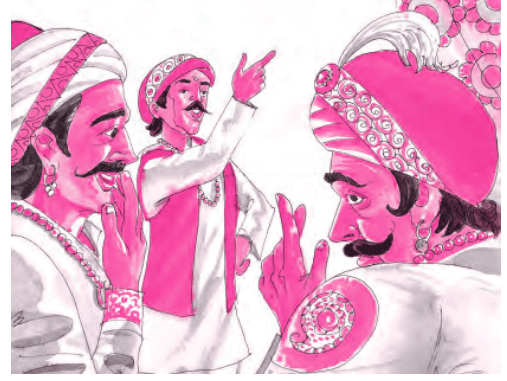
Q2. Why does the disciple decide to stay in the Kingdom of Fools? Is it a good idea?
Ans: The disciple wanted to stay in the Kingdom of Fools because everything was cheap. He liked the idea of eating tasty food at a low price.
But this was not a good idea. The guru had warned him that the people of the kingdom were foolish and no one could guess what they might do. He said such a place would not stay safe for long.
Q3. Name all the people who are tried in the king’s court, and give the reasons for their trial.
Ans: The king’s court put the merchant, the bricklayer, the dancing girl, and the goldsmith on trial. This happened because a thief died when the wall of the merchant’s house fell. The merchant was blamed for having a weak wall. The bricklayer was blamed for not building the wall properly. The dancing girl was blamed for distracting the bricklayer. The goldsmith was blamed because he made the dancing girl keep walking to his house many times.
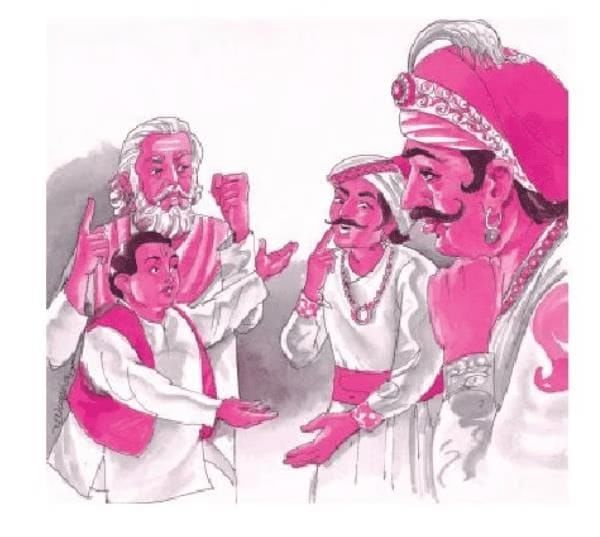
Q4. Who is the real culprit, according to the king? Why does he escape punishment?
Ans: The king said that the merchant’s dead father was at fault for building a weak wall. But he also believed that the rich merchant was truly guilty, as he had received both his father's wealth and his mistakes. However, the merchant was not punished because he was too thin to be tied to the stake.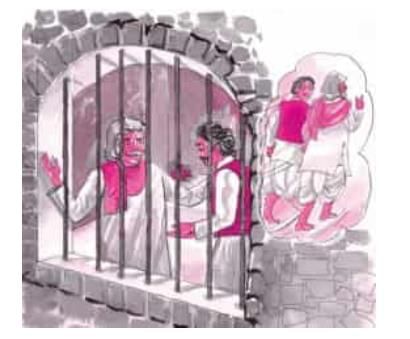
Q5. What are the Guru’s words of wisdom? When does the disciple remember them?
Ans: The Guru had warned, "This is a city of fools. You never know what they might do next."
The disciple remembered these words when he was ordered to be executed, even though he had done nothing wrong. He was chosen for execution just because he was fat enough to fit on the stake.
Q6. How does the guru manage to save his disciple’s life?
Ans: The Guru reached just in time to save his disciple and played a clever trick. He told the king that the stake was special and that the person who died first would be reborn as the next king. The one who died second would become the minister. The king didn’t want to miss this chance. So, he let the Guru and his disciple go. In this way, the Guru saved his disciple’s life.
The document NCERT Solutions for Class 9 English Moments Chapter 4 - In the Kingdom of Fools is a part of the Class 9 Course English Class 9.
All you need of Class 9 at this link: Class 9
|
180 videos|980 docs|124 tests
|
FAQs on NCERT Solutions for Class 9 English Moments Chapter 4 - In the Kingdom of Fools
| 1. What is the central theme of the story "In the Kingdom of Fools"? |  |
Ans. The central theme of the story "In the Kingdom of Fools" revolves around the consequences of foolishness and the importance of critical thinking and intelligence.
| 2. How does the protagonist end up in the Kingdom of Fools in the story? | |
Ans. The protagonist ends up in the Kingdom of Fools by following the advice of a stranger who tells him that everyone in that kingdom is a fool except for the king.
| 3. What lesson does the protagonist learn during his time in the Kingdom of Fools? | |
Ans. The protagonist learns the valuable lesson that blindly believing what others say without using his own judgment can lead to disastrous consequences.
| 4. How does the story "In the Kingdom of Fools" highlight the importance of intelligence and critical thinking? | |
Ans. The story highlights the importance of intelligence and critical thinking by showing how the protagonist's lack of these qualities causes him to make poor decisions and suffer the consequences.
| 5. What is the significance of the title "In the Kingdom of Fools" in relation to the story's message? | |
Ans. The title "In the Kingdom of Fools" symbolizes the idea that blindly following others without thinking for oneself can lead to foolish outcomes, underscoring the importance of independent thinking and intelligence.
About this Document

24.5K Views

4.69/5
Rating

Oct 21, 2025
Last updated
Document Description: NCERT Solutions - In the Kingdom of Fools for Class 9 2025 is part of English Class 9 preparation.
The notes and questions for NCERT Solutions - In the Kingdom of Fools have been prepared according to the Class 9 exam syllabus. Information about NCERT Solutions - In the Kingdom of Fools covers topics
like and NCERT Solutions - In the Kingdom of Fools Example, for Class 9 2025 Exam. Find important definitions, questions, notes, meanings, examples, exercises and tests below for NCERT Solutions - In the Kingdom of Fools.
Introduction of NCERT Solutions - In the Kingdom of Fools in English is available as part of our English Class 9
for Class 9 & NCERT Solutions - In the Kingdom of Fools in Hindi for English Class 9 course.
Download more important topics related with notes, lectures and mock test series for Class 9
Exam by signing up for free. Class 9: NCERT Solutions for Class 9 English Moments Chapter 4 - In the Kingdom of Fools
Description
Full syllabus notes, lecture & questions for NCERT Solutions for Class 9 English Moments Chapter 4 - In the Kingdom of Fools - Class 9 | Plus excerises question with solution to help you revise complete syllabus for English Class 9 | Best notes, free PDF download
Information about NCERT Solutions - In the Kingdom of Fools
In this doc you can find the meaning of NCERT Solutions - In the Kingdom of Fools defined & explained in the simplest way possible. Besides explaining types of
NCERT Solutions - In the Kingdom of Fools theory, EduRev gives you an ample number of questions to practice NCERT Solutions - In the Kingdom of Fools tests, examples and also practice Class 9
tests


Related Searches
NCERT Solutions for Class 9 English Moments Chapter 4 - In the Kingdom of Fools
,Free
,Sample Paper
,past year papers
,Summary
,mock tests for examination
,study material
,practice quizzes
,NCERT Solutions for Class 9 English Moments Chapter 4 - In the Kingdom of Fools
,MCQs
,Important questions
,video lectures
,ppt
,Extra Questions
,Viva Questions
,Exam
,shortcuts and tricks
,Previous Year Questions with Solutions
,NCERT Solutions for Class 9 English Moments Chapter 4 - In the Kingdom of Fools
,Semester Notes
,Objective type Questions
;



Additional Information about NCERT Solutions - In the Kingdom of Fools for Class 9 Preparation
NCERT Solutions - In the Kingdom of Fools Free PDF Download
The NCERT Solutions - In the Kingdom of Fools is an invaluable resource that delves deep into the core of the Class 9 exam.
These study notes are curated by experts and cover all the essential topics and concepts, making your preparation more efficient and effective.
With the help of these notes, you can grasp complex subjects quickly, revise important points easily,
and reinforce your understanding of key concepts. The study notes are presented in a concise and easy-to-understand manner,
allowing you to optimize your learning process. Whether you're looking for best-recommended books, sample papers, study material,
or toppers' notes, this PDF has got you covered. Download the NCERT Solutions - In the Kingdom of Fools now and kickstart your journey towards success in the Class 9 exam.
Importance of NCERT Solutions - In the Kingdom of Fools
The importance of NCERT Solutions - In the Kingdom of Fools cannot be overstated, especially for Class 9 aspirants.
This document holds the key to success in the Class 9 exam.
It offers a detailed understanding of the concept, providing invaluable insights into the topic.
By knowing the concepts well in advance, students can plan their preparation effectively.
Utilize this indispensable guide for a well-rounded preparation and achieve your desired results.
NCERT Solutions - In the Kingdom of Fools Notes
NCERT Solutions - In the Kingdom of Fools Notes offer in-depth insights into the specific topic to help you master it with ease.
This comprehensive document covers all aspects related to NCERT Solutions - In the Kingdom of Fools.
It includes detailed information about the exam syllabus, recommended books, and study materials for a well-rounded preparation.
Practice papers and question papers enable you to assess your progress effectively.
Additionally, the paper analysis provides valuable tips for tackling the exam strategically.
Access to Toppers' notes gives you an edge in understanding complex concepts.
Whether you're a beginner or aiming for advanced proficiency, NCERT Solutions - In the Kingdom of Fools Notes on EduRev are your ultimate resource for success.
NCERT Solutions - In the Kingdom of Fools Class 9 Questions
The "NCERT Solutions - In the Kingdom of Fools Class 9 Questions" guide is a valuable resource for all aspiring students preparing for the
Class 9 exam. It focuses on providing a wide range of practice questions to help students gauge
their understanding of the exam topics. These questions cover the entire syllabus, ensuring comprehensive preparation.
The guide includes previous years' question papers for students to familiarize themselves with the exam's format and difficulty level.
Additionally, it offers subject-specific question banks, allowing students to focus on weak areas and improve their performance.
Study NCERT Solutions - In the Kingdom of Fools on the App
Students of Class 9 can study NCERT Solutions - In the Kingdom of Fools alongwith tests & analysis from the EduRev app,
which will help them while preparing for their exam. Apart from the NCERT Solutions - In the Kingdom of Fools,
students can also utilize the EduRev App for other study materials such as previous year question papers, syllabus, important questions, etc.
The EduRev App will make your learning easier as you can access it from anywhere you want.
The content of NCERT Solutions - In the Kingdom of Fools is prepared as per the latest Class 9 syllabus.
|
© EduRev
|
Education Revolution
|


|




Signup on EduRev and stay on top of your study goals
10M+ students crushing their study goals daily