Alphabet - 2

Alphabet (Part 2) - Reasoning for CLAT 2018 Preparation
Rule 7: Relative Distance Between Pairs Of Letters
What this rule tests: Find pairs of letters in a given word that have the same number of letters between them as those two letters have in the English alphabet.
Method: For short words you can inspect visually. For longer words it is faster and less error-prone to write the letter positions (place values) of each letter in the word and then compare differences.
Example (simple): In the word arc, the letters a and c have one letter (r) between them in the word. In the alphabet, a and c also have one letter (b) between them. Hence the pair a-c is counted (one such pair).
Tip: If you find it convenient, write the alphabet-place numbers (a=1, b=2, ... z=26) under the letters of the word and check absolute differences between positions in the word and compare with absolute differences of their alphabet place values.
Now practice on a longer word where writing place values helps:
In the word SUPERSONIC there are ten letters. Writing their place values helps to locate matching relative distances.
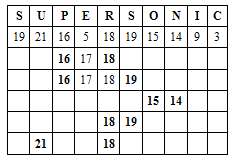
Using the place values you can check all pairs; in this word there are five such pairs of letters that have the same relative distance in the word as in the alphabet.
More worked examples
Ex 42: How many such pairs of letters are there in the word BRIGHTER which have as many letters between them in the word as in the English alphabet?
Ans 42:
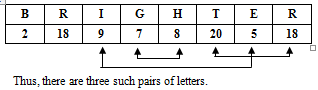
Thus, there are three such pairs of letters.
Ex 43: How many such pairs of letters are there in the word DABBLE each of which has as many letters between them in the word as in the English alphabet?
Ans 43:
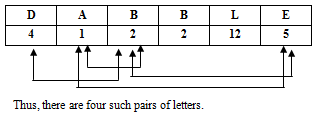
Thus, there are four such pairs of letters.
Ex 44: How many such pairs of letters are there in the word PENCIL each of which has as many letters between them as in the alphabet?
Ans 44:
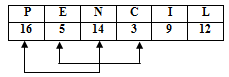
Thus, there are two such pairs of letters.
Ex 45: How many such pairs of letters are there in the word ADEQUATELY each of which has as many letters between them in the word as in the English alphabet?
Ans 45:
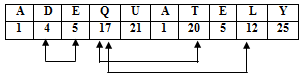
Thus, there are three such pairs of letters.
Ex 46: How many such pairs of letters are there in the word SURPRISE each of which has as many letters between them in the word as in the English alphabet?
Ans:
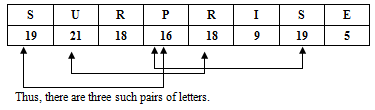
Thus, there are three such pairs of letters.
Rule 8: New Word Formation
What this rule tests: Form meaningful words using specified letters (positions) from a given key word. Each letter may be used only once. These questions check vocabulary and quick anagramming ability.
Approach: Identify the specified positions, write down those letters, then list or mentally try all meaningful permutations. If only one meaningful word can be formed, supply its required letter (as asked). If more than one meaningful word is possible, answer according to the instruction (often mark a special option 'M'), and if no meaningful word is possible mark the special option for 'no word' (often 'X' or 'N' depending on the question).
Practice examples (preserve questions and answers exactly):
Ex 47: If it is possible to make only one meaningful word with the Second, the five, and the eight letters of the word "CARETAKER", which of the following will be the first letter of that word? If more than one such word can be made, give 'M' as the answer and if no such word can be made, give 'X' as the answer.
(1) I
(2) N
(3) X
(4) M
Ans (4)
Solution:
| 1 | 2 | 3 | 4 | 5 | 6 | 7 | 8 | 9 |
| C | A | R | E | T | A | K | E | R |
The 2nd, 5th, and the 8th letters of this word are A, T and E and following words can be formed from these letters:
| Meaningful word ⇒ | EAT |
| Meaningful word ⇒ | TEA |
| Meaningful word ⇒ | ATE |
| More than one word are formed so the answer as per the choice given is 'M' | |
Ex 48: If it is possible to make only one meaningful word with the second, the fifth, and the eight and tenth letters of the word "SPONTANEOUS", which of the following will be the first letter of that word? If more than one such word can be made, give 'M' as the answer and if no such word can be made, give 'X' as the answer.
(1) S
(2) O
(3) M
(4) X
Ans (4)
Solution:
| 1 | 2 | 3 | 4 | 5 | 6 | 7 | 8 | 9 | 10 | 11 |
| S | P | O | N | T | A | N | E | O | U | S |
The 2nd, 5th, 8th and the 10th letters are 'P, T, E and U'. It is not possible to make any meaningful word from these letters, so the answer here is 'X'.
Ex 49: If it is possible to make a meaningful word with the fourth, the seventh, the eleventh and the thirteen letters of the word CATEGORISATION, which of the following will be the second letter of that word? If more than one such word can be formed, give 'M' as the answer and if no such word can be formed give 'X' as the answer.
(1) T
(2) R
(3) X
(4) M
Ans (4)
| 1 | 2 | 3 | 4 | 5 | 6 | 7 | 8 | 9 | 10 | 11 | 12 | 13 | 14 |
| C | A | T | E | G | O | R | I | S | A | T | I | O | N |
The letters as per the question are 'E, R, T and O'.
| Meaningful word ⇒ | T | O | R | E |
| Meaningful word ⇒ | R | O | T | E |
| Because more than one word is formed from these four letters, the answer as per option is 'M'. | ||||
Ex 50: If it is possible to make a meaningful word from the first, the forth, the five and the ninth letters of the word "INTERPRETATION", last letter of the word is your answer. If more than one such word can be formed, give 'M' as your answer and if no such word can be formed give 'N' as your answer.
(1) I
(2) N
(3) N
(4) M
Ans (4)
| 1 | 2 | 3 | 4 | 5 | 6 | 7 | 8 | 9 | 10 | 11 | 12 | 13 |
| I | N | T | E | R | P | R | E | T | A | T | I | O |
Specified letters ⇒ I, E, R, T
Ex 51: If it is possible to make a meaningful word with the second, third, fifth and twelfth letters of the word METROPOLITAN, using each letter only once, then what is the last letter of that word? It more than one such word can be formed mark 'M' as the answer and it no such word can be formed mark 'X' as the answer.
(1) O
(2) E
(3) X
(4) M
Ans (4)
Solution :
| Meaningful word ⇒ | T | I | E | R |
| Meaningful word ⇒ | R | I | T | E |
| Meaningful word ⇒ | T | I | R | E |
| More than one word is formed, so the answer is 'N' | ||||
| 1 | 2 | 3 | 4 | 5 | 6 | 7 | 8 | 9 | 10 | 11 | 12 |
| M | E | T | R | O | P | O | L | I | T | A | N |
Specified letters ⇒ E, T, O, N
| Meaningful word ⇒ | N | O | T | E |
| Meaningful word ⇒ | T | O | N | E |
| More than one word is formed, so the answer is 'M'. | ||||
Rule 9: Interchange Position Of Alphabet
What this rule tests: Rearranging letters of a word by reversing blocks, interchanging fixed positions, or swapping adjacent pairs, then answering positional questions (e.g., which letter is nth from left/right after the change).
Strategy: Carefully follow the instruction for re-ordering. Draw the original word as a sequence, perform the specified swaps or reversals, then read off the required position. Where many positions change, writing the entire final arrangement is safer.
Ex 52: If the new word is formed such as the new word starts with last four letters of the word CONCENTRATION written in reverse order followed by next two in reverse order, then the next three in reverse order and then followed by first four in the reverse order, which letter would be eighth from the right end?
| C | O | N | C | E | N | T | R | A | T | I | O | N |
| N | O | I | T | A | R | T | N | E | C | N | O | C |
It is clear from the diagram that R is at 8th position from the right end.
Ex 53: If the 1 & 3, 2 & 4, 5 & 7, 6 & 8 letters of the word PLEASURE are interchanged in the word , which will be second from right?
Solution : There are eight letters in the word 'PLEASURE' and the second letter from right will be 7th letter from left side. The 7th letter is getting exchanged with the 5th letter, so the 5th letter 'S' will now occupy the place at present occupied by R.
| P | L | E | A | S | U | R | E |
| E | A | P | L | R | E | S | U |
It is clear from diagram that 2nd from the right is S.
Ex 54: If the first and second letters of the word 'DEPRESSION' were interchanged, also the third and fourth letters the fifth and the sixth letters and so on, which of the following would be the seventh letter from the right?
Solution: There are eleven letters in the word and the seventh from right will be fifth from left. The fifth letter is getting exchanged with the fourth letter; the letter occupying the fifth position in the final arrangement will be the original fourth letter P. So the letter P will occupy the seventh place from the right side.
| D | E | P | R | E | S | S | I | O | N |
| E | D | R | P | S | E | I | S | N | O |
Ex 55: If position of 5th & 12th, 4th & 14th, 3rd & 10th, 2nd & 11th, 1st & 13th of the word "GLORIFICATIONS" are interchanged. What will be 12th letter from right end?
Sol. We want the position 12th from right end. There are fourteen letters in this word, so the 12th letter from right means 15 - 12 = 3rd from left side.
But 3rd letter is interchanged with 10th letter so the answer is 'T'.
Ex 56: In the word, "GLORIFICATIONS", if the first letter is changed with last letter, second letter with second last and so on. Which letter will come after T in the new arrangement?
Sol: After T, comes 'A'. The result of these changes will be that the whole sequence of letters is reversed. So, now A will come after 'T' in that reversed arrangement.
FAQs on Alphabet - 2
| 1. What is the rule of relative distance between pairs of letters in the context of alphabet reasoning for CLAT 2018 preparation? |  |
| 2. How does new word formation relate to alphabet reasoning in CLAT 2018 preparation? | |
| 3. What does it mean to interchange the position of the alphabet in alphabet reasoning for CLAT 2018 preparation? | |
| 4. How can the rule of relative distance between pairs of letters be applied in solving alphabet reasoning questions for CLAT 2018 preparation? | |
| 5. Can you provide an example of a question that involves the rule of new word formation in alphabet reasoning for CLAT 2018 preparation? | |