NEET Exam > NEET Notes > Chemistry Class 11 > Nomenclature of Elements with Atomic Number > 100
Nomenclature of Elements with Atomic Number > 100 | Chemistry Class 11 - NEET PDF Download
| Table of contents |

|
| Elements with Atomic Number > 100 (IUPAC) |
|
| Notation for IUPAC nomenclature of elements. |
|
| Nomenclature of Elements |
|
|
|

Elements with Atomic Number > 100 (IUPAC)
According to IUPAC, elements with atomic number > 100 are represented by three latter symbols.
- These symbols are based on the first letter of numbers from 0 to 9. The names of these numbers are derived from Greek and Latin languages.
- The Latin words for various digits of the atomic number are written together in the order of which makes the atomic number and suffix 'ium' is added at the end. In case of bi and tri one 'i' is omitted.
Notation for IUPAC nomenclature of elements.
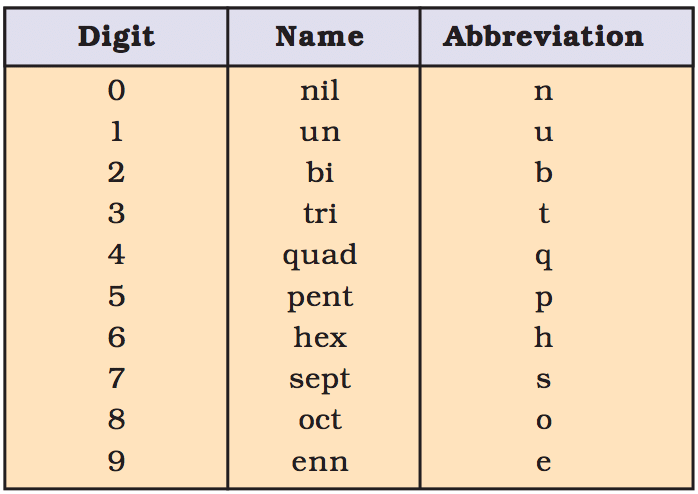
Nomenclature of Elements
Atomic Number | Name | Symbol | IUPAC Official Name | IUPAC Symbol |
104 | Unnilquadium | Unq | Rutherfordium | Rf |
105 | Unnilpentium | Unp | Dubnium | Db |
106 | Unnilhexium | Unh | Seaborgium | Sg |
107 | Unnilseptium | Uns | Bohrium | Bh |
108 | Unniloctium | Uno | Hassnium | Hs |
109 | Unnilennium | Une | Meitnerium | Mt |
110 | Ununnilium | Uun | Darmstadtium | Ds |
111 | Ununnium | Uuu | * | * |
112 | Ununbium | Uub | * | * |
113 | Ununtrium | Uut | + | |
114 | Ununquadium | Uuq | * | * |
115 | Ununpentium | Uup | + | |
116 | Ununhexium | Uuh | + | |
117 | Ununseptium | Uus | + | |
118 | Ununoctium | Uuo | + |
- Official IUPAC name yet to be announced + Elements yet to be discovered
- IUPAC recommended this nomenclature to be followed until their names are officially recognised.
The document Nomenclature of Elements with Atomic Number > 100 | Chemistry Class 11 - NEET is a part of the NEET Course Chemistry Class 11.
All you need of NEET at this link: NEET
|
114 videos|263 docs|74 tests
|
FAQs on Nomenclature of Elements with Atomic Number > 100 - Chemistry Class 11 - NEET
| 1. What is the IUPAC nomenclature for elements with atomic number greater than 100? |  |
Ans. The IUPAC nomenclature for elements with atomic number greater than 100 is based on a systematic naming system where the element is named using its atomic number as a prefix followed by the suffix "-ium". For example, element 101 is named "unnilunium" and element 102 is named "unnilbium".
| 2. How many elements with atomic number greater than 100 have been discovered so far? | |
Ans. As of now, a total of six elements with atomic number greater than 100 have been discovered. These elements are 101- Mendeleevium (Md), 102- Nobelium (No), 103- Lawrencium (Lr), 104- Rutherfordium (Rf), 105- Dubnium (Db), and 106- Seaborgium (Sg).
| 3. Who is responsible for assigning names to elements with atomic number greater than 100? | |
Ans. The International Union of Pure and Applied Chemistry (IUPAC) is responsible for assigning names to elements with atomic number greater than 100. They follow a systematic approach to ensure consistency and uniformity in the nomenclature of elements.
| 4. What are the criteria for naming elements with atomic number greater than 100? | |
Ans. The criteria for naming elements with atomic number greater than 100 include using the element's atomic number as a prefix, followed by the suffix "-ium". The names should be unique and not conflicting with any existing names or symbols. The names are also subjected to approval by the IUPAC.
| 5. Can the names of elements with atomic number greater than 100 be changed in the future? | |
Ans. Yes, the names of elements with atomic number greater than 100 can be changed in the future. The IUPAC periodically reviews and reevaluates the names of elements, and if necessary, they can propose changes to ensure accuracy and consistency in the nomenclature. However, any proposed changes would go through a thorough scientific and public scrutiny process before being officially adopted.
About this Document

3.6K Views

4.73/5
Rating

Oct 11, 2025
Last updated
Document Description: Nomenclature of Elements with Atomic Number > 100 for NEET 2025 is part of Chemistry Class 11 preparation.
The notes and questions for Nomenclature of Elements with Atomic Number > 100 have been prepared according to the NEET exam syllabus. Information about Nomenclature of Elements with Atomic Number > 100 covers topics
like Elements with Atomic Number > 100 (IUPAC), Notation for IUPAC nomenclature of elements., Nomenclature of Elements, and Nomenclature of Elements with Atomic Number > 100 Example, for NEET 2025 Exam. Find important definitions, questions, notes, meanings, examples, exercises and tests below for Nomenclature of Elements with Atomic Number > 100.
Introduction of Nomenclature of Elements with Atomic Number > 100 in English is available as part of our Chemistry Class 11
for NEET & Nomenclature of Elements with Atomic Number > 100 in Hindi for Chemistry Class 11 course.
Download more important topics related with notes, lectures and mock test series for NEET
Exam by signing up for free. NEET: Nomenclature of Elements with Atomic Number > 100 | Chemistry Class 11 - NEET
Description
Full syllabus notes, lecture & questions for Nomenclature of Elements with Atomic Number > 100 | Chemistry Class 11 - NEET - NEET | Plus excerises question with solution to help you revise complete syllabus for Chemistry Class 11 | Best notes, free PDF download
Information about Nomenclature of Elements with Atomic Number > 100
In this doc you can find the meaning of Nomenclature of Elements with Atomic Number > 100 defined & explained in the simplest way possible. Besides explaining types of
Nomenclature of Elements with Atomic Number > 100 theory, EduRev gives you an ample number of questions to practice Nomenclature of Elements with Atomic Number > 100 tests, examples and also practice NEET
tests

Related Searches
shortcuts and tricks
,MCQs
,study material
,practice quizzes
,Extra Questions
,ppt
,Nomenclature of Elements with Atomic Number > 100 | Chemistry Class 11 - NEET
,Free
,Sample Paper
,video lectures
,Exam
,Nomenclature of Elements with Atomic Number > 100 | Chemistry Class 11 - NEET
,Summary
,past year papers
,Important questions
,Objective type Questions
,Semester Notes
,Nomenclature of Elements with Atomic Number > 100 | Chemistry Class 11 - NEET
,Previous Year Questions with Solutions
,mock tests for examination
,Viva Questions
;




Additional Information about Nomenclature of Elements with Atomic Number > 100 for NEET Preparation
Nomenclature of Elements with Atomic Number > 100 Free PDF Download
The Nomenclature of Elements with Atomic Number > 100 is an invaluable resource that delves deep into the core of the NEET exam.
These study notes are curated by experts and cover all the essential topics and concepts, making your preparation more efficient and effective.
With the help of these notes, you can grasp complex subjects quickly, revise important points easily,
and reinforce your understanding of key concepts. The study notes are presented in a concise and easy-to-understand manner,
allowing you to optimize your learning process. Whether you're looking for best-recommended books, sample papers, study material,
or toppers' notes, this PDF has got you covered. Download the Nomenclature of Elements with Atomic Number > 100 now and kickstart your journey towards success in the NEET exam.
Importance of Nomenclature of Elements with Atomic Number > 100
The importance of Nomenclature of Elements with Atomic Number > 100 cannot be overstated, especially for NEET aspirants.
This document holds the key to success in the NEET exam.
It offers a detailed understanding of the concept, providing invaluable insights into the topic.
By knowing the concepts well in advance, students can plan their preparation effectively.
Utilize this indispensable guide for a well-rounded preparation and achieve your desired results.
Nomenclature of Elements with Atomic Number > 100 Notes
Nomenclature of Elements with Atomic Number > 100 Notes offer in-depth insights into the specific topic to help you master it with ease.
This comprehensive document covers all aspects related to Nomenclature of Elements with Atomic Number > 100.
It includes detailed information about the exam syllabus, recommended books, and study materials for a well-rounded preparation.
Practice papers and question papers enable you to assess your progress effectively.
Additionally, the paper analysis provides valuable tips for tackling the exam strategically.
Access to Toppers' notes gives you an edge in understanding complex concepts.
Whether you're a beginner or aiming for advanced proficiency, Nomenclature of Elements with Atomic Number > 100 Notes on EduRev are your ultimate resource for success.
Nomenclature of Elements with Atomic Number > 100 NEET Questions
The "Nomenclature of Elements with Atomic Number > 100 NEET Questions" guide is a valuable resource for all aspiring students preparing for the
NEET exam. It focuses on providing a wide range of practice questions to help students gauge
their understanding of the exam topics. These questions cover the entire syllabus, ensuring comprehensive preparation.
The guide includes previous years' question papers for students to familiarize themselves with the exam's format and difficulty level.
Additionally, it offers subject-specific question banks, allowing students to focus on weak areas and improve their performance.
Study Nomenclature of Elements with Atomic Number > 100 on the App
Students of NEET can study Nomenclature of Elements with Atomic Number > 100 alongwith tests & analysis from the EduRev app,
which will help them while preparing for their exam. Apart from the Nomenclature of Elements with Atomic Number > 100,
students can also utilize the EduRev App for other study materials such as previous year question papers, syllabus, important questions, etc.
The EduRev App will make your learning easier as you can access it from anywhere you want.
The content of Nomenclature of Elements with Atomic Number > 100 is prepared as per the latest NEET syllabus.
|
© EduRev
|
Education Revolution
|


|




Signup to see your scores
go up within 7 days!
Access 1000+ FREE Docs, Videos and Tests
Takes less than 10 seconds to signup