Integration of Irrational Functions | Mathematics (Maths) for JEE Main & Advanced PDF Download
| Table of contents |

|
| Definition |
|
| Solved Examples |
|
| Integrals of the type where x & y are linear or quadratic expressions |
|
| Integration Of A Binomial Differential |
|

Definition
Certain types of integrals of algebraic irrational expressions can be reduced to integrals of rational functions by a appropriate change of the variable. Such transformation of an integral is called its rationalization.
- If the integrand is a rational function of fractional powers of an independent variable x, i.e. the function R
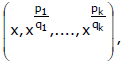 then the integral can be rationalized by the substitution x = tm, where m is the least common multiple of the numbers q1, q2, ...., qk.
 - If the integrand is a rational function of x and fractional powers of a linear fractional function of the form
 then rationalization of the integral is effected by the substitution
  where m has the same sense as above.
Solved Examples
Ex.1 Evaluate 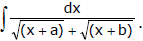
Sol.
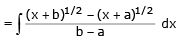
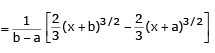
Rationalizing the denominator, we have 

Ex.2 Evaluate I = 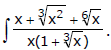
Sol. The least common multiple of the numbers 3 and 6 is 6, therefore we make the substitution
x = t6, dx = 6t5 dt.


Ex.3 Evaluate I = 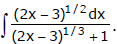
Sol. The integrand is a rational function of  therefore we put 2x – 3 = t6, whence


Returning to x, we get
Ex.4 Evaluate 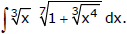
Sol.
Let x = t3 ⇒ dx = 3t2 then


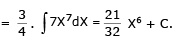

Ex.5 Evaluate I = 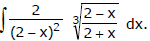
Sol. The integrand is a rational function of x and the expression  therefore let us introduce the substitution




Integrals of the type  where x & y are linear or quadratic expressions
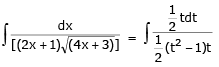
Ex.1 Integrate 
Sol.
Put 4x + 3 = t2, so that 4dx = 2tdt and (2x + 1) 

Ex.2 Evaluate 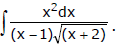
Sol.
Put (x + 2) = t2, so that dx = 2t dt, Also x = t2 – 2.
∴ 
 dividing the numerator by the denominator


Ex.3 Integrate 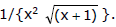
Sol.
Put (x + 1) = t2, so that dx = 2t dt. Also x = t2 – 1.






Ex.4 Integrate 
Sol.
Put (1 + x) = 1/t, so that dx = – (1/t2) dx.
Also x = (1/t) – 1.




Ex.5 Evaluate 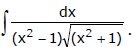
Sol.
Put x = 1/t, so that dx = – (1/t2) dt.
∴ 
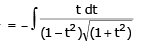
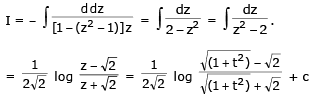
Now put 1 + t2 = z2 so that t dt = z dz. Then
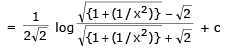
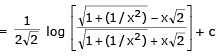 [∵ t = 1/x]
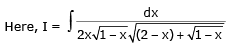
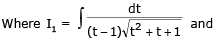
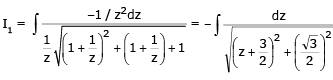
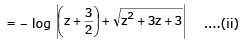
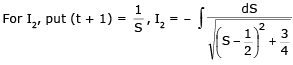
Ex.6 Evaluate I = 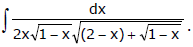
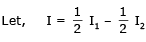
Sol.








Integration Of A Binomial Differential
The integral 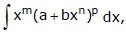 where m, n, p are rational numbers, is expressed through elementary functions only in the following three cases :
Case I : p is an integer. Then, if p > 0, the integrand is expanded by the formula of the binomial; but if p < 0, then we put x = tk, where k is the common denominator of the fractions and n.
Case II : is an integer. We put a + bxn = tα, where α is the denominator of the fraction p.
Case III : + p is an integer we put a + bxn = tαxn, where a is the denominator of the fraction p.
Ex.1 Evaluate I = 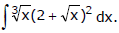
Sol.
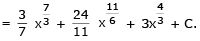
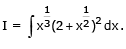 Here p = 2, i.e. an integer, hence we have case I.

Ex.2 Evaluate I = 
Sol. 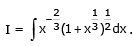
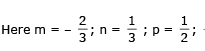
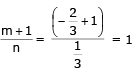
i.e. an integer.we have case II. Let us make the substitution. Hence , 
Ex.3 Evaluate I = 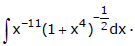
Sol.
Here p = – 1/2 is a fraction, m+1/2 = -5/2 also a fraction, but m+1/n + p/2 = -5/2 -1/2 = -3 is an integer, i.e. we have case III, we put 1 + x4 = x4/2,
Hence 
Substituting these expression into the integral, we obtain
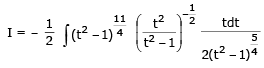

Returning to x, we get I = 
|
172 videos|476 docs|154 tests
|
FAQs on Integration of Irrational Functions - Mathematics (Maths) for JEE Main & Advanced
| 1. What are binomial differentials? |  |
| 2. How do you integrate a binomial differential? | |
| 3. What are some examples of integrating binomial differentials? | |
| 4. Are there any special cases when integrating binomial differentials? | |
| 5. Can binomial differentials involve irrational functions? | |




MCQs
,Previous Year Questions with Solutions
,Extra Questions
,Objective type Questions
,Summary
,Integration of Irrational Functions | Mathematics (Maths) for JEE Main & Advanced
,mock tests for examination
,study material
,Viva Questions
,Important questions
,Sample Paper
,ppt
,Integration of Irrational Functions | Mathematics (Maths) for JEE Main & Advanced
,Free
,practice quizzes
,Exam
,shortcuts and tricks
,Semester Notes
,video lectures
,Integration of Irrational Functions | Mathematics (Maths) for JEE Main & Advanced
,past year papers
;




Integration of Irrational Functions Free PDF Download
Importance of Integration of Irrational Functions
Integration of Irrational Functions Notes
Integration of Irrational Functions JEE Questions
Study Integration of Irrational Functions on the App
|
© EduRev
|
Education Revolution
|


|




within 7 days!