Binomial Theorem and Important Terms of Binomial Expansion

Binomial Theorem
A. Binomial Theorem
The Binomial Theorem gives a formula to expand any positive integral power of a binomial expression into a sum of terms involving binomial coefficients.

The expansion of (x + y)n is
(x + y)n = nC0 xn + nC1 xn-1 y + nC2 xn-2 y2 + ··· + nCr xn-r yr + ··· + nCn yn

The theorem can be proved by mathematical induction on n. The coefficients nCr are the binomial coefficients, defined by
nCr = n! / (r! (n - r)!), for 0 ≤ r ≤ n.
Observations :
- The number of terms in the expansion is (n + 1), i.e. one more than the exponent n.
- The sum of the exponents of x and y in each term is n.
- Binomial coefficients equidistant from the beginning and the end are equal: nCr = nCn-r.
Example 1
Ex.1 The value of

Sol.
The numerator is of the form a3 + b3 + 3ab(a + b) = (a + b)3, where a = 18 and b = 7.

Numerator = (18 + 7)3 = 253.
The denominator can be written as

= (3 + 2)6 = 56 = 253.
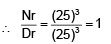
Therefore the value is 1.
B. IMPORTANT TERMS IN THE BINOMIAL EXPANSION
(a) General term
The general term or the (r + 1)th term in the expansion of (x + y)n is
Tr+1 = nCr xn-r yr, for r = 0, 1, 2, ..., n.
Example 2
Ex.2 Find : (a) The coefficient of x7 in the expansion of

(b) The coefficient of x-7 in the expansion of

Also, find the relation between a and b, so that these coefficients are equal.
Sol.
(a) Consider the expansion of
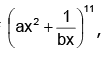
The general term is

Equate the exponent of x to 7: 22 - 3r = 7.
3r = 15.
r = 5.
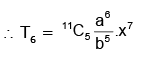
Hence the coefficient of
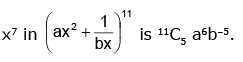
(b) Consider the expansion of

The general term is

Equate the exponent of x to -7: 11 - 3r = -7.
3r = 18.
r = 6.
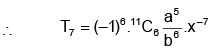
Hence the coefficient of
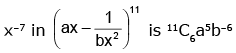
Also given coefficient of
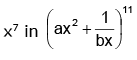
= coefficient of
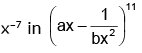

Therefore ab = 1 (since 11C5 = 11C6), which is the required relation between a and b.
Hence the coefficient of x-7 in
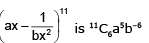
Also given coefficient of x7 in

11C5 a6 b-5 = 11C6 a5 b-6.
Therefore ab = 1 (because 11C5 = 11C6), as required.
Example 3
Ex.3 Find the number of rational terms in the expansion of (91/4 + 81/6)1000.
Sol.
The general term in the expansion of (91/4 + 81/6)1000 is

The general term is rational when the exponents of prime factors (3 and 2) are integers.
The exponent of 3 in the term is 1000 - r/2.
The exponent of 2 in the term is r/2.
Both 1000 - r/2 and r/2 must be integers, so r must be even.
The possible values of r are {0, 2, 4, ..., 1000}.
Hence the number of rational terms is 1000/2 + 1 = 501.
(b) Middle term
The middle term(s) in the expansion of (x + y)n are:
- If n is even, there is one middle term: T(n+2)/2 = nCn/2 xn/2 yn/2.
- If n is odd, there are two middle terms: T(n+1)/2 and T(n+3)/2.
Example 4
Ex.4 Find the middle term in the expansion of

Sol.
The number of terms in the expansion of
is 10 (even). So there are two middle terms.
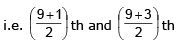
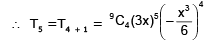
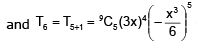
The two middle terms are T5 and T6.


(c) Term independent of x
The term independent of x (constant term) is the term in which the exponent of x is zero. To find it, equate the exponent of x in the general term to zero and solve for r.
Example 5
Ex.5 The term independent of x in
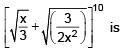
Sol.
The general term in the expansion is
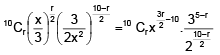
For a constant term we require 3r/2 = 10.
r = 20/3, which is not an integer.
Therefore there is no constant term in this expansion.
(d) Numerically greatest term
To find the numerically greatest term in the expansion of (x + a)n for a given x, compare successive terms Tr and Tr+1 using the ratio Tr+1 / Tr. If this ratio > 1 then Tr+1 > Tr; if < 1 then Tr > Tr+1. Use this comparison to find the index r for which the term is maximum.
Let Tr and Tr+1 be consecutive terms in the expansion of (1 + a/x)n (or after factoring out common powers). One derives an inequality for r and locates the greatest term.
If r is a positive integer m and a fraction f such that 0 < f < 1 and r < m + f, then Tm+1 is the greatest term. If r < m (i.e. integer), then Tm and Tm+1 may both be greatest and equal.
Example 6
Ex.6 Find numerically the greatest term in the expansion of (3 - 5x)11 when x = 1/5
Sol.
Since
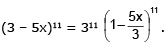
We compute the ratio of successive terms and find the range of r for which terms increase and then decrease:
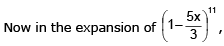



Thus the greatest terms occur for r = 2 and r = 3, i.e. T3 and T4.
The greatest term when r = 2 is:

The greatest term when r = 3 is:
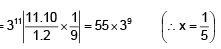

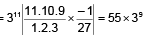
Both greatest terms have equal numerical values.
C. A USEFUL RESULT FOR (√A + B)n
Let (√A + B)n = I + f, where I is an integer part and f is the fractional part with 0 < f < 1.
If n is odd and I and n are positive integers, then (I + f) f = Kn, where A - B2 = K > 0 and A - B < 1.
If n is even, then (I + f)(1 - f) = Kn.
Example 7
Ex.7 If (6√6 + 14)2n+1 = [N] + F and F = N - [N] ; where [*] denotes greatest integer, then NF is equal to
Sol.
Since (6√6 + 14)2n+1 = [N] + F, let us assume that f = (6√6 - 14)2n+1, where 0 ≤ f < 1.


[N] + F - f is an even integer.
Now 0 < F < 1 and 0 < f < 1 so -1 < F - f < 1 and F - f is an integer; hence F - f = 0.
Thus
NF = (6√6 + 14)2n+1 (6√6 - 14)2n+1 = 202n+1.
This completes the evaluation of NF.
Summary
The Binomial Theorem provides a systematic way to expand (x + y)n and identify specific terms: the general term, middle term(s), constant term, and numerically greatest term. Use binomial coefficients nCr, check exponents for integrality when powers are fractional, and compare successive terms to find maxima. The examples illustrate extraction of coefficients, counting rational terms, locating middle and constant terms, and special identities involving conjugate expressions.
FAQs on Binomial Theorem and Important Terms of Binomial Expansion
| 1. What is the Binomial Theorem? |  |
| 2. What are the important terms used in binomial expansion? | |
| 3. How can the Binomial Theorem be applied to expand binomial expressions? | |
| 4. What is the significance of the Binomial Theorem in mathematics? | |
| 5. Can the Binomial Theorem be used for negative exponents? | |