Inheritance of Two Genes, Polygenic Inheritance & Pleiotropy | Biology Class 12 - NEET PDF Download
| Table of contents |

|
| Introduction of Inheritance of Two Genes |
|
| Law of Independent Assortment |
|
| Chromosomal Theory of Inheritance |
|
| Linkage |
|
| What is Polygenic Inheritance? |
|
| What is Pleiotropy in Genetics? |
|

Introduction of Inheritance of Two Genes
Mendel worked with and crossed pea plants that differed in two characters, as is seen in the cross between a pea plant that has seeds of yellow colour and round shape and one that had seeds of green colour and wrinkled shape. Mendel found that the seeds resulting from the crossing of the parents had yellow coloured and round shaped seeds. Here can you tell which of the characters in the pairs yellow/ green colour and round/wrinkled shape was dominant?
Thus, the yellow colour was dominant over the green and round shape dominant over wrinkled. These results were identical to those that he got when he made separate monohybrid crosses between yellow and green seeded plants and between round and wrinkled seeded plants.
Law of Independent Assortment
“The law of independent assortment states that the allels of different genes are inherited independently within the organisms that reproduce sexually.”
According to the law of independent assortment, the alleles of two more genes get sorted into gametes independent of each other. The allele received for one gene does not influence the allele received for another gene.
Mendel’s experiment always portrayed that the combinations of traits of the progeny are always different from their parental traits. Based on this, he formulated the Law of Independent Assortment.
Reasons for Independent Assortment
Independent assortment takes place during the process of meiosis. In this process, the chromosomes are halved and are known as haploid.
To understand the law of independent assortment, it is very important to understand the law of segregation. In this, two different genes are sorted into different gamete cells. On the other hand, the law of independent assortment occurs when the maternal and paternal genes are divided randomly.
Mendel’s Experiment on the Law of Independent Assortment
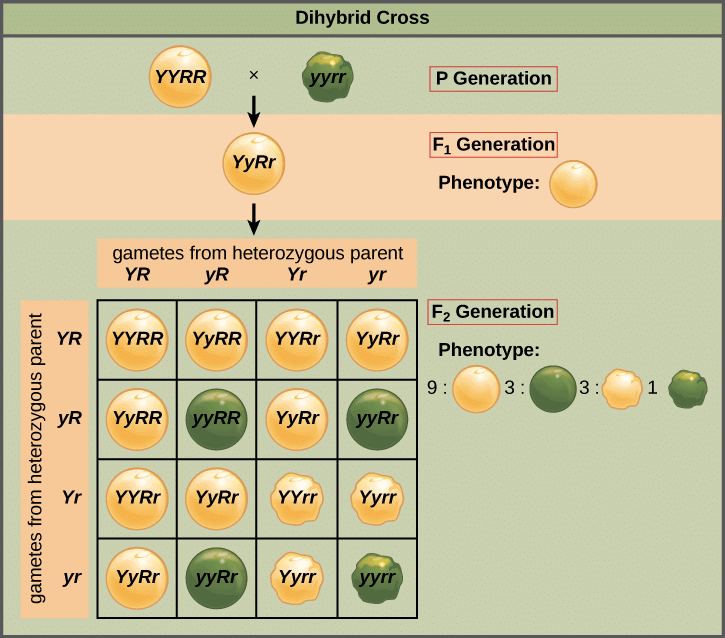
The Law of Independent Assortment states that during a dihybrid cross (crossing of two pairs of traits), an assortment of each pair of traits is independent of the other. In other words, during gamete formation, one pair of trait segregates from another pair of traits independently. This gives each pair of characters a chance of expression.
In the dihybrid cross, he chose round-yellow seed and wrinkled green seed and crossed them. He obtained only round yellow seeds in the F1 generation. Later, self-pollination of F1 progeny gave four different combinations of seeds in the F2 generation. He obtained round-yellow, wrinkled-yellow, round green and wrinkled green seeds in the phenotypic ratio 9:3:3:1.
The phenotypic ratio 3:1 of yellow: green colour and the ratio 3:1 of the round: wrinkled seed shape during monohybrid cross was retained in the dihybrid cross as well. Thus, he concluded that characters are distributed independently and inherited independently. Based on this observation, he developed his third law – Law of Independent Assortment.
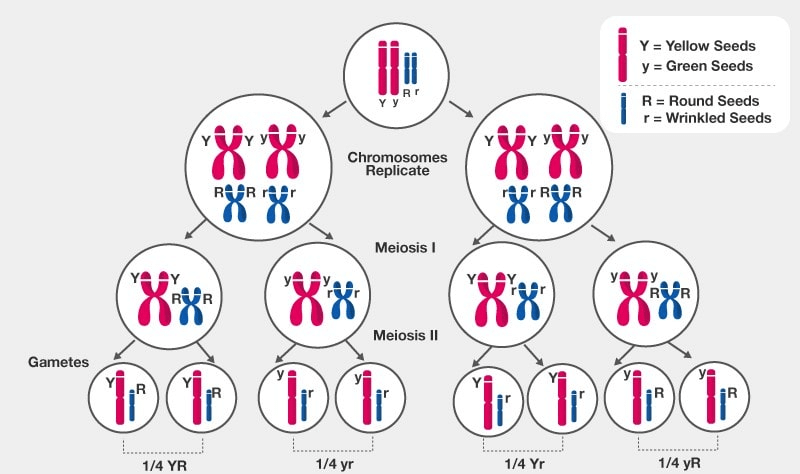
The dihybrid crosses between the parental genotype RRYY (round yellow seeds) and rryy (green wrinkled seeds) explains the law. Here the chances of formation of gametes with the gene R and the gene r are 50:50. Also, the chances of formation of gametes with the gene Y and the gene y are 50:50. Thus, each gamete should have either R or r and Y or y.
The Law of Independent Assortment states that the segregation of R and r is independent of the segregation of Y and y. This results in four types of gametes RY, Ry, rY, and ry. These combinations of alleles are different from their parental combination (RR, YY, rr and yy).
Example of Law of Independent Assortment
Let us consider an example of rabbits with two visible traits:
- fur colour (black or white)
- eye colour (green or red)
Two-hybrid rabbits are crossed. Both the rabbits have a genotype BbGg. Before breeding each rabbit produced gametes. During this, the alleles are separated and the copy of each chromosome is assigned to different gamete. That means, regardless of the parental phenotype, the baby rabbits inherit different combinations of the traits. Alternatively, a baby rabbit can have a genotype Bbgg.
Chromosomal Theory of Inheritance
This theory was proposed by Walter Sutton and Theodor Boveri (1902). Following are the main points of this theory
1. Gametes serve as the bridge between two successive generations.
2. Male and Female gametes play an equal role in contributing hereditary components of future generation.
3. Only the nucleus of sperm combines with ovum. Thus, the hereditary information is contained in the nucleus.
4. Chromatin in the nucleus is associated with the cell division in the form of chromosomes.
5. Any type of deletion or addition in the chromosomes can cause structural and functional changes in living beings.
6. A sort of parallelism is observed between Mendelian factors and chromosomes.
7. A number of genes or Mendelian factors are found in each chromosome.
8. Determination of sex in most of the animals and plants is affected by specific chromosomes. These chromosomes are called sex chromosomes.
Parallelism Between Gene and Chromosomes
1. Chromosomes are also transferred from one generation to the next as in the case of genes (Mendelian factors).
2. The number of chromosomes is fixed in each living species.These are found as homologous pairs in diploid cells. One chromosome from father and the other contributed by the mother constitute a homologous pair.
3. Before cell division, each chromosome as a whole and the alleles of genes get replicated and are separated during mitotic division.
4. Meiosis takes place during gamete formation. Homologous chromosomes form synapses during prophase-I stage which in later course get separated and transferred to daughter cells. Each gamete or a haploid cell has only one allele of each gene present in the chromosome.
5. A characteristic diploid number is again established by the union of the two haploid gametes.
6. Both chromosomes and the alleles (Mendelian factors) behave according to Mendel's law of segregation.
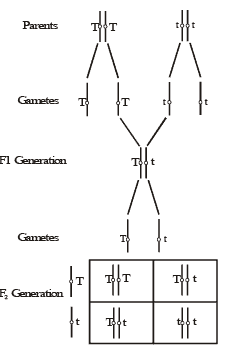
In the homologus chromosomes of a pure tall plant, allele (T) is found for tallness in each chromosome. Likewise, in a pure dwarf plant (tt), allele (t) is present in each chromosome.
These homologous chromosomes get separated during meiotic division. Hence, each gamete possesses only one chromosome of an each pair. Accordingly, all the gametes of tall plants possess a chromosome with an allele of tallness (T), while the gametes of dwarf plants possess a chromosome with an allele for dwarfness (t). Their cross to produce F1 generation will yield tall hybrid plants with homologous chromosomal pair containing Tt allelic pair. In this generation two kinds of gamete will be formed during gameto -genesis, 50% with the allele (T) for tallness and 50% with the allele for dwarfness (t).Random combination of these gametes will produce offsprings in F2 generation in the ratio of 25% pure tall (TT), 50% hybrid tall (Tt) and 25% dwarf (tt)
Linkage
Collective inheritance of character is called linkage. Linkage first time seen by Bateson and Punnett in Lathyrus odoratus and gave coupling and repulsion phenomenon. But they did not explain the phenomenon of linkage. Sex linkage was first discovered by Morgan in Drosophila & coined the term linkage. He proposed the theory of linkage.
 Linkage and Recombination
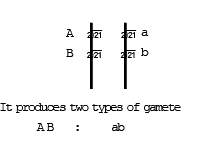
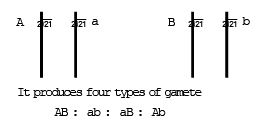
Linkage and independent assortment can be represented in dihybrid plant, as –
In case of linkage in dihybrid AaBb
In case of independent assortment in dihybrid AaBb
Theory of Linkage
1. Linked genes are linearly located on same chromosome. They get separated if exchange (crossing over), takes place between them.
2. Strength of linkage α1/ distance between the genes . It means, if the distance between two genes is increased then strength of linkage is reduced and it proves that greater is the distance between genes, the greater is the probability of their crossing over. Crossing over obviously disturbs or degenerates linkage. Linked genes can be separated by crossing over.
Factors affecting crossing over (C.O):
(1) Distance  = C.O.
(2) Temperature = C.O.
(3) X-Ray = C.O.
(4) Age = C.O.
(5) Sex - Male C.O. (Crossing over totally absent in male Drosophila.)
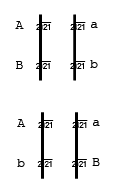
Arrangement of Linked Genes on Chromosomes :-The arrangement of linked genes in any dihybrid plant is two types.
[a] Cis-Arrangement :- When, two dominant genes located on one chromosome and both recessive genes located on another chromosome, such type of arrangement is termed as cis-arrangement. Cis-arrangement is an original arrangement.
- Two types of gamete can be produced in cis-arrangement → (AB) and (ab).
[b] Trans-Arrangement :- When a chromosome bears one dominant and one recessive gene, and another chromosome also possess one dominant and one recessive gene, such type of arrangement is called trans-arrangement. Trans-arrangement is not an original form. It is due to crossing over. Two types of gamete also formed in trans-arrangement but it is different from cis-arrangement (Ab) and (aB).
Types of Linkage:
1. Complete Linkage: Linkage in which genes always show parental combination. It never forms new combination. Crossing over is absent in it. Such genes are located very close on the chromosomes. Such type of linkage very rare in nature. e.g. male Drosophila, female silk moth.
2. Incomplete Linkage: When new combinations also appear along with parental combination in off-springs, this type of linkage is called incomplete linkage, the new combinations form due to crossing over. The percentage of new combination is equal to the percentage of crossing over.(<50%)
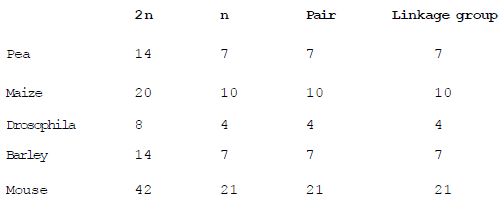
Linkage Group: All the genes which are located on one pair of homologous chromosome form one linkage group. Genes which are located on homologous chromosomes inherit together so we consider one linkage group.
- No. of Linkage group = haploid no. of homologous chromosomes.
Application of Linkage
Distance can be identified by the incomplete linkage. It's unit is centi Morgan.

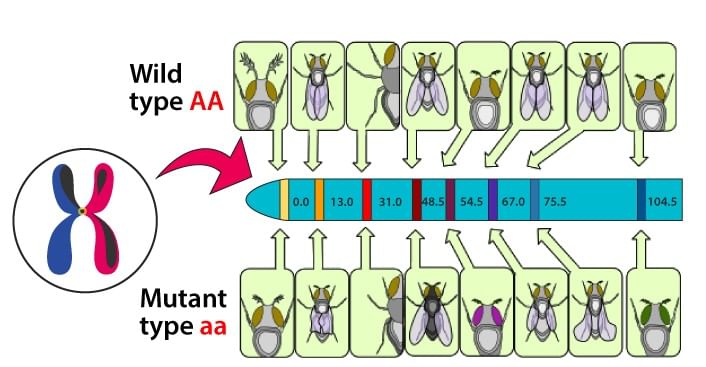
Genetic map/Linkage map/Chromosomal map - In genetic map different genes are linearly arranged according to % of crossing over (μ Distance) between them. With the help of genetic map we can find out the position of a particular gene on chromosome. Genetic map is helpful in the study of genome.
What is Polygenic Inheritance?
Polygenic inheritance is defined as quantitative inheritance, where multiple independent genes have an additive or similar effect on a single quantitative trait.
Polygenic inheritance is also known as multiple gene inheritance or multiple factor inheritance.
Characteristics of Polygenic Inheritance
- Polygene refers to a gene that exerts a slight effect on a phenotype along with other genes.
- The effect of a single gene is too small, so it is difficult to detect.
- Multiple genes produce an equal effect.
- Each allele has a cumulative or additive effect.
- Polygenic inheritance differs from multiple alleles, as in multiple alleles, three or more alleles are present in the same locus of which any two alleles are present in an organism, e.g. ABO blood group system, which is controlled by three alleles.
- There is no epistasis involved, i.e. masking of the expression of an allele of the different locus.
- There is no linkage or dominance, rather there exist contributing and non-contributing alleles, which are known as active or null alleles respectively.
- Polygenic inheritance is characterised by the continuous variation of the phenotype of a trait.
- The polygenic inheritance pattern is complex. It is difficult to predict phenotype.
- The statistical analysis can give the estimate of population parameters.
Polygenic Inheritance in Humans
There are many traits in humans, which show polygenic inheritance, e.g. skin and hair colour, height, eye colour, the risk for diseases and resistance, intelligence, blood pressure, bipolar disorder, autism, longevity, etc.
Brief description of some of the traits:
Skin Pigmentation
Inheritance of skin pigmentation is polygenic inheritance. Around 60 loci contribute to the inheritance of a single trait. If we take an example of a pair of alleles of three different and unlinked loci as A and a, B and b, C and c. The capital letters represent the incompletely dominant allele for dark skin colour. The more capital letters show skin colour towards the darker range and small letters towards the lighter colour of the skin. Parents having genotype AABBCC and aabbcc will produce offspring of intermediate colour in the F1 generation, i.e. AaBbCc genotype. In the F2 generation of two triple heterozygotes (AaBbCc x AaBbCc) mate, they will give rise to varying phenotypes ranging from very dark to very light in the ratio 1:6:15:20:15:6:1.
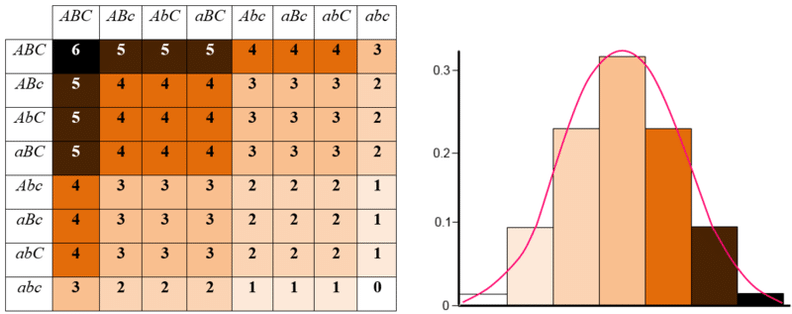 From Light to Dark
- Height: There are around 400 genes responsible for the phenotype and the environment greatly influences the expression of genes.
- Eye Colour: The colour of the eye is determined by polygenes. At least 9 colours of eye colour are recognised in humans. There are two major eye colour genes and 14 more genes that determine the expression of the phenotype. A different number of alleles contribute to each colour. These are found to be X-linked.
Polygenic Inheritance in Plants
Polygenic inheritance in plants includes the colour and shape of the stem, pollen, flower, yield, oil content, size of a seed, time to mature or flower, etc.
Brief description of some of the traits:
Kernel Colour of Wheat
The three independent pairs of alleles are involved in the expression of kernel colour of wheat. They show independent assortment. When dark red wheat kernel (AABBCC) is crossed with the white wheat kernel (aabbcc) the F1 generation has an intermediate red colour kernel (AaBbCc). When F1 generation is crossbred, F2 generation has 63 red kernel plants having different shades of red and 1 white kernel.
Effect of Environment on Polygenic Inheritance
- The expression of polygenesis greatly influenced by environmental conditions. The genotype sets the range for a quantitative trait, but the environmental conditions decide the phenotype within its genetic limits. Genes function differently in different environmental conditions. Environment regulates the activity of certain genes and sets them on or off.
- The range of phenotype possible under the different environmental conditions from the same genotype is termed as ‘norm of reaction’. The norm of the reaction is narrow for certain genotypes and broad for some genotypes, e.g. genotypes involved in human height have a very broad norm of reaction.
- Identical twins raised in two different environments show that individuals may have genetic potential or vulnerability, but environmental conditions influence the expression of genotype. Human characters such as intelligence, depression, height, skin colour, schizophrenia show the effect of the environment on gene expression. Phenotypic expression is dependent on both nature and nurture.
Examples:
- Diet and general health greatly influences height
- Flower, the colour of a shrub, Hydrangeas, depends on the level of aluminium present in the soil
- Effect of temperature on the skin of Himalayan rabbits.
What is Pleiotropy in Genetics?
In genetics, Pleiotropy is defined as the expression of multiple traits by a single gene. Pleiotropy is derived from a Greek word meaning more ways.
A simple example of a Pleiotropy is phenylketonuria is a disease. It is a genetic disorder caused by the low metabolism of the amino acid phenylalanine in the body cells.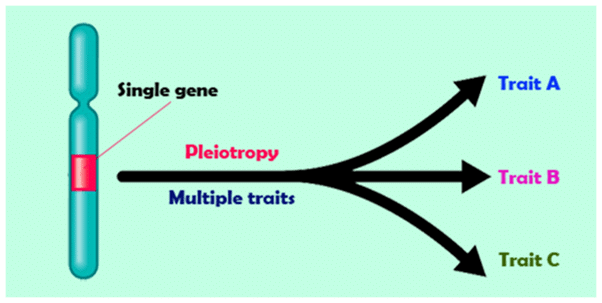 Pleiotropy
Gregor Mendel, the father of genetics made various interesting observations during his study of inheritance regarding the colour of different plant components. Significantly, Mendel also observed that the plants with coloured seed coats had coloured leaf axils ( a part that connects leaves to stems) and coloured flowers. Mendel also noticed that pea plants had colourless seed coats with no pigmentation on their axils and white-coloured flowers. The colour of the seed coat was always concerned with specific axil and flower colour.
Today we come to the conclusion that Mendel’s observations were based on the result of pleiotropy which is the phenomenon wherein an individual gene plays its role in multiple phenotypic traits. Here, the gene of seed coat colour was not the only one responsible for its colour but also for the axil pigmentation and flower.
A human genetic disorder known as the Marfan syndrome is caused due to the mutation in a single gene yet it affects various aspects of growth and development that include vision, height, and heart functioning. All these are examples of pleiotropy or a gene that affects multiple characteristics.
Gene Pleiotropy
The gene which focuses on the number of functions of a particular gene is termed as the Gene pleiotropy. It is also referred to as molecular-gene pleiotropy.
When we talk about Mendel’s experiments with white-coloured flower and purple coloured plants, we do not think about phenotypes concerned with the colours of two flowers. However, Mendel observed that the colours were always related to two different features: the seed coat colour and the colour of axils.
A plant bearing white-coloured flowers consist of colourless axils and seed coats, whereas plants with purple flowers have brown-grey coloured seed coats with reddish axils. Hence, instead of affecting only one characteristic, the colour gene affects three.
Genes of this kind that control multiple and unrelated features are called pleiotropic where the term pleio refers to many and tropic indicates effects. In this manner, the discrete phenotypes could be identified back to a defect in one gene with different jobs.
Moreover, the alleles of pleiotropic genes are transferred in a similar way as alleles of genes affect the single traits. Although a phenotype has various elements, these elements are expressed as a package and the recessive and dominant versions of the package would be visible in the offspring of two heterozygotes in a 3:1 ratio.
Human Genetic Disorders
The genes which are affected by human genetic disorders are mostly pleiotropic. For example, a person with a hereditary disorder known as Marfan syndrome could have a set of unrelated symptoms that involve the following:
- Abnormal tall height.
- Dislocation of the eye lens.
- Lean fingers and toes.
- Heart problems that include the aorta, large blood vessels that carry blood away from the heart, ruptures.
The above symptoms do not seem relevant but as it turns out, it could be traced back to the mutation of an individual gene. This gene encodes a protein into chains and makes fibrils that provide flexibility and strength to the body’s connective tissues. Mutations that are responsible for Marfan syndrome minimize the amount of functional protein formed by the body and results in lesser fibrils.
|
59 videos|290 docs|168 tests
|
FAQs on Inheritance of Two Genes, Polygenic Inheritance & Pleiotropy - Biology Class 12 - NEET
| 1. What is the significance of the Law of Independent Assortment? |  |
| 2. How does the Chromosomal Theory of Inheritance relate to polygenic inheritance? | |
| 3. What are some characteristics of polygenic inheritance? | |
| 4. How does polygenic inheritance manifest in humans? | |
| 5. How does the environment affect polygenic inheritance? | |




Sample Paper
,Viva Questions
,practice quizzes
,Extra Questions
,shortcuts and tricks
,Objective type Questions
,Important questions
,past year papers
,Polygenic Inheritance & Pleiotropy | Biology Class 12 - NEET
,Semester Notes
,mock tests for examination
,Exam
,video lectures
,ppt
,Polygenic Inheritance & Pleiotropy | Biology Class 12 - NEET
,MCQs
,Summary
,Inheritance of Two Genes
,Inheritance of Two Genes
,Inheritance of Two Genes
,Polygenic Inheritance & Pleiotropy | Biology Class 12 - NEET
,Free
,Previous Year Questions with Solutions
,study material
;



Inheritance of Two Genes, Polygenic Inheritance & Pleiotropy Free PDF Download
Importance of Inheritance of Two Genes, Polygenic Inheritance & Pleiotropy
Inheritance of Two Genes, Polygenic Inheritance & Pleiotropy Notes
Inheritance of Two Genes, Polygenic Inheritance & Pleiotropy NEET Questions
Study Inheritance of Two Genes, Polygenic Inheritance & Pleiotropy on the App
|
© EduRev
|
Education Revolution
|


|




