Water Recycling & Reuse


Water Recycling
Water recycling is the practice of reusing treated wastewater for beneficial purposes such as agricultural and landscape irrigation, industrial processes, toilet flushing, and replenishing a groundwater basin (groundwater recharge). The terms water recycling, water reclamation, and water reuse are commonly used interchangeably.
A common example is an industrial facility that reuses water from cooling systems after appropriate treatment. A frequent source of recycled water is municipal wastewater (sewage) that has been treated to a required quality. Recycled water provides both resource and financial savings by reducing demand on freshwater sources and lowering the need for long-distance conveyance.
Definitions and types
- Greywater (gray water): Wastewater from bathroom sinks, bathtubs, showers and clothes washing equipment. Greywater is typically reused on-site for landscape irrigation after basic treatment and appropriate precautions.
- Blackwater: Wastewater containing faecal matter and urine (for example from toilets). Blackwater requires more rigorous treatment than greywater before reuse.
- Direct potable reuse: Treated wastewater introduced directly into a potable water distribution system after advanced treatment and monitoring.
- Indirect potable reuse: Treated wastewater discharged to an environmental buffer (for example aquifer or surface water reservoir) before final abstraction and treatment for potable use.
- On-site reuse: Recycling and reuse of water at or very close to the generating facility (e.g., industrial site reusing process water).
Guidelines for greywater reuse
- Greywater is commonly reused for landscape irrigation; reuse requires user education and implementation of non-toxic, low-sodium soaps and personal-care products to protect vegetation.
- Prefer subsurface irrigation or low-pressure drip systems to minimise human contact and aerosol generation.
- Provide simple treatment (screening, sedimentation, filtration, disinfection) and storage designed to prevent vector breeding.
Motivational Factors For Recycling/reuse
- Augmentation of limited primary water sources and drought resilience.
- Reduction of diversion of water from other uses, including sensitive natural ecosystems.
- Minimisation of infrastructure costs by reducing demand on potable supply and wastewater conveyance systems.
- Reduction and elimination of wastewater discharges to receiving waters, helping control pollution.
- Opportunity to manage local water sources and provide locally controlled supplies.
- Potential to overcome political and institutional constraints by providing decentralised supply options.
Environmental benefits
- Provides a dependable, locally controlled source of water, decreasing pressure on natural water bodies and aquifers.
- Reduces wastewater discharges and associated pollution loads to rivers, lakes and coastal waters.
- Enables creation and enhancement of wetlands and riparian habitats when reused appropriately.
- Reduces energy use associated with transporting water long distances or pumping from deep aquifers when reuse is local or on-site.
- Matching water quality to the specific use reduces treatment energy compared with producing potable-quality water for all uses.
Uses of Recycled Water
- Agriculture (irrigation of non-food and, in some cases, food crops depending on treatment level and cropping restrictions).
- Landscape irrigation (parks, roadside greenery, municipal landscapes).
- Public parks and recreational impoundments (subject to restrictions depending on quality and intended use).
- Golf course irrigation.
- Industrial cooling water (power plants, refineries).
- Processing water for mills and factories.
- Toilet flushing in commercial and residential buildings.
- Dust suppression at construction sites and roadworks.
- Construction activities and concrete mixing (subject to quality needs).
- Filling artificial lakes and decorative water bodies (quality depending on intended contact).
- Groundwater recharge and reservoir augmentation (indirect potable reuse where permitted).
Uses of water recycled from water treatment plants
[A] Secondary treatment; Biological oxidation and disinfection
- Surface irrigation of orchards and vineyards (typically non-food crops or restricted food crops).
- Non-food crop irrigation.
- Restricted landscape impoundments (limited public contact).
- Groundwater recharge to non-potable aquifers (where hydrogeologic and treatment safeguards exist).
- Wetlands, wildlife habitat enhancement and streamflow augmentation.
- Industrial cooling processes and other industrial non-contact uses.
[B] Tertiary and advanced treatment
- Landscape and golf course irrigation with fewer restrictions.
- Toilet flushing and other indoor non-potable uses.
- Vehicle washing (subject to local regulations and water quality needs).
- Food crop irrigation where food-safety requirements are met.
- Unrestricted recreational impoundments (where pathogens and chemical risks are controlled).
- Indirect potable reuse - groundwater recharge of potable aquifers and augmentation of surface water reservoirs after advanced treatment and monitoring.
Quality Issues Of Wastewater Reuse/recycling
Despite a long history of wastewater reuse in many parts of the world, safety concerns persist primarily because of variability in the quality of recycled water and the potential presence of pathogens, chemicals and emerging contaminants.
- Available evidence indicates there is no clear increase in enteric diseases in urban areas irrigated with treated reclaimed wastewater when appropriate treatment, handling and monitoring are applied.
- There is no evidence of significant risks of viral or microbial disease resulting from exposure to effluent aerosols produced during spray irrigation with reclaimed water when disinfection and operational controls are in place.
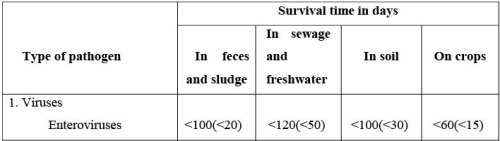
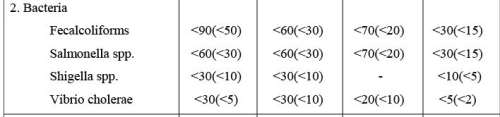
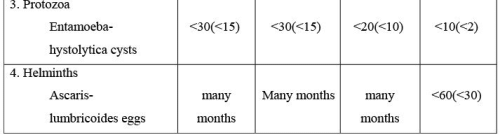
Pathogen survival time
Key health hazards to consider
- Microbial pathogens - bacteria (e.g., faecal coliforms, Salmonella), viruses, protozoa (e.g., Giardia, Cryptosporidium), helminths (eggs of parasitic worms).
- Chemical contaminants - nutrients (nitrogen, phosphorus), heavy metals, salts, organics and industrial chemicals.
- Emerging contaminants - pharmaceuticals, personal care products, hormone-disrupting compounds; these require specific treatment and monitoring strategies.
- Physical hazards - suspended solids that affect irrigation equipment and aesthetics.
Monitoring parameters and indicators
- Microbial indicators: total coliforms, faecal coliforms or E. coli, enterococci, helminth eggs (where relevant).
- Organic pollution: Biochemical Oxygen Demand (BOD), Chemical Oxygen Demand (COD), Total Organic Carbon (TOC).
- Suspended solids: Total Suspended Solids (TSS) and turbidity.
- Inorganic chemicals: nutrients (NH4-N, NO3-N, PO4-P), chloride, electrical conductivity (salinity), heavy metals (as required by use).
- Residual disinfectant (e.g., residual chlorine) for disinfection performance and distribution protection.
Primary Water Quality Criteria
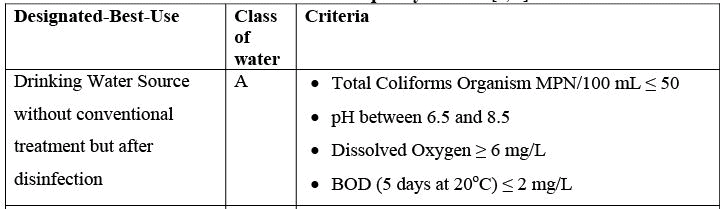
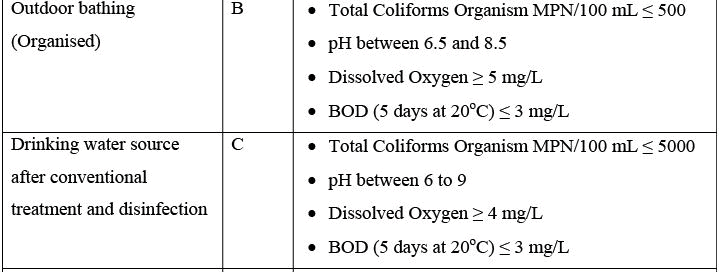
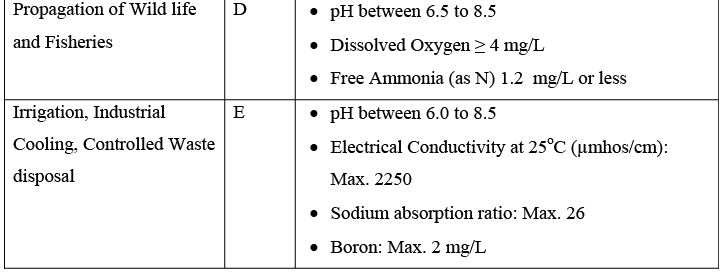
In India, the Central Pollution Control Board (CPCB) developed the concept of "designated best use". Out of several possible uses of a water body, the use requiring the highest quality of water is called its designated best use, and the water body is designated accordingly. The CPCB has identified five such designated best uses (commonly labelled A, B, C, D and E), each associated with classes of acceptable quality and parameters to be monitored.
Typical CPCB designated best uses (summary)
- Class A: Drinking water source without conventional treatment but after disinfection (highest quality requirement).
- Class B: Outdoor bathing (recreational water with controlled human contact).
- Class C: Drinking water source with conventional treatment and disinfection.
- Class D: Propagation of wildlife and fisheries (aquatic life protection).
- Class E: Irrigation, industrial cooling and controlled waste disposal (uses tolerant of lower water quality).
Water quality criteria
Treatment Technologies For Reuse
Selection of treatment processes depends on the intended reuse, required water quality, local regulations and economics. Typical treatment train elements are given below.
Primary treatment
- Screening and grit removal to protect downstream processes.
- Primary sedimentation (settling) to remove settleable solids and reduce suspended solids and biochemical oxygen demand (BOD).
Secondary treatment
- Biological processes (activated sludge, trickling filters, rotating biological contactors) to remove organic matter and reduce BOD and suspended solids.
- Secondary clarification to separate biomass from treated effluent.
- Typically combined with disinfection (chlorination, UV) for non-potable reuse.
Tertiary and advanced treatment
- Filtration (sand filters, multimedia filters, membrane filtration - microfiltration, ultrafiltration) to remove remaining suspended solids and pathogens.
- Chemical or biological nutrient removal for nitrogen and phosphorus control when required.
- Advanced oxidation processes (ozone, UV/H2O2), activated carbon adsorption to reduce organics and some trace contaminants.
- Reverse osmosis (RO) and nanofiltration for high-quality reuse such as indirect or direct potable reuse; these require concentrate management.
Disinfection
- Common methods: chlorination, ultraviolet (UV) irradiation, ozonation.
- Choice depends on target organisms, contact time, residual requirements, and formation of disinfection by-products.
Design And Operational Considerations
- Source separation: Segregation of greywater and blackwater simplifies treatment and reduces treatment cost for many reuse applications.
- Storage and retention: Design to avoid prolonged storage that may promote regrowth of organisms and odour formation; include protection against mosquito breeding.
- Distribution systems: Use separate piping (dual distribution) for reclaimed and potable water. Implement cross-connection controls and backflow prevention.
- Public health protection: Choose irrigation methods and buffer zones to minimise human exposure; prefer subsurface or drip irrigation for crops eaten raw.
- Operational monitoring: Routine monitoring of microbial and chemical parameters, maintenance of disinfection residuals and filtration systems.
- Regulatory compliance: Design to meet local standards and CPCB/state regulations for designated uses.
Crop and irrigation restrictions (general guidance)
- Restrict reuse of minimally treated wastewater for crops eaten raw or for those in close contact with edible portions unless adequate treatment and safeguards are applied.
- Use higher treatment quality for irrigation of leafy vegetables and fruits consumed raw.
- Apply stricter controls for spray irrigation where aerosols may cause human exposure.
Health, Safety And Risk Management
- Identify exposure pathways (ingestion, dermal contact, aerosol inhalation) and implement control measures accordingly.
- Establish microbial and chemical monitoring programmes adapted to the risk profile of each reuse application.
- Develop emergency response and contingency plans for treatment failures or accidental discharges.
- Educate users and operators about safe handling, maintenance and personal hygiene when working with reclaimed water.
Economic, Social And Institutional Aspects
- Recycled-water projects can offer operational cost savings by reducing potable-water demand and discharge volumes, but capital costs and distribution infrastructure (dual piping) must be considered.
- Institutional arrangements and clear regulatory frameworks are essential for sustained reuse programmes, including responsibility for operation, monitoring and public communication.
- Community acceptance is critical; transparent information about safety, benefits and safeguards improves public confidence.
Examples And Applications
- Industrial reuse: Cooling water circulated and partially treated on-site to reduce freshwater intake and effluent discharge.
- Municipal reuse: Treated secondary or tertiary effluent used for park irrigation, toilet flushing in large buildings, and industrial processes.
- Groundwater recharge: Treated effluent injected or infiltrated to augment aquifers for later abstraction (indirect potable reuse in a managed environment).
- Decentralised reuse: Housing complexes treating greywater for landscape irrigation and toilet flushing to lower demand on municipal potable water.
Concluding Remarks
Recycling and reuse of water are practical and sustainable strategies to stretch limited water supplies, reduce environmental pollution and provide local water security. Successful reuse schemes rely on appropriate treatment matched to the intended use, robust monitoring and operational controls, institutional support and public acceptance. The CPCB concept of designated best use provides a regulatory framework to determine acceptable water quality for various uses and should guide design and operation of reuse systems.
FAQs on Water Recycling & Reuse
| 1. What is water recycling and reuse? |  |
| 2. How does water recycling and reuse work? | |
| 3. What are the benefits of water recycling and reuse? | |
| 4. Is recycled water safe to use? | |
| 5. What are some examples of water recycling and reuse projects? | |