Mechanical Engineering Exam  >  Mechanical Engineering Notes  >  Thermodynamics  >  Significance of Chemical Engineering Thermodynamics Process Plant Schema - Thermodynamics

Significance of Chemical Engineering Thermodynamics Process Plant Schema - Thermodynamics

Significance of Chemical Engineering Thermodynamics: Process Plant Schema

Before concluding this chapter it is appropriate to preview the practical scope and utility of the principles of thermodynamics as applied to real process plants. Although the laws of thermodynamics are formulated from abstract, general principles, they supply the fundamental constraints and relations under which all real process operations occur. The ultimate application of thermodynamic knowledge in chemical engineering is the design, analysis and operation of a process plant that converts raw materials into desired products through a sequence of unit operations. Engineering thermodynamics is therefore one of the principal elements of the technical knowledge required for process design and optimisation.

Significance of Chemical Engineering Thermodynamics: Process Plant Schema

Overview of a Typical Process Plant and Where Thermodynamics Enters

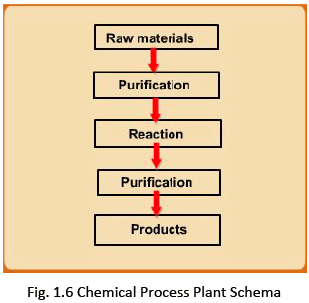
A typical large-scale chemical process plant converts raw materials (feeds) into products by a sequence of unit operations: pretreatment and purification of feeds, chemical conversion in reactors, and downstream separation and finishing operations. Thermodynamics provides the theoretical framework to evaluate what is possible and to compute quantities that guide design and operation. Key stages in a plant where thermodynamics plays a central role are:

  • Feed purification and separation: Most feeds are mixtures and must be purified or fractionated before reaction. Separation processes commonly used include distillation, liquid-liquid extraction, crystallisation, precipitation and membrane separation. Practically all such processes rely on the formation of two or more phases in which components distribute unequally; phase equilibrium relations determine how well components can be separated.
  • Chemical reaction: The chemical reactor is the heart of the plant. When feeds are available in the required composition and conditions, chemical reactions produce the desired product. Thermodynamics determines the equilibrium composition, the limits to conversion, and the direction in which reaction will proceed.
  • Downstream purification: Reactor effluent is generally a multicomponent mixture containing unreacted feed, desired products and side-products. Further separation and purification stages are required to meet product specifications; thermodynamics constrains the achievable purity and the minimum energy required for separation.
  • Energy management and utilities: Heat and work exchanges, enthalpy balances and exergy (available work) calculations are central to estimating plant energy requirements, utility sizing and heat-integration strategies.

Why separation equipment dominates capital cost

Separation equipment can represent more than half the capital investment for a typical large chemical plant. This is because separation tasks (for example, achieving high purity or recovering solvents) often require multiple stages, large surface areas, and significant energy input. Thermodynamic data and phase-equilibrium calculations are used to select the appropriate separation method and to determine the number of theoretical stages, minimum reflux ratio (for distillation), and the minimum work of separation.

Thermodynamic Principles Used in Plant Design

The laws and relations of thermodynamics are used to compute the principal quantities required for design and operation. The most frequently used concepts are:

  • Phase equilibrium and activity/fugacity: Vapour-liquid, liquid-liquid and solid-liquid equilibria are described by activity coefficients, fugacities and equilibrium constants. Phase diagrams, tie-lines and lever-rule calculations give the maximum separation possible for a given condition and composition.
  • Chemical equilibrium: The equilibrium composition of reacting systems is obtained from the equilibrium constant. The relation between standard Gibbs free energy change and equilibrium constant is ΔG° = -RT ln K, which links thermodynamic data to the maximum achievable conversion under given temperature and pressure.
  • Energy balances and enthalpy changes: Heat of reaction, sensible heat, latent heat and heat effects from mixing determine the heating/cooling duties for reactors and separators. Enthalpy balances are essential for sizing heat exchangers and utility systems.
  • Exergy and minimum work: Exergy analysis quantifies the useful work obtainable and the irreversibilities in a process. The minimum theoretical work for separation or chemical synthesis is found from Gibbs energy differences and gives a lower bound for energy consumption.

Key thermodynamic quantities and their practical use

  • Gibbs free energy (G): Determines equilibrium in isothermal/isobaric systems and gives the direction of spontaneous change. Used to compute equilibrium composition of reactions and to estimate minimum work for separation.
  • Enthalpy (H): Used in energy balances for reactors and separations. Reaction enthalpy determines heating/cooling requirements.
  • Entropy (S): Related to irreversibility and disorder; combined with enthalpy, it governs the second law constraints and exergy losses.
  • Activity and fugacity: Correct non-ideal behaviour in mixtures; required for accurate phase equilibrium and reaction equilibrium predictions.

Concrete Examples Where Thermodynamics Determines Feasibility and Design

Examples illustrating how thermodynamics constrains plant operations:

  • Distillation of an ethanol-water mixture: Vapour-liquid equilibrium (VLE) shows an azeotrope near 95.6 % ethanol (by volume) at atmospheric pressure, which is a thermodynamic limit to separation by simple distillation; further purification requires alternative methods (e.g., azeotropic distillation, pressure swing, molecular sieves). Thermodynamic VLE data determine the minimum reflux ratio and the theoretical number of stages for column design.
  • Equilibrium conversion in reactors: For an exothermic synthesis such as ammonia formation (N2 + 3H2 ⇌ 2NH3), equilibrium constants and Gibbs free-energy relations indicate that conversion increases at lower temperature and higher pressure. Thermodynamics thus sets the maximum attainable conversion; kinetics and catalysis are then used to approach that limit practically.
  • Crystallisation and precipitation: Solubility curves (solid-liquid equilibria) determine the maximum recovery and the temperature profile required for crystallisation; thermodynamic solubility data guide cooling profiles and seed addition strategies.

How Thermodynamics Guides Optimisation and Choice of Operating Conditions

Thermodynamics helps to choose temperature, pressure and composition ranges that make a process feasible and economical. Typical considerations include:

  • Reaction temperature and pressure: Thermodynamics tells whether higher temperature favours or disfavors a desired reaction (Le Chatelier's principle expressed via the temperature dependence of K). Pressure affects equilibria involving gases and can be used to shift conversion where appropriate.
  • Choice of solvent or phase for separation: Phase equilibrium data decide whether liquid-liquid extraction or distillation is more appropriate; activity coefficient models and binary/ternary phase diagrams are used in selection and design.
  • Energy integration: Enthalpy and heat-capacity data support heat-integration studies to reduce net utility consumption by matching hot and cold streams.
  • Minimum energy requirements: Thermodynamic minima (for example, minimum reflux ratio in distillation or minimum work of separation) set targets for process improvement and indicate how near a proposed design is to the thermodynamic limit.

Computational Role and Design Effort

In the basic design stage of a process plant, calculations rooted in thermodynamics commonly constitute a large fraction of the computational work - often reported as 50-70% of the total calculation load. These calculations include phase-equilibrium computations, property estimations, reaction equilibrium solving, enthalpy and material balances, and optimisation of operating variables. Accurate thermodynamic models and reliable property data are therefore essential for realistic and safe designs.

Applications beyond Design: Safety, Environment and Energy Efficiency

Thermodynamic analysis contributes to safer and more sustainable plant operation:

  • Safety: Phase-behaviour and vapour-pressure data help predict conditions for vapour formation, flammability limits and potential runaway scenarios. Knowledge of enthalpies and heat capacities is essential for relief-system sizing and emergency cooling requirements.
  • Environmental impact: Thermodynamics allows estimation of minimum energy consumption and material efficiencies, which directly affect emissions and waste generation. Exergy analysis helps identify and reduce avoidable irreversibilities.
  • Process intensification and sustainability: Thermodynamic limits indicate when novel process routes, alternative solvents, or different phase operations can yield significant energy or material savings.

Summary

Chemical engineering thermodynamics provides the fundamental constraints and calculational methods required to design, analyse and operate process plants. From predicting maximum separability of mixtures, to determining equilibrium conversions in reactors, to estimating the minimum energy required for separation and synthesis, thermodynamics underpins nearly every major design decision. Mastery of phase equilibria, chemical equilibrium, enthalpy and exergy concepts, together with reliable property models, is therefore indispensable for engineers working on real process plants.

The document Significance of Chemical Engineering Thermodynamics Process Plant Schema - Thermodynamics is a part of the Mechanical Engineering Course Thermodynamics.
All you need of Mechanical Engineering at this link: Mechanical Engineering
29 videos|152 docs|36 tests

FAQs on Significance of Chemical Engineering Thermodynamics Process Plant Schema - Thermodynamics

1. What is the importance of chemical engineering thermodynamics in the process plant schema?
Ans. Chemical engineering thermodynamics plays a crucial role in the process plant schema as it helps engineers understand and predict the behavior of chemical processes. By applying thermodynamic principles, engineers can optimize process design, improve energy efficiency, and ensure the safety and reliability of plant operations.
2. How does chemical engineering thermodynamics contribute to process plant optimization?
Ans. Chemical engineering thermodynamics provides insights into the thermodynamic properties of fluids and mixtures, allowing engineers to analyze process conditions and make informed decisions for optimization. It helps in determining the most suitable operating conditions, such as temperature, pressure, and composition, to maximize product yield, minimize energy consumption, and reduce waste generation.
3. What are the key concepts in chemical engineering thermodynamics relevant to the process plant schema?
Ans. Some key concepts in chemical engineering thermodynamics relevant to the process plant schema include phase equilibrium, reaction thermodynamics, heat transfer, mass transfer, and energy balance. These concepts enable engineers to analyze the behavior of chemicals and their transformations within the plant, facilitating process design, equipment selection, and troubleshooting.
4. How does chemical engineering thermodynamics ensure the safety of process plants?
Ans. Chemical engineering thermodynamics aids in the design of safe process plants by helping engineers understand the behavior of hazardous substances under different conditions. It allows for the prediction of critical temperatures, pressures, and compositions, ensuring that the process plant operates within safe limits. Additionally, thermodynamic analysis assists in the design of relief systems and emergency response procedures to prevent accidents and mitigate risks.
5. How can chemical engineering thermodynamics be used to improve energy efficiency in process plants?
Ans. Chemical engineering thermodynamics allows engineers to analyze the energy requirements and losses within a process plant. By optimizing heat exchangers, minimizing energy-intensive separations, and utilizing thermodynamic cycles, engineers can improve energy efficiency. Thermodynamic analysis also helps in identifying opportunities for waste heat recovery, process integration, and the use of alternative energy sources, leading to significant energy savings and environmental benefits.
Related Searches
study material, mock tests for examination, MCQs, shortcuts and tricks, Significance of Chemical Engineering Thermodynamics Process Plant Schema - Thermodynamics, Important questions, pdf , Sample Paper, video lectures, Free, Summary, Previous Year Questions with Solutions, Significance of Chemical Engineering Thermodynamics Process Plant Schema - Thermodynamics, Semester Notes, practice quizzes, Viva Questions, Extra Questions, Exam, Significance of Chemical Engineering Thermodynamics Process Plant Schema - Thermodynamics, past year papers, Objective type Questions, ppt;