Electrical Engineering (EE) Exam  >  Electrical Engineering (EE) Test  >  Analog and Digital Electronics  >  Test: Self Bias - Electrical Engineering (EE) MCQ

Self Bias - Free MCQ Practice Test with solutions, GATE EE Analog and Digital


MCQ Practice Test & Solutions: Test: Self Bias (10 Questions)

You can prepare effectively for Electrical Engineering (EE) Analog and Digital Electronics with this dedicated MCQ Practice Test (available with solutions) on the important topic of "Test: Self Bias". These 10 questions have been designed by the experts with the latest curriculum of Electrical Engineering (EE) 2026, to help you master the concept.

Test Highlights:

  • - Format: Multiple Choice Questions (MCQ)
  • - Duration: 10 minutes
  • - Number of Questions: 10

Sign up on EduRev for free to attempt this test and track your preparation progress.

Test: Self Bias - Question 1

The collector current (IC) that is obtained in a self biased transistor is_________

Detailed Solution: Question 1

The collector current is analysed by the DC analysis of a transistor. It involves the DC equivalent circuit of a transistor. The base current is first found and the collector current is obtained from the relation, IC=IBβ.

Test: Self Bias - Question 2

The thermal runway is avoided in a self bias because_________

Detailed Solution: Question 2

The self destruction of a transistor due to increase temperature is called thermal run away. It is avoided by the negative feedback produced by the emitter resistor in a self bias. The IC which is responsible for the damage is reduced by decreased output signal.

Test: Self Bias - Question 3

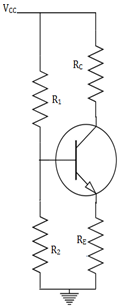
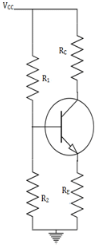
What is the Thevenin’s voltage (VTH) in a self bias shown below?

Detailed Solution: Question 3

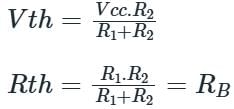
The base current cannot be obtained directly from the KVL or KCL applications. The VCC and VBE cannot come under a single equation. So, the circuit is changed with a Thevenin’s voltage (VTH) and Thevenin’s resistance.

Test: Self Bias - Question 4

 What is the Thevenin’s resistance (RTH) in a self bias shown below?
Detailed Solution: Question 4

The base current cannot be obtained directly from the KVL or KCL applications. A potential divider network is formed by R1 and R2.The VCC and VBE cannot come under a single equation. So, the circuit is changed with a Thevenin’s resistance.

Test: Self Bias - Question 5

The stability factor for a self biased transistor is_________

Detailed Solution: Question 5

The stability of the circuit is inversely proportional to the stability factor. The emitter resistor is very large when compared to the Thevenin’s resistance. When β is not that large, then S=(1+ β)( RTH+ RE)/ (1+ β)RE+ RTH.

Test: Self Bias - Question 6

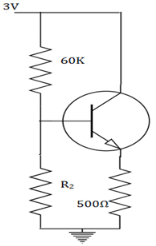
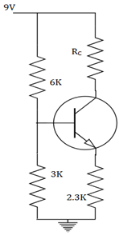
 In the circuit, the transistor has a large β value (VBE=0.7V). Find the current through RC.
Detailed Solution: Question 6

We know, IC=VTH-VBE/RE
=9*3/9=3V. IC=3-0.7/2.3=1mA.

Test: Self Bias - Question 7

A silicon NPN transistor is used and it has a large value of β. Find the required value of R2when IC=1mA.​

Detailed Solution: Question 7

 For silicon, VBE=0.8V, VCE=0.2V. IC=VTH-VBE/RE. By pitting the values, we have VTH=1.3V. R2 can be found from, VCCR2/R1+R2. We get R2=40KΩ.

Test: Self Bias - Question 8

The value of αac for all practical purposes, for commercial transistors range from_________

Detailed Solution: Question 8

For all practical purposes, αac=αdc=α and practical values in commercial transistors range from 0.9-0.99. It is the measure of the quality of a transistor. Higher is the value of α, better is the transistor in the sense that collector current approaches the emitter current.

Test: Self Bias - Question 9

Which of the following is true?

Detailed Solution: Question 9

HJ-C is thermal resistance between junction and case and HC-A is thermal resistance between case and ambient. The circuit designer has no control over HJ-C. So, a proper approach to dissipate heat from case to ambient is through heat sink.

Test: Self Bias - Question 10

Directions: Each of the next items consists of two statements, one labeled as the `Assertion (A)' and the other as 'Reason (R)' You are to examine these two statements carefully and select the answers to these items using the codes given below :

Assertion (A): The bias stability of a self-bias amplifier circuit can be improved by increasing the values of both the base resistor (RB) and the emitter resistor (RE).

Reason (R): The base resistor (RB) provides the required voltage to the base terminal and the emitter resistor (RE) provides negative feedback to the amplifier. 

Detailed Solution: Question 10
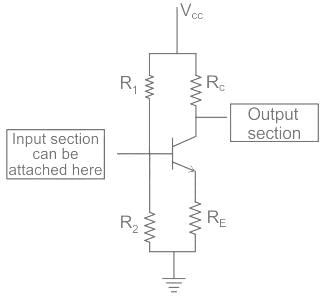
The Self-bias circuit is also known as voltage divider bias.

The Self-bias circuit can be simplified by using the Thevenin theorem:

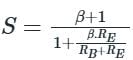
The stability factor for the self-bias circuit is:

So if RE increases or RB decreases,

then the circuit becomes more stable.

Hence the Assertion given is false.

The base resistance RB or RTH provides the required voltage to the base terminal and should be selected such that the emitter junction is forward biased.

Resistor RE results in negative feedback action which helps in keeping Ic stable,

Thus RE is responsible for stable Ic.

Hence, the Reason given is true.

So, option (d) is correct.

135 videos|183 docs|71 tests
Information about Test: Self Bias Page
In this test you can find the Exam questions for Test: Self Bias solved & explained in the simplest way possible. Besides giving Questions and answers for Test: Self Bias, EduRev gives you an ample number of Online tests for practice
135 videos|183 docs|71 tests
Download as PDF