NEET Exam  >  NEET Test  >  Biology Class 11  >  31 Years NEET Previous Year Questions: Neural Control & Coordination - NEET MCQ

31 Years NEET Previous Year Questions: Neural Control & Coordination Free


Test Description

20 Questions MCQ Test Biology Class 11 - 31 Years NEET Previous Year Questions: Neural Control & Coordination

31 Years NEET Previous Year Questions: Neural Control & Coordination for NEET 2026 is part of Biology Class 11 preparation. The 31 Years NEET Previous Year Questions: Neural Control & Coordination questions and answers have been prepared according to the NEET exam syllabus.The 31 Years NEET Previous Year Questions: Neural Control & Coordination MCQs are made for NEET 2026 Exam. Find important definitions, questions, notes, meanings, examples, exercises, MCQs and online tests for 31 Years NEET Previous Year Questions: Neural Control & Coordination below.
Solutions of 31 Years NEET Previous Year Questions: Neural Control & Coordination questions in English are available as part of our Biology Class 11 for NEET & 31 Years NEET Previous Year Questions: Neural Control & Coordination solutions in Hindi for Biology Class 11 course. Download more important topics, notes, lectures and mock test series for NEET Exam by signing up for free. Attempt 31 Years NEET Previous Year Questions: Neural Control & Coordination | 20 questions in 20 minutes | Mock test for NEET preparation | Free important questions MCQ to study Biology Class 11 for NEET Exam | Download free PDF with solutions
31 Years NEET Previous Year Questions: Neural Control & Coordination - Question 1

Match List-I with List-II    [NEET 2024]
2024

Choose the correct answer from the options given below:

Detailed Solution for 31 Years NEET Previous Year Questions: Neural Control & Coordination - Question 1
  • A. Schwann cellsSchwann cells are responsible for the formation of the myelin sheath around neurons in the peripheral nervous system. Thus, A corresponds to III (Myelin Sheath).
  • B. Synaptic knob: The synaptic knob is the part of a neuron that releases neurotransmitters into the synapse to transmit nerve signals to the next neuron. Thus, B corresponds to I (Neurotransmitter).
  • C. Bipolar neuronsBipolar neurons are primarily found in the retina, where they play a role in visual processing. Thus, C corresponds to IV (Retina).
  • D. Multipolar neuronsMultipolar neurons are found in the cerebral cortex, where they play a key role in complex brain functions. Thus, D corresponds to II (Cerebral cortex).

Thus, the correct match is:

  • A-III: Schwann cells form the myelin sheath.
  • B-I: Synaptic knobs release neurotransmitters.
  • C-IV: Bipolar neurons are found in the retina.
  • D-II: Multipolar neurons are found in the cerebral cortex.
31 Years NEET Previous Year Questions: Neural Control & Coordination - Question 2

Match List-I with List-II:    [NEET 2024]
2024

Choose the correct answer from the options given below:

Detailed Solution for 31 Years NEET Previous Year Questions: Neural Control & Coordination - Question 2
  • A. Limbic system: The limbic system is involved in emotions, and the amygdala is a major component of the limbic system, which plays a key role in emotional responses. Thus, A corresponds to III (Amygdala).
  • B. Arachnoid: The arachnoid is one of the cranial meninges (protective layers surrounding the brain). Therefore, B corresponds to IV (Cranial meninge).
  • C. Corpus callosum: The corpus callosum is a tract of nerve fibers that connects the two cerebral hemispheres, allowing communication between them. Thus, C corresponds to II (Tract of nerve fibres).
  • D. Hypothalamus: The hypothalamus is involved in regulating various physiological processes such as body temperature. Therefore, D corresponds to I (Body temperature).

Thus, the correct match is:

  • A-III: Limbic system is related to the amygdala.
  • B-IV: Arachnoid is a cranial meninge.
  • C-II: Corpus callosum is a tract of nerve fibres.
  • D-I: Hypothalamus regulates body temperature.
31 Years NEET Previous Year Questions: Neural Control & Coordination - Question 3

Given below are two statements:       (NEET 2024)
Statement I:
The cerebral hemispheres are connected by nerve tract known as corpus callosum.
Statement II: The brain stem consists of the medulla oblongata, pons and cerebrum.
In the light of the above statements, choose the most appropriate answer from the options given below:

Detailed Solution for 31 Years NEET Previous Year Questions: Neural Control & Coordination - Question 3
  • Statement I describes the corpus callosum, a structure in the brain. The corpus callosum is a large bundle of nerve fibers that connects the two cerebral hemispheres, allowing for communication between them. This statement is correct.
  • Statement II mentions the brain stem and lists its components as the medulla oblongata, pons, and cerebrum. The error here is in including the cerebrum as part of the brain stem. In actuality, the brain stem consists of the medulla oblongata, the pons, and the midbrain, not the cerebrum. The cerebrum is part of the forebrain and is responsible for higher cognitive functions such as thinking, perceiving, planning, and understanding language. Therefore, Statement II is incorrect.

Topic in NCERT: HindBrain
Line in NCERT: "The hemispheres are connected by a tract of nerve fibres called corpus callosum. Three major regions make up the brain stem; mid brain, pons and medulla oblongata."

31 Years NEET Previous Year Questions: Neural Control & Coordination - Question 4

Match List I with List II:       (NEET 2024)
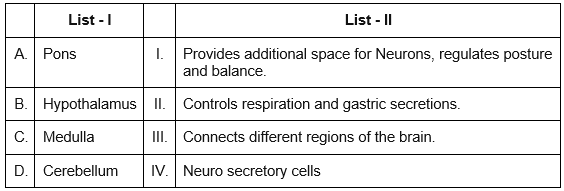
Choose the correct answer from the options given below :

Detailed Solution for 31 Years NEET Previous Year Questions: Neural Control & Coordination - Question 4

To match List I with List II correctly, we start by identifying the function of each brain region described in List I and match these descriptions to the corresponding functions stated in List II:

  • Pons: The pons is part of the brainstem located between the midbrain and the medulla oblongata. It principally acts as a bridge connecting various parts of the brain, and it is also involved in controlling essential functions like sleep and respiration.
  • Hypothalamus: The hypothalamus is a small portion at the base of the brain that plays a crucial role in hormone release and regulation of essential bodily functions, including temperature control, thirst, hunger, sleep, mood, and sexual behavior. It contains several neurosecretory cells that produce hormones.
  • Medulla: The medulla oblongata, also part of the brainstem, primarily controls autonomic functions such as breathing, heart rate, and digestion (including gastric secretions).
  • Cerebellum: The cerebellum is located at the back of the brain and is responsible for controlling motor skills, balance, coordination, and posture. It helps refine the movements dictated by the motor cortex.

Now, let's match these descriptions to those listed in List II:
A. Pons should match with "Connects different regions of the brain." - this corresponds to III.
B. Hypothalamus should match with "Neurosecretory cells." - this corresponds to IV.
C. Medulla should match with "Controls respiration and gastric secretions." - this corresponds to II.
D. Cerebellum should match with "Provides additional space for Neurons, regulates posture and balance." - this corresponds to I.

When we look at the given options:
Option A: A-II, B-III, C-I, D-IV (wrong)
Option B: A-III, B-IV, C-II, D-I (correct)
Option C: A-I, B-III, C-II, D-IV (wrong)
Option D: A-II, B-I, C-III, D-IV (wrong)

The correct answer is Option B: A-III, B-IV, C-II, D-I.

31 Years NEET Previous Year Questions: Neural Control & Coordination - Question 5

The parts of human brain that helps in regulation of sexual behaviour, expression of excitement, pleasure, rage, fear etc. are:       (2023)

Detailed Solution for 31 Years NEET Previous Year Questions: Neural Control & Coordination - Question 5

  • The limbic system, which includes structures such as the amygdala and hippocampus, plays a significant role in regulating emotions, including fear, pleasure, and anger. The hypothalamus, another component of the limbic system, is involved in various functions, including the regulation of sexual behavior and responses to pleasure and excitement. Therefore, option D is correct.
  • Option (A), (B) and (C) are not correct because corpora quadrigemina is a part of the midbrain and consists of four round swellings. Corpus callosum is a tract of nerve fibres that connects right and left cerebral hemispheres. Thalamus is a major coordinating centre in the forebrain for sensory and motor signalling. Midbrain, pons and medulla oblongata together form the brain stem.

Topic in NCERT: Limbic System

Line in NCERT: "the limbic system which is concerned with olfaction, autonomic responses, regulation of sexual behaviour, expression of emotional reactions, and motivation."

31 Years NEET Previous Year Questions: Neural Control & Coordination - Question 6

Match List-I with List - II :       (NEET 2022 Phase 2)
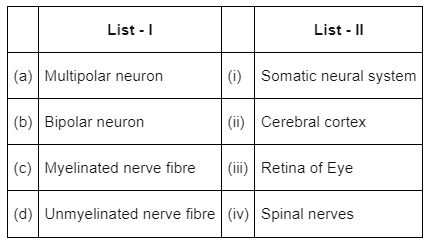
Choose the correct answer from the options given below :

Detailed Solution for 31 Years NEET Previous Year Questions: Neural Control & Coordination - Question 6

Option (a) is the correct answer because
(a) Multipolar neurons are present in cerebral cortex.
(b) Bipolar neurons are found in the retina of the eye.
(c) Myelinated nerve fibres are found in spinal and cranial nerves
(d) Unmyelinated nerve fibres are commonly found in autonomous and somatic neural systems.

31 Years NEET Previous Year Questions: Neural Control & Coordination - Question 7

Select the incorrect statement regarding synapses:       (NEET 2022 Phase 1)

Detailed Solution for 31 Years NEET Previous Year Questions: Neural Control & Coordination - Question 7

Option (c) is the correct answer as impulse transmission across an electrical synapse is always faster than that across a chemical synapse.

  • Chemical synapses use chemicals for transmission which are known as neurotransmitters.
  • The membranes of presynaptic and postsynaptic neurons are in close proximity in an electrical synapse.
  • In an electrical synapse, the transmission of the impulse occurs in the form of an electrical current from one neuron to the next neuron.

Topic in NCERT: Transmission of Impulses

Line in NCERT: "Impulse transmission across an electrical synapse is always faster than that across a chemical synapse."

31 Years NEET Previous Year Questions: Neural Control & Coordination - Question 8

Which part of the brain is responsible for thermoregulation?  [2019]

Detailed Solution for 31 Years NEET Previous Year Questions: Neural Control & Coordination - Question 8

Hypothalamus is thermoregulatory centre. Hence it is called “thermostat” of the body. It keeps body temperature at roughly 37°C by means of a complex thermostat system.

Topic in NCERT: Hypothalamus and its Functions

Line in NCERT: "The hypothalamus contains a number of centres which control body temperature."

31 Years NEET Previous Year Questions: Neural Control & Coordination - Question 9

Which of the following structures or regions is incorrectly paired with its functions?  (NEET 2018)
 

Detailed Solution for 31 Years NEET Previous Year Questions: Neural Control & Coordination - Question 9

The limbic system is collection of nuclei, tracts, and cortical areas that covers the brain and that surrounds the thalamus. The limbic system deals with three key functions: emotions, memories and arousal (or stimulation). There is no involvement in movement.

Thus, the correct answer is option B.

31 Years NEET Previous Year Questions: Neural Control & Coordination - Question 10

Receptor sites for neurotransmitters are present on    (NEET 2017)

Detailed Solution for 31 Years NEET Previous Year Questions: Neural Control & Coordination - Question 10

Pre-synaptic membrane is involved in the release of neurotransmitter in the chemical synapse. The receptors sites for neurotransmitters are present on postsynaptic membrane of neuron.

Topic in NCERT: Transmission of Impulses

Line in NCERT: "The released neurotransmitters bind to their specific receptors, present on the post-synaptic membrane."

31 Years NEET Previous Year Questions: Neural Control & Coordination - Question 11

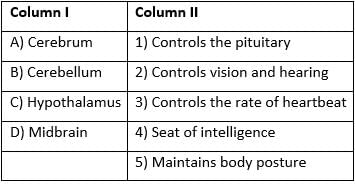
Which of the following regions of the brain is incorrectly paired with its function?    (NEET / AIPMT 2015 Cancelled Paper )

Detailed Solution for 31 Years NEET Previous Year Questions: Neural Control & Coordination - Question 11

Cerebellum maintains the balance and body posture. It is not concerned with logical part.

31 Years NEET Previous Year Questions: Neural Control & Coordination - Question 12

Injury localized to the hypothalamus would most likely disrupt:    (2014)

Detailed Solution for 31 Years NEET Previous Year Questions: Neural Control & Coordination - Question 12

The hypothalamus is a highly complex structure in the brain that regulates many important brain chemicals. The hypothalamus is responsible for hormone production. The hormones produced by this area govern body temperature, thirst, hunger, sleep, circadian rhythm, moods, sex drive, and the release of other hormones in the body. This area of the brain controls the pituitary gland and other glands in the body.

Topic in NCERT: Hypothalamus and its Functions

Line in NCERT: "The hypothalamus contains a number of centres which control body temperature, urge for eating and drinking."

31 Years NEET Previous Year Questions: Neural Control & Coordination - Question 13

A sagittal section of human-brain is shown here. Identify at least two labels from A-D. [NEET Kar. 2013]
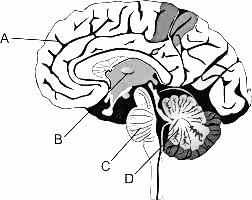
Detailed Solution for 31 Years NEET Previous Year Questions: Neural Control & Coordination - Question 13

Cerebrum is the first and most developed part of fore brain. It makes 2/3 part of total brain. Pons is a small spherical projection, which is situated below the midbrain and upper side of the medulla oblongata. It acts as a relay centre among different parts of brain. B and D are thalamus and spinal cord respectively.
Topic in NCERT: CENTRAL NEURAL SYSTEM
Line in NCERT: "The human brain can be divided into three major parts: (i) forebrain, (ii) midbrain, and (iii) hindbrain."

31 Years NEET Previous Year Questions: Neural Control & Coordination - Question 14

A diagram showing axon terminal and synapse is given. Identify correctly at least two of A-D. [NEET 2013]
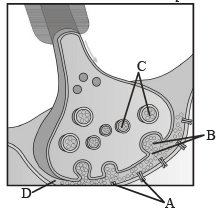
Detailed Solution for 31 Years NEET Previous Year Questions: Neural Control & Coordination - Question 14

A-Receptor, C-Synaptic vesicles B  is synaptic cleft. A synapse is  formed by the membranes of a synaptic neuron and post synaptic neuron, which may or may not separated by a gap called synaptic cleft. It is filled by fluid called neurotransmitter which are involved in transmission of impulse at these synapses.

Topic in NCERT: Neurotransmitters

Line in NCERT: "The axon terminals contain vesicles filled with these neurotransmitters."

31 Years NEET Previous Year Questions: Neural Control & Coordination - Question 15

The most abundant intracellular cation is : [NEET 2013]

Detailed Solution for 31 Years NEET Previous Year Questions: Neural Control & Coordination - Question 15

The most abundant intracellular cation is K+.

Topic in NCERT: Generation and Conduction of Nerve Impulse

Line in NCERT: "K* and negatively charged proteins and low concentration of Na*."

31 Years NEET Previous Year Questions: Neural Control & Coordination - Question 16

When a neuron is in resting state I not conducting any impulse, the axonal membrane is: [2011]

Detailed Solution for 31 Years NEET Previous Year Questions: Neural Control & Coordination - Question 16

When a neurone is in resting state i.e., not conducting any impulse, the axonal membrane is comparatively more permeable to K+ ion and nearly impermeable to Na+ ions.

Topic in NCERT: Generation and Conduction of Nerve Impulse

Line in NCERT: "When a neuron is not conducting any impulse, i.e., resting, the axonal membrane is comparatively more permeable to potassium ions (K*) and nearly impermeable to sodium ions (Na+)."

31 Years NEET Previous Year Questions: Neural Control & Coordination - Question 17

The nerve centres which control the body temperature and the urge for eating are contained  in: [2010]

Detailed Solution for 31 Years NEET Previous Year Questions: Neural Control & Coordination - Question 17

Hypothalamus contains important nerve centres that controls the body temperature, thirst, hunger and eating, water balance and sexual function.

Topic in NCERT: Hypothalamus and its Functions

Line in NCERT: "The hypothalamus contains a number of centres which control body temperature, urge for eating and drinking."

31 Years NEET Previous Year Questions: Neural Control & Coordination - Question 18

Which part of human brain is concerned with the regulation of body temperature? [2009]

Detailed Solution for 31 Years NEET Previous Year Questions: Neural Control & Coordination - Question 18

Hypothalamus part of human brain is concerned with the regulation of body temperature. The hypothalamus is a portion of the brain that contains a number of small nuclei with a variety of functions. The hypothalamus is small cone-shaped structure, projects downward, ending in the pituitary.

Topic in NCERT: Hypothalamus and its Functions

Line in NCERT: "The hypothalamus contains a number of centres which control body temperature, urge for eating and drinking."

31 Years NEET Previous Year Questions: Neural Control & Coordination - Question 19

During the propagation of a nerve impulse, the action potential results from the movement of : [2008]

Detailed Solution for 31 Years NEET Previous Year Questions: Neural Control & Coordination - Question 19

During the propagation of nerve impulse when a stimulus of adequate strength is applied to a polarised membrane, the permeability of the membrane to Na+ is greatly increased at the point of stimulation. As a result the sodium ion channels permit the influx of Na+ by diffusion. Since, there are more Naions entering than leaving, the electrical potential of the membrane changes from - 70 mV towards zero. At 0 mV the membrane is said to be depolarised. While the resting potential is determined largely by K+ ions, the action potential is determined largely by Na+ ions. Action potential is another name of nerve impulse. The stimulated negatively charged point on the outside of the membrane sends out an electrical current to the positive point adjacent to it. This local current causes the adjacent inner part of the membrane to reverse its potential from -70 mV to-+30 mV.

Topic in NCERT: Transmission of Impulses

Line in NCERT: "The rise in the stimulus-induced permeability to Na* is extremely short-lived."

31 Years NEET Previous Year Questions: Neural Control & Coordination - Question 20

During the transmission of nerve impulse through a nerve fibre, the potential on the inner side of the plasma membrane has which type of electric change? [2007]

Detailed Solution for 31 Years NEET Previous Year Questions: Neural Control & Coordination - Question 20

Once the events of depolarization have occurred, a nerve impulse or spike is initiated. Action potential is another name of nerve impulse. It lasts about 1 msec (millisecond). The stimulalted, negatively charged point on the outside of the membrane sends out an electrical current to the positive point (still polarized adjacent to it). This local current causes the adjacent inner part of the membrane to reverse its potential from –70 mV to +30 mV. The reversal repeats itself over and over until the nerve impulse is conducted through the length of the neuron

Topic in NCERT: Transmission of Impulses

Line in NCERT: "The outer surface of the membrane becomes negatively charged and the inner side becomes positively charged."

142 videos|400 docs|138 tests
Information about 31 Years NEET Previous Year Questions: Neural Control & Coordination Page
In this test you can find the Exam questions for 31 Years NEET Previous Year Questions: Neural Control & Coordination solved & explained in the simplest way possible. Besides giving Questions and answers for 31 Years NEET Previous Year Questions: Neural Control & Coordination, EduRev gives you an ample number of Online tests for practice
142 videos|400 docs|138 tests
Download as PDF