You can prepare effectively for NEET Biology Class 12 with this dedicated MCQ Practice Test (available with solutions) on the important topic of "31 Years NEET Previous Year Questions: Reproductive Health ". These 30 questions have been designed by the experts with the latest curriculum of NEET 2026, to help you master the concept.
Test Highlights:
Sign up on EduRev for free to attempt this test and track your preparation progress.
What are the potential drawbacks in adoption of the IVF method? [NEET 2025]
A. High fatality risk to mother
B. Expensive instruments and reagents
C. Husband/wife necessary for being donors
D. Less adoption of orphans
E. Not available in India
F. Possibility that the early embryo does not survive
Choose the correct answer from the options given below:
Detailed Solution: Question 1
Which of the following is not a natural/traditional contraceptive method? [NEET 2024]
Detailed Solution: Question 2
Match List I with List II [NEET 2024]

Choose the correct answer from the option given below:
Detailed Solution: Question 3
Which of the following is NOT an example of Assisted Reproductive Technology (ART)? [NEET 2024]
Detailed Solution: Question 4
Match List-I with List-II relating to examples of various kind of IUDs and barrier : [NEET 2024]

Choose the correct answer from the options given below:
Detailed Solution: Question 5
Following is a list of STDs. Select the diseases which are not completely curable. [NEET 2024]
A. Genital warts
B. Genital herpes
C. Syphilis
D. Hepatitis-B
E. Trichomoniasis
Choose the correct answer from the options given below:
Detailed Solution: Question 6
Given below are two statements: one is labelled as Assertion A and other is labelled as Reason R. [NEET 2023]
Assertion A : Amniocentesis for sex determination is one of the strategies of Reproductive and Child Health Care Programme.
Reason R : Ban on amniocentesis checks increasing menace of female foeticide.
In the light of the above statements, choose the correct answer from the options given below.
Detailed Solution: Question 7
Which one of the following common sexually transmitted diseases is completely curable when detected early and treated properly? [NEET 2023]
Detailed Solution: Question 8
Match List I with List II [NEET 2023]

Choose the correct answer from the options given below:
Detailed Solution: Question 9
Which of the following sexually transmitted infections are completely curable? [NEET 2023]
Detailed Solution: Question 10
Match List - I with List - II [NEET 2023]

Choose the correct answer from the options given below:
Detailed Solution: Question 11
Given below are two statements: [NEET 2023]
I: Intra Cytoplasmic Sperm Injection (ICSI) is another specialized procedure of in-vivo fertilization.
II: Infertility cases due to the inability of the male partner to inseminate the female can be corrected by Artificial Insemination (AI).
Choose the correct answer from the options given below:
Detailed Solution: Question 12
Which of the following statements are correct? [NEET 2023]
A. Reproductive health refers to total well-being in all aspects of reproduction
B. Amniocentesis is legally banned for sex determination in India
C. "Saheli" – an oral contraceptive for females was developed in collaboration with ICMR (New Delhi)
D. Amniocentesis is used to determine genetic disorders and survivability of foetus
Choose the most appropriate answer from the options given below:
Detailed Solution: Question 13
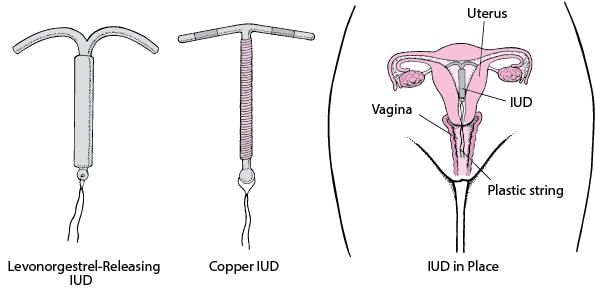
Which of the following is not an Intra Uterine Device? [NEET 2022 Phase 2]
Detailed Solution: Question 14
IUDs are small objects made up of plastic or copper that are inserted in the uterine cavity. Which of the following statements are correct about IUDs ? [NEET 2022 Phase 2]
a. IUDs decrease phagocytosis of sperm within the uterus.
b. The released copper ions suppress the sperm motility.
c. IUDs do not make the cervix hostile to the sperm.
d. IUDs suppress the fertilization capacity of sperm.
e. The IUDs require surgical intervention for their insertion in the uterine cavity.
Choose the most appropriate answer from the options given below:
Detailed Solution: Question 15
Lippe's loop is a type of contraceptive used as: [NEET 2022]
Detailed Solution: Question 16
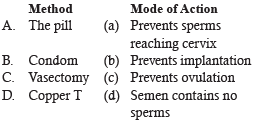
Match List-I with List-II with respect to methods of Contraception and their respective actions. [NEET 2022]

Choose the correct answer from the options given below:
Detailed Solution: Question 17
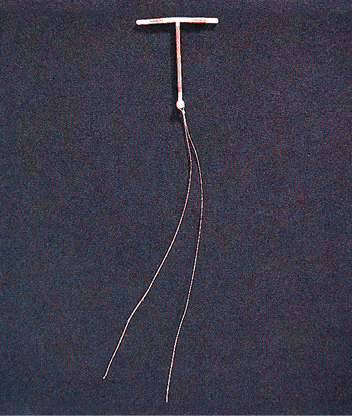
Which of the following is hormone-releasing IUD? [NEET 2021]
Detailed Solution: Question 18
Topic in NCERT: IUDsLine in NCERT: "IUDs (CUT, Cu7, Multiload 375) and the hormone releasing IUDs (Progestasert, LNG-20)."
Select option including all the sexually transmitted diseases. (2020)
Detailed Solution: Question 19
Topic in NCERT: SEXUALLY TRANSMITTED INFECTIONS (STIs)
Line in NCERT: "Gonorrhoea, syphilis, genital herpes, chlamydiasis, genital warts, trichomoniasis, hepatitis-B and of course, the most discussed infection in the recent years, HIV leading to AIDS are some of the common STIs."
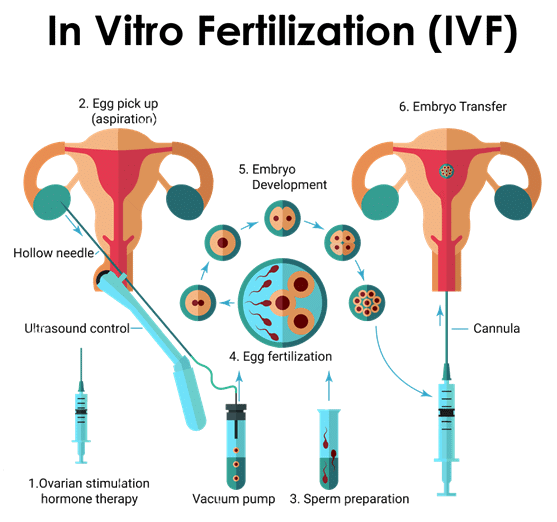
In which of the following techniques, the embryos are transferred to assist those females who cannot conceive? [NEET 2020]
Detailed Solution: Question 20
Topic in NCERT: In Vitro Fertilisation (IVF) and Assisted Reproductive Technologies (ART)Line in NCERT: "In vitro fertilisation (IVF-fertilisation outside the body in almost similar conditions as that in the body) followed by embryo transfer (ET) is one of such methods."
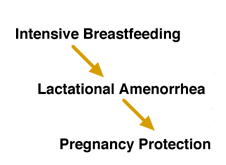
Which of the following contraceptive methods involve the role of hormones? [NEET 2019]
Detailed Solution: Question 21
Topic in NCERT: Oral contraceptivesLine in NCERT: "Pills have to be taken daily for a period of 21 days starting preferably within the first five days of menstrual cycle."
The contraceptive ‘Saheli’: [NEET 2018]
Detailed Solution: Question 22
In the case of a couple where the male is having a very low sperm count, which technique will be suitable for fertilization? [NEET 2017]
Detailed Solution: Question 23
Topic in NCERT: INFERTILITYLine in NCERT: "Infertility cases either due to inability of the male partner to inseminate the female or due to very low sperm counts in the ejaculates, could be corrected by artificial insemination (AI) technique."
One of the following is NOT a method of contraception – which one? [NEET Kar. 2013]
Detailed Solution: Question 24
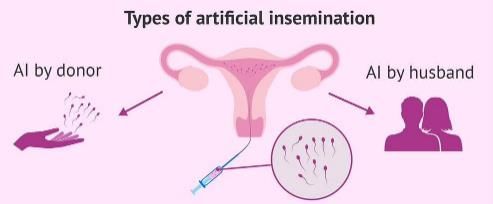
Artificial insemination mean: [NEET 2013]
Detailed Solution: Question 25
Topic in NCERT: Assisted Reproductive Technologies (ART)
Line in NCERT: "In this technique, the semen collected either from the husband or a healthy donor is artificially introduced either into the vagina or into the uterus (IUI – intra-uterine insemination) of the female."
One of the legal methods of birth control is: [NEET 2013]
Detailed Solution: Question 26
Topic in NCERT: Natural Methods of Contraception
Line in NCERT: "Periodic abstinence is one such method in which the couples avoid or abstain from coitus from day 10 to 17 of the menstrual cycle when ovulation could be expected."
Which of the following CANNOT be detected in a developing foetus by amniocentesis? [NEET 2013]
Detailed Solution: Question 27
Topic in NCERT: AMNIOCENTESIS AND INFERTILITYLine in NCERT: "amniocentesis some of the amniotic fluid of the developing foetus is taken to analyse the fetal cells and dissolved substances. This procedure is used to test for the presence of certain genetic disorders such as, down syndrome, haemoplilia, sickle-cell anemia, etc."
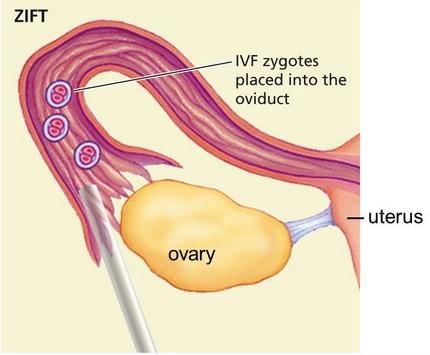
The test-tube Baby Programme employs which one of the following techniques: [2012]
Detailed Solution: Question 28
The technique called gamete intrafallopian transfer (GIFT) is recommended for those females: [2011 M]
Detailed Solution: Question 29
Topic in NCERT: Assisted Reproductive Technologies (ART)Line in NCERT: "Transfer of an ovum collected from a donor into the fallopian tube (GIFT - gamete intra fallopian transfer) of another female who cannot produce one, but can provide suitable environment for fertilisation."
Medical Termination of Pregnancy (MTP) is considered safe up to how many weeks of pregnancy? [2011]
Detailed Solution: Question 30
Topic in NCERT: MEDICAL TERMINATION OF PREGNANCY (MTP)Line in NCERT: "MTPs are considered relatively safe during the first trimester, i.e., upto 12 weeks of pregnancy."
70 videos|297 docs|167 tests |