NEET Exam  >  NEET Test  >  Topic-wise MCQ Tests  >  31 Years NEET Previous Year Questions: Biological Classification - 1 - NEET MCQ

31 Years NEET Previous Year Questions: Biological Classification - 1 Free


MCQ Practice Test & Solutions: 31 Years NEET Previous Year Questions: Biological Classification - 1 (30 Questions)

You can prepare effectively for NEET Topic-wise MCQ Tests for NEET with this dedicated MCQ Practice Test (available with solutions) on the important topic of "31 Years NEET Previous Year Questions: Biological Classification - 1". These 30 questions have been designed by the experts with the latest curriculum of NEET 2026, to help you master the concept.

Test Highlights:

  • - Format: Multiple Choice Questions (MCQ)
  • - Duration: 30 minutes
  • - Number of Questions: 30

Sign up on EduRev for free to attempt this test and track your preparation progress.

31 Years NEET Previous Year Questions: Biological Classification - 1 - Question 1

Each of the following characteristics represent a Kingdom proposed by Whittaker. Arrange the following in increasing order of complexity of body organization.    [2025]
A. Multicellular heterotrophs with cell wall made of chitin.
B. Heterotrophs with tissue/organ/organ system level of body organization.
C. Prokaryotes with cell wall made of polysaccharides and amino acids.
D. Eukaryotic autotrophs with tissue/organ level of body organization.
E. Eukaryotes with cellular body organization.undefined
Choose the correct answer from the options given below:

Detailed Solution: Question 1

Whittaker proposed five kingdoms based on cellular structure and body organization. The correct increasing order of complexity is:
C: Kingdom Monera (Prokaryotes; simplest)
E: Kingdom Protista (Unicellular eukaryotes)
A: Kingdom Fungi (Multicellular without true tissues)
D: Kingdom Plantae (Tissues and organs)
B: Kingdom Animalia (Tissues, organs, and organ systems)
Thus, the increasing order of complexity is: C, E, A, D, B.

31 Years NEET Previous Year Questions: Biological Classification - 1 - Question 2

Match List-I with List-II:    [2024]

2024

Choose the correct answer from the options given below:

Detailed Solution: Question 2

A. Euglenoid: Euglenoids can switch between photosynthetic and heterotrophic modes, thus matching with IV.
B. Dinoflagellate: Many dinoflagellates are photosynthetic, aligning with III.
C. Slime mould: Slime moulds are primarily saprophytic, which corresponds to II.
D. Plasmodium: Plasmodium is a well-known parasitic organism, matching with I.

2024

31 Years NEET Previous Year Questions: Biological Classification - 1 - Question 3

Which one of the following is not a criterion for classification of fungi?    [2024]

Detailed Solution: Question 3

The classification of fungi is based on various criteria that broadly include morphology, genetics, and physiological features. Each of the provided options, except one, is a valid criterion for the classification of fungi:

  • Morphology of mycelium: Fungi can have different types of mycelium, which refers to their vegetative structure. Fungi can be classified based on whether they have septate (with cross-walls) or coenocytic (without cross-walls) mycelium. This morphological characteristic is crucial for classification.
  • Mode of spore formation: Spore formation in fungi is a key reproductive strategy and varies significantly among different groups. Spores can be produced sexually or asexually, and the structures involved in spore production are critical for classification. Fungi are often categorized based on whether they form spores inside a sac (ascospores) or on basidia (basidiospores), among others.
  • Fruiting body: The presence and type of fruiting body (such as mushrooms, toadstools, puffballs, etc.) are used in fungi classification. These structures are involved in the production of spores and can be quite distinctive among different fungi groups.

However, the option that is not a criterion for the classification of fungi is:
Mode of nutrition: While fungi are heterotrophic (meaning they obtain their food by absorbing dissolved molecules, typically from decomposing material), this characteristic is generally true across all fungi. They can be saprophytic (decomposers), parasitic (feeding on living organisms), or mutualistic (engaging in mutually beneficial relationships). Despite these differences in their ecological roles or interactions, the mode of nutrition is not typically used as a primary criterion for formal taxonomic classification in fungi. It is more pertinent to ecological or functional groupings rather than taxonomic classification.
Therefore, the correct answer is Option B: Mode of nutrition.

31 Years NEET Previous Year Questions: Biological Classification - 1 - Question 4

The asexual spores of deuteromycetes are:    [2024]

Detailed Solution: Question 4

Deuteromycetes, also known as imperfect fungi, reproduce asexually through spores called conidia. These spores are produced exogenously on specialized structures called conidiophores. Other options such as aplanospores and zoospores are associated with different fungal groups, while basidiospores are produced by basidiomycetes.

31 Years NEET Previous Year Questions: Biological Classification - 1 - Question 5

Match List I with List II    [2024]
2024

Choose the correct answer from the options given below:

Detailed Solution: Question 5

Let's analyze the matching based on what each item in List I corresponds to in List II:

  • Rhizopus is commonly known as black bread mold, which matches with "Bread mould." Therefore, Rhizopus corresponds to III.
  • Ustilago is a type of smut fungus that affects grains, so it rightfully matches with "Smut fungus." Thus, Ustilago corresponds to II.
  • Puccinia is well-known for causing rust in plants, indicating that it matches with "Rust fungus." This means Puccinia corresponds to IV.
  • Agaricus is the genus that includes various mushrooms, such as the common button mushroom. This matches with "Mushroom," so Agaricus corresponds to I.

Given the matches:
A - Rhizopus corresponds to III, B - Ustilago corresponds to II, C - Puccinia corresponds to IV, D - Agaricus corresponds to I. Comparing these with the provided options:
Option A (A-III, B-II, C-IV, D-I) matches exactly with the analysis above.
Therefore, the correct answer is: Option A.

31 Years NEET Previous Year Questions: Biological Classification - 1 - Question 6

Given below are two statements:    [2022 Phase 1]
Statement I: Mycoplasma can pass through less than 1 micron filter size.
Statement II: Mycoplasma are bacteria with cell wall.
In the light of the above statements, choose the most appropriate answer from the options given below: 

Detailed Solution: Question 6

Mycoplasma are the smallest cells and are only 0.3 μm in length. So it can pass through less than 1 μm filter size.
Mycoplasma lack cell wall.
2022

31 Years NEET Previous Year Questions: Biological Classification - 1 - Question 7

Mad cow disease in cattle and Cr Jacob disease in humans are due to infection by ______.    [2022 Phase 2]

Detailed Solution: Question 7

Prions are abnormally folded proteins. They cause mad cow disease in cattle and Cr Jacob disease in humans.

31 Years NEET Previous Year Questions: Biological Classification - 1 - Question 8

Which of the following statements is correct?    (2021)

Detailed Solution: Question 8

  • Some of the organisms can fix atmospheric nitrogen in specialised cells called heterocysts, e.g., Nostoc and Anabaena.
  • Most fungi are heterotrophic and absorb soluble organic matter from dead substrates and hence are called saprophytes.
  • Fusion of protoplasms between two motile or non-motile gametes is called plasmogamy.
  • Fusion of two nuclei is called karyogamy.

Hence, the correct option is D

NCERT Reference: Page no. 22 of topic “2.3 KINGDOM FUNGI” of chapter 2 of NCERT

31 Years NEET Previous Year Questions: Biological Classification - 1 - Question 9

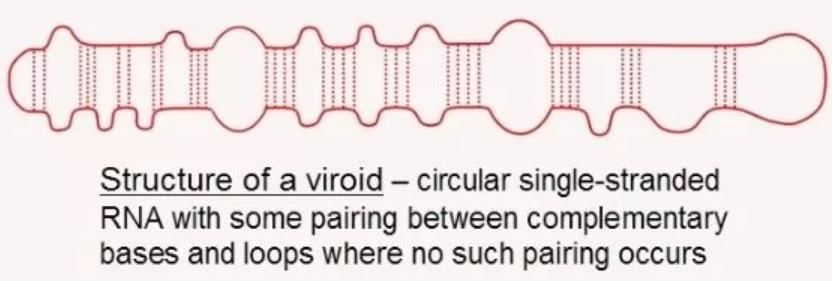
Which of the following is correct about viroids?    (2020)
Detailed Solution: Question 9

  • Viroids have free RNA without protein coat.
  • Potato spindle tuber disease is a disease caused by viroids.

Hence, the correct option is D

NCERT Reference: Page no. 27 of chapter 2 of NCERT

31 Years NEET Previous Year Questions: Biological Classification - 1 - Question 10

Which of the following is incorrect about Cyanobacteria?  (2020)
Detailed Solution: Question 10

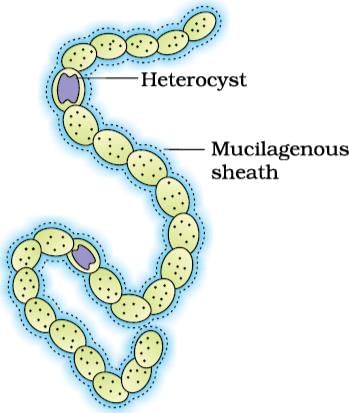
  • The cyanobacteria are unicellular, colonial or filamentous, freshwater/marine or terrestrial algae.
  • The colonies are generally surrounded by a gelatinous sheath. They often form blooms in polluted water bodies.
  • Some of these organisms can fix atmospheric nitrogen in specialised cells called heterocysts, e.g. Nostoc and Anabaena.


Fig: Nostoc showing Heterocyst

Hence, the correct option is B

NCERT Reference: Page no. 19 of topic “2.1.2 Eubacteria” of chapter 2 of NCERT

31 Years NEET Previous Year Questions: Biological Classification - 1 - Question 11

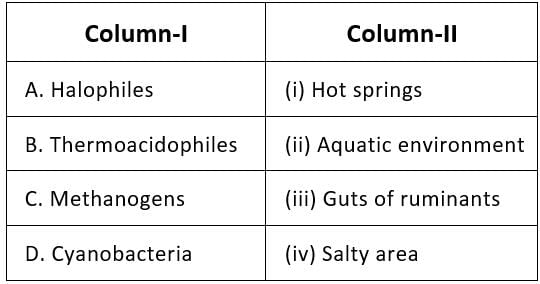
Match the organisms in column-I with habitats in column-II.     (2019)
Select the correct answer from the options given below:  (2019)

Detailed Solution: Question 11

  • Halophiles can be found in hypersaline environments which are widely distributed in various geographical areas on Earth, such as saline lakes, salt pans, salt marshes, or saline soils.
  • Thermoacidophiles can be found in hot springs and solfataric environments, within deep-sea vents, or in other environments of geothermal activity. These are microorganisms that are both thermophilic and acidophilic, i.e., they can grow under conditions of high temperature and low pH.
  • Methanogens are a group of microorganisms that can produce methane as a byproduct of their metabolism. They hold an important place in the digestive system of ruminants.
  • Cyanobacteria, also called blue-green algae, are microscopic organisms found naturally in all types of water. These single-celled organisms live in fresh, brackish (combined salt and fresh water), and marine water.

Hence, the correct option is A

NCERT Reference: Page no. 19 of topic “2.1.1 Archaebacteria” of chapter 2 of NCERT

31 Years NEET Previous Year Questions: Biological Classification - 1 - Question 12

Which of the following statements is incorrect?     (2019)

Detailed Solution: Question 12

  • Infective constituent of the virus is not the protein coat, but the nucleic acid, either DNA or RNA
  • In general, viruses that infect plants have single stranded RNA and viruses that infect animals have either single or double stranded RNA or double stranded DNA.

Hence, the correct option is D

NCERT Reference: Page no. 26 (last paragraph) of chapter 2 of NCERT

31 Years NEET Previous Year Questions: Biological Classification - 1 - Question 13

Mad cow disease in cattle is caused by an organism which has:     (2019)

Detailed Solution: Question 13

  • In modern medicine certain infectious neurological diseases were found to be transmitted by an agent consisting of abnormally folded protein. The agent was similar in size to viruses.
  • These agents were called prions. The most notable diseases caused by prions are bovine spongiform encephalopathy (BSE) commonly called mad cow disease in cattle.

Hence, the correct option is B

NCERT Reference: Page no. 27 of “Prions” of chapter 2 of NCERT

31 Years NEET Previous Year Questions: Biological Classification - 1 - Question 14

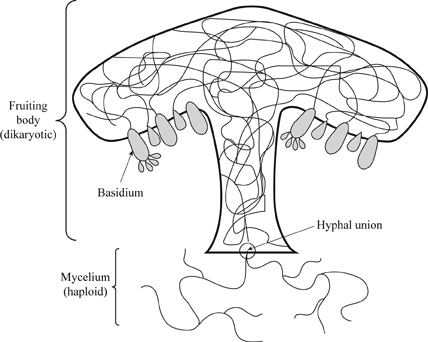
After karyogamy followed by meiosis, spores are produced exogenously in ______.   (2018)
Detailed Solution: Question 14

  • In Agaricus, (member of Basidiomycetes), basidium commonly produces four microspores or basidiospores exogenously. 
    Definition of The Major Groups Of Fungi | Chegg.com
  • Neurospora (member of Ascomycetes) produces ascospores, endogenously inside the fruiting body, ascus.
  • Alternaria (member of Deuteromycetes) does not produce any sexual spores.
  • Saccharomyces (member of Ascomycetes) produces ascospores endogenously.

Hence, the correct option is C

NCERT Reference: Page no. 24 of topic “2.3.3 Basidiomycetes” of chapter 2 of NCERT

31 Years NEET Previous Year Questions: Biological Classification - 1 - Question 15

Which among the following is not a prokaryote.    (2018)
Detailed Solution: Question 15

  • An organism that does not possess a true nucleus (nucleus with nuclear membrane) and membrane-bounded organelles are called as prokaryotes
  • Monerans are prokaryotes. Eg. bacteria (Mycobacterium), cyanobacteria (Nostoc and Oscillatoria). 
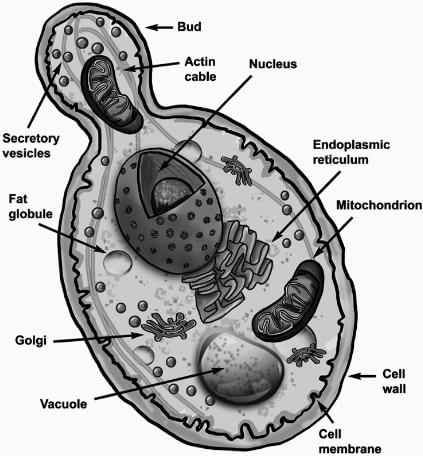
  • Saccharomyces belong to Kingdom Fungi which possess a true nucleus and membrane-bounded organelles i.e., eukaryotic. 


Fig: Saccharomyces

Hence, the correct option is A

NCERT Reference: Page no. 23 of topic “2.3.2 Ascomycetes” of chapter 2 of NCERT

31 Years NEET Previous Year Questions: Biological Classification - 1 - Question 16

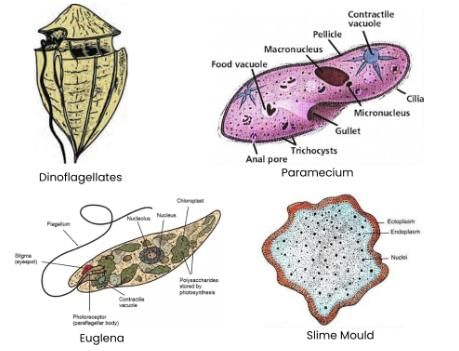
Chrysophytes, Euglenoids, Dinoflagellates and Slime moulds are included in the kingdom______.              [2016]
Detailed Solution: Question 16

All unicellular eukaryotic organisms like diatoms, desmids (chrysophytes), euglenoids, dinoflagellates and slime mould are included in Protista

Characteristics of Kingdom Protista:

  • Unicellular eukaryotic.
  • Mostly aquatic.
  • Well defined nucleus present.
  • Various membrane bound organelles  present.
  • Flagella and cilia, if present have  (9+2) pattern of microtubular stands.
  • Reproduction is asexual and sexual.
  • Autotrophic, parasitic and heterotrophic.

Hence, the correct option is B

NCERT Reference: Page no. 20 of topic “2.2 KINGDOM PROTISTA” of chapter 2 NCERT

31 Years NEET Previous Year Questions: Biological Classification - 1 - Question 17

Which one of the following statements is wrong?              [2016]

Detailed Solution: Question 17

  • A biological kingdom composed of prokaryotes (especially bacteria) is Monera. As such, it is made up of cells that are single-celled and without a true nucleus.

Now, let us find the solution from the options:

  • Typically, Cyanobacteria receive their energy via oxygen photosynthesis, which creates oxygen gas in the Earth's atmosphere. Cyanobacteria are also named Blue-green algae. They are bacteria which are photosynthetic. Thus, option A is not the correct option.
  • Single-celled biflagellates with two specialized flagella are golden algae. The pigment fucoxanthin and the use of oil droplets as a nutritional reserve define them. Desmids are sometimes referred to as golden algae. Thus, option B is not the correct option.
  • Eubacteria are single-celled prokaryotic microorganisms which have a variety of features and are present in all regions of the world in diverse environments. Bacteria have two domains, namely archaea and Eubacteria. True bacteria, too, are named Eubacteria. They've got rigid walls of cells and flagella.
  • Algal fungi are also named Phycomycetes. They have distinctive coenocytic aseptate hyphae. Thus, option D is not the correct option.

Hence, the correct option is C

NCERT Reference: Page no. 19 of topic “2.1.2 Eubacteria” of chapter 2 of NCERT

31 Years NEET Previous Year Questions: Biological Classification - 1 - Question 18

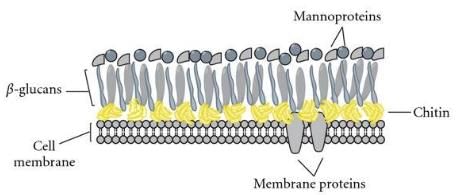
One of the major components of cell wall of most fungi is                     [2016]
Detailed Solution: Question 18

  • The cell wall is an outermost, rigid layer that provides support to the cell.
  • The presence of a cell wall is a characteristic feature of plants, fungi and bacteria. It is absent in animals.
  • The fungi are the group of eukaryotic cells that are saprotrophic in nature and include yeasts, mushrooms and moulds.
  • The cell wall of fungus is mainly made up of chitin, glycans and glycoproteins. It provides rigidity and shape to the cell and helps in ion exchange and metabolism.
  • Chitin is a homo-polysaccharide which is made up of N-acetyl glucosamine (NAG).
  • The peptidoglycan is the major component of the cell wall of bacteria. In Gram-positive bacteria, a thick layer of peptidoglycan and teichoic acid is present in the cell wall, due to which it is unable to get the pink colour of safranin dye. It appears violet in colour. In Gram-negative bacteria, a thin layer of peptidoglycan layer is present in the cell wall, due to which it gets the pink colour of safranin dye. It appears pink in colour.
  • Cellulose is the major component of the cell wall of plants and algae. Cellulose is a homopolysaccharide of the glucose molecule. It is the most abundant organic molecule on earth. It is digested by a cellulase enzyme.
  • The hemicellulose is a heteropolysaccharide, made up of galactose, mannose and arabinose. It is present in the cell wall of plants and acts as cementing in ground substance.

Hence, the correct option is A

NCERT Reference: Page no. 22 of topic “2.3 KINGDOM FUNGI” of chapter 2 of NCERT

31 Years NEET Previous Year Questions: Biological Classification - 1 - Question 19

Which of the following statements is wrong for viroids?            [2016]

Detailed Solution: Question 19

  • Viroids are infectious, nonprotein‐coding, highly structured small circular low-molecular-weight ribonucleic acids (RNAs) able to replicate autonomously and induce diseases in higher plants. 
  • Viroids are single-stranded covalently closed circular RNA molecules existing as highly base-paired rod-like structures.

Hence, the correct option is D

NCERT Reference: Page no. 27 of chapter 2 of NCERT

31 Years NEET Previous Year Questions: Biological Classification - 1 - Question 20

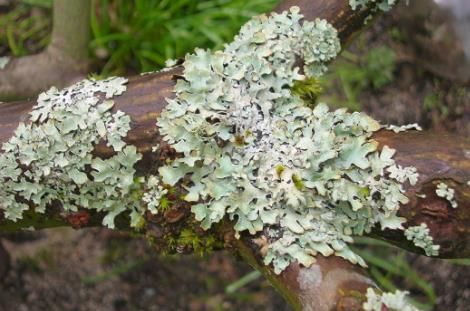
Which of the following are the most suitable indicators of SO2 pollution in the environment?                  [2015]
Detailed Solution: Question 20

  • Lichens are very good pollution indicators. They cannot grow in the place where sulphur dioxide, pollutant is available in the environment. 
  • Whereas Conifers, Algae and Fungi do not act as pollution indicators.

Fig: Lichens as Air pollution indicators

Hence, the correct option is D

NCERT Reference: Page no. 27 of chapter 2 of NCERT

31 Years NEET Previous Year Questions: Biological Classification - 1 - Question 21

 Choose the wrong statements:                                  [2015]

Detailed Solution: Question 21

A. Neurospora has a short life cycle and hence, it is used in genetical and biochemical studies. Hence, statement A is correct.

B. Morels or Morchella, commonly known as a sponge mushroom produces fruiting body basidiocarp which is edible. Truffles are the ascomycetes which also produce edible fruiting bodies. Hence, statement B is incorrect.

C. Yeast is a unicellular i.e. single-celled and non-mycelial saprophytic fungus. In anaerobic conditions, yeast converts sugar into alcohol with the release of carbon dioxide and some energy. Due to this, yeast is used in the fermentation process. Hence, statement C is correct.

D. Penicillium is a saprophytic fungus belonging to Ascomycetes. The mycelium is profusely branched and septate. Cells are thin-walled with many nuclei in them. Thus, it is multicellular. Penicillin is an antibiotic produced from Penicillium. Hence, statement D is correct.

Hence, the correct option is B

NCERT Reference: Page no. 24 of topic “2.3.2 Ascomycetes” of chapter 2 of NCERT

31 Years NEET Previous Year Questions: Biological Classification - 1 - Question 22

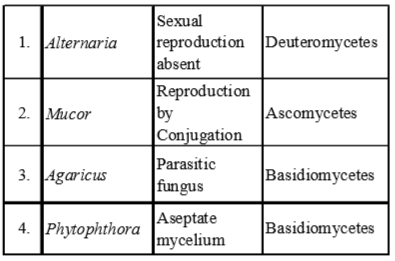
 Which one of the following matches is correct ?        [2015]

Detailed Solution: Question 22

Let us find the correct answer from the following,

Option A: Alternaria belongs to Deuteromycetes, which are also known as imperfect fungi since they reproduce through asexual reproduction or vegetative reproduction. Deuteromycetes reproduce by asexual spores known as conidia. Some members of deuteromycete are parasitic and saprophytes, while a majority of them are decomposers of litter and they help in mineral cycling. Alternaria lack sexual reproduction. Therefore, this is the correct option.

Option B: Mucor is a type of fungus seen in soil and plant leaves. They belongs to the category of phycomycetes and they undergoes asexual reproduction by zoospores or aplanospores. Other examples for phycomycetes are Rhizopus and Albugo. Therefore, this is the incorrect option.

Option C: Agaricus, which is also known as mushroom, belongs to basidiomycetes. They grow on soil, logs and tree stumps. Asexual spores are absent, but vegetative reproduction is common in them.These are saprophytic fungi and are not parasitic. Ustillago and Puccinia are other examples for basidiomycetes. Therefore, this is the incorrect option.

Option D: Phytophthora belongs to algal fungi, also known as phycomycetes. These are mostly found in aquatic habitats. They have coenocytic and septate mycelium. Therefore, this is the incorrect option.

Hence, the correct option is A

NCERT Reference: Page no. 24 of topic “2.3.4 Deuteromycetes” of chapter 2 of NCERT

31 Years NEET Previous Year Questions: Biological Classification - 1 - Question 23

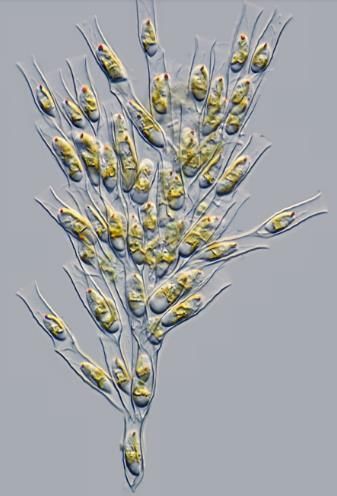
In which group of organisms the cell walls form two thin overlapping shells which fit together?                  [2015]
Detailed Solution: Question 23

  • In chrysophytes, the cell walls form two thin overlapping shells holding together.
  • The body of Diatoms appears like a soap box due to overlapping shells. 

Fig: Chrysophytes

Hence, the correct option is D

NCERT Reference: Page no. 20 of topic “2.2.1 Chrysophytes” of chapter 2 of NCERT

31 Years NEET Previous Year Questions: Biological Classification - 1 - Question 24

 True nucleus is absent in :                     [2015 RS]

Detailed Solution: Question 24

  • Anabaena is a cyanobacteria which lacks a true nucleus because of the absence of a nuclear membrane.
  • Vaucheria, Volvox, and Mucor have domain Eukaryota while Anabaena has domain Prokaryota. Eukaryotes have membrane-bound well-defined nucleus whereas Prokaryotes do not have a membrane-bound nucleus because, in them, the genetic material lies freely in the cytoplasm. 

Hence, the correct option is D

NCERT Reference: Page no. 19 of topic “2.1.2 Eubacteria” of chapter 2 of NCERT

31 Years NEET Previous Year Questions: Biological Classification - 1 - Question 25

 The imperfect fungi which are decomposer of litter and help in mineral cycling belong to:                     [2015]

Detailed Solution: Question 25

  • Deuteromycetes are the imperfect fungi which include all those fungi in which the sexual stage is either absent or not known.
  • Some of the members are saprophytes or parasites while most of them are decomposers of litter and help in the cycling of minerals. E.g., Colletotrichum, Helminthosporium, etc.

Hence, the correct option is D

NCERT Reference: Page no. 24 of topic “2.3.4 Deuteromycetes” of chapter 2 of NCERT

31 Years NEET Previous Year Questions: Biological Classification - 1 - Question 26

Which one is wrong statement?                                 [2015]

Detailed Solution: Question 26

  • Mucor is a type of fungi that does not produce flagellate zoospores. It reproduces asexually through non-motile spores known as sporangiospores. These are formed inside a sac called a sporangium. Therefore, the first statement is incorrect. 
  • Gymnosperms don't have double fertilization, the endosperm is haploid and is formed by the repeated division of haploid megaspores and later develops into female gametophyte with haploid chromosomes.
  • Brown algae are also known as Phaeophyceae. It is a group of marine multi-cellular algae, which play a critical role in marine environments. Its brown color is due to the presence of pigment fucoxanthin. It also consist of pigment chlorophyll a and c.
  • Archegonia is the female reproductive part of flask-shaped structure. It contains of neck and swollen base, where neck consist of one or more layers of cells and swollen part contains of egg. It is found in Bryophytes (eg: ferns and mosses), gymnosperms (eg: cycads and conifers), and Pteridophyta (eg: azolla).

Hence, the correct option is A
NCERT Reference: Page no. 23 of topic “2.3.1 Phycomycetes”of chapter 2 of NCERT

31 Years NEET Previous Year Questions: Biological Classification - 1 - Question 27

 Pick up the wrong statement.                                           [2015]

Detailed Solution: Question 27

The kingdom Monera possesses unicellular organisms (e.g - bacteria) having no nuclear membrane.

Hence, the correct option is C

NCERT Reference: Page no. 18 of chapter 2 of NCERT

31 Years NEET Previous Year Questions: Biological Classification - 1 - Question 28

 Five kingdom system of classification suggested by R.H. Whittaker is based on:                        [2014]

Detailed Solution: Question 28

Correct option is A.  All of these
R. H. Whittaker recommended the Five Kingdom Classification in 1969. He partitioned living creatures into five realms Monera, Protista, Fungi, Plantae, and Animalia. The grouping depended on the cell structure like a prokaryotic cell or eukaryotic cell, cell divider constituents, and so forth body organization, method of sustenance (autotrophic, heterotrophic), propagation, and phylogenetic connections.

Final answer: The Five Kingdom Classification suggested by R. H. Whittaker was based on the complexity of body organization, mode of nutrition, and presence or absence of a well-defined nucleus.

31 Years NEET Previous Year Questions: Biological Classification - 1 - Question 29

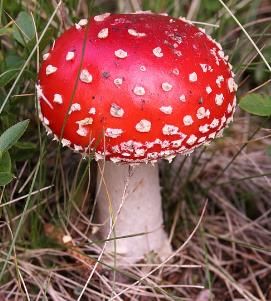
 Which one of the following fungi contains hallucinogens?             [2014]
Detailed Solution: Question 29

  • Several mushrooms such as Amanita muscaria, Psilocybe mexicana and Panaeolus spp. secrete hallucinogenic substances like psilocybin and psilocin.
  • These substances may destroy brain cells and the perception power of human beings. 

Amanita Muscaria:

31 Years NEET Previous Year Questions: Biological Classification - 1 - Question 30

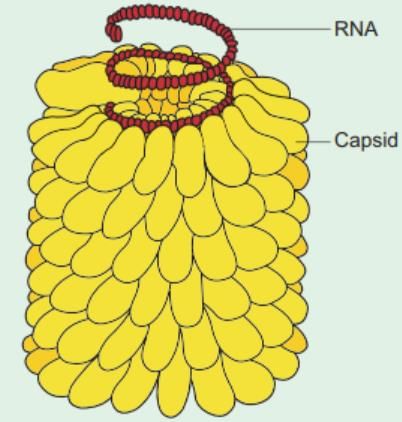
Which of the following shows coiled RNA strand and capsomeres?            [2014]
Detailed Solution: Question 30

  • TMV (Tobacco Mosaic Virus) is a rod shaped virus.
  • The rod has a core which contains helically coiled single-stranded RNA.
  • There is a protective covering of protein called capsid around the infective part.
  • Capsid consists of small subunits called capsomeres and has antigenic properties. 

Hence, the correct option is B

NCERT Reference: Page no. 26 of topic “2.6 VIRUSES, VIROIDS, PRIONS AND LICHENS” of chapter 2 of NCERT

8 docs|805 tests
Information about 31 Years NEET Previous Year Questions: Biological Classification - 1 Page
In this test you can find the Exam questions for 31 Years NEET Previous Year Questions: Biological Classification - 1 solved & explained in the simplest way possible. Besides giving Questions and answers for 31 Years NEET Previous Year Questions: Biological Classification - 1, EduRev gives you an ample number of Online tests for practice
Download as PDF