NEET Exam  >  NEET Test  >  Topic-wise MCQ Tests  >  31 Years NEET Previous Year Questions: Plant Kingdom - 1 - NEET MCQ

31 Years NEET Previous Year Questions: Plant Kingdom - 1 Free MCQ Practice


MCQ Practice Test & Solutions: 31 Years NEET Previous Year Questions: Plant Kingdom - 1 (35 Questions)

You can prepare effectively for NEET Topic-wise MCQ Tests for NEET with this dedicated MCQ Practice Test (available with solutions) on the important topic of "31 Years NEET Previous Year Questions: Plant Kingdom - 1". These 35 questions have been designed by the experts with the latest curriculum of NEET 2026, to help you master the concept.

Test Highlights:

  • - Format: Multiple Choice Questions (MCQ)
  • - Duration: 35 minutes
  • - Number of Questions: 35

Sign up on EduRev for free to attempt this test and track your preparation progress.

31 Years NEET Previous Year Questions: Plant Kingdom - 1 - Question 1

The correct sequence of events in the life cycle of bryophytes is       [2025]
A. Fusion of antherozoid with egg
B. Attachment of gametophyte to substratum
C. Reduction division to produce haploid spores
D. Formation of sporophyte
E. Release of antherozoids into water
Choose the correct answer from the options given below:

Detailed Solution: Question 1

In the life cycle of bryophytes, the gametophyte is the dominant phase. The correct sequence is:
B. The gametophyte first attaches to the substratum.
E. The male sex organs (antheridia) release antherozoids into water.
A. Antherozoids swim and fuse with the egg in archegonia to form a zygote.
D. The zygote develops into a sporophyte.
C. The sporophyte undergoes reduction division (meiosis) to produce haploid spores.

31 Years NEET Previous Year Questions: Plant Kingdom - 1 - Question 2

Given below are the stages in the life cycle of pteridophytes. Arrange the following stages in the correct sequence.    [Neet 2025]
A. Prothallus stage
B. Meiosis in spore mother cells
C. Fertilisation
D. Formation of archegonia and antheridia in the gametophyte
E. Transfer of antherozoids to the archegonia in the presence of water
Choose the correct answer from the options given below:

Detailed Solution: Question 2

The life cycle of pteridophytes includes alternation of generations. The correct sequence is:
B. Meiosis in spore mother cells – forms haploid spores
A. Prothallus stage – spores germinate into gametophyte (prothallus)
D. Formation of archegonia and antheridia in gametophyte – gametophyte develops sex organs
E. Transfer of antherozoids to archegonia in presence of water – fertilisation requires water for sperm movement
C. Fertilisation – results in diploid zygote developing into sporophyte

31 Years NEET Previous Year Questions: Plant Kingdom - 1 - Question 3

Match List-I with List-II    [Neet 2025]

2025

Choose the option with all correct matches.

Detailed Solution: Question 3

A. Pteridophyte: Salvinia (IV)
Correct. Salvinia is an aquatic fern, hence a pteridophyte.
B. Bryophyte: Polystichum (III)
Correct.  Polytrichum is a moss.
C. Angiosperm: Salvia (I)
Correct. Salvia is a flowering plant (angiosperm).
D. Gymnosperm: Ginkgo (II)
Correct. Ginkgo is a well-known gymnosperm.

31 Years NEET Previous Year Questions: Plant Kingdom - 1 - Question 4

In bryophytes, the gemmae help in which one of the following?    [Neet 2025]

Detailed Solution: Question 4

Gemmae are small, multicellular, green, disc-like structures found in bryophytes (e.g., Marchantia). They are produced in gemma cups and serve the purpose of asexual reproduction. When detached from the parent plant, they develop into new individuals, genetically identical to the parent.

31 Years NEET Previous Year Questions: Plant Kingdom - 1 - Question 5

Which one of the following is the characteristic feature of gymnosperms?    [Neet 2025]

Detailed Solution: Question 5

Gymnosperms are seed-producing plants that do not form flowers or fruits. Their seeds are naked, meaning they are not enclosed within fruits, but are exposed on the surface of cone scales or other structures. This is a key distinguishing feature from angiosperms, which have seeds enclosed within fruits.

31 Years NEET Previous Year Questions: Plant Kingdom - 1 - Question 6

Match List-I with List-II    [NEET 2024]

2024

Choose the correct answer from the options given below:

Detailed Solution: Question 6

A. Microscopic angiosperm → Wolffia (IV): Wolffia is a genus of tiny floating aquatic plants known as the smallest flowering plants. Hence, it is the microscopic angiosperm.
B. Tallest gymnosperm → Sequoia (III): The Sequoia (often referred to as the Giant Sequoia or Redwoods) is the tallest gymnosperm, known for its height.
C. Thalloid bryophyte → Marchantia (II): Marchantia is a type of thalloid bryophyte, meaning its plant body is undifferentiated into roots, stems, and leaves (a thallus).
D. Heterosporous pteridophyte → Salvinia (I): Salvinia is a heterosporous pteridophyte, meaning it produces two types of spores (microspores and megaspores) for reproduction.
Therefore, the correct matching is:
A-IV (Wolffia)
B-III (Sequoia)
C-II (Marchantia)
D-I (Salvinia)
Thus, the correct answer is (B) A-IV, B-III, C-II, D-I.

31 Years NEET Previous Year Questions: Plant Kingdom - 1 - Question 7

Read the following statements and choose the set of correct statements:    [NEET 2024]
In the members of Phaeophyceae,
A. Asexual reproduction occurs usually by biflagellate zoospores.
B. Sexual reproduction is by oogamous method only.
C. Stored food is in the form of carbohydrates which is either mannitol or laminarin.
D. The major pigments found are chlorophyll a, c and carotenoids and xanthophyll.
E. Vegetative cells have a cellulosic wall, usually covered on the outside by gelatinous coating of algin.
Choose the correct answer from the options given below:

Detailed Solution: Question 7

Ans: (c)
Let's analyze each statement:

  • Statement A: Asexual reproduction occurs usually by biflagellate zoospores: This statement is true for Phaeophyceae (brown algae). Asexual reproduction in these algae generally involves the release of biflagellate zoospores that swim away and eventually settle and grow into new individuals.
  • Statement B: Sexual reproduction is by oogamous method only:  This statement is partially true. While sexual reproduction in Phaeophyceae often is oogamous (involving a large non-motile egg and a smaller motile sperm), there are instances where isogamy (both gametes are motile and similar in size) occurs, though it is less common. Thus, the statement might be misleading as it implies that oogamy is the only method of sexual reproduction.
  • Statement C: Stored food is in the form of carbohydrates which is either mannitol or laminarin: This statement is correct. In brown algae, the primary carbohydrates stored are mannitol and laminarin. These serve as crucial energy storage compounds.
  • Statement D: The major pigments found are chlorophyll a, c and carotenoids and xanthophyll:  This statement is true. The brown algae have chlorophyll a, c, various carotenoids, and xanthophylls like fucoxanthin which give them their distinctive brown color.
  • Statement E: Vegetative cells have a cellulosic wall, usually covered on the outside by a gelatinous coating of algin: This statement is true. Brown algae have cell walls made of cellulose and are often covered by a layer of alginates, which can form a gelatinous coating. This helps in providing structural support and protection against dessication and mechanical damage.

Given these analyses:
A, C, D, and E are true.
B is not exclusively true as it suggests that oogamy is the only form of sexual reproduction.
Thus, the correct option is:
Option C: A, C, D and E only

31 Years NEET Previous Year Questions: Plant Kingdom - 1 - Question 8

Which of the following is the correct match?    [NEET 2024]

Detailed Solution: Question 8

Gymnosperms are seed-producing plants that do not have flowers or fruits. The examples listed in option (a) - Cedrus, Pinus, Sequoia - are all gymnosperms. Cedrus and Pinus are types of conifers (cone-bearing trees), and Sequoia is known for being the tallest tree and is also a gymnosperm.
Let’s review the other options:
(b) Angiosperms: Wolffia, Eucalyptus, Sequoia:
Wolffia and Eucalyptus are angiosperms, but Sequoia is a gymnosperm, not an angiosperm. This makes option (b) incorrect.
(c) Bryophytes: Polytrichum, Polysiphonia, Sphagnum:
Polytrichum and Sphagnum are bryophytes (non-vascular plants), but Polysiphonia is a type of red algae, not a bryophyte. Therefore, this option is incorrect.
(d) Pteridophytes: Equisetum, Ginkgo, Adiantum:
Equisetum and Adiantum are pteridophytes (ferns), but Ginkgo is a gymnosperm, not a pteridophyte. So, this option is also incorrect.
Therefore, the correct match is (a) Gymnosperms: Cedrus, Pinus, Sequoia.

31 Years NEET Previous Year Questions: Plant Kingdom - 1 - Question 9

Given below are two statements: One is labelled as Assertion (A) and the other is labelled as Reason (R):    [NEET 2023]
Assertion (A): In gymnosperms, the pollen grains are released from the microsporangium and carried by air currents.
Reason (R): Air currents carry the pollen grains to the mouth of the archegonia where the male gametes are discharged and pollen tube is not formed.In the light of the above statements, choose the correct answer from the options given below:

Detailed Solution: Question 9

Assertion (A): "In gymnosperms, the pollen grains are released from the microsporangium and carried by air currents."
This is True. In gymnosperms, the pollen grains are released from the microsporangium (pollen sacs) and are carried by wind (air currents) to reach the female cones for fertilization.
Reason (R): "Air currents carry the pollen grains to the mouth of the archegonia where the male gametes are discharged and pollen tube is not formed."
This is False. In gymnosperms, the pollen grains do not reach the mouth of the archegonia (female reproductive organ). Instead, the pollen grains land on the ovule, where a pollen tube is formed to carry the male gametes (sperm) to the egg cell for fertilization. Hence, the statement that "pollen tube is not formed" is incorrect.
Therefore, the correct answer is (d) (A) is True, (R) is False.

31 Years NEET Previous Year Questions: Plant Kingdom - 1 - Question 10

Identify the pair of heterosporous pteridophytes among the following:    [NEET 2023]

Detailed Solution: Question 10

Selaginella and Salvinia are heterosporous pteridophytes. They produces two different kind of spores.
Psilotum, Lycopodium and Equisetum are homosporous pteridophytes.

31 Years NEET Previous Year Questions: Plant Kingdom - 1 - Question 11

Given below are two statements : One labelled as Assertion A and the other labelled as Reason R:
Assertion A: The first stage of gametophyte in the life cycle of moss is protonema stage.
Reason R: Protonema develops directly from spores produced in capsule.
In the light of the above statements, choose the most appropriate answer from options given below:    [NEET 2023]

Detailed Solution: Question 11

The life cycle of mosses consists of two stages: the gametophyte stage and the sporophyte stage.

  • Assertion A states : "The first stage of the gametophyte in the life cycle of moss is the protonema stage." This statement is correct. After a spore germinates, it forms a mass of green, branched, one-cell-thick filaments known as the protonema, which is indeed the first stage of the gametophyte generation in mosses.
  • Reason R states : "Protonema develops directly from spores produced in the capsule." This statement is also correct. The spores are produced in a capsule, which is the sporophyte part of the moss life cycle. When these spores are released and germinate, they grow into the protonema.

Not only are both statements correct, but Reason R provides a correct explanation for Assertion A.
Therefore, the answer is: Option A : Both A and R are correct and R is the correct explanation of A.

31 Years NEET Previous Year Questions: Plant Kingdom - 1 - Question 12

Match List - I with List - II   [NEET 2023]

2023

Choose the correct answer from the options given below:

Detailed Solution: Question 12

  • Pteropsida (A) corresponds to Adiantum (III): Pteropsida includes ferns, and Adiantum is a type of fern.
  • Lycopsida (B) corresponds to Selaginella (IV): Lycopsida is a class of club mosses, and Selaginella is a type of club moss.
  • Psilopsida (C) corresponds to Psilotum (I): Psilopsida is a group of primitive vascular plants, and Psilotum is an example.
  • Sphenopsida (D) corresponds to Equisetum (II): Sphenopsida includes horsetails, and Equisetum is a type of horsetail.

Thus, the correct answer is (d) (A-III) (B-IV) (C-I) (D-II).

31 Years NEET Previous Year Questions: Plant Kingdom - 1 - Question 13

Which classes of algae possess pigment fucoxanthin and pigment phycoerythrin, respectively?    [NEET 2023]

Detailed Solution: Question 13

  • Fucoxanthin is a type of carotenoid pigment that is primarily found in the class Phaeophyceae (brown algae). It gives these algae their characteristic brown or olive color and plays a role in capturing light energy for photosynthesis.
  • Phycoerythrin is a phycobilin pigment found in Rhodophyceae (red algae). It imparts a red or pink color to these algae and is important for capturing light in the red and blue wavelengths, which helps red algae to thrive in deeper waters where light penetration is limited.

Summary:

  • Phaeophyceae (Brown algae) possess fucoxanthin as their primary pigment, which gives them their brownish color.
  • Rhodophyceae (Red algae) possess phycoerythrin, which gives them their red or pink color.

Thus, the correct match is (b) Phaeophyceae and Rhodophyceae.

31 Years NEET Previous Year Questions: Plant Kingdom - 1 - Question 14

Match List-I with List-II :    [NEET 2022 Phase 2]

2022
Choose the correct answer from the options given below:

Detailed Solution: Question 14

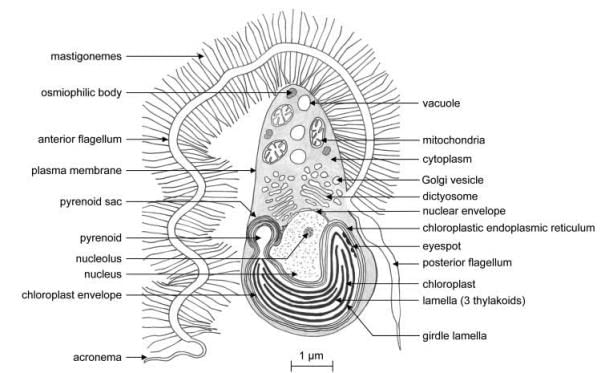
Chlamydomonas is a unicellular alga. Cycas is a gymnosperm. Selaginella is a heterosporous pteridophyte and Sphagnum is a moss.

31 Years NEET Previous Year Questions: Plant Kingdom - 1 - Question 15

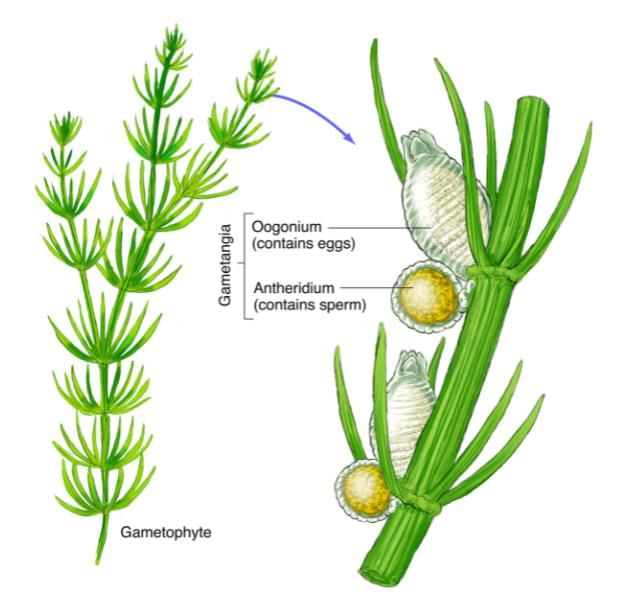
Read the following statements and identify the characters related to the alga shown in the diagram :    [NEET 2022 Phase 2]
(a) It is a member of Chlorophyceae
(b) Food is stored in the form of starch
(c) It is monoecious plant showing oogonium and antheridium
(d) Food is stored in the form of laminarin or mannitol
(e) It shows dominance of pigments Chlorophyll a, c and Fucoxanthin
Choose the correct answer from the options given below :  

Detailed Solution: Question 15

Alga shown in the diagram is Chara. It is a member of Chlorophyceae. Food is stored in the form of starch.
Chara is monoecious plant showing oogonium and antheridium on the same plant body.

31 Years NEET Previous Year Questions: Plant Kingdom - 1 - Question 16

Match the plant with the kind of life cycle it exhibits:    [NEET 2022 Phase 1]

2022

Choose the correct answer from the options given below:

Detailed Solution: Question 16

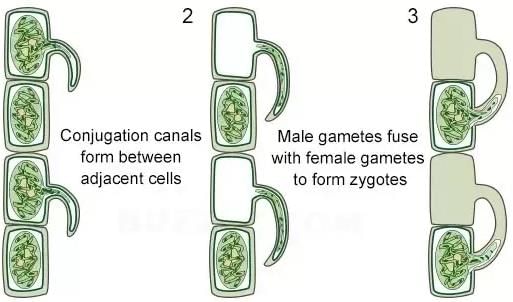
  • Spirogyra is an alga. It shows haplontic life-cycle.
  • Fern is pteridophyte. The dominant phase of life-cycle is diploid sporophyte. Its gametophyte is called prothallus.
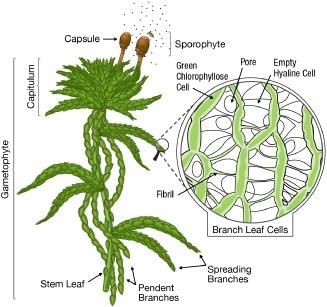
  • Funaria is a bryophyte. Its gametophyte is a leafy stage.
  • Cycas is a gymnosperm. The main plant body in gymnosperm is sporophyte. They have highly reduced gametophyte stage.

31 Years NEET Previous Year Questions: Plant Kingdom - 1 - Question 17

Which of the following is incorrectly matched?    [NEET 2022 Phase 1]

Detailed Solution: Question 17

Ulothrix is a member of Chlorophyceae (green algae), with reserve food material, starch. Mannitol is stored food material of Phaeophyceae (brown algae).

31 Years NEET Previous Year Questions: Plant Kingdom - 1 - Question 18

Hydrocolloid carrageen is obtained from:    [NEET 2022 Phase 1]

Detailed Solution: Question 18

Hydrocolloids are water holding substances for e.g. carrageen obtained from red algae (Rhodophyceae).

31 Years NEET Previous Year Questions: Plant Kingdom - 1 - Question 19

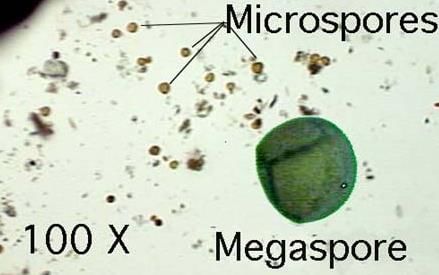
Genera like Selaginella and Salvinia produce two kinds of spores. Such plants are known as   [2021]
Detailed Solution: Question 19

Genera like Selaginella and Salvinia which produce two kinds of spores, macro (large) and micro (small) spores, are known as heterosporous.

Hence, the correct option is B.

NCERT Reference: Page no. 37 of topic “3.3 PTERIDOPHYTES” of chapter 3 of NCERT.

31 Years NEET Previous Year Questions: Plant Kingdom - 1 - Question 20

Strobili or cones are found in:    [2020]
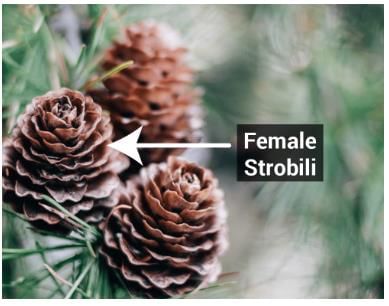
Detailed Solution: Question 20

  • Strobilus is a structure present on many land plant species consisting of sporangia bearing structure densely aggregated along a stem. Equisetum produces strobili.
  • Marchantia, pteris and salvinia do not produce strobilus.

Hence, the correct option is B.

NCERT Reference: Page no. 36 of topic “3.3 PTERIDOPHYTES” of chapter 3 of NCERT.

31 Years NEET Previous Year Questions: Plant Kingdom - 1 - Question 21

From evolutionary point of view, retention of the female gametophyte with developing young embryo on the parent sporophyte for some time, is first observed in:         (2019)

Detailed Solution: Question 21

  • In Pteridophytes, megaspore is retained for some time in female gametophytes. However, permanent retention is required for seed formation and hence seed is not formed.
  • That's why Pteridophytes are said to be precursors of seed habit.

Hence, the correct option is D.

NCERT Reference: Page no. 36 of topic “3.3 PTERIDOPHYTES” of chapter 3.

31 Years NEET Previous Year Questions: Plant Kingdom - 1 - Question 22

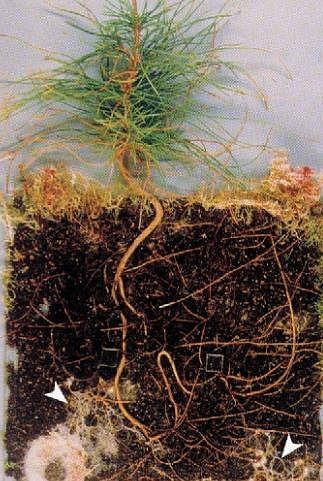
Pinus seed cannot germinate and establish without fungal association. This is because:    [2019]
Detailed Solution: Question 22

  • Pinus has mutualistic association with fungus in the form of mycorrhizae.
  • The fungi help the plant in the absorption of essential nutrients from the soil and the plant provides fungi with high energy-yielding carbohydrates.

Hence, the correct option is C.

NCERT Reference: Page no. 38 of topic “3.4 GYMNOSPERMS” of chapter 3 of NCERT.

31 Years NEET Previous Year Questions: Plant Kingdom - 1 - Question 23

Which of the following statements is correct?    [2018]

Detailed Solution: Question 23

  • Gymnosperms have naked ovule.
  • Selaginella and Salvinia both produce two kinds of spores, macro (large) and micro (small) hence, called heterosporous.
  • Equisetum (horsetail, scouring rush) is a pteridophyte.
  • Stems are branched in Cedrus but unbranched in Cycas.

Hence, the correct option is A.
NCERT Reference: Page no. 38 of topic “3.4 GYMNOSPERMS” of chapter 3 of NCERT.

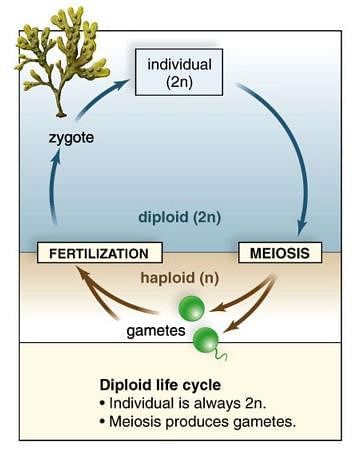
31 Years NEET Previous Year Questions: Plant Kingdom - 1 - Question 24

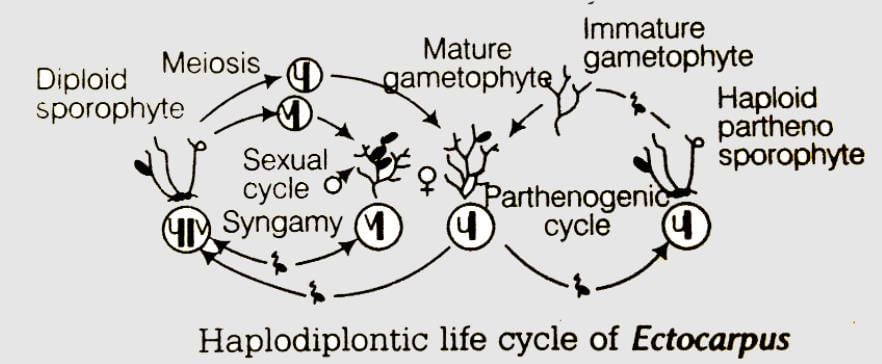
Life cycles of Ectocarpus and Fucus respectively are:    [2017]
Detailed Solution: Question 24

Ectocarpus possesses haplodiplontic whereas Fucus possesses diplontic life cycle.


Fig: Diploid life cycle: Fucus

Hence, the correct option is B.
NCERT Reference: Page no. 43 of chapter 3 of NCERT.

31 Years NEET Previous Year Questions: Plant Kingdom - 1 - Question 25

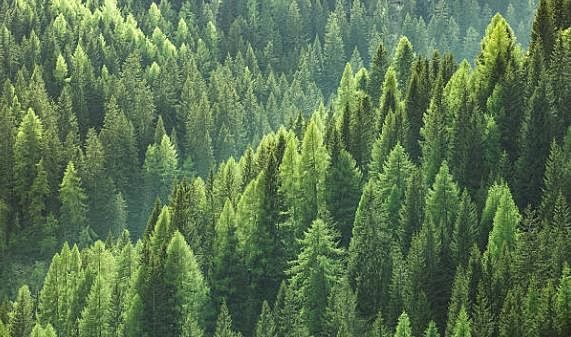
Conifers are adapted to tolerate extreme environmental conditions because of: [2016]
Detailed Solution: Question 25

  • The presence of thick cuticle, presence of sunken stomata, and needle-like leaves are xerophytic adaptations of conifers for tolerating extreme environmental conditions.

Hence, the correct option is C.

NCERT Reference: Page no. 38 of topic “3.4 GYMNOSPERMS” of chapter 3 of NCERT.

31 Years NEET Previous Year Questions: Plant Kingdom - 1 - Question 26

Which one of the following statements is wrong: [2016]

Detailed Solution: Question 26

  • Algin is obtained from Laminaria & Fucus – Brown algae while Carrageenan from Chondrus crispus – Red algae.
  • Agar-agar is a gelling agent with unbranched polysaccharides and is used in microbiology as a solidifying agent of liquid culture mediums. It is extracted from the cell wall of red algae, mostly from Gelidium species and Gracilaria species.
  • Laminaria and Sargassum are brown algae and are cultivated as a crop. 
  • Algae are green photosynthetic organisms that release oxygen in the immediate vicinity through the process of photosynthesis. 

Hence, the correct option is B.

NCERT Reference: Page no. 32 of topic “3.1 ALGAE” of chapter 3 of NCERT.

31 Years NEET Previous Year Questions: Plant Kingdom - 1 - Question 27

In bryophytes and pteridophytes, transport of male gametes requires: [2016]
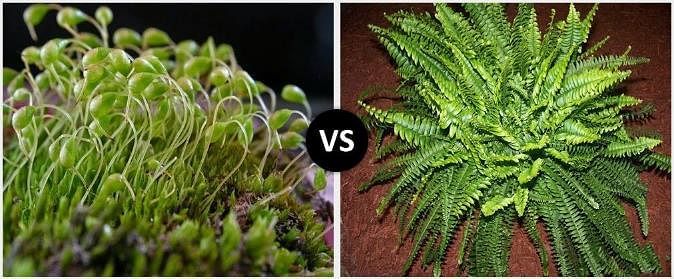
Detailed Solution: Question 27

  • In bryophytes and pteridophytes, transport of male gametes requires water
  • The male gametes, produced by reproductive structures called antheridia, are free-swimming sperm cells that need water to transport them to the female gametes, which are enclosed within structures called archegonia.
  • Because of the need for water, bryophytes are especially common in wet habitats such as bogs, streambanks, and moist forests. However, they are not restricted to these habitats, and some mosses thrive in deserts, above the tree line, and in the Arctic tundra.


Fig: Bryophytes vs Pteridophytes

Hence, the correct option is D.

NCERT Reference: Topics “3.2 BRYOPHYTES” and “3.3 PTERIDOPHYTES” of chapter 3 of NCERT.

31 Years NEET Previous Year Questions: Plant Kingdom - 1 - Question 28

 Select the correct statement: [2016]

Detailed Solution: Question 28

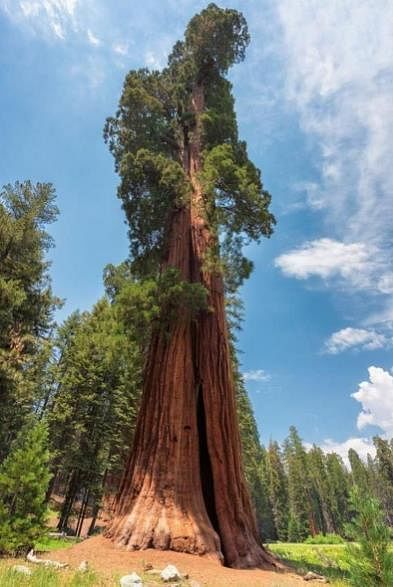
The tallest trees in the world are redwoods (Sequoia sempervirens), which tower above the ground in California. These trees can easily reach heights of 300 feet (91 meters).


Fig: Sequoia sempervirens

Hence, the correct option is C.
NCERT Reference: Page no. 38 of topic “3.4 GYMNOSPERMS” of chapter 3 of NCERT.

31 Years NEET Previous Year Questions: Plant Kingdom - 1 - Question 29

In which of the following gametophyte is not independent free living? [2015]
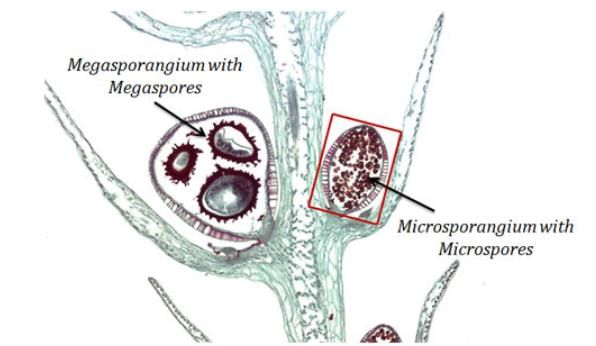
Detailed Solution: Question 29

Pinus belongs to gymnosperms in which male and female gametophytes do not have an independent free-living existence.

They remain within the sporangia which are of two types:

  • Microsporangia
  • Megasporangia

Hence, the correct option is C.
NCERT Reference: Page no. 39 of topic “3.4 GYMNOSPERMS” of chapter 3 of NCERT.

31 Years NEET Previous Year Questions: Plant Kingdom - 1 - Question 30

Read the following five statements (A to E) and select the option with all correct statements: [2015]

(A) Mosses and Lichens are the first organisms to colonize bare rock.
(B) Selaginella is a homosporous pteridophyte.
(C) Coralloid roots in Cycas have VAM.
(D) Main plant body in bryophytes is gametophytic, whereas in pteridophytes it is sporophytic.
(E) In gymnosperms, male and female gametophytes are present within sporangia located on the sporophyte.

Detailed Solution: Question 30

  • The thalli of lichens can adhere to the surface of the rock and absorb moisture from the atmosphere; therefore, these colonize the bare surfaces of rocks first. These lichens produce acids that corrode the rock and their thalli collect windblown soil particles among them that help in formation of a thin film of soil. 
  • The adult plant body of bryophyte represents the gametophyte. A short-lived sporophyte occurs as a parasite on the gametophyte. In gymnosperms, a leafy green sporophyte generates cones containing male and female gametophytes; female cones are bigger than male cones and are located higher up in the tree. 
  • The coralloid roots contain symbiotic cyanobacteria (blue-green algae), which fix nitrogen and, in association with root tissues, produce such beneficial amino acids as asparagine and citrulline. 

Hence, the correct option is B.

NCERT Reference: Topics “3.2 BRYOPHYTES” and “3.4 GYMNOSPERMS” of chapter 3 of NCERT.

View more questions
8 docs|805 tests
Information about 31 Years NEET Previous Year Questions: Plant Kingdom - 1 Page
In this test you can find the Exam questions for 31 Years NEET Previous Year Questions: Plant Kingdom - 1 solved & explained in the simplest way possible. Besides giving Questions and answers for 31 Years NEET Previous Year Questions: Plant Kingdom - 1, EduRev gives you an ample number of Online tests for practice
Download as PDF