NEET Exam  >  NEET Test  >  Biology Class 12  >  31 Years NEET Previous Year Questions: Organisms & Populations - 1 - NEET MCQ

31 Years NEET Previous Year Questions: Organisms & Populations - 1 Free


MCQ Practice Test & Solutions: 31 Years NEET Previous Year Questions: Organisms & Populations - 1 (15 Questions)

You can prepare effectively for NEET Biology Class 12 with this dedicated MCQ Practice Test (available with solutions) on the important topic of "31 Years NEET Previous Year Questions: Organisms & Populations - 1". These 15 questions have been designed by the experts with the latest curriculum of NEET 2026, to help you master the concept.

Test Highlights:

  • - Format: Multiple Choice Questions (MCQ)
  • - Duration: 15 minutes
  • - Number of Questions: 15

Sign up on EduRev for free to attempt this test and track your preparation progress.

31 Years NEET Previous Year Questions: Organisms & Populations - 1 - Question 1

Epiphytes that are growing on the mango branch is an explanation of which of the following      [NEET 2025]

Detailed Solution: Question 1

  • Commensalism is a type of ecological interaction where one species benefits, and the other species neither benefits nor is harmed.
  • In this interaction, the species that benefits is referred to as the "commensal," while the unaffected species is the "host."
  • Epiphytes are plants that grow on other plants (such as trees) for physical support but do not extract nutrients or cause harm to the host plant.
  • In the given example, epiphytes growing on a mango branch represent commensalism because the epiphytes benefit from the support provided by the mango tree, while the mango tree remains unaffected.
  • Barnacles growing on a whale; the barnacles get a place to live and access to food, while the whale is unaffected is another example of Commensalism.

Table: Popular Interactions
2025

Note:

  • '+' : Beneficial
  • '-' : Detrimental (Harmful)
  • '0' : Neutral (Neither benefitted nor harmed)

Explanation of Other Options:
Mutualism:

  • In mutualism, both species involved in the interaction benefit from each other.
  • For example, pollination is a mutualistic relationship where bees collect nectar (food) from flowers and, in return, help the plant with pollination.

Predation:

  • Predation involves one species (the predator) hunting, killing, and consuming another species (the prey).
  • For instance, a lion hunting a deer is an example of predation.

Amensalism:

  • Amensalism is an interaction where one species is harmed, and the other species remains unaffected.
  • For example, the secretion of chemicals by certain fungi that inhibit the growth of nearby plants is an example of amensalism.

31 Years NEET Previous Year Questions: Organisms & Populations - 1 - Question 2

Given below are two statements:     [NEET 2025]
Statement I: Fig fruit is a non-vegetarian fruit as it has enclosed fig wasps in it. 
Statement II: Fig wasp and fig tree exhibit mutual relationship as fig wasp completes its life cycle in fig fruit and fig fruit gets pollinated by fig wasp.
In the light of the above statements, choose the most appropriate answer from the options given below:

Detailed Solution: Question 2

Statement I: "Fig fruit is a non-vegetarian fruit as it has enclosed fig wasps in it" is incorrect because:

  • Fig fruits are considered vegetarian as they are plant-based, and any wasp remnants are naturally decomposed during fruit development.
  • The presence of wasps is part of a natural ecological process and does not change the classification of the fruit as vegetarian.

Statement II: "Fig wasp and fig tree exhibit a mutual relationship as fig wasp completes its life cycle in fig fruit and fig fruit gets pollinated by fig wasp" is incorrect because:

  • A part of the life cycle of the wasp is completed in fig fruit. (not complete)
  • Fig wasps lay their eggs inside the fig fruit, and their larvae develop there.
  • Fig species can be pollinated only by its ‘partner’ wasp species and no other species.
  • The female wasp uses the fruit not only as an oviposition (egg-laying) site but uses the developing seeds within the fruit for nourishing its larvae.
  • The wasp pollinates the fig inflorescence while searching for suitable egg-laying sites.
  • In return for the favour of pollination, the fig offers the wasp some of its developing seeds, as food for the developing wasp larvae.

31 Years NEET Previous Year Questions: Organisms & Populations - 1 - Question 3

Which one of the following equations represent the Verhulst-Pearl Logistic Growth of population?      [NEET 2025]

Detailed Solution: Question 3

Verhulst-Pearl logistic growth, also simply known as logistic growth, is a model of population growth that describes how a population grows more slowly as it approaches its carrying capacity. 
A population growing in a habitat with limited resources show initially a lag phase, followed by phases of acceleration and deceleration and finally an asymptote, when the population density reaches the carrying capacity.
A plot of N in relation to time (t) results in a sigmoid curve. This type of population growth is called Verhulst-Pearl Logistic Growth.

  • Ideally if the resources in a habitat are unlimited, the population shows exponential growth pattern.
  • But resources are not available to any species population in unlimited amount. Thus, the species compete for the available resources to survive.
  • This competition for the limited resources restricts the exponential or unlimited growth of any population.
  • Any given habitat can only provide resources to support a maximum possible number, beyond which it further growth of population is not possible. This is known as the carrying capacity (K) for a particular species in a habitat.

Logistic growth is represented as: 2025

where,

  • N = Population Density at time t
  • K = Carrying Capacity,
  • r = Intrinsic rate of natural increase
  • dn/dt = Rate of change of population density.
  • 'r' value denotes the difference between the per capita birth and death (b-d).
  • The environmental resistance is represented in the equation as2025
    2025

31 Years NEET Previous Year Questions: Organisms & Populations - 1 - Question 4

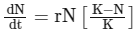
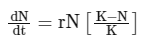
The equation of Verhulst-Pearl logistic growth is NEET Previous Year Questions (2016-2024): Organisms & Populations. From this equation, K indicates:     (NEET 2024)
Detailed Solution: Question 4

The Verhulst-Pearl logistic growth equation you've presented is a fundamental model used to describe how populations grow under limited resource conditions. This model is sensitive to both the variables and coefficients it incorporates:
NEET Previous Year Questions (2016-2024): Organisms & Populations
Here:
N represents the population size at time t.
r  is the intrinsic rate of natural increase, indicating the rate at which the population grows per individual when resources are not limiting.
K represents the carrying capacity of the environment.
In the context of this equation:
The term NEET Previous Year Questions (2016-2024): Organisms & Populations is a fraction that reduces the effective growth rate as the population size N approaches the carrying capacity K. This term essentially represents the remaining proportion of resources available as the population grows larger.
Based on this understanding:
Option A: "Intrinsic rate of natural increase" – Incorrect, this is represented by r in the equation.
Option B: "Biotic potential" – Incorrect, biotic potential generally refers to the maximum reproductive capacity of an organism under optimal conditions, often considered similar to r but not specifically the same as K.
Option C: "Carrying capacity" – Correct, as K in the equation is specifically describing the carrying capacity, which is the maximum population size that the environment can sustain indefinitely given the food, habitat, water, and other necessities available in the environment. Option D: "Population density" – Incorrect, while N relates directly to population density at any time, K is about the upper limit of that density sustainable by the environment. Therefore, Option C is the correct answer. The variable K in the Verhulst-Pearl logistic growth equation indeed stands for the carrying capacity.

31 Years NEET Previous Year Questions: Organisms & Populations - 1 - Question 5

Q1: Given below are two statements:     (NEET 2024)
Statement I : Gause’s ‘Competitive Exclusion Principle’ states that two closely related species competing for the same resources cannot co-exist indefinitely and competitively inferior one will be eliminated eventually.
Statement II : In general, carnivores are more adversely affected by competition than herbivores.
In the light of the above statements, choose the correct answer from the options given below:

Detailed Solution: Question 5

Gause's 'Competitive Exclusion Principle' states that two closely related species competing for the same resources cannot co-exist indefinitely and the competitively inferior one will be eliminated eventaully. Thus, statement I is correct.
Statement II is incorrect as in general, herbivores and plants appear to be more adversely affected by competition than carnivores. 

31 Years NEET Previous Year Questions: Organisms & Populations - 1 - Question 6

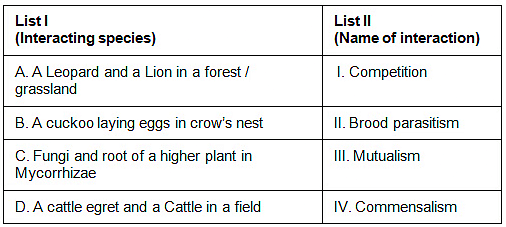
Q1: Match List I with List II.     (NEET 2023)
NEET Previous Year Questions (2016-2024): Organisms & Populations
Choose the correct answer from the options given below.

Detailed Solution: Question 6

  • A leopard and a lion in a forest/grassland (A) : These two species are predators that hunt in the same environment and likely compete for the same prey. This is an example of competition (I).
  • A cuckoo laying an egg in a crow's nest (B) : The cuckoo is known for laying its eggs in the nests of other birds, such as crows. The crow then raises the cuckoo's young, often at the expense of its own offspring. This is a form of brood parasitism (II).
  • Fungi and the root of a higher plant in mycorrhizae (C) : Mycorrhizae are symbiotic relationships between fungi and plant roots, in which the fungi help the plant absorb water and nutrients from the soil, while the plant provides the fungi with carbohydrates. This is an example of mutualism (III).
  • A cattle egret and a cattle in a field (D) : Cattle egrets are often seen near cattle, feeding on the insects that the cattle stir up as they move and graze. The egret benefits from this interaction (by getting easy access to food), while the cattle are unaffected. This is an example of commensalism (IV).

Given this information, the correct match is :
Option D : A-I, B-II, C-III, D-IV

31 Years NEET Previous Year Questions: Organisms & Populations - 1 - Question 7

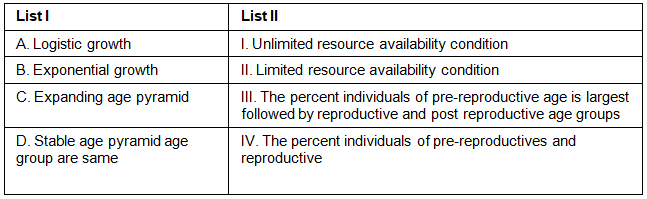
Q2: Match List I with List II.     (NEET 2023)
NEET Previous Year Questions (2016-2024): Organisms & Populations
Choose the correct answer from the options given below:

Detailed Solution: Question 7

  • Logistic growth (A) is a type of population growth that occurs under conditions of limited resources (II).
  • Exponential growth (B) is a type of population growth that occurs under conditions of unlimited resources (I).
  • An expanding age pyramid (C) represents a population where the percentage of individuals in the pre-reproductive age group is the largest, followed by the reproductive and post-reproductive age groups (III).
  • A stable age pyramid (D) represents a population where the percentage of individuals in the pre-reproductive and reproductive age groups are approximately equal (IV).

So, the correct match is : A-II, B-I, C-III, D-IV.

31 Years NEET Previous Year Questions: Organisms & Populations - 1 - Question 8

If '8' Drosophila in a laboratory population of '80' died during a week, the death rate in the population is ____ individuals per Drosophila per week.     (NEET 2022)

Detailed Solution: Question 8

If 8 Drosophila in a laboratory population of 80 died during a week, the death rate in the population is  8/80 = 0.1  individuals per Drosophila per week.

31 Years NEET Previous Year Questions: Organisms & Populations - 1 - Question 9

While explaining interspecific interaction of population, (+) sign is assigned for beneficial interaction, (−) sign is assigned for detrimental interaction and (0) for neutral interaction. Which of the following interactions can be assigned (+) for one species and (−) for another species involved in the interaction?     (NEET 2022)

Detailed Solution: Question 9

In predation, one species is benefited where as the other is harmed. It is (+ −) type of population interaction.

31 Years NEET Previous Year Questions: Organisms & Populations - 1 - Question 10

Which one of the following statements cannot be connected to Predation?     (NEET 2022)

Detailed Solution: Question 10

One of the species in predation gains benefit on the expense of the other. Predators help in maintaining species diversity in a community, by reducing the intensity of competition among competing prey species. If a predator is too efficient and overexploits its prey, then the prey might become extinct.

31 Years NEET Previous Year Questions: Organisms & Populations - 1 - Question 11

Inspite of interspecific competition in nature, which mechanism the competing species might have evolved for their survival?    [2021]

Detailed Solution: Question 11

While they do not rule out the occurrence of interspecific competition in nature, they point out that species facing competition might evolve mechanisms that promote co-existence rather than exclusion. One such mechanism is ‘resource partitioning'.

31 Years NEET Previous Year Questions: Organisms & Populations - 1 - Question 12

Which of the following is not an attribute of a population?    [2020]

Detailed Solution: Question 12

Species interaction refers to direct and indirect interrelationship between different organisms, while on the other hand population attributes include population size, population density, population spacing, and age structure. Mortality is the ratio of deaths in an area to the population of that area; expressed per 1000 per year. Sex ratio is  the ratio of males to females in a population.

31 Years NEET Previous Year Questions: Organisms & Populations - 1 - Question 13

Carnivorous animals lions and leopards, occupy the same niche but lions predate mostly larger animals and leopards take smaller ones. This mechanism of competition is referred to as   [2019]

Detailed Solution: Question 13

Explanation:
The mechanism of competition described in the question is referred to as resource partitioning. Here's a detailed explanation:
1. Definition of resource partitioning:
- Resource partitioning is a mechanism that allows similar species to coexist in the same habitat by dividing and utilizing resources differently.
- It reduces competition between species by allowing them to occupy different ecological niches.
2. Competition between lions and leopards:
- Lions and leopards are both carnivorous animals and have overlapping habitats.
- However, they have different prey preferences.
- Lions primarily prey on larger animals like zebras and wildebeests, while leopards focus on smaller prey like impalas and gazelles.
3. How resource partitioning occurs in this scenario:
- Lions and leopards have divided the available resources (prey) based on their size and hunting abilities.
- By preying on different-sized animals, they reduce direct competition for food.
- This allows both species to coexist in the same habitat without completely excluding one another.
4. Benefits of resource partitioning:
- Resource partitioning allows species to specialize in different ecological niches, leading to more efficient resource utilization.
- It promotes species diversity and prevents competitive exclusion, where one species outcompetes and eliminates another species.
5. Other examples of resource partitioning:
- Darwin's finches in the Galapagos Islands have evolved different beak sizes to utilize different food sources.
- Different species of warblers in North America occupy different parts of trees to feed on insects.
In conclusion, the mechanism of competition described in the question, where lions and leopards occupy the same niche but prey on different-sized animals, is an example of resource partitioning. This strategy allows both species to coexist by reducing direct competition for food resources.

31 Years NEET Previous Year Questions: Organisms & Populations - 1 - Question 14

Natality refers to  [2018]

Detailed Solution: Question 14

Natality refers to the number of births during a given period in the population that are added to the initial density. Death rate or mortality is the number of deaths in the population during a given time period. Immigration is the number of individuals entering a habitat. Emigration is the number of individuals of the population that left the habitat and had gone elsewhere during a time period.

31 Years NEET Previous Year Questions: Organisms & Populations - 1 - Question 15

Asymptote in a logistic growth curve is obtained when   [2017]

Detailed Solution: Question 15

Asymptote in a logistic growth curve is obtained when population density (N) reaches the carrying capacity (K), i.e., N = K.

70 videos|297 docs|167 tests
Information about 31 Years NEET Previous Year Questions: Organisms & Populations - 1 Page
In this test you can find the Exam questions for 31 Years NEET Previous Year Questions: Organisms & Populations - 1 solved & explained in the simplest way possible. Besides giving Questions and answers for 31 Years NEET Previous Year Questions: Organisms & Populations - 1, EduRev gives you an ample number of Online tests for practice
70 videos|297 docs|167 tests
Download as PDF