NEET Exam  >  NEET Test  >  Physics Class 12  >  31 Year NEET Previous Year Questions: Electromagnetic Waves - NEET MCQ

31 Year NEET Previous Questions: Electromagnetic Waves Free MCQ Practice


MCQ Practice Test & Solutions: 31 Year NEET Previous Year Questions: Electromagnetic Waves (27 Questions)

You can prepare effectively for NEET Physics Class 12 with this dedicated MCQ Practice Test (available with solutions) on the important topic of "31 Year NEET Previous Year Questions: Electromagnetic Waves". These 27 questions have been designed by the experts with the latest curriculum of NEET 2026, to help you master the concept.

Test Highlights:

  • - Format: Multiple Choice Questions (MCQ)
  • - Duration: 54 minutes
  • - Number of Questions: 27

Sign up on EduRev for free to attempt this test and track your preparation progress.

31 Year NEET Previous Year Questions: Electromagnetic Waves - Question 1

Which of the following, is the longest wave ?       [1989]

Detailed Solution: Question 1

Rays  -    Wavelength
[Range in m]
X-rays    -  1 × 10–11 to 3 × 10⁻⁸
γ-rays     -  6 × 10–14 to 1 × 10–11
Microwaves    -  10–3 to 0.3
Radiowaves    -  10 to 104

31 Year NEET Previous Year Questions: Electromagnetic Waves - Question 2

Pick out the longest wavelength from the following types of radiation. [1990]

Detailed Solution: Question 2

Wavelength of red light is longest

31 Year NEET Previous Year Questions: Electromagnetic Waves - Question 3

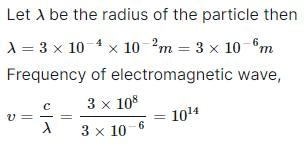
The frequency of electromagnetic wave, whichis best suited to observe a particle of radius3 × 10–4 cm is of the order of             [1991]
Detailed Solution: Question 3

31 Year NEET Previous Year Questions: Electromagnetic Waves - Question 4

The structure of solids is investigated by using        [1992]

Detailed Solution: Question 4

X-rays are used for the investigation of
structure of solids

31 Year NEET Previous Year Questions: Electromagnetic Waves - Question 5

A signal emitted by an antenna from a certainpoint can be received at another point of thesurface in the form of                [1993]

Detailed Solution: Question 5

Sea waves travel in a straight line thus, they can only be used for in line communication. Whereas sky waves and ground waves are used for larger distances.

31 Year NEET Previous Year Questions: Electromagnetic Waves - Question 6

The oscillating electric and magnetic field vectorsof electromagnetic wave are oriented along   [1994]

Detailed Solution: Question 6

The direction of oscillations of E and B fields are perpendicular to each other as well as to the direction of propagation. So, electromagnetic waves are transverse in nature. The electric and magnetic fields oscillate in same phase.

31 Year NEET Previous Year Questions: Electromagnetic Waves - Question 7

Which one of the following electromagneticradiations has the smallest wavelength? [1994]

Detailed Solution: Question 7

Rays  -    Wavelength
[Range in m]
X-rays    -  1 × 10–11 to 3 × 10⁻⁸
γ-rays     -  6 × 10–14 to 1 × 10–11
Microwaves    -  10–3 to 0.3
Radiowaves    -  10 to 104

31 Year NEET Previous Year Questions: Electromagnetic Waves - Question 8

If ∈0 and μ0 are the electric permittivity and  magnetic permeability in vacuum, ∈ and μ are corresponding quantities in medium, then refractive index of the medium is [1997]

Detailed Solution: Question 8

We know that velocity of  lectromagnetic
wave in vacuum 

velocity of electromagnetic wave in
medium is (v) =

Therefore refractive index of the medium

31 Year NEET Previous Year Questions: Electromagnetic Waves - Question 9

​In a circuit, inductance L and capacitance C are connected as shown in the figure. A1 and A  

are ammeters. When key K is pressed to complete the circuit, then just after closing key (K), the readings of A1 and A2 will be          [1999]

Detailed Solution: Question 9

Initially there is no D.C. current in inductive circuit and maximum D.C. current is in capacitive current. Hence, the current is zero in A2 and maximum in A1.

31 Year NEET Previous Year Questions: Electromagnetic Waves - Question 10

The electromagnetic radiations are caused by       [1999]

Detailed Solution: Question 10

A stationary charge produces electric field only; an uniformly moving charge produces localised electromagnetic field; an accelerated charge produces electromagnetic radiations.

31 Year NEET Previous Year Questions: Electromagnetic Waves - Question 11

If the frequencies of X-rays, γ-rays, and ultraviolet rays are a, b, and c respectively, then which of the following is correct about their frequencies?  [2000]

Detailed Solution: Question 11

Gamma rays have the lowest wavelength and therefore the highest frequency.

Ultraviolet rays have the highest wavelength and thus the lowest frequency.

Therefore, the order of frequency is: b > a > c.

31 Year NEET Previous Year Questions: Electromagnetic Waves - Question 12

Which of the following is positively charged?      [2001]

Detailed Solution: Question 12

α rays contain Helium nuclei which contains 2 unit of positive charge.

31 Year NEET Previous Year Questions: Electromagnetic Waves - Question 13

if   represent electric and magnetic field vectors of the electromagnetic waves, then the direction of propagation of the waves will be along

Detailed Solution: Question 13

Direction of propagation of electro-magnetic waves is perpendicular to Electric field and Magnetic field. Hence, direction is given by

31 Year NEET Previous Year Questions: Electromagnetic Waves - Question 14

Which of the following electromagneticradiations has the least wavelength? [2002]

Detailed Solution: Question 14

Gamma ray has highest frequency and lowest wavelength.

31 Year NEET Previous Year Questions: Electromagnetic Waves - Question 15

Green-house effect is the heating up of earth's atmosphere due to         [2002]

Detailed Solution: Question 15

Infrared rays is the cause of Green house effect. The glass transmits visible light and short infrared rays which are absorbed by plants. Then it emits long infrared rays, which are reflected back by glass.

31 Year NEET Previous Year Questions: Electromagnetic Waves - Question 16

Which one of the following rays is notelectromagnetic wave ? [2003]

Detailed Solution: Question 16

β ray is not electromagnetic ray

31 Year NEET Previous Year Questions: Electromagnetic Waves - Question 17

We consider the radiation emitted by the humanbody. Which of the following statements is true?      [2003]

Detailed Solution: Question 17

Depends on the magnitude of frequency

31 Year NEET Previous Year Questions: Electromagnetic Waves - Question 18

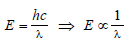
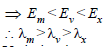
If λv, λx and λm represent the wavelengths of visible light, X–rays and microwaves respectively, then
Detailed Solution: Question 18

Option B is correct.

X-rays have wavelengths typically in the range 10-11 m to 10-8 m, much smaller than visible wavelengths.

Visible light wavelengths lie approximately in the range 4×10⁻⁷ m to 7×10⁻⁷ m.

Microwaves have wavelengths roughly in the range 10-4 m to 10-1 m, much larger than visible wavelengths.

Arranging these from largest to smallest gives λm > λv > λx, which corresponds to Option B.


31 Year NEET Previous Year Questions: Electromagnetic Waves - Question 19

The electric and magnetic field of an electromagneticwave are       [2007]

Detailed Solution: Question 19

Variation in magnetic field causes electric field and vice-versa.
In electromagnetic waves, .
Both  and    are in the same phase.
In electromagnetic waves
E = E0 sin(ωt - kx)
B = B0 sin(ωt - kx)
The electromagnetic waves travel in the
direction of 

31 Year NEET Previous Year Questions: Electromagnetic Waves - Question 20

The velocity of electromagnetic radiation in a medium of permittivity ∈0 and permeability μ0 is given by [2008]

Detailed Solution: Question 20

The velocity of electromagnetic radiation
in a medium of permittivity  ∈and
permeability μis equal to 

31 Year NEET Previous Year Questions: Electromagnetic Waves - Question 21

The electric field part of an electromagnetic wave in a medium is represented by Ex=0;

 Ez = 0. The wave is :               [2009]

Detailed Solution: Question 21

Comparing with the equation of wave

31 Year NEET Previous Year Questions: Electromagnetic Waves - Question 22

Which of the following statement is false for theproperties of electromagnetic waves? [2010]

Detailed Solution: Question 22

Electromagnetic waves are the combination of mutually perpendicular electric and magnetic fields. So, option (c) is false.

31 Year NEET Previous Year Questions: Electromagnetic Waves - Question 23

The electric and the magnetic field associated with an E.M. wave, propagating along the +z-axis, can be represented by [2011]

Detailed Solution: Question 23

The electromagnetic wave is propagating along the +z axis.
Since the electric and magnetic fields are perpendicular to each other and also perpendicular to the direction of propagation of wave.
Also. gives the direction of wave propagation.

31 Year NEET Previous Year Questions: Electromagnetic Waves - Question 24

The decreasing order of wavelength of infrared,microwave, ultraviolet and gamma rays is [2011]

Detailed Solution: Question 24

The decreasing order of the wavelengths is as given below :
microwave, infrared, ultraviolet, gamma
rays.

31 Year NEET Previous Year Questions: Electromagnetic Waves - Question 25

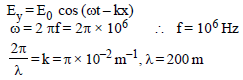
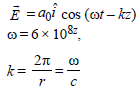
The electric field associated with an e.m. wave in vacuum is given by  cos (kz – 6 ×10⁸t), where E, z and t are in volt/m, meter and seconds respectively. The value of wave vector k is : [2012]
Detailed Solution: Question 25

On comparing the given equation to

31 Year NEET Previous Year Questions: Electromagnetic Waves - Question 26

The ratio of amplitude of magnetic field to theamplitude of electric field for an electromagneticwave propagating in vacuum is equal to :   [2012M]

Detailed Solution: Question 26

The average energy stored in the electric field 

The average energy stored in the magnetic field 

According to conservation of energy

31 Year NEET Previous Year Questions: Electromagnetic Waves - Question 27

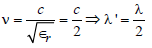
An electromagnetic wave of frequency v = 3.0MHz passes from vacuum into a dielectricmedium with relative permittivity ε = 4.0. Then[NEET Kar. 2013]
Detailed Solution: Question 27

Given: frequency f = 2MHz, relative
permittivity ∈r= 4

From formula,

velocity 

[Since frequency remains unchanged]

74 videos|346 docs|92 tests
Information about 31 Year NEET Previous Year Questions: Electromagnetic Waves Page
In this test you can find the Exam questions for 31 Year NEET Previous Year Questions: Electromagnetic Waves solved & explained in the simplest way possible. Besides giving Questions and answers for 31 Year NEET Previous Year Questions: Electromagnetic Waves, EduRev gives you an ample number of Online tests for practice
74 videos|346 docs|92 tests
Download as PDF