NEET Exam  >  NEET Test  >  Physics Class 11  >  31 Year NEET Previous Year Questions: Mechanical Properties of Fluids - NEET MCQ

31 Year NEET Previous Questions: Mechanical Properties of Fluids Free MCQ


MCQ Practice Test & Solutions: 31 Year NEET Previous Year Questions: Mechanical Properties of Fluids (20 Questions)

You can prepare effectively for NEET Physics Class 11 with this dedicated MCQ Practice Test (available with solutions) on the important topic of "31 Year NEET Previous Year Questions: Mechanical Properties of Fluids". These 20 questions have been designed by the experts with the latest curriculum of NEET 2026, to help you master the concept.

Test Highlights:

  • - Format: Multiple Choice Questions (MCQ)
  • - Duration: 20 minutes
  • - Number of Questions: 20

Sign up on EduRev for free to attempt this test and track your preparation progress.

31 Year NEET Previous Year Questions: Mechanical Properties of Fluids - Question 1

Consider a water tank shown in the figure. It has one wall at x = L and can be taken to be very wide in the z direction. When filled with a liquid of surface tension S and density ρ, the liquid, surface makes angle θ00≪1) with the x - axis at x = L. If y (x) is the height of the surface then the equation for y (x) is:   [2025]
2025

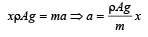
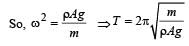
2025

Detailed Solution: Question 1

2025

Curvature = 1 / ROC = |d2y/dx2| / (1 + (dy/dx)2)3/2 ≈ |d2y/dx2| / (1 + 0)3/2 = d2y/dx2
(dy/dx) ≈ tan θ ≈ 0 (small angle approximation)
Change in pressure, ΔP = S × curvature
ΔP = S × d2y/dx2
Also, ΔP = ρgy
⇒ ρgy = S × d2y/dx2
⇒ d2y/dx2 = (ρg / S) y

31 Year NEET Previous Year Questions: Mechanical Properties of Fluids - Question 2

A wire of length L and radius r (r << L) and density ρ is kept floating on the surface of a liquid. The maximum radius of the wire for which it may not sink is: (the surface tension of liquid is T)    [2024]

Detailed Solution: Question 2

Answer: (D) √(2T/(πρg))

For a long thin wire resting on the liquid surface, the maximum upward force provided by surface tension occurs from the two contact edges (one on each side). The total upward force due to surface tension is F_surface = 2T L.

The weight of the wire is its mass times g. Mass = density × volume = ρ × π r2 L, so the weight is W = ρ π r2 L g.

At the limiting (maximum) radius the upward surface-tension force just balances the weight:

2T L = ρ π r2 L g

Cancel L and solve for r:

r2 = 2T / (π ρ g)

r = √(2T/(π ρ g)), which corresponds to option (D).

31 Year NEET Previous Year Questions: Mechanical Properties of Fluids - Question 3

The pressure experienced by a swimmer 20 m below the water surface in a lake is appropriately: (Given density of water = 103 kgm−3, g = 10 ms−2  and 1 atm = 10Pa) [2024]

Detailed Solution: Question 3

To calculate the pressure experienced by the swimmer at a depth of 20 m below the water surface, we need to use the formula for the pressure at a depth in a fluid:
P = P0 + ρgh
Where:

  • P is the total pressure at depth,
  • P0 is the atmospheric pressure at the surface (1 atm),
  • ρ is the density of the water,
  • g is the acceleration due to gravity,
  • h is the depth below the surface.

Given:

  • ρ = 103 kg/m3 (density of water),
  • g = 10 m/s2 (acceleration due to gravity),
  • h = 20 m (depth),
  • P₀ = 1 atm = 105 Pa (atmospheric pressure).

Now, we calculate the pressure at the depth:
First, calculate the hydrostatic pressure due to the water column:
ρgh = (103 kg/m3) × (10 m/s2) × (20 m) = 2 × 10⁵ Pa
Total pressure at the depth is the sum of atmospheric pressure and the hydrostatic pressure:
P = 1 atm + 2 × 10⁵ Pa
Since 1 atm = 105 Pa, we have:
P = 105 Pa + 2 × 10⁵ Pa = 3 × 10⁵ Pa
Now, convert the pressure to atmospheres:
P = 3 × 10⁵ Pa / 105 Pa = 3 atm
Thus, the correct answer is: (c) 3 atm.

31 Year NEET Previous Year Questions: Mechanical Properties of Fluids - Question 4

A thin flat circular disc of radius 4.5 cm is placed gently over the surface of water. If the surface tension of water is 0.07 Nm−1, then the excess force required to take it away from the surface is: [2024]

Detailed Solution: Question 4

The excess force required to remove a thin flat circular disc from the surface of water can be calculated using the formula for the force due to surface tension:
Force (F) = 2πr × T
Where:

  • r is the radius of the disc,
  • T is the surface tension of the water.

Given:
r = 4.5 cm = 0.045 m,
T = 0.07 N/m.
Now, substituting the values into the formula:
F = 2π × 0.045 × 0.07
F ≈ 2 × 3.1416 × 0.045 × 0.07
F ≈ 0.0198 N
Converting to milli Newtons (mN):
F ≈ 19.8 mN
So, the correct answer is:
(d) 19.8 mN.

31 Year NEET Previous Year Questions: Mechanical Properties of Fluids - Question 5

 An ideal fluid is flowing in a non-uniform cross-sectional tube XY (as shown in the figure) from end X to end Y. If K1 and K2 are the kinetic energies per unit volume of the fluid at X and Y respectively, the correct relationship between K1 and K2 is:    [2024]
2024

Detailed Solution: Question 5

To solve this problem, we need to apply the principle of conservation of mechanical energy (also known as Bernoulli's theorem) and understand the relationship between velocity and kinetic energy in a fluid flow.

Bernoulli's Principle:

Bernoulli's equation states that for an ideal, incompressible fluid flowing through a non-uniform cross-sectional tube, the total mechanical energy (sum of pressure energy, kinetic energy, and potential energy) remains constant along a streamline.

The equation is given by:

P + ½ ρv2 + ρgh = constant

Where:

  • P is the pressure of the fluid,
  • ρ is the density of the fluid,
  • v is the velocity of the fluid,
  • g is the acceleration due to gravity,
  • h is the height of the fluid at a point (potential energy term).

In the given problem, K1 and K2 represent the kinetic energy per unit volume at points X and Y. The kinetic energy per unit volume is:
K = ½ ρv2

Now, we are given that the cross-section of the tube is non-uniform, which means the velocity of the fluid will change as it moves from one section to another.

Relationship Between Kinetic Energy and Velocity:
Since the tube is non-uniform, the velocity of the fluid will change based on the cross-sectional area. According to the continuity equation:
A1v1 = A2v2
Where:

  • A1 and A2 are the cross-sectional areas at points X and Y,
  • v1 and v2 are the velocities of the fluid at points X and Y.

If the cross-sectional area at point Y is smaller than at point X, the velocity of the fluid will increase at point Y (since the fluid must maintain the same flow rate). This implies that the kinetic energy at point Y (K2) will be higher than at point X (K1).

Therefore, based on the continuity equation and Bernoulli's principle, the correct relationship between the kinetic energy per unit volume at points X and Y is:

K1 > K2

This is because, at point X, the velocity is lower (due to a larger cross-sectional area), and at point Y, the velocity is higher (due to a smaller cross-sectional area), which leads to a greater kinetic energy at X.
Thus, the correct answer is: (c) K1 > K2.

31 Year NEET Previous Year Questions: Mechanical Properties of Fluids - Question 6

The venturi-meter works on [2023]

Detailed Solution: Question 6

B. Bernoulli's principle is correct.

Bernoulli's equation: P + 1/2 ρv2 + ρgh = constant along a streamline.

For flow in a horizontal tube the ρgh terms at two points are equal and cancel, so differences in pressure are due to differences in the kinetic energy per unit volume (that is, the 1/2 ρv2 term).

Continuity equation: A1v1 = A2v2. A reduction in area causes an increase in velocity at the throat.

Therefore the throat of the meter has a higher speed and a lower pressure than the wider section; the resulting pressure difference (measured between the two sections) is related to the flow rate. This combination of the continuity equation and Bernoulli's principle is the basis of the instrument.

Final answer: B.

31 Year NEET Previous Year Questions: Mechanical Properties of Fluids - Question 7

The amount of energy required to form a soap bubble of radius 2 cm from a soap solution is nearly: (the surface tension of soap solution 0.03 Nm− 1)     [2023]

Detailed Solution: Question 7

To calculate the energy required to form a soap bubble, we need to consider the work done to increase the surface area of the bubble.
When a soap bubble is formed, it has two surfaces (inner and outer) exposed to the air. The energy required is related to the surface area of the bubble and the surface tension of the soap solution.

Formula for Energy:
The energy required to form a soap bubble is given by the formula:
Energy (E) = 4πr2 × T
Where:

  • r is the radius of the bubble,
  • T is the surface tension of the soap solution.

Since a soap bubble has two surfaces, the total surface area exposed is 2 * 4πr2. The formula for the energy required to form a soap bubble is:
E = 8πr2 × T
Given:

  • r = 2 cm = 0.02 m,
  • T = 0.03 N/m (surface tension).

Now, substituting the given values into the formula:
E = 8π × (0.02)2 × 0.03
E = 8π × 0.0004 × 0.03
E = 8 × 3.1416 × 0.000012
E ≈ 3.01 × 10⁻⁴ J
Thus, the correct answer is: (d) 3.01 × 10⁻⁴ J.

31 Year NEET Previous Year Questions: Mechanical Properties of Fluids - Question 8

Which of the following statements is not true?       [2023]

Detailed Solution: Question 8

(a) The coefficient of viscosity is a scalar quantity - TRUE
The coefficient of viscosity (η) represents the internal friction of a fluid and has only magnitude, no direction.

(b) Surface tension is a scalar quantity - TRUE
Surface tension is measured as energy per unit area or force per unit length, and it has only magnitude, no direction.

(c) Pressure is a vector quantity - FALSE
Pressure is defined as force per unit area. While force is a vector, when we calculate pressure, we consider only the magnitude of the force acting perpendicular to the surface area. Pressure at a point acts equally in all directions (Pascal's principle) and is characterized only by its magnitude, making it a scalar quantity.

(d) Relative density is a scalar quantity - TRUE
Relative density (or specific gravity) is the ratio of the density of a substance to a reference substance (usually water). Being a ratio of two scalar quantities, it is also a scalar quantity.
Therefore, option (c) is the incorrect statement, making it the correct answer to this question.

31 Year NEET Previous Year Questions: Mechanical Properties of Fluids - Question 9

The viscous drag acting on a metal sphere of diameter 1 mm, falling through a fluid of viscosity 0.8 Pa-s with a velocity of 2 m s–1 is nearly equal to:     [2023]

Detailed Solution: Question 9

To calculate the viscous drag on a metal sphere falling through a fluid, we use Stokes' Law, which is given by the formula:
F = 6πηrv
Where:

  • F is the viscous drag force (in N),
  • η is the dynamic viscosity of the fluid (in Pa-s),
  • r is the radius of the sphere (in m),
  • v is the velocity of the sphere (in m/s).

Given:

  • Diameter of the sphere = 1 mm = 1 × 10⁻³ m
  • Radius, r = (1 × 10⁻³ m) / 2 = 0.5 × 10⁻³ m = 5 × 10⁻⁴ m
  • Viscosity, η = 0.8 Pa-s
  • Velocity, v = 2 m/s

Calculation:
Substitute the given values into the formula:
F = 6π × 0.8 × (5 × 10-4) × 2
F = 6 × 3.14 × 0.8 × 5 × 10-4 × 2
F = 15.072 × 10⁻³ N
Thus, the viscous drag is approximately 15 × 10-3 N.
Final Answer: (a) 15 × 10−3 N

31 Year NEET Previous Year Questions: Mechanical Properties of Fluids - Question 10

If a soap bubble expands, the pressure inside the bubble      [2022]

Detailed Solution: Question 10

Excess pressure inside the bubble =
P = P+ 4T/R
as ‘R’ increases ‘P’ decreases

31 Year NEET Previous Year Questions: Mechanical Properties of Fluids - Question 11

A spherical ball is dropped in a long column of a highly viscous liquid. The curve in the graph shown, which represents the speed of the ball (v) as a function of time (t) is        [2022]
2022

Detailed Solution: Question 11

Initial speed of ball is zero and it finally attains terminal speed
2022

31 Year NEET Previous Year Questions: Mechanical Properties of Fluids - Question 12

The velocity of a small ball of mass M and density d, when dropped in a container filled with glycerine becomes constant after some time. If the density of glycerine is d/2, then the viscous force acting on the ball will be:      [2021]

Detailed Solution: Question 12

Mass = M
2021
Density of ball = d
Density of glycerine = d/2
2021

31 Year NEET Previous Year Questions: Mechanical Properties of Fluids - Question 13

A barometer is constructed using a liquid (density = 760 kg/m3 ). What would be the height of the liquid column, when a mercury barometer reads 76 cm? (Density of mercury = 13600 kg/m) [2020]

Detailed Solution: Question 13

Density of liquid, ρl = 760 kg /m3
Density of mercury, ρm = 13600 kg /m3
Height of liquid column in mercury barometer,
hm = 76 cm = 0.76 m
If height of liquid in liquid column be hl , then

2020

31 Year NEET Previous Year Questions: Mechanical Properties of Fluids - Question 14

A liquid does not wet the solid surface if angle of contact is          [2020]

Detailed Solution: Question 14

A liquid does not wet the solid surface, if the angle of contact is obtuse i.e., θ > 90º.

31 Year NEET Previous Year Questions: Mechanical Properties of Fluids - Question 15

A soap bubble, having radius of 1 mm, is blown from a detergent solution having a surface tension of 2.5 × 10⁻² N/m. The pressure inside the bubble equals at a point Z0 below the free surface of water in a container. Taking g = 10 m/s2, density of water = 103 kg/m3, the value of Z0 is [2019]

Detailed Solution: Question 15

Excess pressure = 4T/R, Gauge pressure
2019

31 Year NEET Previous Year Questions: Mechanical Properties of Fluids - Question 16

A small hole with area area of cross-section 2 mm2 is present near the bottom of a fully filled open tank of height 2 m. Taking g = 10 m/s2, the rate of flow of water through the open hole would be nearly [2019]

Detailed Solution: Question 16

2019
Rate of liquid flow
2019
2019

31 Year NEET Previous Year Questions: Mechanical Properties of Fluids - Question 17

A small sphere of radius 'r' falls from rest in a viscous liquid. As a result, heat is produced due to viscous force. The rate of production of heat when the sphere attains its terminal velocity, is proportional to:-    [2018]

Detailed Solution: Question 17

2018

31 Year NEET Previous Year Questions: Mechanical Properties of Fluids - Question 18

A fluid is in streamline flow across a horizontal pipe of variable area of cross section. For this which of the following statements is correct? [NEET Kar. 2013]

Detailed Solution: Question 18

According to Bernoulli’s theorem,

= constant and Av = constant

If A is minimum, v is maximum, P is minimum.

31 Year NEET Previous Year Questions: Mechanical Properties of Fluids - Question 19

The wetability of a surface by a liquid depends primarily on [NEET 2013]

Detailed Solution: Question 19

Wetability of a surface by a liquid primarily depends on angle of contact between the surface and liquid.
If angle of contact is acute liquids wet the solid and vice-versa.

31 Year NEET Previous Year Questions: Mechanical Properties of Fluids - Question 20

A U tube with both ends open to the atmosphere, is partially filled with water. Oil, which is immiscible with water, is poured into one side until it stands at a distance of 10 mm above the water level on the other side. Meanwhile the water rises by 65 mm from its original level (see diagram). The density of the oil is:-
2017

Detailed Solution: Question 20

2017

97 videos|376 docs|102 tests
Information about 31 Year NEET Previous Year Questions: Mechanical Properties of Fluids Page
In this test you can find the Exam questions for 31 Year NEET Previous Year Questions: Mechanical Properties of Fluids solved & explained in the simplest way possible. Besides giving Questions and answers for 31 Year NEET Previous Year Questions: Mechanical Properties of Fluids, EduRev gives you an ample number of Online tests for practice
97 videos|376 docs|102 tests
Download as PDF