NEET Exam  >  NEET Test  >  Physics Class 11  >  31 Year NEET Previous Year Questions: System of Particles & Rotational Motion - 1 - NEET MCQ

31 Year NEET Previous Questions: System of Particles & Rotational Motion


MCQ Practice Test & Solutions: 31 Year NEET Previous Year Questions: System of Particles & Rotational Motion - 1 (15 Questions)

You can prepare effectively for NEET Physics Class 11 with this dedicated MCQ Practice Test (available with solutions) on the important topic of "31 Year NEET Previous Year Questions: System of Particles & Rotational Motion - 1". These 15 questions have been designed by the experts with the latest curriculum of NEET 2026, to help you master the concept.

Test Highlights:

  • - Format: Multiple Choice Questions (MCQ)
  • - Duration: 30 minutes
  • - Number of Questions: 15

Sign up on EduRev for free to attempt this test and track your preparation progress.

31 Year NEET Previous Year Questions: System of Particles & Rotational Motion - 1 - Question 1

A constant torque of 1000 N-m turns a wheel of the moment of inertia 200 kg-m2 about an axis through its centre. Its angular velocity after 3 seconds is:
[2001]

Detailed Solution: Question 1

Torque, T = 1000N - m & I = 200 Kg-m2
► T = Iα = 1000
► α = 1000 / 200 = 5 rad/s2
We know that, ω = ωo + αt
= 0 + 3 x 5 = 15 rad/s

31 Year NEET Previous Year Questions: System of Particles & Rotational Motion - 1 - Question 2

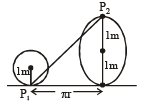
A wheel of radius 1m rolls for war d half a revolution on horizontal ground. The magnitude of the displacement of the point of the wheel initially in contact with the ground is:
[2002]

Detailed Solution: Question 2

Linear distance moved by the wheel in half revolution = πr
Point P1 after half revolution reaches at P2 vertically 2m above the ground.
∴ Displacement P1P= (π2r2 + 22)1/2 = 2 + 4)1/2     [∵ r = 1m]

31 Year NEET Previous Year Questions: System of Particles & Rotational Motion - 1 - Question 3

If the linear density (mass per unit length) of a rod of length 3m is proportional to x, where x is the distance from one end of the rod, the distance of the centre of gravity of the rod from this end is:
[2002]

Detailed Solution: Question 3

Consider an element of length dx at a distance x from end A.
Here mass per unit length λ of rod is:

λ ∝ x ⇒ λ = kx
∴ dm = λdx = kx dx

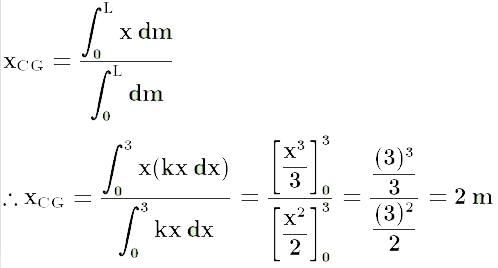
Position of centre of gravity of rod from end A is:


31 Year NEET Previous Year Questions: System of Particles & Rotational Motion - 1 - Question 4

A disc is rotating with angular velocity ω. If a child sits on it, what is conserved?
[2002]

Detailed Solution: Question 4

If external torque is zero, angular momentum remains conserved (External torque is zero because the weight of the child acts downward).

L = Iω = constant

31 Year NEET Previous Year Questions: System of Particles & Rotational Motion - 1 - Question 5

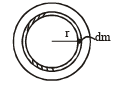
A composite disc is to be made using equal masses of aluminium and iron so that it has as high a moment of inertia as possible. This is possible when:
[2002]
Detailed Solution: Question 5

Density of iron > Density of aluminium
Moment of inertia = ∫ r2 dm


Since, ρiron > ρaluminium
So, the whole of aluminium is kept in the core and the iron at the outer rim of the disc.

31 Year NEET Previous Year Questions: System of Particles & Rotational Motion - 1 - Question 6

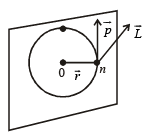
When a mass is rotating in a plane about a fixed point, its angular momentum is directed along:
[2012]

Detailed Solution: Question 6

  • By right-hand screw rule, the direction of L is ⊥ to the plane containing .
  • The mass is rotating in the plane, about a fixed point, thus this plane will contain  and the direction of  will be perpendicular to this plane.

31 Year NEET Previous Year Questions: System of Particles & Rotational Motion - 1 - Question 7

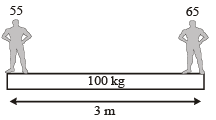
Two persons of masses 55 kg and 65 kg respectively, are at the opposite ends of a boat. The length of the boat is 3.0 m and weighs 100 kg. The 55 kg man walks up to the 65 kg man and sits with him. If the boat is in still water the centre of mass of the system shifts by:
[2012]
Detailed Solution: Question 7

There is no external force so centre of mass of the system will not shift.

31 Year NEET Previous Year Questions: System of Particles & Rotational Motion - 1 - Question 8

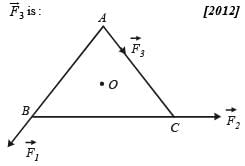
ABC is an equilateral triangle with O as its centre. represent three forces acting along the sides AB, BC and AC respectively. If the total torque about O is zero the magnitude of
Detailed Solution: Question 8

The torques F1​d and F2​d of F1​ and F2​respectively are counterclockwise. The torque F3​d is clockwise. Applying condition for rotational equilibrium,

F1 d + F2 d = F3 d
F3 = F1 + F2

31 Year NEET Previous Year Questions: System of Particles & Rotational Motion - 1 - Question 9

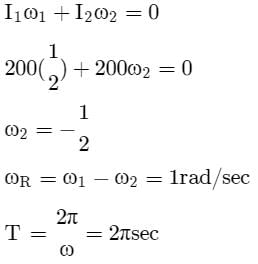
A circular platform is mounted on a frictionless vertical axle. Its radius R = 2 m and its moment of inertia about the axle is 200 kgm2. It is initially at rest. A 50 kg man stands on the edge of the platform and begins to walk along the edge at the speed of 1 ms–1 relative to the ground. Time taken by the man to complete one revolution is:
Detailed Solution: Question 9

By applying the law of conservation of angular momentum,

31 Year NEET Previous Year Questions: System of Particles & Rotational Motion - 1 - Question 10

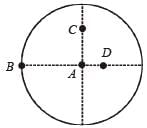
The moment of inertia of a uniform circular disc is maximum about an axis perpendicular to the disc and passing through:
[2012M]
Detailed Solution: Question 10

According to the parallel axis theorem of the moment of Inertia,   

I = Icm + md2

So, d is maximum for point B so Imax about B.

31 Year NEET Previous Year Questions: System of Particles & Rotational Motion - 1 - Question 11

Three masses are placed on the x-axis: 300g at origin, 500g at x = 40cm and 400g at x = 70 cm.The distance of the centre of mass from the origin is:
[2012M]

Detailed Solution: Question 11

► Xcm = (m1x1 + m2x2 + m3x3) / (m1 + m2 + m3)
► Xcm = (300 x (0) + 500(40) + 400 x 70) / (300 + 500 + 400)
► Xcm = 500 x 40 + 400 x 70 / 1200
► Xcm = 50 + 70 / 3 = 120 / 3 = 40 cm

31 Year NEET Previous Year Questions: System of Particles & Rotational Motion - 1 - Question 12

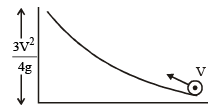
A small object of uniform density rolls up a curved surface with an initial velocity  ‘ν’. It reaches up to a maximum height of 3v2 / 4g with respect to the initial position. The object is a: 
[2013]
Detailed Solution: Question 12

From law of conservation of mechanical energy:
► 1 / 2 Iω2 + 0 + 1 / 2 mv2 = mg x 3v2 / 4g
► 1 / 2 Iω2 = 3 / 4 mv2 - 1 / 2 mv2
► 1 / 2 Iω= mv2 / 4
► (1 / 2 )* I * (V2 / R2) = mv2 / 4
► I = 1 / 2 mR2
Hence, object is a disc.

31 Year NEET Previous Year Questions: System of Particles & Rotational Motion - 1 - Question 13

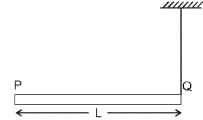
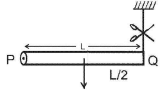
A rod PQ of mass M and length L is hinged at end P. The rod is kept horizontal by a massless string tied to point Q as shown in the figure. When the string is cut, the initial angular acceleration of the rod is:
[2013]
Detailed Solution: Question 13

Weight of the rod will produce the torque,
τ = mg x L / 2 = I α = mL2 / 3 α (∵ Irod = ML2 / 3)
Hence, angular acceleration, α = 3g / 2L

31 Year NEET Previous Year Questions: System of Particles & Rotational Motion - 1 - Question 14

Two discs are rotating about their axes, normal to the discs and passing through the centres of the discs. Disc D1 has 2 kg mass and 0.2 m radius and initial angular velocity of  50 rad s–1. Disc D2 has 4kg mass, 0.1 m radius and initial angular velocity of 200 rad s–1. The two discs are brought in contact face to face, with their axes of rotation coincident. The final angular velocity (in rad s–1) of the system is:
[2013]

Detailed Solution: Question 14

Given: m1 = 2 kg, m2 = 4 kg, r1 = 0.2 m, r2 = 0.1 m, w1 = 50 rad s–1, w2 = 200 rad s–1
As, I1W1 = I2W2 = Constant
∴ Wf = I1W1 + I2W2 / I1 + I2 
= [(1 / 2 m1r1w)+ (1 / 2 m2r2w2 )] / (1 / 2 m1r12 + 1 / 2 m2r22)​
By putting the value of m1, m2, r1, r2 and solving we get final angular velocity = 100 rad s–1

31 Year NEET Previous Year Questions: System of Particles & Rotational Motion - 1 - Question 15

The ratio of radii of gyration of a circular ring and a circular disc, of the same mass and radius, about an axis passing through their centres and perpendicular to their planes are:
[2013]

Detailed Solution: Question 15

I = MK2  ⇒ K = √I / M
Iring = MR2 and Idisc = 1 / 2 MR2
► K1 / K2 = (I1 / I2 )1/2 = √MR2 / (MR2 / 2) = √2 : 1

97 videos|376 docs|102 tests
Information about 31 Year NEET Previous Year Questions: System of Particles & Rotational Motion - 1 Page
In this test you can find the Exam questions for 31 Year NEET Previous Year Questions: System of Particles & Rotational Motion - 1 solved & explained in the simplest way possible. Besides giving Questions and answers for 31 Year NEET Previous Year Questions: System of Particles & Rotational Motion - 1, EduRev gives you an ample number of Online tests for practice
97 videos|376 docs|102 tests
Download as PDF