Civil Engineering (CE) Exam  >  Civil Engineering (CE) Test  >  SSC JE Civil Engineering 2026 Mock Test Series  >  Test: Irrigation Engineering- 2 - Civil Engineering (CE) MCQ

SSC JE Civil Engineering 2026 Test: Irrigation Engineering- 2 Free Online


MCQ Practice Test & Solutions: Test: Irrigation Engineering- 2 (20 Questions)

You can prepare effectively for Civil Engineering (CE) SSC JE Civil Engineering 2026 Mock Test Series with this dedicated MCQ Practice Test (available with solutions) on the important topic of "Test: Irrigation Engineering- 2". These 20 questions have been designed by the experts with the latest curriculum of Civil Engineering (CE) 2026, to help you master the concept.

Test Highlights:

  • - Format: Multiple Choice Questions (MCQ)
  • - Duration: 12 minutes
  • - Number of Questions: 20

Sign up on EduRev for free to attempt this test and track your preparation progress.

Test: Irrigation Engineering- 2 - Question 1

Which of the following statement is correct for sprinkler irrigation method?

Detailed Solution: Question 1

In this method Irrigation water is applied to the land in the form of spray. The sprinkler irrigation is used for all the crops except rice and jute and for almost all the soils except very heavy soils with very low infiltration rates.

In this method, borders and field channels are not required and hence more land is available for cropping.

Test: Irrigation Engineering- 2 - Question 2

Capacity of an irrigation tank depends on:

Detailed Solution: Question 2

The rate at which water can be extracted from the tank is known as capacity of the tank. Capacity of irrigation tank depends on the type of crop and its duty.

Test: Irrigation Engineering- 2 - Question 3

Acidic soils are reclaimed by:

Detailed Solution: Question 3

Due to the presence of injurious salts like Na2CO3, Na2SO4 and NaCl, Soil will become saline which lead to efflorescence and if it continuous for a longer time then the soil will become alkaline. These soils are reclaimed by leaching, crop rotation, providing sub surface drainage area, addition of gypsum etc.

On the other hand, acidic soils can be reclaimed by basic salts such as limestone.

Test: Irrigation Engineering- 2 - Question 4

The Lacey’s silt factor for a particular alluvium is 2.0. This alluvium would comprise:

Detailed Solution: Question 4
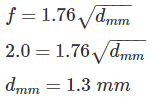
Lacey’s silt factor is given by:

Test: Irrigation Engineering- 2 - Question 5

A check dam is a:

Detailed Solution: Question 5

Check dams are small barriers built across streams or gullies to slow water flow, reduce erosion, and promote sediment deposition, thereby aiding in soil conservation.

Test: Irrigation Engineering- 2 - Question 6

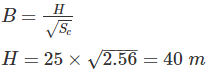
The base width of a solid gravity dam is 25 m. The material of the dam has a specific gravity of 2.56 and the dam is designed as an elementary profile ignoring uplift. What is the approximately allowable height of the dam?

Detailed Solution: Question 6
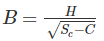
For elementary profile of the dam,

Base width of the dam is given by:

When uplift is ignored, C =0

Test: Irrigation Engineering- 2 - Question 7

At a certain point in the floor of weir, the uplift pressure head due to seepage is 4.5 m. If the relative density of concrete is 2.5, the minimum thickness of floor required at this point to counteract the uplift pressure is:

Detailed Solution: Question 7

Minimum thickness of floor required is,

Test: Irrigation Engineering- 2 - Question 8

In a river, silt excluder and silt ejector are constructed:

Detailed Solution: Question 8

Silt excluders are constructed on the bed of the river, upstream of the head regulator. While silt ejectors are constructed on the bed of the canal and a little distance downstream from the head regulator.

As, Silt excluders remove silt from the water before it enters the canal and silt ejectors extract the silt from the canal water after the silted water has travelled a certain distance in the off-take canal.

Test: Irrigation Engineering- 2 - Question 9

The most economical method of soil conservation is to:

Detailed Solution: Question 9

Afforestation means planting trees. As we know, the roots of the trees help to hold the soil layer firmly, it is evident that it helps not to make the soil loose and prevents erosion.

Thus by planting more and more trees, the top layer of the soil becomes less prone to erosion by wind, water etc. Hence it prevents erosion and helps in soil conservation.

Note: Contour bunds and check bunds are basically water harvesting techniques.

Test: Irrigation Engineering- 2 - Question 10

Outlet discharge for a particular crop is given by:

Detailed Solution: Question 10
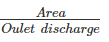
The duty at the head water course is called as “outlet Discharge factor”.

The ratio between the area of the crop irrigated and the quantity of water required during its entire period of growth is known as duty. Duty is measured in hectares per cumec.

Hence, 

Outlet factor = 

Test: Irrigation Engineering- 2 - Question 11

The alignment of a canal:

Detailed Solution: Question 11

i) The canal which is aligned along the *water-shed line* is known as ridge canal. Canal can also be aligned along contours of the country, right angle to contours of the country but the most economical is ridge canal. The advantage of this type of canal is that it can irrigate the areas on both the sides.

ii) As per financial perspective of the country, canal should not be located near-by our valuable properties because of problems in flood like situations.

iii) It should be so aligned such that minimum number of cross drainage work is required.

Test: Irrigation Engineering- 2 - Question 12

The loss of head per unit length of the creep is called:

Detailed Solution: Question 12

According to Bligh’s creep theory, the percolation water creeps along the base profile of the apron with the sub-soil. The path traced by the percolating water is known as creep length and the head loss per unit creep length is known as hydraulic gradient or percolating coefficient.

Test: Irrigation Engineering- 2 - Question 13

In a river, spurs are provided:-

Detailed Solution: Question 13

Groynes or spurs are constructed transverse to the river flow extending from the bank into the river. This form of river training works performs one or more functions such as:

i) Training the river along the desired course to reduce the concentration of flow at the point of attack,

ii) Creating a slack flow for silting up the area in the vicinity and protecting the bank by keeping the flow away from it.

Test: Irrigation Engineering- 2 - Question 14

Groynes are adopted for river bank protection works. When it is placed inclined downstream in the direction of flow in the river, it is designated as which one of the following?

Test: Irrigation Engineering- 2 - Question 15

A drop in canal bed is generally provided if:

Detailed Solution: Question 15

Canal fall is solid masonry structure which is constructed on the canal if the natural ground slope is steeper than the designed channel bed slope.

If the difference in slope is smaller, single fall can be constructed. If it is of higher then falls are constructed at regular intervals.

Test: Irrigation Engineering- 2 - Question 16

If the discharge required for different crops is 0.6 cumecs in the field and the capacity factor and time factors are 0.8 and 0.5 respectively, then what is the design discharge of the distributary at its head?

Detailed Solution: Question 16
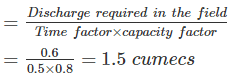
Design discharge

Test: Irrigation Engineering- 2 - Question 17

If D is the depth of scour below original bed, then the width of launching apron is generally taken as:

Detailed Solution: Question 17

Heavy scour of the river bed at curved heads and shanks of guide banks can cause undermining of stone pitching thereby resulting in failure of guide banks. Such a failure can be prevented by providing launching apron beyond the toe of guide banks. The width of launching apron is generally taken as 1.5D.

Test: Irrigation Engineering- 2 - Question 18

The ratio of the water stored in the root zone during irrigation, to the water needed in the root zone prior to irrigation is called:

Detailed Solution: Question 18
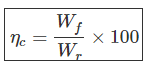
Irrigation Efficiencies:

i) Water Conveyance Efficiency, (ηc)

where, Wf = Water delivered to the field 

Wr = Water delivered from the reservoir

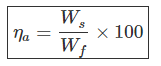
ii) Water Application Efficiency (ηa)

where, Ws = Water stored in the root zone 

Wf = Water delivered to the field

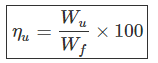
iii) Water use Efficiency (ηu

where, Wu = Water use consumptively. 

Wf = Water delivered to the filed

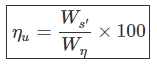
iv) Water storage Efficiency (ηu

where, Ws’ = Actual water stored in the root zone

Wf = Water needed to store to bring the water content up to field capacity.

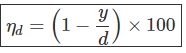
v) Water distribution Efficiency, (ηd

where, y = Average numerical deviation in the depth of water stored from the average depth of irrigation stored

d = Average depth during irrigation

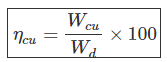
vi) Consumptive use Efficiency (ηcu

where, Wcu or Cu = Water used by plant consumptively. 

Wd = Net amount of water depleted from root zone.

Test: Irrigation Engineering- 2 - Question 19

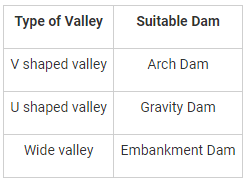
A constant centre (in plan – view) arch dam is best suited for:

Detailed Solution: Question 19
Test: Irrigation Engineering- 2 - Question 20

Thession’s polygon is used for determination of:

1 videos|1 docs|64 tests
Information about Test: Irrigation Engineering- 2 Page
In this test you can find the Exam questions for Test: Irrigation Engineering- 2 solved & explained in the simplest way possible. Besides giving Questions and answers for Test: Irrigation Engineering- 2, EduRev gives you an ample number of Online tests for practice
Download as PDF