NEET Exam  >  NEET Test  >  Chemistry Class 11  >  31 Years NEET Previous Year Questions: Classification of Elements & Periodicity in Properties - NEET MCQ

31 Years NEET Previous Year Questions: Classification of Elements & Periodicity


Test Description

30 Questions MCQ Test Chemistry Class 11 - 31 Years NEET Previous Year Questions: Classification of Elements & Periodicity in Properties

31 Years NEET Previous Year Questions: Classification of Elements & Periodicity in Properties for NEET 2026 is part of Chemistry Class 11 preparation. The 31 Years NEET Previous Year Questions: Classification of Elements & Periodicity in Properties questions and answers have been prepared according to the NEET exam syllabus.The 31 Years NEET Previous Year Questions: Classification of Elements & Periodicity in Properties MCQs are made for NEET 2026 Exam. Find important definitions, questions, notes, meanings, examples, exercises, MCQs and online tests for 31 Years NEET Previous Year Questions: Classification of Elements & Periodicity in Properties below.
Solutions of 31 Years NEET Previous Year Questions: Classification of Elements & Periodicity in Properties questions in English are available as part of our Chemistry Class 11 for NEET & 31 Years NEET Previous Year Questions: Classification of Elements & Periodicity in Properties solutions in Hindi for Chemistry Class 11 course. Download more important topics, notes, lectures and mock test series for NEET Exam by signing up for free. Attempt 31 Years NEET Previous Year Questions: Classification of Elements & Periodicity in Properties | 30 questions in 30 minutes | Mock test for NEET preparation | Free important questions MCQ to study Chemistry Class 11 for NEET Exam | Download free PDF with solutions
31 Years NEET Previous Year Questions: Classification of Elements & Periodicity in Properties - Question 1

Which of the following statements are true? [NEET 2025]

2025

Choose the correct answer from the options given below:

Detailed Solution for 31 Years NEET Previous Year Questions: Classification of Elements & Periodicity in Properties - Question 1

Statement A: "Unlike Ga that has a very high melting point, Cs has a very low melting point."

  • This statement is False. Gallium (Ga) has a relatively high melting point, while Cesium (Cs) has an almost equal melting point.
    2025

Statement B: "On Pauling scale, the electronegativity values of N and Cl are same."

  • This statement is incorrect. Nitrogen (N) has an electronegativity of 3.04, and Chlorine (Cl) has an electronegativity of 3.16 on the Pauling scale, so they have different electronegativities.

Statement C: "K+, Cl-, Ca2+ and S2- are all isoelectronic species."

  • This statement is true. All these ions (K+, Cl-, Ca2+, and S2-) have the same number of electrons (18 electrons), making them isoelectronic species.

Statement D: "The correct order of the first ionization enthalpies of Na, Mg, Al, and Si is Si > Al > Mg > Na."

  • This statement is incorrect. The correct order of ionization enthalpies is Si > Al > Mg > Na. Magnesium (Mg) has a higher ionization enthalpy than Aluminum (Al), and Sodium (Na) has the lowest ionization enthalpy due to its larger atomic size and lower nuclear charge compared to others.

Statement E: "The atomic radius of Cs is greater than that of Li and Rb."

  • This statement is correct. While Cesium (Cs) has a larger atomic radius than Lithium (Li), it is also larger than Rubidium (Rb). The atomic radius increases as you move down a group in the periodic table, so Li < Na < K < Rb < Cs..

Therefore, the correct answer is: Option d) C and E only.

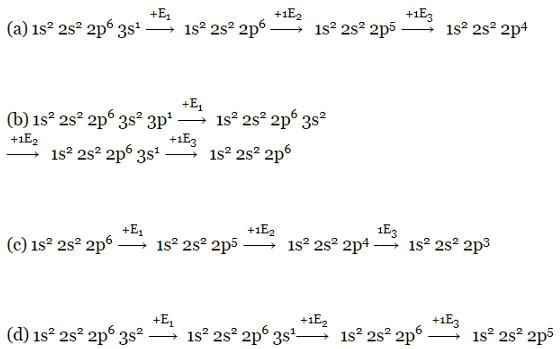
31 Years NEET Previous Year Questions: Classification of Elements & Periodicity in Properties - Question 2

Which among the following electronic configurations belong to main group elements?   [NEET 2025]

2025

Choose the correct answer from the option given below:

Detailed Solution for 31 Years NEET Previous Year Questions: Classification of Elements & Periodicity in Properties - Question 2

Analyze the given electronic configurations to determine whether they belong to main group elements:

  • A. [Ne]3s1: This corresponds to sodium (Na), which is in Group 1. It is a main group element.
  • B. [Ar]3d34s2: This corresponds to vanadium (V), which is a transition metal (Group 5). It is not a main group element.
  • C. [Kr]4d105s25p5: This corresponds to iodine (I), which is in Group 17. It is a main group element.
  • D. [Ar]3d104s1: This corresponds to copper (Cu), which is a transition metal (Group 11). It is not a main group element.
  • E. [Rn]5f06d27s2: This corresponds to thorium (Th), which is an actinide and not a main group element.

So, only A and C belong to main group elements.

31 Years NEET Previous Year Questions: Classification of Elements & Periodicity in Properties - Question 3

Arrange the following elements in increasing order of electronegativity:    [NEET 2024]
N, O, F, C, Si
Choose the correct answer from the options given below :

Detailed Solution for 31 Years NEET Previous Year Questions: Classification of Elements & Periodicity in Properties - Question 3

Electronegativity is a chemical property that describes the tendency of an atom to attract a shared pair of electrons (or electron density) towards itself in a chemical bond. The Pauling scale is the most commonly used scale to measure electronegativity. According to this scale:
The electronegativity of Fluorine (F) is the highest among the elements at around 3.98.
Oxygen (O) follows next with an electronegativity of about 3.44.
Nitrogen (N) has an electronegativity of approximately 3.04.
Carbon (C) has an electronegativity value close to 2.55.
Silicon (Si), being further down the group in the periodic table than Carbon, has a lower electronegativity of about 1.90.
Based on these values, we can arrange the elements in order of increasing electronegativity as follows:
Si < C < N < O < F
Thus, considering the options provided:
Option A: Si < C < N < O < F is the correct answer since it correctly ranks the elements from the lowest to the highest electronegativity.

31 Years NEET Previous Year Questions: Classification of Elements & Periodicity in Properties - Question 4

Arrange the following elements in increasing order of first ionization enthalpy:    [NEET 2024]
Li, Be, B, C, N
Choose the correct answer from the options given below:

Detailed Solution for 31 Years NEET Previous Year Questions: Classification of Elements & Periodicity in Properties - Question 4

The first ionization enthalpy, also known as ionization energy, is the energy required to remove the most loosely bound electron from a neutral atom in the gaseous phase to form a cation. The trend of first ionization energies generally increases across a period from left to right in the periodic table. This is due to the increasing nuclear charge and the decreasing atomic radius, which cause the valence electrons to be attracted more strongly to the nucleus.
However, there are notable exceptions based on the electron configuration stability and electron pairing in orbitals. Let's analyze the given elements:
Lithium (Li): Being the first element in the period, it has the smallest nuclear charge and only one electron in its outer shell, which makes it easy to remove an electron.
Beryllium (Be): This element has two electrons in the 2s orbital. The removal of one electron slightly disturbs the fully filled 2s sub-shell, creating more stability than having an unpaired electron. Therefore, Be has a higher ionization energy than Li.
Boron (B): This element has a half-filled 2p orbital configuration (one electron in the 2p orbital), which is relatively less stable compared to a full or empty p orbital, leading to a slightly lower ionization energy than Be.
Carbon (C): With two electrons in separate 2p orbitals (following Hund's rule), C experiences more effective nuclear shielding and electron-electron repulsion compared to a single electron in Boron's 2p orbital. This makes it relatively easier to remove an electron from B than from C, but harder than removing one from Be.
Nitrogen (N): It has exactly half-filled 2p orbitals, which provides extra stability and hence has a higher ionization energy than Carbon. Contrarily, the configuration of three p electrons is stable owing to the exchange energy and symmetric distribution in space.
Given these points, we can order the elements by increasing first ionization enthalpy as follows:
Li < B < Be < C < N
This matches with Option B. Thus, the correct answer is:
Option B
Li < B < Be < C < N

31 Years NEET Previous Year Questions: Classification of Elements & Periodicity in Properties - Question 5

Identify the incorrect statement:    [NEET 2024]

Detailed Solution for 31 Years NEET Previous Year Questions: Classification of Elements & Periodicity in Properties - Question 5

Statement 1: The oxidation state of Al in [AlCl(H₂O)₅]2+ is +3, and the coordination number (covalency) is 6, which is correct for this complex. Thus, Statement 1 is correct.
Statement 2Na2O is indeed a basic oxide (since Na is an alkali metal), and Cl2O7 is an acidic oxide (since it is formed by a non-metal). Therefore, Statement 2 is correct.
Statement 3O2-F-Na+, and Mg2+ all have the same number of electrons (10 electrons), making them isoelectronic species. Therefore, Statement 3 is correct.
Statement 4Mg has an atomic radius larger than Mg2+Al is larger than Al3+. Therefore, the smallest ion among MgAlMg2+, and Al3+ is Al3+, not Al. Hence, Statement 4 is incorrect.

31 Years NEET Previous Year Questions: Classification of Elements & Periodicity in Properties - Question 6

Match List-I with List-II:    [NEET 2024]

2024

Choose the correct answer from the options given below:

Detailed Solution for 31 Years NEET Previous Year Questions: Classification of Elements & Periodicity in Properties - Question 6

A. Mendelevium
The symbol for Mendelevium is Md.
B. Meitnerium
The symbol for Meitnerium is Mt.
C. Moscovium
The symbol for Moscovium is Mc.
D. Nobelium
The symbol for Nobelium is No.
Thus, the correct match is: A-IV, B-I, C-II, D-III
So, the correct answer is (c).

31 Years NEET Previous Year Questions: Classification of Elements & Periodicity in Properties - Question 7

The correct decreasing order of atomic radii (pm) of Li, Be, B, and C is:      [NEET 2024]

Detailed Solution for 31 Years NEET Previous Year Questions: Classification of Elements & Periodicity in Properties - Question 7

The atomic radius generally decreases as we move across a period from left to right, due to the increase in nuclear charge, which pulls the electrons closer to the nucleus. On the other hand, the atomic radius increases as we move down a group because the number of electron shells increases, making the atom larger.
Now, let's look at the elements in question:

  • Li (Lithium): Group 1, Period 2
  • Be (Beryllium): Group 2, Period 2
  • B (Boron): Group 13, Period 2
  • C (Carbon): Group 14, Period 2
  • Li has the largest atomic radius because it's in Group 1 and Period 2, so it has the least nuclear charge compared to the others.
  • Be has a smaller atomic radius than Li because it is in Group 2, and its increased nuclear charge pulls the electrons closer.
  • B has a smaller atomic radius than Be, as it is further across the period (Group 13).
  • C has the smallest atomic radius, as it is in Group 14 and further along the period, with the highest nuclear charge.

Thus, the correct order is: Li > Be > B > C.
Therefore, the correct answer is (b).

31 Years NEET Previous Year Questions: Classification of Elements & Periodicity in Properties - Question 8

Match List-I with List-II       [NEET 2024]

2024

Choose the correct answer from the options given below:

Detailed Solution for 31 Years NEET Previous Year Questions: Classification of Elements & Periodicity in Properties - Question 8

A. Lanthanoid
Lanthanoids are elements in the f-block of the periodic table. The element Ce (Cerium) is a lanthanoid.
So, A-I: Ce.

B. d-Block element
d-block elements are transition metals. The element Mn (Manganese) belongs to the d-block.
So, B-IV: Mn.

C. p-Block element
p-block elements are located in groups 13 to 18. The element As (Arsenic) is a p-block element.
So, C-II: As.

D. s-Block element
s-block elements are found in groups 1 and 2. The element Cs (Cesium) is an s-block element.
So, D-III: Cs.
Thus, the correct answer is (C) A-I, B-IV, C-II, D-III.

31 Years NEET Previous Year Questions: Classification of Elements & Periodicity in Properties - Question 9

 The element expected to form the largest ion to achieve the nearest noble gas configuration is:        [NEET 2023]

Detailed Solution for 31 Years NEET Previous Year Questions: Classification of Elements & Periodicity in Properties - Question 9

To determine which element forms the largest ion to achieve the nearest noble gas configuration, we need to consider how each element achieves a stable electron configuration and the size of the resulting ion.

  1. Sodium (Na): Sodium has an atomic number of 11 and typically forms a Na+ ion by losing 1 electron. The electron configuration of Na is [Ne]3s1, and when it loses one electron, it achieves the electron configuration of Ne (a noble gas). The ion Na+ is smaller compared to the neutral atom.
  2. Oxygen (O): Oxygen has an atomic number of 8 and typically forms an O2- ion by gaining 2 electrons. The electron configuration of O is 1s2 2s2 2p4, and when it gains 2 electrons, it achieves the electron configuration of Ne (a noble gas). The ion O2- is larger than the neutral oxygen atom due to the increased electron-electron repulsion after gaining electrons.
  3. Fluorine (F): Fluorine has an atomic number of 9 and typically forms an F- ion by gaining 1 electron. The electron configuration of F is 1s2 2s2 2p5, and when it gains 1 electron, it achieves the electron configuration of Ne (a noble gas). The ion F- is also larger than the neutral fluorine atom due to the increased electron-electron repulsion.
  4. Nitrogen (N): Nitrogen has an atomic number of 7 and typically forms a N3- ion by gaining 3 electrons. The electron configuration of N is 1s2 2s2 2p3, and when it gains 3 electrons, it achieves the electron configuration of Ne (a noble gas). The N3- ion is the largest among the ions because it gains 3 electrons, which causes the largest increase in size due to electron-electron repulsion.

Thus, the N3- ion formed by Nitrogen (N) is the largest, as it gains 3 electrons and achieves the noble gas configuration of Ne.
Therefore, the correct answer is (D) Nitrogen (N).

31 Years NEET Previous Year Questions: Classification of Elements & Periodicity in Properties - Question 10

Which one of the following represents all isoelectronic species?       [NEET 2023]

Detailed Solution for 31 Years NEET Previous Year Questions: Classification of Elements & Periodicity in Properties - Question 10

To determine which set of species are isoelectronic, we need to check if they all have the same number of electrons.
Isoelectronic species:These are species that have the same number of electrons but may differ in their nuclear charge.Let's check the electron count for each option:Option (a): Na+, Cl-, O-, NO+

  • Na+: Atomic number of Na = 11, so Na+ has 10 electrons.
  • Cl-: Atomic number of Cl = 17, so Cl- has 18 electrons.
  • O-: Atomic number of O = 8, so O- has 9 electrons.
  • NO+: Nitrogen (N) has an atomic number of 7 and oxygen (O) has an atomic number of 8. NO+ has 9 electrons (8 from oxygen and 1 from nitrogen, after losing an electron).
    So, these species are not isoelectronic.

Option (b): N₂O, N₂O₄, NO+, NO

  • The electron count for each of these species would need to be checked individually, but from the atomic structure, it's clear that they do not all have the same number of electrons. So, they are not isoelectronic.

Option (c): Na+, Mg2+, O-, F-

  • Na+: 10 electrons (from earlier)
  • Mg2+: Atomic number of Mg = 12, so Mg2+ has 10 electrons.
  • O-: 9 electrons.
  • F-: Atomic number of F = 9, so F- has 10 electrons.
    These species are not all isoelectronic, as O- has 9 electrons, while the others have 10.

Option (d): Ca2+, Ar, K+, Cl-

  • Ca2+: Atomic number of Ca = 20, so Ca2+ has 18 electrons.
  • Ar: Atomic number of Ar = 18, so Ar has 18 electrons.
  • K+: Atomic number of K = 19, so K+ has 18 electrons.
  • Cl-: Atomic number of Cl = 17, so Cl- has 18 electrons.
    All these species have 18 electrons and are isoelectronic with each other.

Conclusion:
The correct answer is (d) Ca2+, Ar, K+, Cl- because they all have the same number of electrons (18) and are isoelectronic.

31 Years NEET Previous Year Questions: Classification of Elements & Periodicity in Properties - Question 11

Which of the following pairs is correctly matched?    [NEET 2023]

Detailed Solution for 31 Years NEET Previous Year Questions: Classification of Elements & Periodicity in Properties - Question 11

Basic oxides: Basic oxides are typically oxides of metals that react with acids to form salts and water. Examples include In2O3K2O, and SnO2.
However, SnO2 is slightly amphoteric, so this option is not entirely accurate.
Neutral oxides: Neutral oxides are oxides that do not react significantly with either acids or bases. CONO2, and N2O are all neutral oxides.

  • CO (Carbon monoxide) is neutral.
  • NO2 (Nitrogen dioxide) and N2O (Dinitrogen monoxide) are neutral oxides as well.
  • So, option (b) is incorrect.

Acidic oxides: Acidic oxides are oxides that react with water to form acids and can react with bases to form salts. Examples include Mn2O7SO2, and TeO3.

  • Mn2O7 (Manganese heptoxide) is acidic.
  • SO2 (Sulfur dioxide) is acidic.
  • TeO3 (Tellurium trioxide) is also acidic.

Therefore, option (c) is correct.
Amphoteric oxides: Amphoteric oxides can act both as acids and bases. Examples include BeOGa2O3, and GeO.

  • BeO (Beryllium oxide) is amphoteric.
  • Ga2O3 (Gallium oxide) is amphoteric.
  • GeO (Germanium oxide) is also amphoteric.
  • This matches well with the definition of amphoteric oxides, making option (d) correct.

Conclusion: The correct answer is (c) Acidic oxides - Mn2O7SO2TeO3.

31 Years NEET Previous Year Questions: Classification of Elements & Periodicity in Properties - Question 12

The correct sequence given below contains neutral, acidic, basic, and amphoteric oxide each, respectively is:      [NEET 2023]

Detailed Solution for 31 Years NEET Previous Year Questions: Classification of Elements & Periodicity in Properties - Question 12
  • NO (Nitric oxide) is a neutral oxide, as it does not react significantly with acids or bases.
  • CO2 (Carbon dioxide) is an acidic oxide, as it reacts with water to form an acid (H2CO3) and with bases to form salts.
  • CaO (Calcium oxide) is a basic oxide, as it reacts with acids to form salts and water.
  • ZnO (Zinc oxide) is amphoteric, as it can react with both acids and bases to form salts.

So, the correct sequence is: NO (neutral), CO2 (acidic), CaO (basic), ZnO (amphoteric).
Thus, the correct answer is (d) NO, CO2, CaO, ZnO.

31 Years NEET Previous Year Questions: Classification of Elements & Periodicity in Properties - Question 13

The IUPAC name of an element with atomic number 119 is      [NEET 2022 Phase 1]

Detailed Solution for 31 Years NEET Previous Year Questions: Classification of Elements & Periodicity in Properties - Question 13

IUPAC name of element : 119 : ununennium

31 Years NEET Previous Year Questions: Classification of Elements & Periodicity in Properties - Question 14

Gadolinium has a low value of third ionisation enthalpy because of     [NEET 2022 Phase 1]

Detailed Solution for 31 Years NEET Previous Year Questions: Classification of Elements & Periodicity in Properties - Question 14

Electronic configuration of Gadolinium
Gd :- [Xe] 4f7 5d1 6s2
In case of 3rd ionisation enthalpy electron will be removed from 5d and resultant configuration will be [Xe]4f7 that is stable electronic configuration as it will have high exchange energy, hence less energy will be required to remove 3rd electron.

31 Years NEET Previous Year Questions: Classification of Elements & Periodicity in Properties - Question 15

The correct order of first ionization enthalpy for the given four elements is :    [NEET 2022 Phase 2]

Detailed Solution for 31 Years NEET Previous Year Questions: Classification of Elements & Periodicity in Properties - Question 15
  • Generally, on moving left to right in a period. First ionization enthalpy of elements increases due to increase in effective nuclear charge.
  • Due to more stable half-filled outer electronic configuration (2s22p3) of N, its first ionization enthalpy is more than O. 

So, correct order of IP is : C < O < N < F

31 Years NEET Previous Year Questions: Classification of Elements & Periodicity in Properties - Question 16

Decrease in size from left to right in actinoid series is greater and gradual than that in lanthanoid series due to:      [NEET 2022 Phase 2]

Detailed Solution for 31 Years NEET Previous Year Questions: Classification of Elements & Periodicity in Properties - Question 16

Due to more diffused nature of 5f orbitals as compared to 4f orbitals the shielding effect of 5f is poor, resulting in the decrease in size from left to right in actinoid series which is greater and gradual than that in lanthanoid series

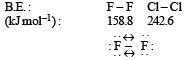
31 Years NEET Previous Year Questions: Classification of Elements & Periodicity in Properties - Question 17

Fluorine is a stronger oxidising agent than chlorine because :   [NEET 2022 Phase 2]
(a) F-F bond has a low enthalpy of dissociation.
(b) Fluoride ion (F) has high hydration enthalpy.
(c) Electron gain enthalpy of fluorine is less negative than chlorine.
(d) Fluorine has a very small size.
Choose the most appropriate answer from the options given :

Detailed Solution for 31 Years NEET Previous Year Questions: Classification of Elements & Periodicity in Properties - Question 17

Fluorine is a stronger oxidising agent than chlorine due to
(i) Low dissociation enthalpy of F-F bond
(ii) High hydration enthalpy of F− ion

31 Years NEET Previous Year Questions: Classification of Elements & Periodicity in Properties - Question 18

 Identify the incorrect match.     [NEET 2020]
2020

Detailed Solution for 31 Years NEET Previous Year Questions: Classification of Elements & Periodicity in Properties - Question 18

101 - Unnilunium - Mendelevium
103 - Unniltrium - Lawrencium
106 - Unnilhexium - Seaborgium
111 - Unununium - Roentgenium
110 - Ununnilium - Darmstadtium

31 Years NEET Previous Year Questions: Classification of Elements & Periodicity in Properties - Question 19

Match the following:    [NEET 2020]
2020
Which of the following is correct option?

Detailed Solution for 31 Years NEET Previous Year Questions: Classification of Elements & Periodicity in Properties - Question 19

CO : Neutral oxide
BaO : Basic oxide
Al2O3 : Amphoteric oxide
Cl2O7 : Acidic oxide

31 Years NEET Previous Year Questions: Classification of Elements & Periodicity in Properties - Question 20

For the second period elements the correct increasing order of first ionisation enthalpy is:    [NEET 2019]

Detailed Solution for 31 Years NEET Previous Year Questions: Classification of Elements & Periodicity in Properties - Question 20

Ionisation enthalpy increases in a period from left to right, because of increased nuclear charge and decrease in atomic radii. But because of half filled orbitals of Be, N and fully filled orbitals of Ne, stability of those atoms inceases.
So, the correct increasing order of first ionisation enthalpy will be :
Li < B < Be < C < O < N < F < Ne

31 Years NEET Previous Year Questions: Classification of Elements & Periodicity in Properties - Question 21

The correct order of atomic radii in group 13 elements is      [NEET 2018]

Detailed Solution for 31 Years NEET Previous Year Questions: Classification of Elements & Periodicity in Properties - Question 21

Ga is slightly smaller than Al due poor shielding of d e– so Zeff increasing.
So, Atomic size : B < Ga < Al < In < Tl

31 Years NEET Previous Year Questions: Classification of Elements & Periodicity in Properties - Question 22

Which of the following oxides is most acidic in nature?       [NEET 2018]

Detailed Solution for 31 Years NEET Previous Year Questions: Classification of Elements & Periodicity in Properties - Question 22

In metals, on moving down the group, metallic character increases, so basic nature increases hence most acidic will be BeO. In fact, BeO is amphoteric oxide while other given oxides are basic oxides.

31 Years NEET Previous Year Questions: Classification of Elements & Periodicity in Properties - Question 23

The element Z = 114 has been discovered recently. It will belong to which of the following family/groupand electronic configuration ?     [NEET 2017]

Detailed Solution for 31 Years NEET Previous Year Questions: Classification of Elements & Periodicity in Properties - Question 23

2017

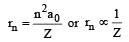
31 Years NEET Previous Year Questions: Classification of Elements & Periodicity in Properties - Question 24

The species Ar, K+ and Ca2+ contain the same number of electrons. In which order do their radii increase ?     [AIPMT 2015 Cancelled Paper]

Detailed Solution for 31 Years NEET Previous Year Questions: Classification of Elements & Periodicity in Properties - Question 24

⇒ Ca2+ < K+ < Ar
Ar, K+ and Ca2+ are isoelectronic i.e with the same number of electrons, 18. For isoelectronic species, ionic radii decrease with increases in effective (relative) positive charge. Also Ar, K and Ca belong to the same period.

31 Years NEET Previous Year Questions: Classification of Elements & Periodicity in Properties - Question 25

Which of the following orders of ionic radii is correctly represented?    [NEET 2014]

Detailed Solution for 31 Years NEET Previous Year Questions: Classification of Elements & Periodicity in Properties - Question 25

Cation loose electrons are smaller in size than the parent atom, where anions gain electrons are larger in size than the parent atom.
Hence the order is H- > H. > H+

31 Years NEET Previous Year Questions: Classification of Elements & Periodicity in Properties - Question 26

Which one of the following arrangements represents the correct order of least negative to most negative electron gain enthalpy for C, Ca, Al, F and O? [NEET Kar. 2013]

Detailed Solution for 31 Years NEET Previous Year Questions: Classification of Elements & Periodicity in Properties - Question 26

As the nuclear charge increases, the force of attraction between the nucleus and the incoming electron increses and hence the elecron gain enthalpy becomes more negative, hence the correct order is Ca   <   Al    <   C    <   O   <    F

31 Years NEET Previous Year Questions: Classification of Elements & Periodicity in Properties - Question 27

Identify the wrong statement in the following: [2012]

Detailed Solution for 31 Years NEET Previous Year Questions: Classification of Elements & Periodicity in Properties - Question 27

As the positive charge increases on metal cation, radius decreases. This is due to the fact that nuclear charge in the case of a cation is acting on lesser number of electrons and pulls them closer.

31 Years NEET Previous Year Questions: Classification of Elements & Periodicity in Properties - Question 28

What is the value of electron gain enthalpy of Na+ if IE1 of Na = 5.1 eV ? [2011M]

Detailed Solution for 31 Years NEET Previous Year Questions: Classification of Elements & Periodicity in Properties - Question 28

IE1 of Na = – Electron gain enthalpy of Na+                    = – 5.1 Volt.

31 Years NEET Previous Year Questions: Classification of Elements & Periodicity in Properties - Question 29

Among the elements Ca, Mg, P and Cl, the order of increasing atomic radii is : [2010]

Detailed Solution for 31 Years NEET Previous Year Questions: Classification of Elements & Periodicity in Properties - Question 29

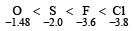
31 Years NEET Previous Year Questions: Classification of Elements & Periodicity in Properties - Question 30

Which of the following represents the correct order of increasing electron gain enthalpy with negative sign for the elements O, S, F and Cl ? [2010]

Detailed Solution for 31 Years NEET Previous Year Questions: Classification of Elements & Periodicity in Properties - Question 30

O < S < F < CI

Electron gain enthalpy – 141 – 200 – 333 – 349 kJ mol–1

101 videos|250 docs|76 tests
Information about 31 Years NEET Previous Year Questions: Classification of Elements & Periodicity in Properties Page
In this test you can find the Exam questions for 31 Years NEET Previous Year Questions: Classification of Elements & Periodicity in Properties solved & explained in the simplest way possible. Besides giving Questions and answers for 31 Years NEET Previous Year Questions: Classification of Elements & Periodicity in Properties, EduRev gives you an ample number of Online tests for practice
101 videos|250 docs|76 tests
Download as PDF