NEET Exam  >  NEET Test  >  Chemistry Class 11  >  31 Year NEET Previous Year Questions: Hydrocarbons - NEET MCQ

31 Year NEET Previous Questions: Hydrocarbons Free MCQ Practice Test [Updated]


MCQ Practice Test & Solutions: 31 Year NEET Previous Year Questions: Hydrocarbons (41 Questions)

You can prepare effectively for NEET Chemistry Class 11 with this dedicated MCQ Practice Test (available with solutions) on the important topic of "31 Year NEET Previous Year Questions: Hydrocarbons". These 41 questions have been designed by the experts with the latest curriculum of NEET 2026, to help you master the concept.

Test Highlights:

  • - Format: Multiple Choice Questions (MCQ)
  • - Duration: 80 minutes
  • - Number of Questions: 41

Sign up on EduRev for free to attempt this test and track your preparation progress.

31 Year NEET Previous Year Questions: Hydrocarbons - Question 1

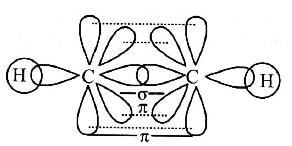
Acetylenic hydrogens are acidic because   [1989]
Detailed Solution: Question 1

The acidity of acetylene or 1--alkynes can be explained on the basis of molecular orbital concept according to which formation of C—H bond in acetylene involves sphybridised carbon atom. Now since s electrons are closer to the nucleus than p electrons, the electrons present in a bond having more s character will be correspondingly more closer to the nucleus.
Thus owing to high s character of the C—H bond in alkynes (s = 50%), the electrons constituting this bond are more strongly held by the carbon nucleus (i.e., the acetylenic carbon atom or the sp orbital acts as more electronegative species than the sp2 and sp3 with the result the hydrogen  present on such a carbon atom (≡C—H) can be esily removed as a proton.

31 Year NEET Previous Year Questions: Hydrocarbons - Question 2

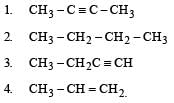
Which is the most suitable reagent among the following to distinguish compound (3) from rest of the compounds ? [1989]
Detailed Solution: Question 2

Br2 in CCl4 (a), Br2 in CH3 COOH (b) and alk.
KMnO4 (c) will react with all unsaturated compounds, i.e., 1, 3 and 4 while ammonical AgNO3 (d) reacts only with terminal alkynes, i.e., 3 and hence compund 3 can be distinguished from 1, 2 and 4 by. ammonical AgNO3 (d).

31 Year NEET Previous Year Questions: Hydrocarbons - Question 3

Select the true statement about benzene amongst the following [1992]

Detailed Solution: Question 3

Benzene do not show addition reaction like other unsaturated hydrocarbons. However it show substitution reactions. Due to resonance all the C – C bonds have the same nature, which is possible because of the cycli c del oca lisati on of π-electr on s in benzene. Monosubstitution will give only a single product.

31 Year NEET Previous Year Questions: Hydrocarbons - Question 4

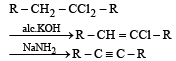
The reagent is [1993]

Detailed Solution: Question 4

On heating ethylene chloride (1, 1 dichloro ethane) with alcoholic potash followed by sodamide alkyne is obtained

31 Year NEET Previous Year Questions: Hydrocarbons - Question 5

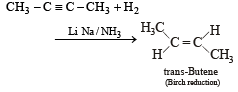
Reduction of 2-butyne with sodium in liquid ammonia gives predominantly : [1993]
Detailed Solution: Question 5

Reduction of alkynes with Na/liq. NH3 gives trans-alkenes. This reaction is called Birch reduction

31 Year NEET Previous Year Questions: Hydrocarbons - Question 6

A compound is treated with NaNH2 to give sodium salt. Identify the compound [1993]

Detailed Solution: Question 6

Only C2H2 (acetylene) has acidic H-atoms and hence reacts with NaNH2 to form sodium salt, i.e.,

31 Year NEET Previous Year Questions: Hydrocarbons - Question 7

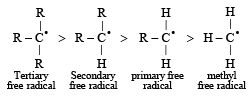
Reactivity of hydrogen atoms attached to different carbon atoms in alkanes has the order [1993]
Detailed Solution: Question 7

The reactivity of H-atoms depends upon the stability of free radicals follows the order : Tertiary > secondary > primary, therefore, reactivity of H-atoms follows the same order, i.e., tertiary > secondary > primary.

31 Year NEET Previous Year Questions: Hydrocarbons - Question 8

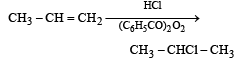
When hydrochloric acid gas is treated with propene in presence of benzoyl peroxide, it gives [1993]
Detailed Solution: Question 8

Peroxide effect is observed only in case of HBr. Therefore, addition of HCl to propene even in the presence of benzyoyl peroxide occurs according to Markovnikov’s rule :

31 Year NEET Previous Year Questions: Hydrocarbons - Question 9

Which of the following compounds has the lowest boiling point ? [1994]

Detailed Solution: Question 9

Of all the options listed CH3CH2CH2CH3 has the least number of C-atoms and hence has the lowest b.p.

31 Year NEET Previous Year Questions: Hydrocarbons - Question 10

When CH3Cl and AlCl3 are used in Friedel-Crafts reaction, the electrophile is [1994]

Detailed Solution: Question 10

31 Year NEET Previous Year Questions: Hydrocarbons - Question 11

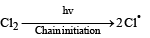
In the free radical chlorination of methane, the chain initiating step involves the formation of
Detailed Solution: Question 11

31 Year NEET Previous Year Questions: Hydrocarbons - Question 12

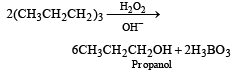
The alkene R – CH = CH2 reacts readily with B2H6 and formed the product B which on oxidation with alkaline hydrogen peroxides produces [1995] 

Detailed Solution: Question 12

31 Year NEET Previous Year Questions: Hydrocarbons - Question 13

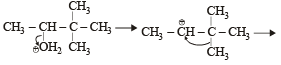
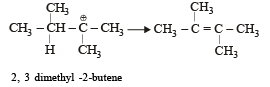
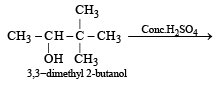
When 3, 3-dimethyl 2-butanol is heated with H2SO4, the major product obtained is [1995]
Detailed Solution: Question 13

When 3, 3 dimethyl 2-butanol is heated with H2SO4 the major product obtained is 2, 3 dimethyl 2-butene.

31 Year NEET Previous Year Questions: Hydrocarbons - Question 14

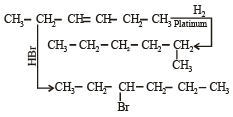
In the presence of platinum catalyst, hydrocarbon A adds hydrogen to form n-hexane. When hydrogen bromide is added to A instead of hydrogen, only a single bromo compound is formed. Which of the following is A? [1996]
Detailed Solution: Question 14

31 Year NEET Previous Year Questions: Hydrocarbons - Question 15

 In reaction sequence [1997]

molecule 'M' and reagent 'R' respectively are
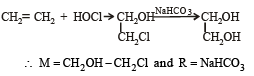
Detailed Solution: Question 15

We know that

31 Year NEET Previous Year Questions: Hydrocarbons - Question 16

 Which one of the following reactions is expected to readily give a hydrocarbon product in good yields ? [1997]
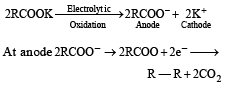
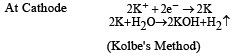
Detailed Solution: Question 16

Electrolysis of a concentrated a queous solution of either sodium or potassium salts of saturated mon-carboxylic acids yields higher alkane at anode.

31 Year NEET Previous Year Questions: Hydrocarbons - Question 17

In commercial gas olines the type of hydrocarbons which are more desirable, is

Detailed Solution: Question 17

Gasoline (petrol) is a mixture of alkanes, alkenes and aromatic hydrocarbons. The quality of a gasoline is determined by the amount of branched chain hydrocarbons (2,2,4-trimethylpentane, commonly known as iso-octane) present in it.

31 Year NEET Previous Year Questions: Hydrocarbons - Question 18

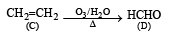
A hydrocarbon A on chlorination gives B which on heating with alcoholic potassium hydroxide changes into another hydrocarbon C. The latter decolourises Baeyer's reagent and on ozonolysis forms formaldehyde only. A is [1998]


Detailed Solution: Question 18

Given

Since hydrocarbon C give only CH2O, on ozonolysis, C should be CH2 = CH2 hence going backward A should be ethane. Thus the reactions are

31 Year NEET Previous Year Questions: Hydrocarbons - Question 19

The reaction of ethyl magnesium bromide with water would give [1999]
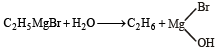
Detailed Solution: Question 19

31 Year NEET Previous Year Questions: Hydrocarbons - Question 20

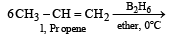
Which of the following reagents convert propene to 1-propanol? [2000]
Detailed Solution: Question 20

We know that

31 Year NEET Previous Year Questions: Hydrocarbons - Question 21

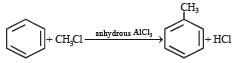
For the formation of toluene by Friedal Craft reaction, reactants used in presence of anhydrous AlCl3 are [2000]
Detailed Solution: Question 21

Friedel-Crafts Alkylation Reaction:

This reaction is used to introduce an alkyl group (like methyl, ethyl, etc.) onto an aromatic ring, such as benzene.

Reactants:

  • Benzene (C6H6)

  • Alkyl halide (e.g., CH3Cl — methyl chloride)

  • Lewis acid catalyst (AlCl3 — aluminum chloride)

Step-by-Step Mechanism:

Step 1: Formation of the Electrophile

The alkyl halide (CH3Cl) reacts with the Lewis acid (AlCl3):

CH3Cl + AlCl3 → CH3⁺ (methyl carbocation) + AlCl4

This step generates a carbocation (CH3⁺), which acts as the electrophile in the reaction.

Step 2: Attack by Benzene

The benzene ring, which is rich in electrons, donates a pair of electrons to the methyl carbocation:

C6H6 + CH3⁺ → C6H5CH3 (toluene)

This forms a new carbon-carbon bond between the benzene ring and the methyl group.

Step 3: Regeneration of Catalyst

A proton (H⁺) is removed from the benzene ring to restore aromaticity. The AlCl4⁻ ion helps in removing this proton:

AlCl4⁻ + H⁺ → AlCl3 + HCl

So, the catalyst AlCl3 is regenerated and can be reused.

Overall Reaction:

C6H6 + CH3Cl → C6H5CH3 (Toluene) + HCl

(in the presence of AlCl3)

Summary:

  • The key step is the generation of a carbocation (CH3⁺).

  • Benzene attacks this electrophile to form an alkylated product.

  • AlCl3 acts as a catalyst and is regenerated at the end.

31 Year NEET Previous Year Questions: Hydrocarbons - Question 22

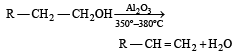
In preparation of alkene from alcohol using Al2O3 which is effective factor? [2001]
Detailed Solution: Question 22

Temperature

While at 220º – 250ºC it forms ether

31 Year NEET Previous Year Questions: Hydrocarbons - Question 23

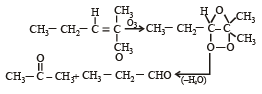
Which alkene on ozonolysis gives CH3CH2CHO and                             

Detailed Solution: Question 23

31 Year NEET Previous Year Questions: Hydrocarbons - Question 24

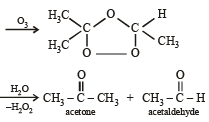
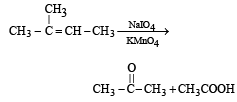
The compound [2003]

on reaction with NaIO4 in the presence of KMnO4 gives
Detailed Solution: Question 24

Oxidation of the C=C bond by KMnO4 gives a vicinal diol, and cleavage of that diol by NaIO4 breaks the C-C bond to form two carbonyl fragments.

The more substituted double-bond carbon (the carbon without a hydrogen) is converted to a ketone, giving CH3COCH3 (acetone).

The less substituted double-bond carbon (the carbon bearing one hydrogen) is converted to an aldehyde, initially giving CH3CHO (acetaldehyde).

Because KMnO4 is present under the oxidative conditions, the formed aldehyde is further oxidised to the corresponding carboxylic acidCH3COOH (acetic acid). Thus the net products are CH3COCH3 and CH3COOH.

31 Year NEET Previous Year Questions: Hydrocarbons - Question 25

Reaction of HBr with propene in the presence of peroxide gives [2004]

Detailed Solution: Question 25

In presence of peroxide, HBr adds on alkenes in anti–markovnikov’s way, thus

Kharasch observed that the addition of HBr to unsymmetrical alkene in the presence of organic peroxides follows an opposite course to that suggested by Markownikoff . This is termed anti-Markownikoff or peroxide effect.

31 Year NEET Previous Year Questions: Hydrocarbons - Question 26

Using anhydrous AlCl3 as catalyst, which one of the following reactions produces ethylbenzene (PhEt)?[2004]

Detailed Solution: Question 26

31 Year NEET Previous Year Questions: Hydrocarbons - Question 27

Which one of the following alkenes will react faster with H2 under catalytic hydrogenation conditions? [2005] (R = Alkyl Substituent)

Detailed Solution: Question 27

The least stable alkene will react will reacts fastest. So in option d, we have 2 pair of alkyl groups in cis position. SO it will react fastest.

31 Year NEET Previous Year Questions: Hydrocarbons - Question 28

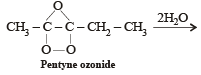
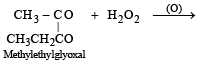
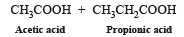
Products of the following reaction : [2005]

Detailed Solution: Question 28

The glyoxal formed as an intermediate is oxidised by H2O2 to give the acids.`

31 Year NEET Previous Year Questions: Hydrocarbons - Question 29

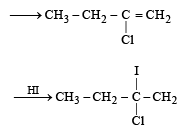
 Predict the product C obtained in the following reaction of butyne-1. [2007]

Detailed Solution: Question 29

This reaction occurs according to Markownikoff’s rule which states that when an unsymmetrical alkene undergo hydrohalogenation, the negative part goes to that C-atom which contain lesser no. of Hatom.

31 Year NEET Previous Year Questions: Hydrocarbons - Question 30

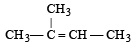
Which of the compounds with molecular formula C5H10 yields acetone on ozonolysis?  [2007]
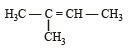
Detailed Solution: Question 30

View more questions
101 videos|250 docs|76 tests
Information about 31 Year NEET Previous Year Questions: Hydrocarbons Page
In this test you can find the Exam questions for 31 Year NEET Previous Year Questions: Hydrocarbons solved & explained in the simplest way possible. Besides giving Questions and answers for 31 Year NEET Previous Year Questions: Hydrocarbons, EduRev gives you an ample number of Online tests for practice
101 videos|250 docs|76 tests
Download as PDF