NEET Exam  >  NEET Test  >  Chemistry Class 12  >  31 Years NEET Previous Year Questions: Solutions - 1 - NEET MCQ

31 Years NEET Previous Year Questions: Solutions - 1 Free MCQ Practice


MCQ Practice Test & Solutions: 31 Years NEET Previous Year Questions: Solutions - 1 (35 Questions)

You can prepare effectively for NEET Chemistry Class 12 with this dedicated MCQ Practice Test (available with solutions) on the important topic of "31 Years NEET Previous Year Questions: Solutions - 1". These 35 questions have been designed by the experts with the latest curriculum of NEET 2026, to help you master the concept.

Test Highlights:

  • - Format: Multiple Choice Questions (MCQ)
  • - Duration: 35 minutes
  • - Number of Questions: 35

Sign up on EduRev for free to attempt this test and track your preparation progress.

31 Years NEET Previous Year Questions: Solutions - 1 - Question 1

Which of the following aqueous solution will exhibit highest boiling point?     [NEET 2025]

Detailed Solution: Question 1

Boiling point elevation is a colligative property:

ΔT= i Kb m

For the same solvent (water), Kb is constant, and at these low concentrations we can compare i×molality (≈ molarity).

  • Na2SO4 → dissociates ideally into 3 ions (2 Na+ + SO42-), so i ≈ 3
    i × M = 3 × 0.01 = 0.03

  • KNO3 → 2 ions, i ≈ 2
    2 × 0.01 = 0.02

  • Glucose (C6H12O6) → non-electrolyte, i = 1
    1×0.015=0.015

  • Urea → non-electrolyte, i=1i=1
    1×0.01=0.011×0.01=0.01

Largest iM → Na2SO4, so it gives the highest boiling point.

31 Years NEET Previous Year Questions: Solutions - 1 - Question 2

Match List-I with List-II      [NEET 2025]

2025

Choose the correct answer from the options given below

Detailed Solution: Question 2

  • A. Humidity: Humidity refers to water vapor (liquid) dispersed in air (gas). This is an example of a liquid in gas solution. (A-II)
  • B. Alloys: Alloys are homogeneous mixtures of metals or a metal and a non-metal in solid form. This is an example of a solid in solid solution. (B-I)
  • C. Amalgams: Amalgams are alloys that consist of a metal (solid) dissolved in mercury (liquid). This is an example of a liquid in solid solution. (C-IV)
  • D. Smoke: Smoke consists of tiny solid particles dispersed in a gas. This is an example of a solid in gas solution. (D-III)

Therefore, the correct option is (d) A-II, B-I, C-IV, D-III. 

31 Years NEET Previous Year Questions: Solutions - 1 - Question 3

5 moles of liquid X and 10 moles of liquid Y make a solution having a vapour pressure of 70 torr. The vapour pressures of pure X and Y are 63 torr and 78 torr respectively. Which of the following is true regarding the described solution?      [NEET 2025]

Detailed Solution: Question 3

Given:

  • nX = 5
  • nY = 10
  • PX0 = 63 torr
  • PY0 = 78 torr
  • Observed total pressure = 70 torr

1. Mole Fractions:

The total number of moles is:

ntotal = nX + nY = 5 + 10 = 15

The mole fraction of X and Y are calculated as follows:

χX = χX / ntotal = 5 / 15 = 0.333

χY = χY / ntotal = 10 / 15 = 0.667

2. Predicted Vapor Pressure (Raoult's Law, Ideal Solution):

Using Raoult’s Law:

Pideal = χX PX0 + χY PY0

Substitute the values:

Pideal = (0.333)(63) + (0.667)(78)

First term:

(0.333)(63) = 20.999 ≈ 21

Second term:

(0.667)(78) = 52.026 ≈ 52

Thus:

Pideal = 21 + 52 = 73 torr

3. Comparison with Observed:

  • Predicted (ideal) pressure = 73 torr
  • Observed pressure = 70 torr

Since Pobs < Pideal, the solution shows a negative deviation from Raoult’s law.

31 Years NEET Previous Year Questions: Solutions - 1 - Question 4

The Henry's law constant (KH) values of three gases (A, B, C) in water are 145,2 × 10⁻⁵ and 35kbar respectively. The solubility of these gases in water follow the order:     [NEET 2024]

Detailed Solution: Question 4

According to Henry's law, the solubility of a gas in a liquid under constant temperature is directly proportional to the partial pressure of the gas above the liquid but is inversely proportional to the Henry's law constant (KH) for the gas. Henry's law can be expressed as:
2024
where c is the concentration (or solubility) of the gas in the liquid,
P is the partial pressure of the gas, and KH is Henry's law constant.
From the equation, it is clear that the solubility of the gas is inversely related to
KH; if KH increases, the solubility decreases, and vice versa.
In the given problem, you have the KH values of the gases A, B, and C as follows:
A: 145 kbar
B: 2×10⁻⁵ kbar
C: 35 kbar
Comparing the KH values:
Gas B has the lowest KH and hence the highest solubility.
Gas A, with the highest KH among the three, will have the lowest solubility.
Gas C has a KH value less than A but greater than B, so its solubility will be lower than B but higher than A.
Therefore, the order of solubility of the gases in water from the highest to the lowest is:
B > C > A\
Thus, the correct option is:
Option B: B > C > A

31 Years NEET Previous Year Questions: Solutions - 1 - Question 5

The plot of osmotic pressure (П) vs concentration  (molL−1) for a solution gives a straight line with slope  25.73L bar mol−1. The temperature at which the osmotic pressure measurement is done is (Use R = 0.083 L bar mol-1 K-1)      [NEET 2024]

Detailed Solution: Question 5

The relationship between the osmotic pressure (Π) of a solution and its concentration (c) can be derived from the van't Hoff equation for dilute solutions, which is given by:
Π = cRT
where:
Π  is the osmotic pressure,
c is the concentration of the solution in moles per liter,

R  is the ideal gas constant in appropriate units, and
T  is the temperature in Kelvin.
According to the problem, the slope of the Π vs c plot is given as 25.73L bar mol−1 which corresponds to the product RT from the van't Hoff equation. We are provided with the value of the gas constant  
R = 0.083 L bar mol−1 K−1.
To find the temperature
T, we use the following equation derived from the slope of the line:
RT=25.73 L bar mol1
To isolate T, we rearrange the equation:

T=25.73 L bar mol−1 / 0.083 L bar mol−1 K−1 ≈ 310 K

To convert this temperature from Kelvin to Celsius, we use the conversion formula:

2024
This value is closest to 37C, which corresponds to Option A. Therefore, the temperature at which the osmotic pressure measurement is done is approximately 37C.

31 Years NEET Previous Year Questions: Solutions - 1 - Question 6

Which of the following pairs of aqueous solutions will have the same value of osmotic pressure?           [NEET 2024]
(Assume complete dissociation in aqueous solution.)

Detailed Solution: Question 6

Osmotic pressure depends on the van't Hoff factor (i), which represents the number of particles a solute dissociates into, and the molarity (M) of the solution.
For two solutions to have the same osmotic pressure, the product of i and M should be the same.
Let's go through the options:

(a) 0.1 M BaCl2 and 0.2 M K2SO4:

  • BaCl2 dissociates into 3 ions, so i = 3.
  • K2SO4 dissociates into 3 ions, so i = 3.
  • The product of i and M for BaCl20.1 × 3 = 0.3.
  • The product of i and M for K2SO40.2 × 3 = 0.6.
  • These values are not equal, so they do not have the same osmotic pressure.

(b) 0.1 M Na3PO4 and 0.1 M K2SO4:

  • Na3PO4 dissociates into 4 ions, so i = 4.
  • K2SO4 dissociates into 3 ions, so i = 3.
  • The product of i and M for Na3PO40.1 × 4 = 0.4.
  • The product of i and M for K2SO40.1 × 3 = 0.3.
  • These values are not equal, so they do not have the same osmotic pressure.

(c) 0.2 M NaCl and 0.1 M K2SO4:

  • NaCl dissociates into 2 ions, so i = 2.
  • K2SO4 dissociates into 3 ions, so i = 3.
  • The product of i and M for NaCl = 0.2 × 2 = 0.4.
  • The product of i and M for K2SO40.1 × 3 = 0.3.
  • These values are not equal, so they do not have the same osmotic pressure.

(d) 0.2 M NaCl and 0.1 M K3[Fe(CN)6]:

  • NaCl dissociates into 2 ions, so i = 2.
  • K3[Fe(CN)6] dissociates into 4 ions, so i = 4.
  • The product of i and M for NaCl = 0.2 × 2 = 0.4.
  • The product of i and M for K3[Fe(CN)6] = 0.1 × 4 = 0.4.
  • These values are equal, so they have the same osmotic pressure.

Thus, the correct answer is (d) 0.2 M NaCl and 0.1 M K3[Fe(CN)6].

31 Years NEET Previous Year Questions: Solutions - 1 - Question 7

Match the equilibrium processes in List-I with their respective physical properties in List-II and choose the correct option:  
[NEET 2024]

2024
Choose the correct answer from the options given below:

Detailed Solution: Question 7

  • A. Liquid ⇌ Vapour: This process refers to boiling point, which is the temperature at which the liquid changes to vapor. So, A → II (Boiling point).
  • B. Solid ⇌ Liquid: This process is the melting point, the temperature at which a solid changes to a liquid. So, B → I (Melting point).
  • C. Solid ⇌ Vapour: This process is known as sublimation, where a solid directly changes into a vapor without passing through the liquid phase. So, C → III (Sublimation point).
  • D. Solute(solid) ⇌ Solute(solution): This refers to the formation of a saturated solution, where the maximum amount of solute is dissolved in the solvent at a particular temperature. So, D → IV (Saturated solution).

Thus, the correct answer is A-II, B-I, C-III, D-IV.

31 Years NEET Previous Year Questions: Solutions - 1 - Question 8

When 5 g of a non-volatile, non-electrolyte solute is dissolved in 100 g of a certain solvent, the freezing point of the solvent decreases by 0.25 K. The molar mass of the solute is:              [NEET 2024]
Kf of the given solvent = 1.2 K kg mol-1

Detailed Solution: Question 8

To find the molar mass of the solute, we will use the formula for the depression in freezing point:
ΔT= Kf × m
Where:

  • ΔTf is the freezing point depression,
  • Kf is the cryoscopic constant (freezing point depression constant) of the solvent,
  • m is the molality of the solution.

First, we can rearrange the equation to find m:
m = ΔTf / Kf
Now, we can calculate the molality m:

Given:

  • ΔT= 0.25 K,
  • Kf = 1.2 K kg mol-1.

So:
m = 0.25 / 1.2 = 0.2083 mol/kg
Now, molality (m) is defined as:

m = (number of moles of solute) / (mass of solvent in kg)

We know:

  • The mass of the solvent is 100 g = 0.1 kg,
  • The mass of the solute is 5 g.

We can substitute the value of m into the formula to find the number of moles of solute:
0.2083 mol/kg = (number of moles of solute) / 0.1 kg
Number of moles of solute = 0.2083 × 0.1 = 0.02083 mol
Now, the molar mass M of the solute is given by:
M = (mass of solute) / (number of moles of solute)
Substituting the known values:
M = 5 g / 0.02083 mol = 240.0 g/mol
Thus, the molar mass of the solute is 240.0 g/mol, so the correct answer is (d) 240.0 g mol-1.

31 Years NEET Previous Year Questions: Solutions - 1 - Question 9

What mass of glucose (C6H12O6) must be dissolved in 1 liter of solution to make it isotonic with a 15 g/L solution of urea (NH2CONH2)?
Given: Molar mass (g/mol) C: 12, H: 1, O: 16, N: 14        [NEET 2024]

Detailed Solution: Question 9

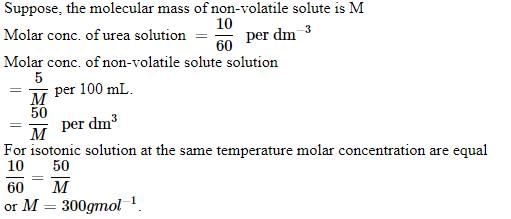
To make the glucose solution isotonic with a 15 g/L urea solution:
Find the molarity of urea:

  • Molar mass of urea = 60 g/mol.
  • Molarity of urea = 15 g/L ÷ 60 g/mol = 0.25 mol/L.

Glucose molarity for isotonic solution:

  • Since glucose is a non-electrolyte, its van't Hoff factor (i) is 1. To match the osmotic pressure of urea, the molarity of glucose should also be 0.25 mol/L.

Calculate mass of glucose:

  • Moles of glucose needed = 0.25 mol.
  • Molar mass of glucose = 180 g/mol.
  • Mass of glucose = 0.25 mol × 180 g/mol = 45 g.

Thus, the mass of glucose required is 45 g.
The correct answer is (d) 45 g.

31 Years NEET Previous Year Questions: Solutions - 1 - Question 10

Given below are two statements: one is labeled as Assertion (A) and the other is labeled as Reason (R):        [NEET 2023]
Assertion (A): Helium is used to dilute oxygen in the diving apparatus.
Reason (R): Helium has a high solubility in O2.In light of the above statements, choose the correct answer:

Detailed Solution: Question 10

Assertion (A)Helium is used to dilute oxygen in diving apparatus is true. Helium is commonly used in helium-oxygen mixtures (like heliox) for deep-sea diving. This is because helium reduces the risk of nitrogen narcosis and allows divers to breathe more safely at greater depths.
Reason (R)Helium has a high solubility in O2 is false. Helium has very low solubility in oxygen (and in most gases). The reason helium is used in diving mixtures is not because it has high solubility in oxygen, but because it has low solubility and doesn't cause narcosis at high pressures, unlike nitrogen.
Therefore, (A) is true, but (R) is false.

31 Years NEET Previous Year Questions: Solutions - 1 - Question 11

Which of the following aqueous solutions of electrolytes will exhibit the least elevation in boiling point?     [NEET 2023]

Detailed Solution: Question 11

The elevation in boiling point (ΔTb) for an electrolyte solution is given by:
ΔTb = i × Kb × m
where:

  • i = van't Hoff factor (number of ions produced per molecule),

  • Kb = ebullioscopic constant (constant for water),

  • m = molality (moles of solute per kg of solvent).

For dilute aqueous solutions (water density ≈ 1 kg/L), molarity (M) approximates molality (m). Thus, ΔTb ≈ i × Kb × M. Since Kb is constant, ΔTb depends on the product i × M.

Calculate i × M for each option:

  • (a) 0.05 M NaCl: NaCl → Na+ + Cl-, i = 2. i × M = 2 × 0.05 = 0.1.

  • (b) 0.1 M KCl: KCl → K+ + Cl-, i = 2. i × M = 2 × 0.1 = 0.2.

  • (c) 0.1 M MgSO4: MgSO₄ → Mg2+ + SO₄2-, i = 3 (assuming complete dissociation). i × M = 3 × 0.1 = 0.3.

  • (d) 1 M NaCl: NaCl → Na+ + Cl-, i = 2. i × M = 2 × 1 = 2.

Comparison:
The lowest i × M value is 0.1 for 0.05 M NaCl, indicating the least elevation in boiling point.

Conclusion: The correct answer is (a) 0.05 M NaCl.

31 Years NEET Previous Year Questions: Solutions - 1 - Question 12

KH value for some gases at the same temperature 'T' are given :       [NEET 2022]

2022

where KH is Henry's Law constant in water. The order of their solubility in water is:

Detailed Solution: Question 12

According to Henry's Law,
p = KHx
Where 'p' is partial pressure of gas in vapour phase.
KH is Henry's Law constant.
'x' is mole fraction of gas in liquid.
Higher the value of KH at a given pressure, lower is the solubility of the gas in the liquid.
∴ Solubility : Ar < CO2 < CH4 < HCHO

31 Years NEET Previous Year Questions: Solutions - 1 - Question 13

The following solutions were prepared by dissolving 10g of glucose (C6H12O6) in 250 ml of water (P1). 10g of urea (CH4N2O) in 250 ml of water (P2) and 10 g of sucrose (C12H22O11) in 250 ml of water (P3). The decreasing order of osmotic pressure of these solutions is:    [NEET 2021]

Detailed Solution: Question 13

Osmotic pressure is given by:
π = i C R T
Since all are non-electrolytes, i = 1. At the same temperature, osmotic pressure depends only on molarity (moles per litre).

Step 1: Molar masses

  • Glucose (C₆H₁₂O₆): 180 g mol-1
  • Urea (CH₄N₂O): 60 g mol-1
  • Sucrose (C₁₂H₂₂O₁₁): 342 g mol-1

Step 2: Number of moles in 10 g

  • Glucose: 10/180 = 0.0556 mol
  • Urea: 10/60 = 0.1667 mol
  • Sucrose: 10/342 = 0.0292 mol

Step 3: Molarity (in 0.250 L solution)

  • P1 (Glucose): 0.0556 / 0.250 = 0.222 M
  • P2 (Urea): 0.1667 / 0.250 = 0.667 M
  • P3 (Sucrose): 0.0292 / 0.250 = 0.117 M

Step 4: Order of osmotic pressures
P2 (0.667) > P1 (0.222) > P3 (0.117)

31 Years NEET Previous Year Questions: Solutions - 1 - Question 14

The correct option for the value of vapour pressure of a solution at 45°C with benzene to octane in a molar ratio 3 : 2 is: [At 45°C vapour pressure of benzene is 280 mm Hg and that of octane is 420 mm Hg. Assume Ideal gas]     [NEET 2021]

Detailed Solution: Question 14

Given, 2021So,2021

Total vapour pressure of solution,

2021

31 Years NEET Previous Year Questions: Solutions - 1 - Question 15

The mixture which shows positive deviation from Raoult’s law is :     [NEET 2020]

Detailed Solution: Question 15

Raoult’s law:

  • If the interactions between unlike molecules (A–B) are weaker than those between like molecules (A–A or B–B), the escaping tendency of molecules increases → vapour pressure of the solution is higher than ideal → positive deviation.
  • If A–B interactions are stronger, vapour pressure decreases → negative deviation.

Now, analyze each option:

(a) Acetone + Chloroform: Shows negative deviation, because strong hydrogen bonding forms between C=O of acetone and H of chloroform.
(b) Chloroethane + Bromoethane: Nearly ideal behaviour, similar polarities and no strong interaction difference.
(c) Ethanol + Acetone: Shows positive deviation, because acetone breaks the H-bonding network of ethanol, reducing A–B attractions compared to A–A.
(d) Benzene + Toluene: Both are non-polar hydrocarbons with very similar forces, so nearly ideal behaviour.

31 Years NEET Previous Year Questions: Solutions - 1 - Question 16

The freezing point depression constant (Kf) of benzene is 5.12 K kg mol-1. The freezing point depression for the solution of molality 0.078 m containing a non-electrolyte solute in benzene is (rounded off upto two decimal places) :     [NEET 2020]

Detailed Solution: Question 16

ΔTf = ikfm
⇒ ΔTf = 1 × 5.12 × 0.078
ΔTf = 0.3993
ΔTf = 0.40 K

31 Years NEET Previous Year Questions: Solutions - 1 - Question 17

For an ideal solution, the correct option is :     [NEET 2019]

Detailed Solution: Question 17

For ideal solution,
Δmix H = 0
Δmix S > 0
Δmix G < 0
Δmix V = 0

31 Years NEET Previous Year Questions: Solutions - 1 - Question 18

The mixture that forms maximum boiling azeotrope is:    [NEET 2019]

Detailed Solution: Question 18

Maximum boiling azeotrope is shown by solution which shows negative deviation from Raoult's law. thanol + water shows positive deviation (minimum-boiling), while water + nitric acid shows negative deviation (maximum-boiling).

31 Years NEET Previous Year Questions: Solutions - 1 - Question 19

If molality of the dilute solutions is doubled, the value of molal depression constant (Kf) will be :-     [NEET 2017]

Detailed Solution: Question 19

The value of molal depression constant, Kis constant for a particular solvent, thus, it will be unchanged when molality of the dilute solution is doubled.

31 Years NEET Previous Year Questions: Solutions - 1 - Question 20

 Which one of the following is incorrect for ideal solution?    [NEET 2016 Phase 2]

Detailed Solution: Question 20

For ideal solution, we have
ΔHmix = 0, ΔVmix = 0
Now Umix = ΔHmix – PΔVmix
∴ ΔUmix = 0
Also, for an ideal solution,
pA = xApAo, pB = xBpBo
∴ Δp = pobserved – pcalculated = 0
ΔGmix = ΔH – TΔSmix
For an ideal solumixtion, ΔSmix ≠ 0
∴ ΔGmix ≠ 0 

31 Years NEET Previous Year Questions: Solutions - 1 - Question 21

The van't Hoff factor (i) for a dilute aqueous solution of the strong electrolyte barium hydroxide is     [NEET 2016 Phase 2]

Detailed Solution: Question 21

Ba(OH)2 is a strong electrolyte and undergoes cent percent dissociation in a dilute aqueous solution.
Ba(OH)2(aq) → Ba2+(aq) + 2OH(aq)
Thus, van’t Hoff factor i = 3. 

31 Years NEET Previous Year Questions: Solutions - 1 - Question 22

At 100°C the vapour pressure of a solution of 6.5 g of a solute in 100 g water is 732 mm. If Kb = 0.52, the boiling point of this solution will be :    [NEET 2016 Phase 1]

Detailed Solution: Question 22

Given that
ws = 6.5 g, wA = 100 g
ps = 732 mm of Hg
kb = 0.52, Tob = 100oC
po = 760 mm of Hg 

2016


⇒ n2 = 0.2046 mol
ΔTb = Kb × m 

2016

31 Years NEET Previous Year Questions: Solutions - 1 - Question 23

Which of the following statements about the composition of the vapour over an ideal 1 : 1 molar mixture of benzene and toluene is correct?      [NEET 2016 Phase 1]
Assume that the temperature is constant at 25°C. (Given Vapour Pressure Data at 25ºC, Benzene = 12.8kPa, toluene = 3.85kPa)

Detailed Solution: Question 23

pBenzene = xBenzene. poBenzene
pToluene = xToluene. poToluene
For an ideal 1 : 1 molar mixture of benzene and toluene
xBenzene = 1/2 and xToluene = 1/2
pBenzene = 1/2poBenzene = 1/2 × 12.8 = 6.4 kPa
pToluene = 1/2poToluene = 1/2 × 3.85 = 1.925 kPa
Thus, the vapour will contain a high percentage of benzene as the partial vapour pressure of benzene is higher as compared to that of toluene. 

31 Years NEET Previous Year Questions: Solutions - 1 - Question 24

Which one is not equal to zero for an ideal solution ?      [NEET / AIPMT 2015 Cancelled Paper]

Detailed Solution: Question 24

For an ideal solution, ΔSmix > 0 while ΔHmix, ΔVmix and ΔP all are 0. 

31 Years NEET Previous Year Questions: Solutions - 1 - Question 25

The boiling point of 0.2 mol kg-1 solution of X in water is greater than equimolal solution of Y in water. Which one of the following statements is true in this case ?    [NEET / AIPMT 2015 Cancelled Paper]

Detailed Solution: Question 25

ΔTb = iKbm
Given, (ΔTb)x > (ΔTb)y
∴ ixKbm > iyKbm
⇒ ix > iy
(Kb is same for same solvent)
So, x is undergoing dissociation in water.

31 Years NEET Previous Year Questions: Solutions - 1 - Question 26

Which one of the following electrolytes has the same value of van‘t Hoff‘s factor (i) as that of Al2(SO4)3 (if all are 100% ionised) [NEET / AIPMT 2015 Cancelled Paper]

Detailed Solution: Question 26

Ai2(SO4)3 ⇌ 2Al+3 + 3SO42–
van't Hoff factor, i = 5
K2SO4 ⇌ 2K+ + SO42–
van't Hoff factor, i = 3
K3[Fe(CN)6] ⇌ 3K+ + [Fe(CN)6]2-
van't Hoff factor, i = 4
Al(NO3)3 ⇌ Al3+ + 3NO3
van't Hoff factor, i = 4
K4[Fe(CN)6] ⇌ 4K+ + [Fe(CN)6]4–
van't Hoff factor, i = 5 

31 Years NEET Previous Year Questions: Solutions - 1 - Question 27

Of the following 0.10 m aqueous solutions, which one will exhibit the largest freezing point depression?      [NEET / AIPMT 2014]

Detailed Solution: Question 27

We know that depression in freezing point (ΔTf ) is given as
ΔTf = iKfm
So, ΔTf ∝ i
Thus, more value of i (Van’t Hoff factor), more will be depression in freezing point.
Al2(SO4)3 ⇌ 2Al+3 + 3SO42–
i is maximum i.e., 5 for Al2(SO4)3

31 Years NEET Previous Year Questions: Solutions - 1 - Question 28

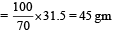
How many grams of concentrated nitric acid solution should be used to prepare 250 mL of 2.0M HNO3 ? The concentrated acid is 70% HNO3             [NEET 2013]
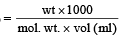
Detailed Solution: Question 28

Molarity (M)

wt. of 70% acid

31 Years NEET Previous Year Questions: Solutions - 1 - Question 29

Which condition is not satisfied by an ideal solution? [NEET Kar. 2013]  

Detailed Solution: Question 29

An ideal solution is that solution in which each component obeys Raoult’s law under all conditions of temperatures and concentrations. For an ideal solution.

31 Years NEET Previous Year Questions: Solutions - 1 - Question 30

Vapour pressure of chloroform (CHCl3) and dichloromethane (CH2Cl2) at 25ºC are 200 mm Hg and 415 mm Hg respectively. Vapour pressure of the solution obtained by mixing 25.5 g of CHCl3 and 40 g of CH2Cl2 at the same temperature will be : (Molecular mass of CHCl3 = 119.5 u and molecular mass of CH2Cl2 = 85 u).             [2012 M]

Detailed Solution: Question 30

The correct answer is option C
Molar mass of CH2​Cl2​ =12×1+1×2+35.5×2=85 g mol–1
Molar mass of CHCl3 ​  =12×1+1×1+35.5×3=119.5 g mol−1
Moles of CH2​Cl2​= 40 g /85 g mol−1 = 0.47 mol
Moles of CHCl3​ = 25.5 g /119.5 g mol−1 = 0.213 mol
Total number of moles = 0.47+0.213=0.683 mol
Mole fraction of component 2
 =0.47mol/0.683mol= 0.688
Mole fraction of component 1
=1.00–0.688=0.312 
We know that:
PT​=p10​+(p20​−p10​)x2​
=200+(415–200)×0.688
=200+147.9
=347.9 mm Hg

View more questions
57 videos|297 docs|82 tests
Information about 31 Years NEET Previous Year Questions: Solutions - 1 Page
In this test you can find the Exam questions for 31 Years NEET Previous Year Questions: Solutions - 1 solved & explained in the simplest way possible. Besides giving Questions and answers for 31 Years NEET Previous Year Questions: Solutions - 1, EduRev gives you an ample number of Online tests for practice
57 videos|297 docs|82 tests
Download as PDF