NEET Exam  >  NEET Test  >  Chemistry Class 12  >  31 Year NEET Previous Year Questions: Aldehydes, Ketones & Carboxylic Acids - 1 - NEET MCQ

31 Year NEET Previous Questions: Aldehydes, Ketones & Carboxylic Acids


MCQ Practice Test & Solutions: 31 Year NEET Previous Year Questions: Aldehydes, Ketones & Carboxylic Acids - 1 (30 Questions)

You can prepare effectively for NEET Chemistry Class 12 with this dedicated MCQ Practice Test (available with solutions) on the important topic of "31 Year NEET Previous Year Questions: Aldehydes, Ketones & Carboxylic Acids - 1". These 30 questions have been designed by the experts with the latest curriculum of NEET 2026, to help you master the concept.

Test Highlights:

  • - Format: Multiple Choice Questions (MCQ)
  • - Duration: 60 minutes
  • - Number of Questions: 30

Sign up on EduRev for free to attempt this test and track your preparation progress.

31 Year NEET Previous Year Questions: Aldehydes, Ketones & Carboxylic Acids - 1 - Question 1

reaction
Consider the above reaction and identify the missing reagent/chemical.  [2021]

Detailed Solution: Question 1

A. CaO (used with NaOH as soda lime) is the correct reagent.

Heating a carboxylate salt with soda lime causes decarboxylation, converting the carboxylate into the corresponding alkane and producing a carbonate salt.

The general transformation is: RCOO-Na+ + NaOH + CaORH + Na2CO3.

This explains formation of the alkane when the carboxylate salt is heated with soda lime.

Brief elimination: DIBAL-H is a selective reducing agent (used to reduce esters/acid derivatives to aldehydes under controlled conditions); B2H6 (diborane) is used in hydroboration and related reductions; and Red Phosphorus is used in different reduction/halogenation contexts. None of these effect the decarboxylation of a carboxylate salt the way soda lime (NaOH + CaO) does.

31 Year NEET Previous Year Questions: Aldehydes, Ketones & Carboxylic Acids - 1 - Question 2

Reaction by which Benzaldehyde cannot be prepared : [NEET 2013]

Detailed Solution: Question 2

Zn/Hg and HCl reduce carboxyl group to
methylene group (Clemmensen reduction).

*Multiple options can be correct
31 Year NEET Previous Year Questions: Aldehydes, Ketones & Carboxylic Acids - 1 - Question 3

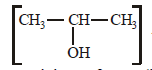
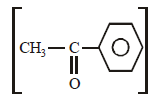
Which of the following compounds will give ayellow precipitate with iodine and alkali ?[2012 M]
Detailed Solution: Question 3

It is iodoform reaction. Acetophenone 

 and 2-Hydroxypropane 

both give a yellow
precipitate of CHI3 (iodoform) with iodine
and alkali.

31 Year NEET Previous Year Questions: Aldehydes, Ketones & Carboxylic Acids - 1 - Question 4

Consider the reaction :
RCHO + NH2NH2 → RCH = N – NH2

What sort of reaction is it ? [2012 M]

Detailed Solution: Question 4

Such reactions take place in slightly acidic
medium and involve nucleophilic addition
of the ammonia derivative.

31 Year NEET Previous Year Questions: Aldehydes, Ketones & Carboxylic Acids - 1 - Question 5

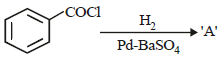
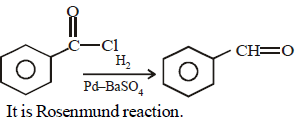
Consider the following reaction :

The product ‘A’ is : [2012 M]
Detailed Solution: Question 5

31 Year NEET Previous Year Questions: Aldehydes, Ketones & Carboxylic Acids - 1 - Question 6

CH3CHO and C6H5CH2CHO can be distinguished chemically by: [2012]

Detailed Solution: Question 6

CH3CHO and C6H5CH2CHO both are aldehydes so they can give the test of Tollen’s reagent, Fehling's solution and Benedict’s solution.

The carbonyl compounds with the structure R-CO-CH3 can only give the Iodoform test.

CH3CHO is the only aldehyde which reacts with NaOH and I2 to give yellow crystals of Iodoform while C6H5CH2CHO doesn’t react with it. 

So, the iodoform test is used to distinguish between CH3CHO and C6H5CH2CHO compounds. 

CH3CHO + 3I+ 4NaOH ⟶ CHI+ HCOONa + 3NaI +3H2O

C6H5CH2CHO + I+ 4NaOH⟶ No reaction.

31 Year NEET Previous Year Questions: Aldehydes, Ketones & Carboxylic Acids - 1 - Question 7

The correct order of decreasing acid strength oftrichloroacetic acid (A), trifluoroacetic acid (A),acetic acid (C) and formic acid (D) is : [2012]

Detailed Solution: Question 7

CF3 COOH > CCl3 COOH > HCOOH >
CH3COOH (Ka order)
The halogenated fatty acids are much
stronger acids than the parent fatty acid
and more over the acidity among the
halogenated fatty acid is increased almost
proportionately with the increase in
electronegativity of the halogen present.
Further formic acid having no alky group is
more acidic than acetic acid.

31 Year NEET Previous Year Questions: Aldehydes, Ketones & Carboxylic Acids - 1 - Question 8

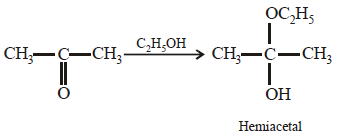
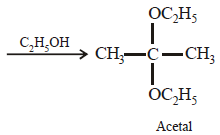
Acetone is treated with excess of ethanol in the presence of hydrochloric acid. The product obtained is : [2012]
Detailed Solution: Question 8

Anhydrous alcohols add to the carbonyl
group of aldehydes in the presence of
anhydrous hydrogen chloride to form
acetals via hemiacetals.

31 Year NEET Previous Year Questions: Aldehydes, Ketones & Carboxylic Acids - 1 - Question 9

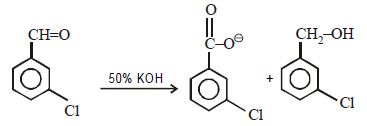
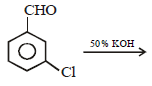
Predict the product in the given reaction.            [2012]
Detailed Solution: Question 9

Cannizzaro reaction - when an aldehyde
containing no α – H undergo reaction in
presence of 50% KOH. It disproportionates
to form a molecule of carboxylic acid and a
molecule of alcohol.

31 Year NEET Previous Year Questions: Aldehydes, Ketones & Carboxylic Acids - 1 - Question 10

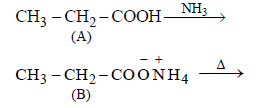
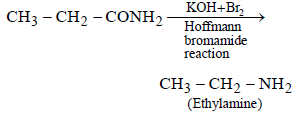
An organic compound ‘A’ on treatment with NH3 gives ‘B’ which on heating gives ‘C’, ‘C’ whentreated with Br2 in the presence of KOH produces ethylamine. Compound ‘A’ is:[2011 M]
Detailed Solution: Question 10

Since, C when heated with Br2 in presence
of KOH produces ethylamine, hence it must
be propanamide and hence the organic
compound (A) will be propanoic acid. The
reactions follows.

31 Year NEET Previous Year Questions: Aldehydes, Ketones & Carboxylic Acids - 1 - Question 11

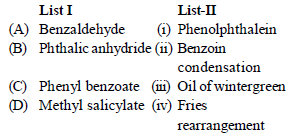
Match the compounds given in List-I with List-II and select the suitable option using the code given below : [2011 M]
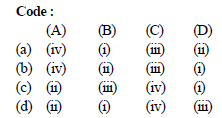
Detailed Solution: Question 11

(a) 


(b) 

(d) 

31 Year NEET Previous Year Questions: Aldehydes, Ketones & Carboxylic Acids - 1 - Question 12

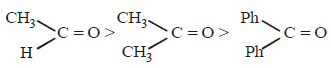
The order of reactivity of phenyl magnesium bromide (PhMgBr) with the following compounds           [2011 M]
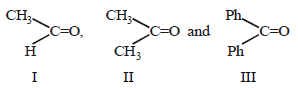
Detailed Solution: Question 12

The reactivity of the carbonyl group toward
the nucleophilic addition reactions depend
upon the magnitude of the positive charge
on the carbonyl carbon atom (electronic
factor) and also on the crowding around
the carboxyl carbon atom in the transition
state (steric factor). Both these factors
predict the following order

(due to steric crowding).

31 Year NEET Previous Year Questions: Aldehydes, Ketones & Carboxylic Acids - 1 - Question 13

Clemmensen reduction of a ketone is carried outin the presence of which of the following ? [2011]
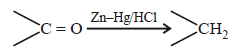
Detailed Solution: Question 13

Clemmensen reduction is

31 Year NEET Previous Year Questions: Aldehydes, Ketones & Carboxylic Acids - 1 - Question 14

Which one of the following compounds will be most readily dehydrated?       [2010]

Detailed Solution: Question 14

The intermediate is carbocation which is
destabilised by C = O group (present on ��-
carbon to the –OH group) in the first three
cases. In (d), α–hydrogen is more acidic which
can be removed as water. Moreover, the
positive charge on the intermediate carbocation
is relatively away from the C = O group.

∴ Correct choice : (d)

31 Year NEET Previous Year Questions: Aldehydes, Ketones & Carboxylic Acids - 1 - Question 15

Following compounds are given:

(a) CH3CH2OH

(b)  CH3COCH3

(c) 
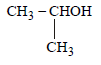
(d)  CH3OH

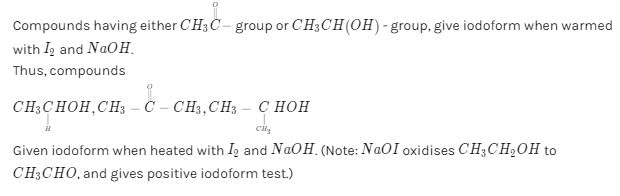
Which of the above compound(s), on being warmed with iodine solution and NaOH, will  give iodoform? [2010]
Detailed Solution: Question 15

Among the given compounds only
CH3OH does not give iodoform reaction.

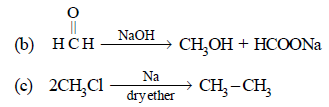
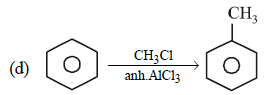
31 Year NEET Previous Year Questions: Aldehydes, Ketones & Carboxylic Acids - 1 - Question 16

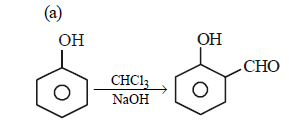
Which of the following reactions will not resultin the formation of carbon-carbon bonds?
Detailed Solution: Question 16

Note that new C–C bond is formed is a, c and d.

31 Year NEET Previous Year Questions: Aldehydes, Ketones & Carboxylic Acids - 1 - Question 17

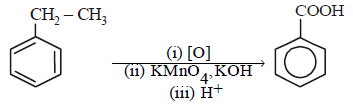
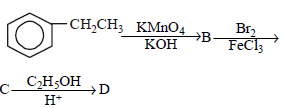
In a set of reactions, ethylbenzene yielded a product D.        [2010]
Detailed Solution: Question 17

31 Year NEET Previous Year Questions: Aldehydes, Ketones & Carboxylic Acids - 1 - Question 18

Propionic acid with Br2|P yields a dibromo product. Its structure would be: [2009]

Detailed Solution: Question 18

This reaction is an example of Hell - Volhard
Zelinsky reaction. In this reaction acids
containing α– H on treatment with X2 /P
give di-halo substituted acid.

31 Year NEET Previous Year Questions: Aldehydes, Ketones & Carboxylic Acids - 1 - Question 19

The relative reactivities of acyl compounds towardsnucleophilic substitution are in the order of : [2008]

Detailed Solution: Question 19

The relative reactivities of acyl compounds
towards nucleophilic substitution follow
the order Acyl halides > Acid anhydride >
Ester > Amide. Thus the correct answer is
(a).

31 Year NEET Previous Year Questions: Aldehydes, Ketones & Carboxylic Acids - 1 - Question 20

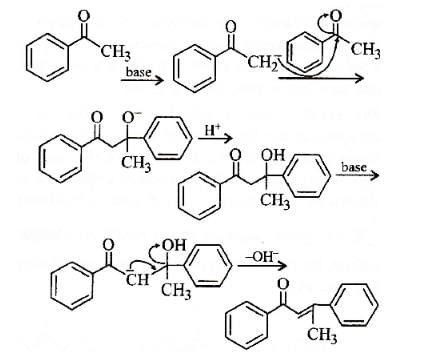
Acetophenone when reacted with a base, C2H5ONa, yields a stable compound which has the structure. [2008]
Detailed Solution: Question 20

The first step is a simple condensation reaction. The last step is an example of ElcB mechanism and the leaving group is hydroxide, which is unusual. Still this step manages to take place owing to the stability incorporated therein the product, which is a conjugated carbonyl compound.

31 Year NEET Previous Year Questions: Aldehydes, Ketones & Carboxylic Acids - 1 - Question 21

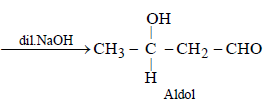
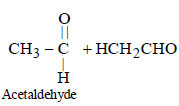
The product formed in Aldol condensation is       [2007]
Detailed Solution: Question 21

Aldehydes and ketones having at least one
α-hydrogen atom in presence of dilute
alkali give β-hydroxy aldehyde or β-
hydroxy ketone

31 Year NEET Previous Year Questions: Aldehydes, Ketones & Carboxylic Acids - 1 - Question 22

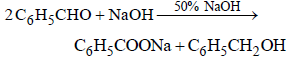
Which one of the following on treatment with 50% aqueous sodium hydroxide yields the corresponding alcohol and acid? [2007]
Detailed Solution: Question 22

  • Aldehydes containing no α-hydrogen atom on warming with 50% NaOH or KOH undergo disproportionation i.e. self oxidation - reduction known as cannizzaro’s reaction.

31 Year NEET Previous Year Questions: Aldehydes, Ketones & Carboxylic Acids - 1 - Question 23

Which of the following represents the correctorder of the acidity in the given compounds?          [2007]

Detailed Solution: Question 23

Electron withdrawing substituent (like
halogen, —NO2, C6H5 etc.) would disperse
the negative charge and hence stabilise the
carboxylate ion and thus increase acidity
of the parent acid. On the other hand,
electron-releasing substituents would
intensify the negative charge, destabilise
the carboxylate ion and thus decrease
acidity of the parent acid.
Electronegativity decreases in order
F > Cl > Br
and hence –I effect also decreases in the
same order, therefore the correct option is

FCH2COOH > ClCH2COOH > BrCH2COOH> CH3COOH

31 Year NEET Previous Year Questions: Aldehydes, Ketones & Carboxylic Acids - 1 - Question 24

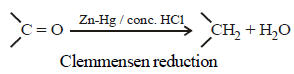
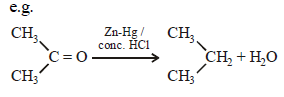
Reduction of aldehydes and ketones intohydrocarbons using zinc amalgam and conc. HClis called [2007]
Detailed Solution: Question 24

31 Year NEET Previous Year Questions: Aldehydes, Ketones & Carboxylic Acids - 1 - Question 25

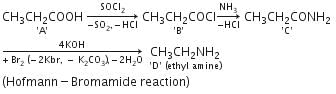
In a set of reactions propionic acid yielded a compound D.                  [2006]

The structure of D would be
Detailed Solution: Question 25

For reaction,
Hence, compound 'D' is CH3-CH2-NH2

31 Year NEET Previous Year Questions: Aldehydes, Ketones & Carboxylic Acids - 1 - Question 26

Self condensation of two moles of ethyl acetatein presence of sodium ethoxide yields [2006]

Detailed Solution: Question 26

It is an example of Claisen condensation. The
product is acetoacetic ester.

31 Year NEET Previous Year Questions: Aldehydes, Ketones & Carboxylic Acids - 1 - Question 27

Nucleophilic addition reaction will be mostfavoured in [2006]

Detailed Solution: Question 27

Aldehydes are more reactive than ketones
due to +I effect of –CH3 group. There are
two – CH3 group in acetone which reduces
+ve charge density on carbon atom of
carbonyl group. More hindered carbonyl
group too becomes less reactive. So in the
give case CH3CHO is the right choice.

31 Year NEET Previous Year Questions: Aldehydes, Ketones & Carboxylic Acids - 1 - Question 28

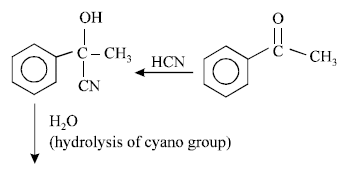
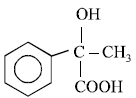
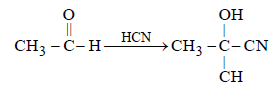
A carbonyl compound reacts with hydrogencyanide to form cyanohydrin which on hydrolysisforms a racemic mixture of  α-hydroxy acid. Thecarbonyl compound is       [2006]
Detailed Solution: Question 28

Out of given compound only acetaldehyde
can form optical active hydroxy acid as it
contains one asymmetric carbon atom as
marked below :

31 Year NEET Previous Year Questions: Aldehydes, Ketones & Carboxylic Acids - 1 - Question 29

In a set of reactions acetic acid yielded a product D.
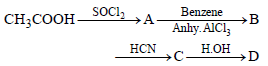
The structure of D would be:                   [2005]
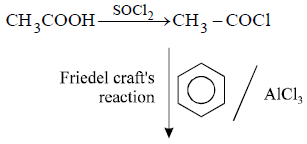
Detailed Solution: Question 29

31 Year NEET Previous Year Questions: Aldehydes, Ketones & Carboxylic Acids - 1 - Question 30

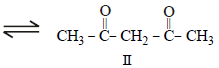
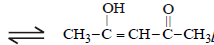
The order of stability of the following tautomeric compounds is :
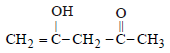
Detailed Solution: Question 30

Enolic form predominates in compounds
containing two carbonyl groups separated
by a – CH2 group. This is due to
following two factors.
(i) Presence of conjugation which
increases stability.
(ii) Formation of intramolecular hydrogen
bond between enolic hydroxyl
group and second carbonyl group
which leads to stablisation of the
molecule. Hence the correct answer is
III > II > I.

57 videos|297 docs|82 tests
Information about 31 Year NEET Previous Year Questions: Aldehydes, Ketones & Carboxylic Acids - 1 Page
In this test you can find the Exam questions for 31 Year NEET Previous Year Questions: Aldehydes, Ketones & Carboxylic Acids - 1 solved & explained in the simplest way possible. Besides giving Questions and answers for 31 Year NEET Previous Year Questions: Aldehydes, Ketones & Carboxylic Acids - 1, EduRev gives you an ample number of Online tests for practice
57 videos|297 docs|82 tests
Download as PDF