Electrical Engineering (EE) Exam  >  Electrical Engineering (EE) Test  >  Control Systems  >  Test: Introduction to Control Systems - 1 - Electrical Engineering (EE) MCQ

Introduction to Control Systems - 1 - GATE EE Free MCQ Test with solutions


Test Description

10 Questions MCQ Test Control Systems - Test: Introduction to Control Systems - 1

Test: Introduction to Control Systems - 1 for Electrical Engineering (EE) 2026 is part of Control Systems preparation. The Test: Introduction to Control Systems - 1 questions and answers have been prepared according to the Electrical Engineering (EE) exam syllabus.The Test: Introduction to Control Systems - 1 MCQs are made for Electrical Engineering (EE) 2026 Exam. Find important definitions, questions, notes, meanings, examples, exercises, MCQs and online tests for Test: Introduction to Control Systems - 1 below.
Solutions of Test: Introduction to Control Systems - 1 questions in English are available as part of our Control Systems for Electrical Engineering (EE) & Test: Introduction to Control Systems - 1 solutions in Hindi for Control Systems course. Download more important topics, notes, lectures and mock test series for Electrical Engineering (EE) Exam by signing up for free. Attempt Test: Introduction to Control Systems - 1 | 10 questions in 30 minutes | Mock test for Electrical Engineering (EE) preparation | Free important questions MCQ to study Control Systems for Electrical Engineering (EE) Exam | Download free PDF with solutions
Test: Introduction to Control Systems - 1 - Question 1

As compared to an open loop system, a closed loop system is:

Detailed Solution for Test: Introduction to Control Systems - 1 - Question 1

A closed loop system is:

  • More accurate: It uses feedback to correct errors, improving the precision of the system's output.
  • More stable: Feedback helps maintain desired performance despite disturbances or changes in system parameters.
  • Comparison to open loop: Open loop systems lack feedback, making them less capable of correcting deviations and maintaining stability

Thus, option A is correct: A closed loop system is more accurate and more stable than an open loop system.

Test: Introduction to Control Systems - 1 - Question 2

Linear system obeys:

Detailed Solution for Test: Introduction to Control Systems - 1 - Question 2

Linear system obeys both reciprocity theorem and principle of maximum power transfer.

Test: Introduction to Control Systems - 1 - Question 3

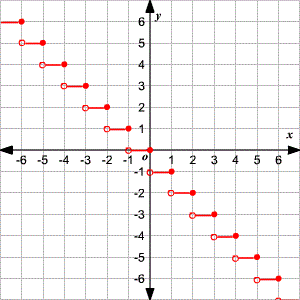
The most commonly used input signal(s) in a control system is/are:
Detailed Solution for Test: Introduction to Control Systems - 1 - Question 3

A step function is commonly used as a input signal in a control system because:

  • If we go through first order system, here we calculate steady-state error by providing input function then we got zero steady-state error.
  • Actually in step function, output follows input always that means steady error is minimum.

Step Function:

Step Function

Test: Introduction to Control Systems - 1 - Question 4

The Laplace transform of a 4 second transportation lag element is

Detailed Solution for Test: Introduction to Control Systems - 1 - Question 4

Correct answer is D. e−4s

Test: Introduction to Control Systems - 1 - Question 5

Assertion (A): Closed loop control systems are known as feedback control systems.
Reason (R): In closed loop control systems, the control action is dependent on the desired output.

Detailed Solution for Test: Introduction to Control Systems - 1 - Question 5
  • In closed loop system there is the presence of a feedback path and this feedback path has connected from output of the system to the input of the system.
  • The whole operation is controlled by the output of the system.
Test: Introduction to Control Systems - 1 - Question 6

As compared to a closed loop system, an open loop system is:

Detailed Solution for Test: Introduction to Control Systems - 1 - Question 6
  • The main difference between an open-loop system and a closed-loop system is that the closed-loop system has the ability to self-correct while the open-loop system doesn't.
  • Consequently, closed-loop systems are often called feedback control systems while open-loop systems are also known as non-feedback controls.
Test: Introduction to Control Systems - 1 - Question 7

Assertion (A): The control system which operates on the time basis is an open loop system.
Reason (R): A field control d.c. motor is an example of open loop system.

Detailed Solution for Test: Introduction to Control Systems - 1 - Question 7

Option D is correct.

A is false. Operating on a time basis (having actions scheduled with respect to time) does not by itself determine whether a system uses feedback; time-driven behaviour can occur in both open-loop and closed-loop systems.

Closed-loop systems may perform actions at specified time intervals while still using feedback to adjust those actions based on output measurements; the presence of time-based scheduling does not imply absence of feedback.

R is true when interpreted as referring to a field-control implementation without speed feedback. Changing the field current of a d.c. motor to control speed, without measuring the motor speed or using that measurement to correct the control action, is an open-loop arrangement.

If the field is adjusted using a measured speed signal and a controller that corrects deviations, the arrangement becomes closed-loop.

Therefore, A is false but R is true, so the correct choice is Option D.

Test: Introduction to Control Systems - 1 - Question 8

Which of the following is an advantage of a closed-loop control system over an open-loop control system?

Detailed Solution for Test: Introduction to Control Systems - 1 - Question 8
  • A closed-loop system automatically corrects errors and disturbances by using feedback. so C is correct 
  • It continuously compares the output with the desired value and adjusts accordingly.
  • Open-loop systems do not correct errors since they lack feedback.
  • While closed-loop systems reduce steady-state error, they may not always eliminate it completely (hence D is incorrect).
  • They are more complex and costly than open-loop systems, making A incorrect.
  • Closed-loop systems require feedback, so B is incorrect.
Test: Introduction to Control Systems - 1 - Question 9

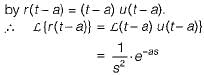
A ramp function occurs at t = a. It's Laplace transform is:
Detailed Solution for Test: Introduction to Control Systems - 1 - Question 9

Ramp function occurring at t = 0 is denoted by r(t) = tu(t).
Ramp function occurring at t - a will be denoted: 

Test: Introduction to Control Systems - 1 - Question 10

In open loop control systems, the control action is independent of the desired________.

Detailed Solution for Test: Introduction to Control Systems - 1 - Question 10

- In open loop control systems, the control action is independent of the desired output signal.
- The system operates without feedback, meaning it doesn't compare the output with the desired value.
- Control actions are predefined and do not adjust based on output changes.
- This can lead to inaccuracies if the system or external conditions change.
- Open loop systems are typically simpler but less accurate compared to closed loop systems, where feedback adjusts the control action.

53 videos|116 docs|40 tests
Information about Test: Introduction to Control Systems - 1 Page
In this test you can find the Exam questions for Test: Introduction to Control Systems - 1 solved & explained in the simplest way possible. Besides giving Questions and answers for Test: Introduction to Control Systems - 1, EduRev gives you an ample number of Online tests for practice
53 videos|116 docs|40 tests
Download as PDF



