Mechanical Engineering Exam  >  Mechanical Engineering Test  >  Topicwise Question Bank  >  Test: Structural of Metals & Alloys - 2 - Mechanical Engineering MCQ

Structural of Metals & Alloys - 2 - GATE ME Free MCQ Test with solutions


MCQ Practice Test & Solutions: Test: Structural of Metals & Alloys - 2 (10 Questions)

You can prepare effectively for Mechanical Engineering Topicwise Question Bank for Mechanical Engineering with this dedicated MCQ Practice Test (available with solutions) on the important topic of "Test: Structural of Metals & Alloys - 2". These 10 questions have been designed by the experts with the latest curriculum of Mechanical Engineering 2026, to help you master the concept.

Test Highlights:

  • - Format: Multiple Choice Questions (MCQ)
  • - Duration: 30 minutes
  • - Number of Questions: 10

Sign up on EduRev for free to attempt this test and track your preparation progress.

Test: Structural of Metals & Alloys - 2 - Question 1

Surface imperfections that separate two orientations that are mirror image of one- another is called

Detailed Solution: Question 1

The grain boundary defects are called twin boundary when the surface imperfect orientations on the side are mirror image of those in the opposite side.

Test: Structural of Metals & Alloys - 2 - Question 2

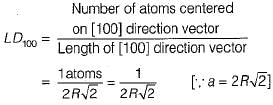
What is the linear density for FCC [100] direction in terms of the atomic radius?
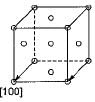
Detailed Solution: Question 2


Test: Structural of Metals & Alloys - 2 - Question 3

Which of the following regions of the electromagnetic spectrum would be used to determine the structure of crystalline solids?

Detailed Solution: Question 3

X-ray crystallography: A technique in which the patterns formed by the diffraction of X-rays on passing through a crystalline substance yield information on the lattice structure of the crystal, and the molecular structure of the substance.

Test: Structural of Metals & Alloys - 2 - Question 4

The defect responsible for the phenomena of slip, by which most metals deform plastically, is known as

Test: Structural of Metals & Alloys - 2 - Question 5

The correct order of co-ordination number in SC, BCC, FCC and HCP unit cells is

Test: Structural of Metals & Alloys - 2 - Question 6

The maximum radius of the interstitial sphere that can fit into the void between the body centred atom of BCC structure is

Test: Structural of Metals & Alloys - 2 - Question 7

Magnesium crystallizes in HCP structure. If the lattice constant is 0.32 nm, the nearest neighbour distance in magnesium is
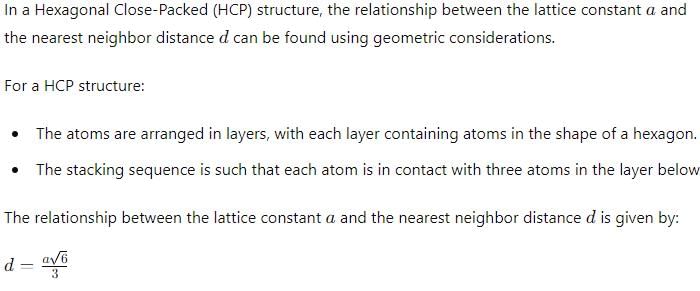
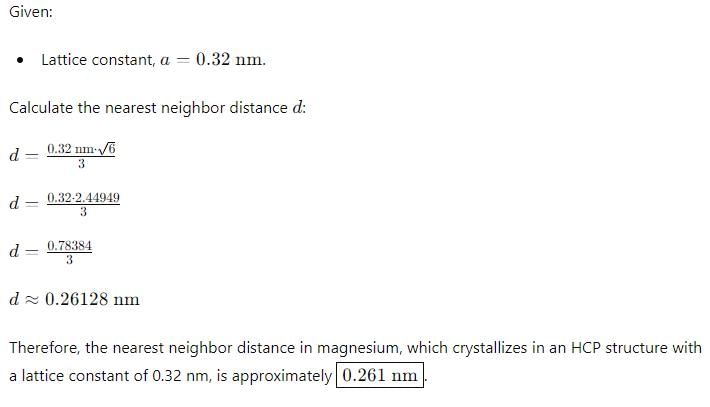
Detailed Solution: Question 7


Test: Structural of Metals & Alloys - 2 - Question 8

The packing factor of diamond cubic crystal structure is

Test: Structural of Metals & Alloys - 2 - Question 9

If (3 2 6) are the Miller indices of a plane, the intercepts made by the plane on the three crystallographic axes are

Detailed Solution: Question 9

 For Miller indices (h, k, l) the intercepts are (a/h, b/k, c/l). For (3, 2, 6) this gives (a/3, b/2, c/6). Multiplying each intercept by 6 yields (2a, 3b, c), which corresponds to option b.

Test: Structural of Metals & Alloys - 2 - Question 10

In a simple cubic lattice d100: d110: d111 is
where d is interpianer spacing.

Detailed Solution: Question 10

Correct Answer :- D

Explanation : d100 = a/(12 + 02 + 02)1/2

= a

d110 = a/(12 + 12+ 02)1/2

= a/(2)1/2

d111 = a/(12 + 12 + 12)1/2

= a/(3)1/2

d100 : d110 : d111 = a : a/(2)1/2 : a/(3)1/2

= 61/2 : 31/2 : 21/2

45 videos|314 tests
Information about Test: Structural of Metals & Alloys - 2 Page
In this test you can find the Exam questions for Test: Structural of Metals & Alloys - 2 solved & explained in the simplest way possible. Besides giving Questions and answers for Test: Structural of Metals & Alloys - 2, EduRev gives you an ample number of Online tests for practice
Download as PDF