CBSE Class 10  >  Class 10 Test  >  Mathematics (Maths)   >  Practice Test: Triangles - Class 10 MCQ

Triangles - Class 10 Maths Free MCQ Practice Test with solutions


MCQ Practice Test & Solutions: Practice Test: Triangles (10 Questions)

You can prepare effectively for Class 10 Mathematics (Maths) Class 10 with this dedicated MCQ Practice Test (available with solutions) on the important topic of "Practice Test: Triangles". These 10 questions have been designed by the experts with the latest curriculum of Class 10 2026, to help you master the concept.

Test Highlights:

  • - Format: Multiple Choice Questions (MCQ)
  • - Duration: 20 minutes
  • - Number of Questions: 10

Sign up on EduRev for free to attempt this test and track your preparation progress.

Practice Test: Triangles - Question 1

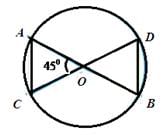
O is the point of intersection of two equal chords ABand CD such that OB = OD, then triangles OAC and ODB are
Detailed Solution: Question 1

Since O is the point of intersection of two equal chords AB and CD such that OB = OD,
As chords are equal and OB = OD, so AO will also be equal to OC
Also ∠AOC = ∠DOB = 450
Now in triangles OAC and ODB
AO/OB = CO/OD
And ∠AOC = ∠DOB = 450
So triangles are isosceles and similar.

Practice Test: Triangles - Question 2

What is the distance from the top of a flag pole to the tip of its shadow if the height of the pole is 18m and the shadow length is 9.6m?

Detailed Solution: Question 2
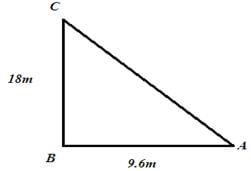
1. Identify the right triangle: The flag pole is vertical (one leg), the shadow is horizontal (second leg), and the line from the top of the pole to the tip of the shadow forms the hypotenuse. 2. Apply Pythagorean theorem: c = √(a2 + b2) where a = 18 m and b = 9.6 m. 3. Calculate the squares: 182 = 324 and 9.62 = 92.16. 4. Sum and find square root: c = √(324 + 92.16) = √(416.16) = 20.4 m. Thus, the distance from the top of the pole to the tip of the shadow is exactly 20.4 meters.

Practice Test: Triangles - Question 3

In triangle PQR, if PQ = 6 cm, PR = 8 cm, QS = 3 cm, and PS is the bisector of angle QPR, what is the length of SR?

Detailed Solution: Question 3
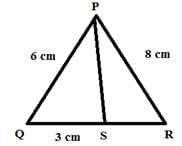

Since, PS is the angle bisector of angle QPR
So, by angle bisector theorem,the internal bisector of angle QPR divides the opposite side QR in the ratio of the adjacent sides: QS : SR = PQ : PR.
QS/SR = PQ/PR
⇒ 3/SR = 6/8
⇒ SR = (3 X 8)/6 cm = 4 cm

Practice Test: Triangles - Question 4

A 5 m long ladder is placed leaning towards a vertical wall such that it reaches the wall at a point 4 m high. If the foot of the ladder is moved 1.6 m towards the wall, then the distance by which the top of the ladder would slide upwards on the wall is:

Detailed Solution: Question 4
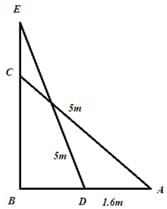
Let AC be the ladder of length 5m and BC = 4m be the height of the wall where ladder is placed. If the foot of the ladder is moved 1.6m towards the wall i.e. AD = 1.6 m, then the ladder is slided upward to position E i.e. CE = x m.

In right triangle ABC
AC2 = AB2 + BC2
⇒52 = AB2 + 42
⇒ AB = 3m
⇒ DB = AB – AD = 3 – 1.6 = 1.4m
In right angled ΔEBD
ED2 = EB2 + BD2
⇒ 52 = EB2 + (1.4)2
⇒ EB = 4.8m
EC = EB – BC = 4.8 – 4 = 0.8m

Practice Test: Triangles - Question 5

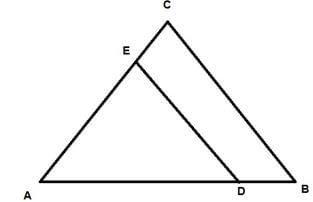
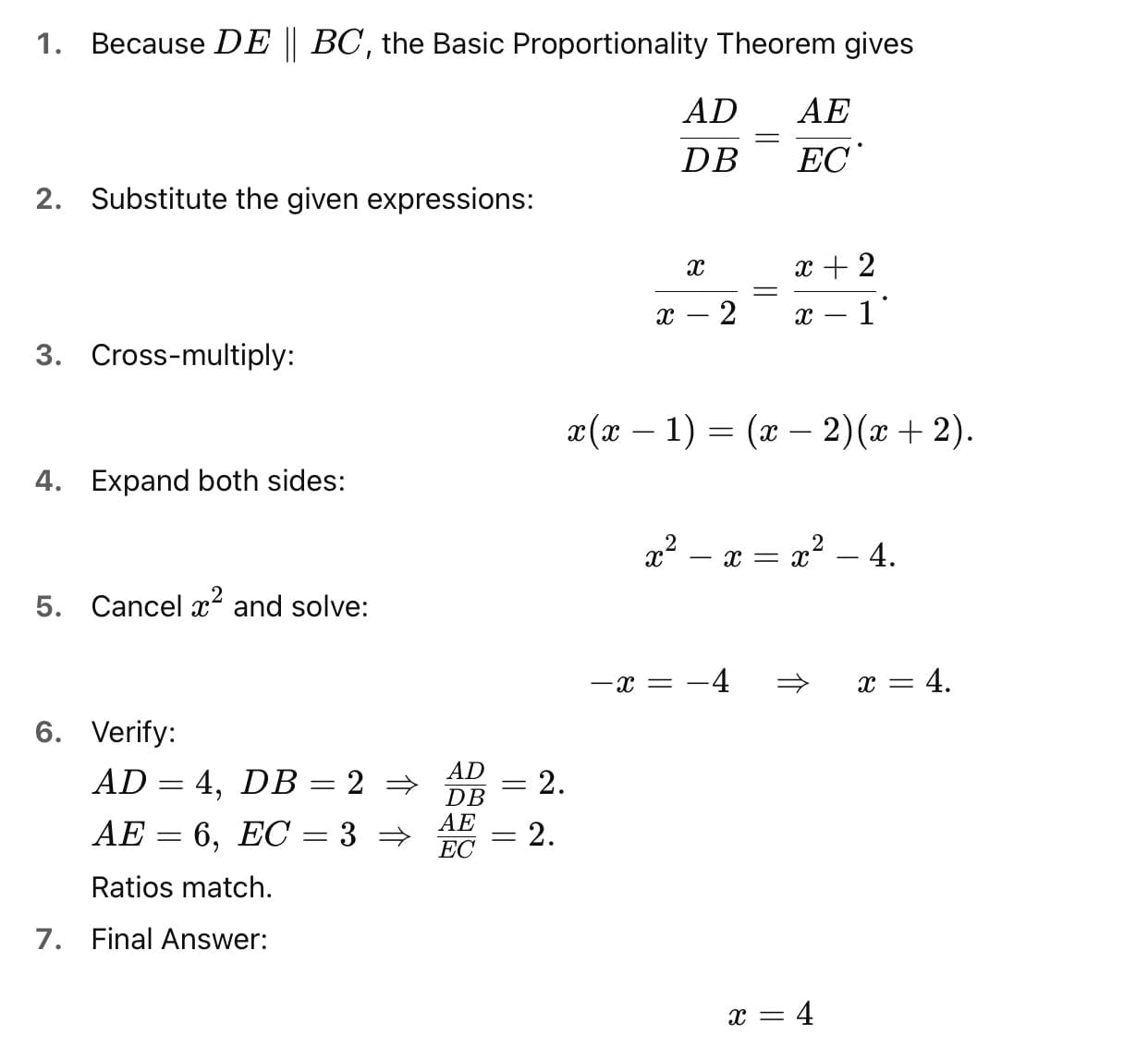
In the figure given below DE || BC. If AD = x, DB = x – 2, AE = x + 2 and EC = x – 1, the value of x is:
Detailed Solution: Question 5
Practice Test: Triangles - Question 6

If ΔABC ~ ΔDEF, AB = 4 cm, DE = 6 cm, EF = 9 cm and FD = 12 cm, find the perimeter of ABC.

Detailed Solution: Question 6

According to question,
ΔABC ~ ΔDEF,
AB = 4 cm, DE = 6 cm, EF = 9 cm and FD = 12 cm,
Therefore,
AB/DE = BC/EF = AC/DF
4/6 = BC/9 = AC/12
⇒ 4/6 = BC/9
⇒ BC = 6 cm
And
4/6 = AC/12
⇒ AC = 8 cm
Perimeter = AB + BC + CA
= 4 + 6 + 8
= 18 cm

Practice Test: Triangles - Question 7

The length of altitude of an equilateral triangle of side 8cm is

Detailed Solution: Question 7
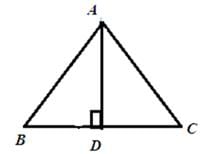
The altitude divides the opposite side into two equal parts,
Therefore, BD = DC = 4 cm

In triangle ABD
AB2 = AD2 + BD2
82 = AD2 + 42
AD2 = 64 – 16
AD2 = 48
AD = 4√3 cm

Practice Test: Triangles - Question 8

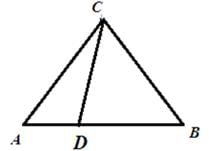
In the figure if ∠ACB = ∠CDA, AC = 8 cm and AD = 3 cm, find BD.
Detailed Solution: Question 8

In triangle ACB and ADC
∠A=∠A
∠ACB = ∠CDA
Therefore triangle ACB and ADC are similar,
Hence
AC/AD = AB/AC
AC2 = AD X AB
82 = 3 x AB
⇒ AB = 64/3
This implies,
BD = 64/3 – AD
⇒ BD = 55/3

Practice Test: Triangles - Question 9

If ABCD is parallelogram, P is a point on side BC and DP when produced meets AB produced at L, then select the correct option

Detailed Solution: Question 9
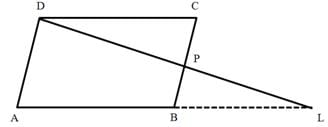

In ΔALD, we have
BP || AD
∴ LB/BA = LP/PD
⇒ BL/AB = PL/DP
⇒ BL/DC = PL/DP [∵ AB = DC
⇒ DP/PL = DC/BL

Practice Test: Triangles - Question 10

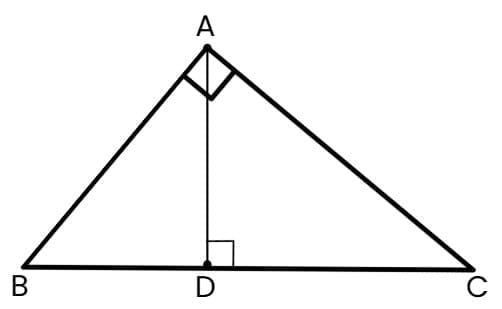
12. In triangle ABC, ∠BAC = 90° and AD ⊥ BC. Then

Detailed Solution: Question 10


Given:
In triangle ABC,
∠BAC = 90° (right-angled triangle at A)
AD ⟂ BC (AD is perpendicular to BC)
So, AD is the altitude drawn from the right angle to the hypotenuse.

Using Property,
When a perpendicular is drawn from the right angle of a right-angled triangle to the hypotenuse, then:
(Altitude)2 = (Product of the segments of the hypotenuse)
So, 
AD2 = BD⋅CD

This relation is shown by Option C
Hence, Correct Option: C

118 videos|526 docs|45 tests
Information about Practice Test: Triangles Page
In this test you can find the Exam questions for Practice Test: Triangles solved & explained in the simplest way possible. Besides giving Questions and answers for Practice Test: Triangles, EduRev gives you an ample number of Online tests for practice
118 videos|526 docs|45 tests
Download as PDF