UPSC Exam  >  UPSC Test  >  Indian Polity CSE  >  Test: Challenges Of Nation Building - UPSC MCQ

Challenges Of Nation Building - UPSC Indian Polity Free MCQ Test with solutions


MCQ Practice Test & Solutions: Test: Challenges Of Nation Building (10 Questions)

You can prepare effectively for UPSC Indian Polity for UPSC CSE with this dedicated MCQ Practice Test (available with solutions) on the important topic of "Test: Challenges Of Nation Building". These 10 questions have been designed by the experts with the latest curriculum of UPSC 2026, to help you master the concept.

Test Highlights:

  • - Format: Multiple Choice Questions (MCQ)
  • - Duration: 10 minutes
  • - Number of Questions: 10

Sign up on EduRev for free to attempt this test and track your preparation progress.

Test: Challenges Of Nation Building - Question 1

The interim government formed under the cabinet mission plan was headed by

Detailed Solution: Question 1

The interim government of India existed from 2 September 1946 to 15 August 1947 with the purpose of transitioning India from British Raj to independence. The interim government was formed on 2 September 1946 from the newly-elected Constituent Assembly of India. It was headed by Jawaharlal Nehru and Vallabhbhai Patel held the second-most powerful position in the council, heading the Department of Home Affairs, and Department of Information and Broadcasting.

Test: Challenges Of Nation Building - Question 2

The States Reorganisation Commission was appointed in which year?

Detailed Solution: Question 2

The Central government had appointed a State Reorganisation Commission in 1953 to look into the question of redrawing the boundaries of states.

Test: Challenges Of Nation Building - Question 3

Which of the following was a consequence of the creation of linguistic states in India after 1956?
i. It helped address regional demands for recognition.
ii. It led to a decrease in democratic participation.
iii. It strengthened national unity by accommodating diversity.
iv. It caused severe divisions within the Indian Union.

Detailed Solution: Question 3

  • The creation of linguistic states in 1956 helped address regional demands for linguistic recognition.
  • This move made people feel represented within a state that spoke their language.
  • It strengthened national unity by respecting India's diverse culture.
  • The creation of linguistic states accommodated various linguistic groups.
  • It did not lead to a decrease in democratic participation or severe divisions.
  • Contrary to initial fears, it reinforced India's commitment to diversity and pluralism.
  • This development created a more inclusive political environment.

Test: Challenges Of Nation Building - Question 4

Assertion (A): The Nizam of Hyderabad resisted joining the Indian Union to maintain the state's independence.
Reason (R): The people of Hyderabad were largely in favor of joining the Indian Union and opposed the Nizam's rule.

Detailed Solution: Question 4

  • The Assertion is true; the Nizam did want to keep Hyderabad independent from India.
  • The Reason is also true; there was significant public sentiment in Hyderabad favoring integration into India.
  • Since the Reason does not accurately explains why the Assertion is true, the correct answer is Option B.

Test: Challenges Of Nation Building - Question 5

The Cities that were divided into ‘communal zones’ during the partition violence were

Detailed Solution: Question 5

  • During the Partition, cities like Lahore, Amritsar, and Calcutta experienced intense violence.
  • Entire sections of these cities were designated for specific religious groups.
  • Lahore and Karachi were predominantly Muslim cities where the non-Muslim population was forced to migrate to India.
  • Amritsar had a mixed population where Muslims were forced to flee to PakistanHindus and Sikhs took over certain areas in Amritsar.

Test: Challenges Of Nation Building - Question 6

Which of the following was one of the three main challenges India faced after independence in 1947?
i. Building a united India by integrating princely states
ii. Setting up a monarchy across the country
iii. Establishing a democratic system with rights for all
iv. Ending foreign trade with other nations

Detailed Solution: Question 6

  • After gaining independence, India faced two significant challenges:
  • Building a united India by convincing the princely states to join the Indian Union was essential for maintaining national unity.
  • Establishing democracy by implementing a parliamentary system and ensuring fundamental rights for all citizens was another major challenge.
  • Setting up a monarchy and ending foreign trade were not part of these challenges as India aimed for democracy, not monarchy, and the goal was economic development, not isolation.

Test: Challenges Of Nation Building - Question 7

Arrange the following events related to the partition and integration of princely states in chronological order:

  1. Sardar Vallabhbhai Patel persuades princely states to join India.
  2. India and Pakistan gain independence.
  3. The Instrument of Accession is signed by princely states.
  4. The Razakars commit atrocities in Hyderabad.

Detailed Solution: Question 7

India and Pakistan gained independence first (2). Patel then worked to integrate the princely states (1), leading to the signing of the Instrument of Accession (3). Finally, the Razakars committed atrocities in Hyderabad, leading to its integration (4).

Test: Challenges Of Nation Building - Question 8

Statement I: The integration of princely states into India was entirely peaceful and without any military intervention.
Statement II: The Razakars in Hyderabad were responsible for significant violence and atrocities before the state was integrated into India.

Which statement(s) is/are true?

Detailed Solution: Question 8

Statement I is false because military intervention was necessary in cases like Hyderabad, where the Nizam resisted joining India. Statement II is true because the Razakars committed atrocities in Hyderabad before the Indian Army intervened.

Test: Challenges Of Nation Building - Question 9

Assertion (A): The successful integration of 565 princely states into India post-independence was crucial for national unity.

Reason (R): The princely states were primarily autonomous regions that had the option to choose their allegiance after independence.
Detailed Solution: Question 9

- The Assertion (A) is true because the integration of the princely states was essential to create a unified nation after the division of British India and the establishment of Pakistan.

- The Reason (R) is also true as the princely states had significant autonomy and could choose whether to join India, Pakistan, or remain independent, which made their integration a vital issue for national unity.

- Since the Reason provides a correct explanation for why the Assertion is true, the correct answer is Option A.

Test: Challenges Of Nation Building - Question 10

Detailed Solution: Question 10

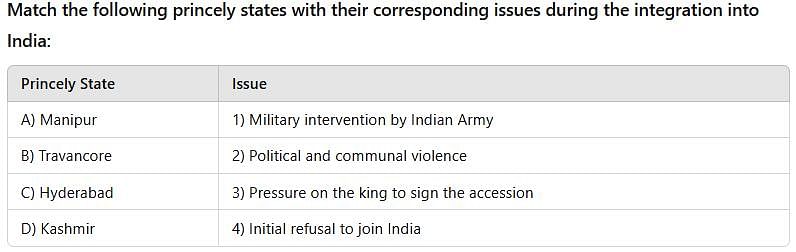
A) Manipur → Pressure on the king to sign accession
The Maharaja of Manipur was persuaded under political pressure in 1949 at Shillong to sign the Instrument of Accession.

B) Travancore → Initial refusal to join India
Travancore’s Diwan, C.P. Ramaswami Iyer, first declared independence but later agreed to join India in 1947.

C) Hyderabad → Military intervention by Indian Army
The Nizam refused to accede, leading to Operation Polo (1948) — a military action that merged Hyderabad with India.

D) Kashmir → Political and communal violence
Tribal invasion and communal unrest in 1947 forced Maharaja Hari Singh to seek India’s help and sign the accession.

187 videos|843 docs|248 tests
Information about Test: Challenges Of Nation Building Page
In this test you can find the Exam questions for Test: Challenges Of Nation Building solved & explained in the simplest way possible. Besides giving Questions and answers for Test: Challenges Of Nation Building, EduRev gives you an ample number of Online tests for practice
187 videos|843 docs|248 tests
Download as PDF