
CAT Exam  >  CAT Test  >  Quantitative Aptitude (Quant)  >  Arun Sharma Test: Number System- 1 - CAT MCQ

Arun Sharma Test: Number System- 1 - CAT Prep Free MCQ with solutions


MCQ Practice Test & Solutions: Arun Sharma Test: Number System- 1 (15 Questions)

You can prepare effectively for CAT Quantitative Aptitude (Quant) with this dedicated MCQ Practice Test (available with solutions) on the important topic of "Arun Sharma Test: Number System- 1". These 15 questions have been designed by the experts with the latest curriculum of CAT 2026, to help you master the concept.

Test Highlights:

  • - Format: Multiple Choice Questions (MCQ)
  • - Duration: 25 minutes
  • - Number of Questions: 15

Sign up on EduRev for free to attempt this test and track your preparation progress.

*Answer can only contain numeric values
Arun Sharma Test: Number System- 1 - Question 1

Find the highest power of 30 in 50!


Detailed Solution: Question 1

30=2×3×5.
Now 5 is the largest prime factor of 30, therefore, the powers of  5 in 50! will be less than those of 2 and 3. Therefore, there cannot be more 30 s than there are 5 in 50! So we find the highest power of 5 in 50! The highest power of 5 in 50! Hence the highest power of 30 in 50! = 12
*Answer can only contain numeric values
Arun Sharma Test: Number System- 1 - Question 2

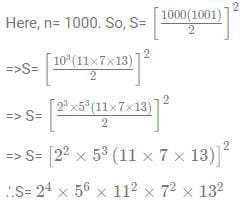
The number of even factors of S, where S = 13 + 23 + 33 +... 10003 is


Detailed Solution: Question 2

S = 13 + 23 + 33 +... 10003 is

We know that the sum of cubes of natural number starting from 1 upto n is given by: 

So, for even factors, we need at least one 2 among the four 2s available with S. We can select either one, two, three or four 2s. For the other prime factors, we also have the option to choose 0 out of the available number of 5s, 11s, 7s and 13s.

So, total even factors= 4×7×3×3×3 = 756.

Arun Sharma Test: Number System- 1 - Question 3

If the number of factors of N is 8 and that of 5N is 16, then the number of factors of 2*N can be

Detailed Solution: Question 3

Let p1, p2, p3 be distinct prime numbers which are not equal to 5.

From the given information, we can conclude that N can be

Case 1: N = p1*p2*p3

Case 2: N = p13∗p2

Case 3: N = p17

Now, 2 can or cannot be one of p1,p2,p3

In case 1:

If 2 ≠ ​p1/p2/p3 then number of factors of 2*p1*p2*p3 = 16.

If 2 is equal to p1 or p2 or p3 then the number of factors of 2*N will be 12.

In case 2:

If 2 ≠  p1 or p2, then number of factors of 2*N=16.

If 2=p1, the number of factors of 2*N will be 10

If 2=p2, the number of factors of 2*N will be 12.

Case 3:

If 2 ≠  p, the number of factors of 2*N = 16.

If 2=p1, the number of factors of 2*N = 9

.'. The number of factors of 2N can be 9,10,12,16.

Arun Sharma Test: Number System- 1 - Question 4

If A, B, C and D are distinct natural numbers, the sum of which adds up to 50. Then, the maximum value of their product is __?

Detailed Solution: Question 4

Given, A, B, C and D are 4 distinct integers and A+B+C+D= 50.
The products of four numbers will be maximum if the numbers are as close to each other as possible.
The A.M. of the four numbers= 
.'. The four numbers are around 12 and continuous. A, B, C and D are 11, 12, 13 and 14.
And hence, the maximum value of the products of the four number=11×12×13×14=24024. 

*Answer can only contain numeric values
Arun Sharma Test: Number System- 1 - Question 5

For natural numbers x,y, and z, if xy + yz = 19 and yz + xz = 51, then the minimum possible value of xyz is


Detailed Solution: Question 5

It is given, y(x + z) = 19

y cannot be 19. 

If y = 19, x + z = 1 which is not possible when both x and z are natural numbers.

Therefore, y = 1 and x + z = 19

It is given, z(x + y) = 51

z can take values 3 and 17

Case 1:

If z = 3, y = 1 and x = 16

xyz = 3*1*16 = 48

Case 2:

If z = 17, y = 1 and x = 2

xyz = 17*1*2 = 34

Minimum value xyz can take is 34.

*Answer can only contain numeric values
Arun Sharma Test: Number System- 1 - Question 6

Let A be the largest positive integer that divides all the numbers of the form 3k + 4k + 5k and B be the largest positive integer that divides all the numbers of the form 4k + 3(4k) + 4k+2, where k is any positive integer. Then (A + B) equals


Detailed Solution: Question 6

A is the HCF of 3k + 4k + 5for different values of k.

For k = 1, value is 12

For k = 2, value is 50

For k = 3, value is 216

HCF is 2. Therefore, A = 2

HCF of the values is when k = 1, i.e. 5*16 = 80

Therefore, B = 80

A + B = 82

Arun Sharma Test: Number System- 1 - Question 7

On day one, there are 100 particles in a laboratory experiment. On day n, where n ≥ 2, one out of every n particles produces another particle. If the total number of particles in the laboratory experiment increases to 1000 on day m, then m equals

Arun Sharma Test: Number System- 1 - Question 8

For some natural number n, assume that (15,000)! is divisible by (n!)!. The largest possible value of n is

Arun Sharma Test: Number System- 1 - Question 9

Brishti went on an 8-hour trip in a car. Before the trip, the car had travelled a total of x km till then, where x is a whole number and is palindromic, i.e., X remains unchanged when its digits are reversed. At the end of the trip, the car had travelled a total of 26862 km till then, this number again being palindromic. If Brishti never drove at more than 110 km/h, then the greatest possible average speed at which she drove during the trip, in km/h, was

Detailed Solution: Question 9

The distance travelled before the trip (x in km.) is a palindrome.
Let the average speed of Brishti be s kmph.
The total distance covered by Brishti after the trip is 26862 km.
The distance covered by Brishti during the trip is 8×s = 8s km.
x = 26862 – 8s
For x to be a palindrome, of the given options, s can only be 100.
Therefore, the average speed of Brishti during the trip is 100 kmph.

Arun Sharma Test: Number System- 1 - Question 10

For any natural numbers m, n, and k, such that k divides both m + 2n and 3m + 4n, k must be a common divisor of

Detailed Solution: Question 10

It is given that k divides m+2n and 3m+4n.

Since k divides (m+2n), it implies k will also divide 3(m+2n). Therefore, k divides 3m+6n.

Similarly, we know that k divides 3m+4n.

We know that if two numbers a, and b both are divisible by c, then their difference (a-b) is also divisible by c.

By the same logic, we can say that {(3m+6n)-(3m+4n)} is divisible by k. Hence, 2n is also divisible by k.

Now, (m+2n) is divisible by k, it implies 2(m+2n) =2m+4n is also divisible by k.

Hence, {(3m+4n)-(2m+4n)} = m is also divisible by k.

Therefore, m, and 2n are also divisible by k.

The correct option is C

*Answer can only contain numeric values
Arun Sharma Test: Number System- 1 - Question 11

In a 3-digit number N, the digits are non-zero and distinct such that none of the digits is a perfect square, and only one of the digits is a prime number. Then, the number of factors of the minimum possible value of N is


Detailed Solution: Question 11

According to question, in the given 3-digit number N, the digits are non-zero and distinct.
So, the possible digits in 3-digit number = 2,3,5,6,7,8
It is also given that only one of the digits is a prime number.
So, the minimum possible value of N = 268
(2 is the smallest prime digit, and the non-prime digits has to be 6 and 8)
Now, 
268 = 4 × 67 = 22 × 67
So, the number of factors =  (2 + 1)(1 + 1) = 3 × 2 = 6

*Answer can only contain numeric values
Arun Sharma Test: Number System- 1 - Question 12

Suppose a,b,c are three distinct natural numbers, such that 3ac = 8(a + b). Then, the smallest possible value of 3a + 2b + c is


Detailed Solution: Question 12

Our task is to minimise 3a +2b + c.

Here, the coefficient for cc is the minimum. 

3ac = 8(a + b)

We know that a, b, and c are natural numbers. So, the product acac should definately be a multiple of 8.

Case 1: a = 1, c = 8 and b = 2 ⇒ 3a+2b+c = 15

Case 2: a = 2, c = 4 and b = 1 ⇒ 3a+2b+c = 12

So, 12 is the correct answer.

Arun Sharma Test: Number System- 1 - Question 13

The number of divisors of (2× 3× 5× 72), which are of the form (3r + 1), where r is a non-negative integer, is

Detailed Solution: Question 13

The divisors of the given number will have the form 2a∗3b∗5c∗7with 0 ≤ a ≤ 6, 0 ≤ b ≤ 5, 0 ≤ c ≤ 3, 0 ≤ d ≤ 2

Because the divisors should be in the form 3r + 1, it cannot be divisible by 3, so (b = 0). 

Reduce modulo 3: 2 mod 3 = 2,5  mod 3 = 2,7  mod 3 = 1

Hence,  2a5c7≡ 2a+c⋅1≡ 2a+c(mod 3)

2k will be in the form 3r+1 only when K is even. So, we need a+c to be even

a ∈ 0,…,6 has 4 even, 3 odd values 

c ∈ 0,…,3 has 2 even, 2 odd

Number of (a,c) with (a+c) even is 4⋅2 + 3⋅2 = 8+6 = 14

For each such pair, there are 3 choices for d = 0,1,2. Thus, total divisors in the form (3r+1) equals 14 × 3 = 42.

*Answer can only contain numeric values
Arun Sharma Test: Number System- 1 - Question 14

The sum of digits of the number (625)65 × (128)36 is


Detailed Solution: Question 14

Thus, the number equals 58 followed by 252 zeros. Now (5= 390625), and the sum of the digits of (390625) is
3 + 9 + 0 + 6 + 2 + 5 = 25.
Zeros add nothing, so the required sum of digits is 25.

Arun Sharma Test: Number System- 1 - Question 15

 How many pairs of integers (x, y) exist such that the product of x, y and HCF(x, y) = 1080?

Detailed Solution: Question 15

  1. Let g = HCF(x, y). Write x = g·d, y = g·h with gcd(d, h) = 1.
    Then x·y·HCF(x, y) = (g d)(g h)g = g³ d h = 1080.

  2. Prime factorization: 1080 = 2³ · 3³ · 5.
    For g³ | 1080, g can only use primes with exponents ≤ 1 (since exponents triple):
    g ∈ {1, 2, 3, 6}.

  3. For each g, N = 1080 / g³ must be split as d·h with gcd(d, h) = 1.
    If N has k distinct primes, the number of ordered coprime splits (d, h) is 2^k
    (each prime-power goes wholly to d or to h).

  • g = 1 ⇒ N = 1080 (primes {2,3,5}, k=3) ⇒ 2³ = 8 ordered pairs

  • g = 2 ⇒ N = 135 = 3³·5 (primes {3,5}, k=2) ⇒ 4 ordered pairs

  • g = 3 ⇒ N = 40 = 2³·5 (primes {2,5}, k=2) ⇒ 4 ordered pairs

  • g = 6 ⇒ N = 5 (primes {5}, k=1) ⇒ 2 ordered pairs

Total ordered pairs = 8 + 4 + 4 + 2 = 18.
Since d ≠ h in all cases (N ≠ 1), unordered pairs = 18 / 2 = 9.

Hence, 9 pairs.

136 videos|255 docs|86 tests
Information about Arun Sharma Test: Number System- 1 Page
In this test you can find the Exam questions for Arun Sharma Test: Number System- 1 solved & explained in the simplest way possible. Besides giving Questions and answers for Arun Sharma Test: Number System- 1, EduRev gives you an ample number of Online tests for practice
136 videos|255 docs|86 tests
Download as PDF

