CAT Exam  >  CAT Test  >  Quantitative Aptitude (Quant)  >  CAT Practice: Coordinate Geometry - CAT MCQ

CAT Practice: Coordinate Geometry - Free MCQ Test with solutions for Quant


MCQ Practice Test & Solutions: CAT Practice: Coordinate Geometry (10 Questions)

You can prepare effectively for CAT Quantitative Aptitude (Quant) with this dedicated MCQ Practice Test (available with solutions) on the important topic of "CAT Practice: Coordinate Geometry". These 10 questions have been designed by the experts with the latest curriculum of CAT 2026, to help you master the concept.

Test Highlights:

  • - Format: Multiple Choice Questions (MCQ)
  • - Duration: 10 minutes
  • - Number of Questions: 10

Sign up on EduRev for free to attempt this test and track your preparation progress.

CAT Practice: Coordinate Geometry - Question 1

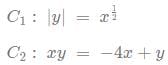
At how many points do the following curves C1 and C2 intersect?
Detailed Solution: Question 1

From curve C1 we can see that x ≥ 0 and y can be either positive or negative. Thus either intersection happens in the first quadrant or fourth quadrant.
x1/2 = |y| or x = y2 ...(I)) from C1
Putting this in the C2 equation
y2(y) = -4y2 + y
On rearranging we get y3 + 4y2 - y  = 0
y(y2 + 4y - 1) = 0
Discriminate of (y2 + 4y - 1) is positive so it must have 2 distinct roots ≠ 0
y(y2 + 4y - 1) = 0 has 3 distinct roots. 
For each value of y there will be unique x such that x1/2 = |Y|.  

CAT Practice: Coordinate Geometry - Question 2

A line passing through the point (3,0) divided the rectangle formed by lines |y - 4| = 2 and |x - 6| = 3 into two congruent parts. If the slope of the line is a/b and a,b are co-primes, the value of a+b is equal to

Detailed Solution: Question 2
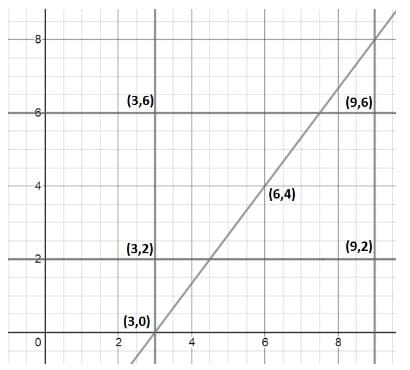

The coordinates of the rectangle are (3,2),(9,2),(3,6) and (9,6).
The line dividing it in two congruent parts should pass through the central point of the rectangle (3 + 9)/2 = 6 and (2 + 6)/2 = 4 i.e (6,4)
The slope of the line passing through (3,0) and (6,4) = 4/3 = a/b
a + b = 4 + 3 = 7

CAT Practice: Coordinate Geometry - Question 3

What is the area of a plane figure bounded by circle centered at origin having radius unity and the points of the lines represented by Max (x, y) = 1 where Max denotes Maximum of the two numbers x & y where x, y > 0?

Detailed Solution: Question 3
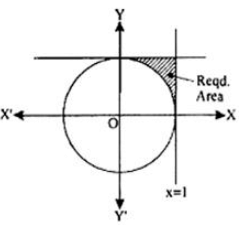
Since x, y>0 thus we are talking of area in first quadrant only.

By definition the lines max, (x, y) = 1 means x = 1 and y £ 1 or y = 1 and x £ 1

Required area is shaded area as shown in the figure

= Area of square - Area of semicircle = 1 - (π/4) sq. units

CAT Practice: Coordinate Geometry - Question 4

ABCD is a square such that A lies on the +ve y-axis, B on +ve x-axis. If D is (12,17), the coordinates of C will be?

Detailed Solution: Question 4
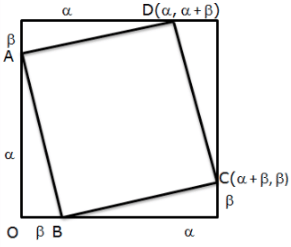
Consider a square drawn according to the given conditions i.e A lies on the +ve y-axis, B on +ve x-axis

Co-ordinates of D is (12,17)

Let OA = a and OB = b

OAB is a right angled triangle, with AB as hypotenuse

Since AB is a side of the sqaure ABCD, remaining lengths will be as shown in the diagram

Therefore, D’s co-ordinates will be of the form (a, a + b) = (12,17)

a = 12 and b = 5; hence C is (17, 5)

CAT Practice: Coordinate Geometry - Question 5

Let ABCD be a parallelogram such that the coordinates of its three vertices A, B, C are (1, 1), (3, 4) and (−2, 8), respectively. Then, the coordinates of the vertex D are

Detailed Solution: Question 5
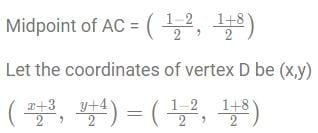
In a parallelogram, two diagonals of parallelogram bisects each other, which concludes that mid-point of both diagonals are the same.

x = -4 and y = 5

The answer is option D.

CAT Practice: Coordinate Geometry - Question 6

Let C be the circle x2 + y2 + 4x - 6y - 3 = 0 and L be the locus of the point of intersection of a 2 pair of tangents to C with the angle between the two tangents equal to 60°. Then, the point at which I touches the line x = 6 is

Detailed Solution: Question 6
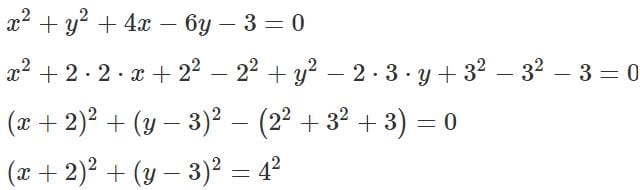

This is the equation of a circle with radius 4 units and centered at (-2, 3)
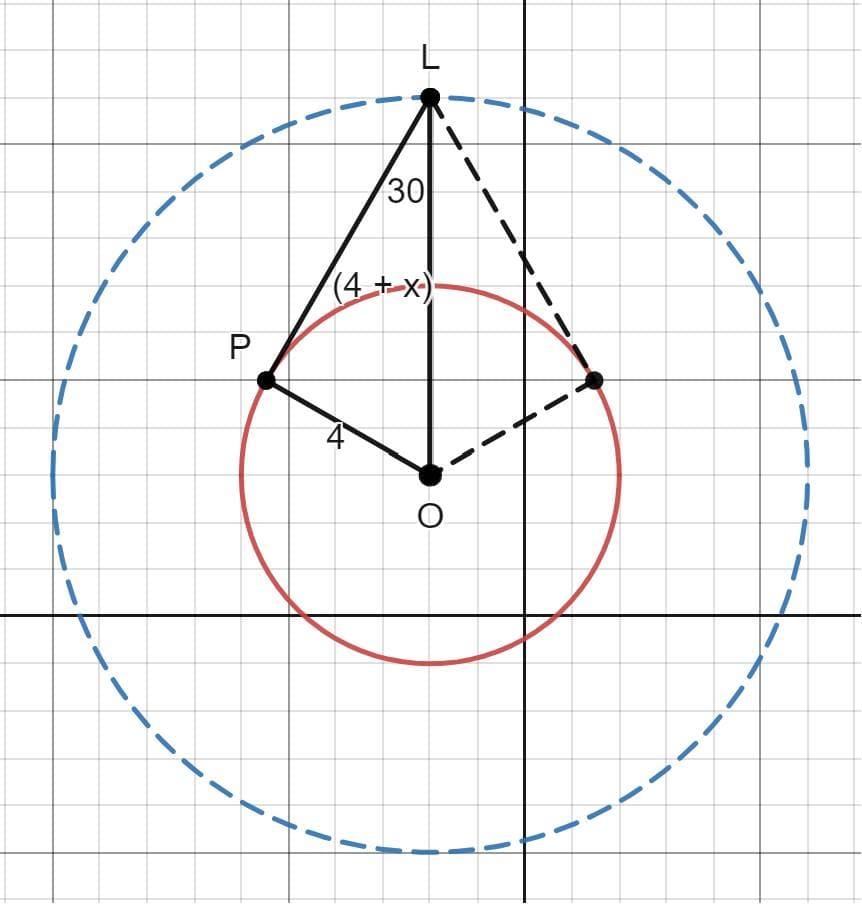
From a point L we drop two tangents on the circle such that the angle between the tangents is 60o.

∠LPO = 90∘ 
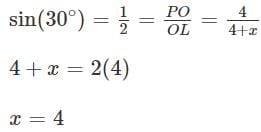
∠PLO=30
 
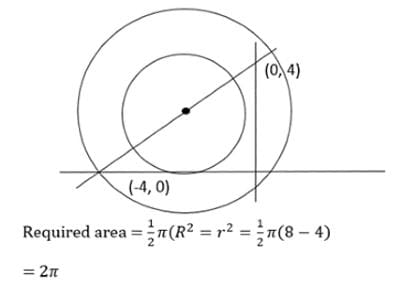
Therefore the locus of the point L, is a circle centered at (-2, 3) and has a radius of (4 + x = 8) units.
The equation of this locus is thus, (x + 2)2 +(y − 3)2 = 82
 When x = 6, we have, (8)2 +(y − 3)2 = 82   , that is y = 3
The circle , (x + 2)2 +(y − 3)2 = 82, touches the line x = 6 at (6, 3).

*Answer can only contain numeric values
CAT Practice: Coordinate Geometry - Question 7

The area of the quadrilateral bounded by the Y -axis, the line x = 5, and the lines |x − y| − |x − 5| = 2, is


Detailed Solution: Question 7
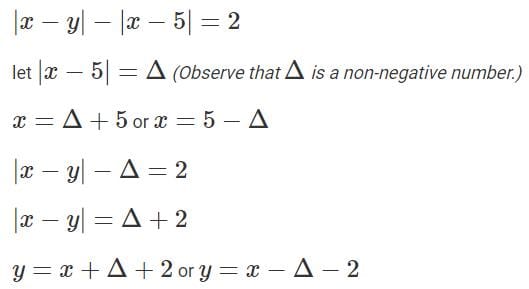


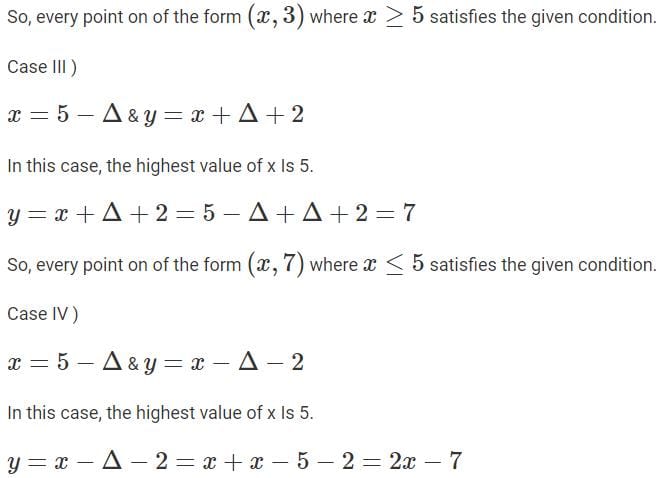
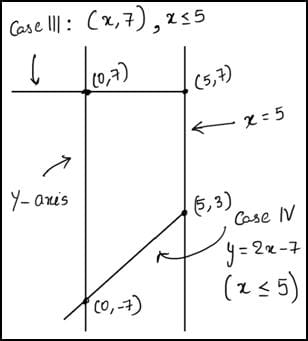
So, every point on the line y = 2x − 7 where x ≤ 5 satisfies the given condition.
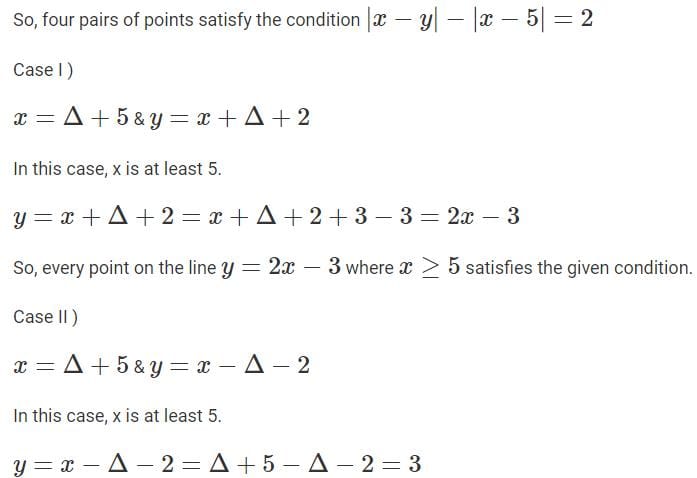
We are to find the area enclosed by the y-axis, x = 5 and the lines of |x−y|−|x−5|=2 .
Because the area we are interested is bounded by x = 0 (y-axis) and x = 5, 0 ≤ x ≤ 5.
So, we’ll only be concerned about Case III and Case IV.
A rough sketch of the bounded region looks like…

The line y = 2x – 7 touches x = 0 and x = 5 at (0, -7) and (5, 3) respectively.

CAT Practice: Coordinate Geometry - Question 8

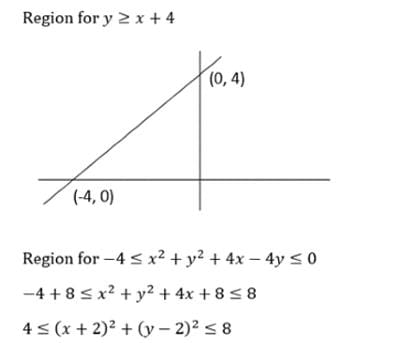
In the XY-plane, the area, in sq. units, of the region defined by the inequalities y ≥ x + 4 and -4 ≤ x2 + y2 + 4(x - y) ≤ 0 is

Detailed Solution: Question 8
*Answer can only contain numeric values
CAT Practice: Coordinate Geometry - Question 9

The coordinates of the three vertices of a triangle are: (1, 2), (7, 2), and (1, 10). Then the radius of the incircle of the triangle is


Detailed Solution: Question 9

Given,
The three vertices are: (1,2), (7,2) and (1,10)
The three side lengths are 6, 8 and 10 respectively.
These are the sides of a right angled triangle.
So, Area = 1/2 × 6 × 8 = 24 sq. units
Inradius = area / semi-perimeter = 24 / 12 = 2 units

CAT Practice: Coordinate Geometry - Question 10

The (x, y) coordinates of vertices P, Q and R of a parallelogram PQRS are (-3, -2), (1, -5) and (9, 1), respectively. If the diagonal SQ intersects the x-axis at (a, 0) , then the value of a is

Detailed Solution: Question 10
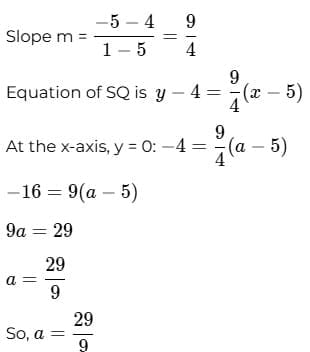
Given (P(-3,-2)), (Q(1,-5)), and (R(9,1)).
For parallelogram (PQRS), S = P + R - Q = (-3,-2) + (9,1) - (1,-5) = (5,4)
Diagonal SQ passes through S(5,4) and Q(1,-5).

136 videos|255 docs|86 tests
Information about CAT Practice: Coordinate Geometry Page
In this test you can find the Exam questions for CAT Practice: Coordinate Geometry solved & explained in the simplest way possible. Besides giving Questions and answers for CAT Practice: Coordinate Geometry, EduRev gives you an ample number of Online tests for practice
136 videos|255 docs|86 tests
Download as PDF