UPSC Exam  >  UPSC Test  >  CSAT Preparation  >  Test: Mensuration- 2 - UPSC MCQ

Mensuration- 2 - UPSC Free MCQ Test with solutions


MCQ Practice Test & Solutions: Test: Mensuration- 2 (10 Questions)

You can prepare effectively for UPSC CSAT Preparation with this dedicated MCQ Practice Test (available with solutions) on the important topic of "Test: Mensuration- 2". These 10 questions have been designed by the experts with the latest curriculum of UPSC 2026, to help you master the concept.

Test Highlights:

  • - Format: Multiple Choice Questions (MCQ)
  • - Duration: 10 minutes
  • - Number of Questions: 10

Sign up on EduRev for free to attempt this test and track your preparation progress.

Test: Mensuration- 2 - Question 1

A right circular cone has height H and radius R. A small cone is cut off at the top by a plane parallel to the base. At what height above the base the section has been made?

Statement (I): H = 20 cm
Statement (II): Volume of small cone: volume of large cone : 1:15

Detailed Solution: Question 1

From statement I, we know that the height of the initial cone is 20cm. However, nothing is said about the small cone. Hence, we cannot answer the question using statement A. So, we can eliminate choices (A) and (D).

We are down to choices (A), (B) or (D).

From Statement II, we know that the ratio of the volume of the small cone to that of the large cone is 1 : 15.

(r is the base radius of the smaller cone and h is the height of the smaller cone)
or r2 * h : R2 * H is 1 : 15

From this information, we will not be able to find the answer to h. Hence, we can eliminate choice (A). 

Combining the information in the two statements: 

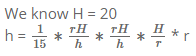
When a section is made the two cones are similar triangles. so 


 Substituting H = 20, we can get the value for h.
Choice (B) is therefore, the correct answer.

Correct Answer: If the question cannot be answered with statement I alone or with statement II alone, but can be answered if both statements are used together.

Test: Mensuration- 2 - Question 2

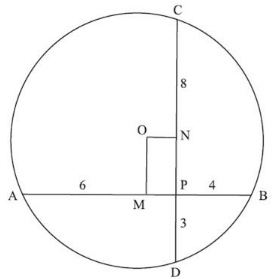
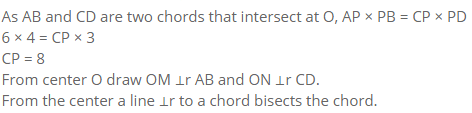
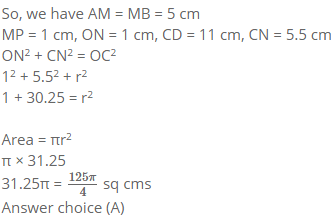
The surface area of a closed rectangular box, which is inscribed in a sphere, is 846 sq. cm., and the sum of the lengths of all its edges is 144 cm. The volume, in cubic cm, of the sphere is

Detailed Solution: Question 2


*Answer can only contain numeric values
Test: Mensuration- 2 - Question 3

The coordinates of the three vertices of a triangle are: (1, 2), (7, 2), and (1, 10). Then the radius of the incircle of the triangle is


Detailed Solution: Question 3

Given,
The three vertices are: (1,2), (7,2) and (1,10)
The three side lengths are 6, 8 and 10 respectively.
These are the sides of a right angled triangle.
So, Area = 1/2 × 6 × 8 = 24 sq. units
Inradius = area / semi-perimeter = 24 / 12 = 2 units

*Answer can only contain numeric values
Test: Mensuration- 2 - Question 4

In a right-angled triangle ABC, the altitude AB is 5 cm, and the base BC is 12 cm. P and Q are two points on BC such that the areas of ΔABP, ΔABQ and ΔABC are in arithmetic progression. If the area of ΔABC is 1.5 times the area of ΔABP, the length of PQ, in cm, is


Detailed Solution: Question 4

The construction of the triangle according to the question is as follows:

Test: Mensuration- 2 - Question 5

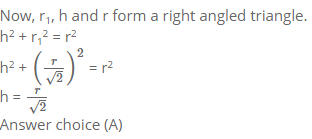
A triangle is drawn with its vertices on the circle C such that one of its sides is a diameter of C and the other two sides have their lengths in the ratio a : b. If the radius of the circle is r, then the area of the triangle is

Detailed Solution: Question 5

Since the angle subtended by the diameter on the circle is a right-angle, such a triangle inscribed in a circle with the diameter as one of its sides will be right angled.

“…and the other two sides have their lengths in the ratio a: b.”
Let the two sides be ax and bx.
The area of the triangle 

Test: Mensuration- 2 - Question 6

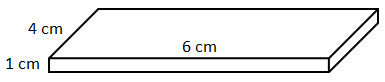
Cylindrical cans of cricket balls are to be packed in a box. Each can has a radius of 7 cm and height of 30 cm. Dimension of the box is l = 76 cm, b = 46 cm, h = 45 cm. What is the maximum number of cans that can fit in the box?

Detailed Solution: Question 6

This question requires a good deal of visualization. Since, both the box and cans are hard solids, simply dividing the volume won’t work because the shape can’t be deformed. 

Each cylindrical can has a diameter of 14 cm and while they are kept erect in the box will occupy height of 30 cm 

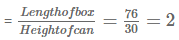
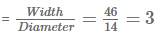
Number of such cans that can be placed in a row

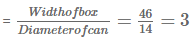
Number of such rows that can be placed

Thus 5 x 3 = 15 cans can be placed in an erect position.

However, height of box = 45cm and only 30 cm has been utilized so far 

Remaining height = 15 cm > 14 cm (Diameter of the can)

So, some cans can be placed horizontally on the base.

Number of cans in horizontal row
Number of such rows
∴ 2 x 3 = 6 cans can be placed horizontally

∴ Maximum number of cans = 15+6 = 21 

Choice (D) is therefore, the correct answer.

Test: Mensuration- 2 - Question 7

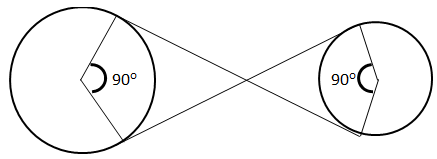
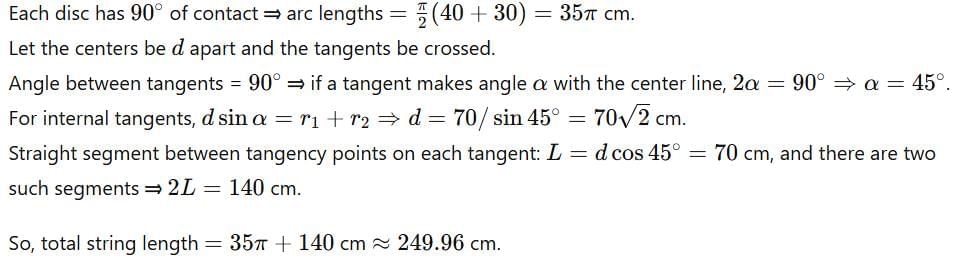
A string is wound around two circular disk as shown. If the radius of the two disk are 40 cm and 30 cm respectively. What is the total length of the string?
Detailed Solution: Question 7

Test: Mensuration- 2 - Question 8

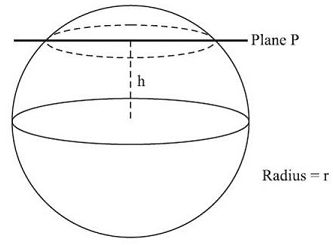
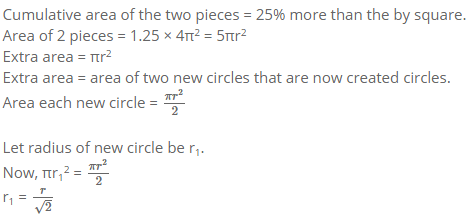
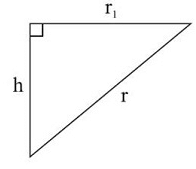
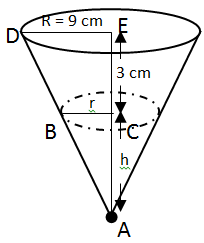
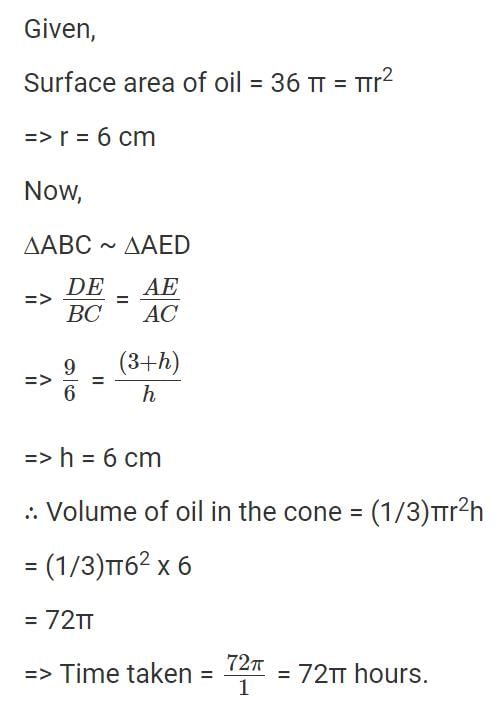
An inverted right circular cone has a radius of 9 cm. This cone is partly filled with oil which is dipping from a hole in the tip at a rate of 1cm2/hour. Currently the level of oil 3 cm from top and surface area is 36π cm2. How long will it take the cone to be completely empty?
Detailed Solution: Question 8

Given,

Test: Mensuration- 2 - Question 9

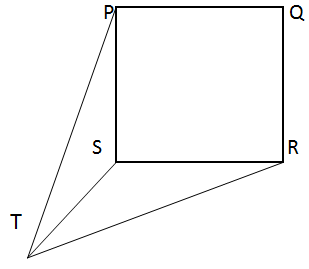
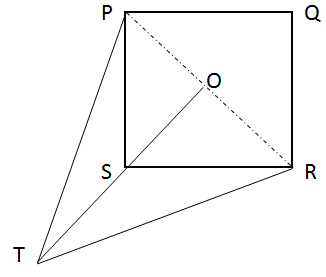
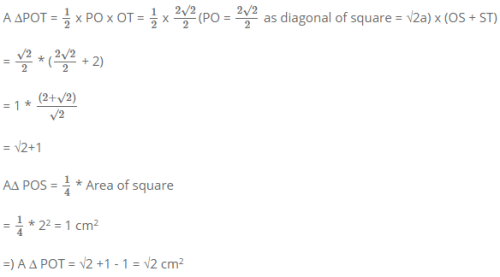
A square PQRS has an equilateral triangle PTO inscribed as shown:
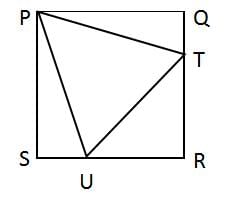
What is the ratio of AΔPQT to AΔTRU?
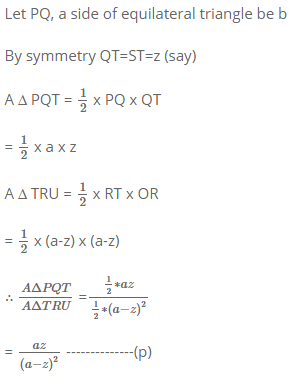
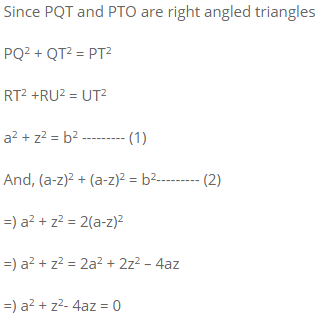
Detailed Solution: Question 9

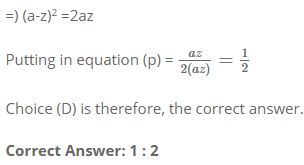
=) a2 + z2 – 2az = 2az (Please note how the solution is being managed here. You must always be aware of what you are looking for. Here, as equation -? we are looking for (a-z)2 in terms of az) 

Test: Mensuration- 2 - Question 10

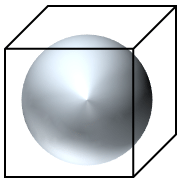
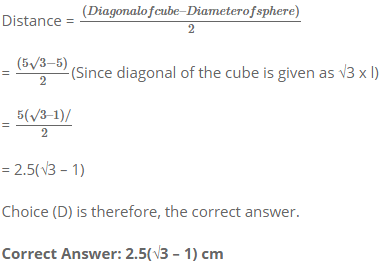
A spherical shaped sweet is placed inside a cube of side 5 cm such that the sweet just fits the cube. A fly is sitting on one of the vertices of the cube. What is the shortest distance the fly must travel to reach the sweet?
Detailed Solution: Question 10

The question demands visualization. The shortest distance required to be travelled by the fly would be diagonally and be given by:-

205 videos|300 docs|137 tests
Information about Test: Mensuration- 2 Page
In this test you can find the Exam questions for Test: Mensuration- 2 solved & explained in the simplest way possible. Besides giving Questions and answers for Test: Mensuration- 2, EduRev gives you an ample number of Online tests for practice
205 videos|300 docs|137 tests
Download as PDF