NEET Exam  >  NEET Test  >  Physics Class 11  >  OneTime: Motion In Two Dimensions - NEET MCQ

OneTime: Motion In Two Dimensions for NEET Physics Class 11 - Free MCQ


MCQ Practice Test & Solutions: OneTime: Motion In Two Dimensions (15 Questions)

You can prepare effectively for NEET Physics Class 11 with this dedicated MCQ Practice Test (available with solutions) on the important topic of "OneTime: Motion In Two Dimensions". These 15 questions have been designed by the experts with the latest curriculum of NEET 2026, to help you master the concept.

Test Highlights:

  • - Format: Multiple Choice Questions (MCQ)
  • - Duration: 150 minutes
  • - Number of Questions: 15

Sign up on EduRev for free to attempt this test and track your preparation progress.

OneTime: Motion In Two Dimensions - Question 1

A particle is projected from point O with velocity u in a direction making an angle α with the horizontal. At any instant its position is at point p at right angles to the initial direction of projection, Its velocity at point p is:

Detailed Solution: Question 1

Horizontal velocity at point O = u cos α
Horizontal velocity at point P = v sin α

In projectile motion horizontal, component of velocity remains constant throughout the motion 
∴ v sin α = u cos α
⇒ v = u cot α


OneTime: Motion In Two Dimensions - Question 2

Pankaj and Sudhir are playing with two different balls of masses m and 2m, respectively. If Pankaj throws his ball vertically up and Sudhir at an angle θ, both of them stay in our view for the same period. The height attained by the two balls are in the ratio:

Detailed Solution: Question 2

Time of flight for the ball thrown by pankaj, 
Time of flight for the ball thrown by sudhir,According to problem,

Height of the ball thrown by pankaj,
Height of the thrown by sudhir,


OneTime: Motion In Two Dimensions - Question 3

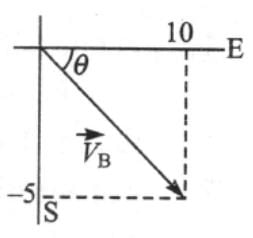
A ship A sailing due east with a velocity of 10 km/h happens to appear sailing due north with a velocity of 5 km/h, to a person, sitting in a moving ship B. Determine the velocity (absolute) of ship B.

.

Detailed Solution: Question 3

Here we are given velocity of 'A', 
Velocity of 'A', w.r.t. 'B', 

Now,

Hence velocity of B, 

i.e. S of E

OneTime: Motion In Two Dimensions - Question 4

A boy projects a stone vertically perpendicular to the trolley car with a speed v. If the trolley car moves with u constant velocity m, the time of flight of the stone is:

Detailed Solution: Question 4

v = vsin θ
u = vcos θ

Time of flight depends on vertical component of velocity.

OneTime: Motion In Two Dimensions - Question 5

Which of the following statements is false for a particle moving in a circle with a constant angular speed?

Detailed Solution: Question 5

In circular motion we know the velocity vector is tangent to the circle. If a particle moves in a circle with constant angular speed it perform uniform circular motion. In uniform circular motion the tangential acceleration of the particle is zero. The particle moves under radial acceleration only which points to the centre of the circle. Hence the velocity and acceleration vectors are perpendicular to each other.

OneTime: Motion In Two Dimensions - Question 6

A particle is moving on a circular path of radius r with uniform velocity v. The change in velocity when the particle moves from P to Q is (∠POQ=40).


Detailed Solution: Question 6

Change in velocity:

OneTime: Motion In Two Dimensions - Question 7

A stone is just released from the window of a train moving along a horizontal straight track. The stone will hit the ground following.

Detailed Solution: Question 7

Due to constant velocity along horizontal and vertical downward force of gravity stone will hit the ground following parabolic path.

OneTime: Motion In Two Dimensions - Question 8

An aeroplane is flying horizontally with a velocity of 600 km/h at a height of 1960 m. When it is vertically at a point A on the ground, a bomb is released from it. The bomb strikes the ground at point B. The distance AB is:

Detailed Solution: Question 8

Horizontal displacement of the bomb AB = Horizontal velocity × time available

*Multiple options can be correct
OneTime: Motion In Two Dimensions - Question 9

A ball is rolled off the edge of a horizontal table at a speed of 4 m/second.  It hits the ground after 0.4 second.  Which statement given below is true.

Detailed Solution: Question 9

Vertical component of velocity of ball at point P

Horizontal component of velocity = initial velocity 


So the speed with which it hits the ground,

and 

⇒ θ = 45º 

It means the ball hits the ground at an angle of 45 to the horizontal.
Height of the table

Horizontal distance travelled by the ball from the edge of table, h = ut = 4 × 0.4 = 1.6 m

OneTime: Motion In Two Dimensions - Question 10

A particle is dropped from a height and another particle is thrown in horizontal direction with speed of 5 m/sec from the same height. The correct statement is:

Detailed Solution: Question 10

For both cases,

Because vertical downward component of velocity will be zero for both the particles.

OneTime: Motion In Two Dimensions - Question 11

A projectile fired with initial velocity u at some angle θ has a range R. If the initial velocity be doubled at the same angle of projection, then the range will be:

Detailed Solution: Question 11

If initial velocity be doubled then range will become four times.

OneTime: Motion In Two Dimensions - Question 12

Assertion: In projectile motion, the angle between the instantaneous velocity and acceleration at the highest point is 180.
Reason: At the highest point, velocity of projectile will be in horizontal direction only.

Detailed Solution: Question 12

At the highest point, vertical component of velocity becomes zero so there will be only horizontal velocity and it is perpendicular to the acceleration due to gravity.

OneTime: Motion In Two Dimensions - Question 13

Assertion: The maximum horizontal range of projectile is proportional to square of velocity.
Reason: The maximum horizontal range of projectile is equal to maximum height attained by projectile.

Detailed Solution: Question 13


when θ = 45º, Rmax ∝ u2


when θ = 90º, Hmax ∝ u2

 It is clear that,

OneTime: Motion In Two Dimensions - Question 14

The radius vector describing the position of the particle A relative to origin.
2-D Kinematics/Motion in plane Problems with Solutions for JEE Main & JEE Advanced
Find the rectangular components of the average velocity in the time interval between t and t + Δ t.

Detailed Solution: Question 14

*Multiple options can be correct
OneTime: Motion In Two Dimensions - Question 15

The radius vector describing the position of the particle A relative to origin.
2-D Kinematics/Motion in plane Problems with Solutions for JEE Main & JEE Advanced

Which of the following statements are true about the motion.

Detailed Solution: Question 15


For these, it is clear that all the four options are correct

97 videos|376 docs|102 tests
Information about OneTime: Motion In Two Dimensions Page
In this test you can find the Exam questions for OneTime: Motion In Two Dimensions solved & explained in the simplest way possible. Besides giving Questions and answers for OneTime: Motion In Two Dimensions, EduRev gives you an ample number of Online tests for practice
97 videos|376 docs|102 tests
Download as PDF