Civil Engineering (CE) Exam  >  Civil Engineering (CE) Test  >  Soil Mechanics  >  Test: Classification of Soils - Civil Engineering (CE) MCQ

Classification of Soils - GATE Civil Soil Mechanics Free MCQ Test


MCQ Practice Test & Solutions: Test: Classification of Soils (10 Questions)

You can prepare effectively for Civil Engineering (CE) Soil Mechanics with this dedicated MCQ Practice Test (available with solutions) on the important topic of "Test: Classification of Soils". These 10 questions have been designed by the experts with the latest curriculum of Civil Engineering (CE) 2026, to help you master the concept.

Test Highlights:

  • - Format: Multiple Choice Questions (MCQ)
  • - Duration: 30 minutes
  • - Number of Questions: 10

Sign up on EduRev for free to attempt this test and track your preparation progress.

Test: Classification of Soils - Question 1

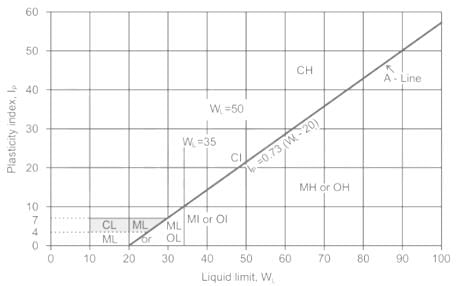
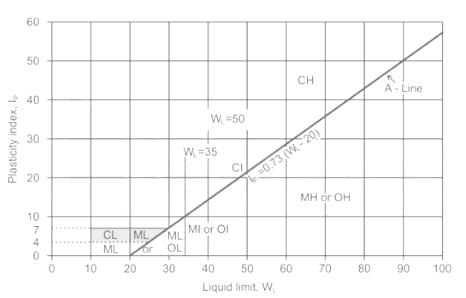
The soil was tested in a National research center and its liquid limit was found to be 15% and the plasticity index was found to be 3%. According to Cassagrande's plasticity chart, which soil type is this?
Detailed Solution: Question 1

Fine grained soil are classified on the basis of plastic chart. Clay is found to exist above A-line whereas silt & organic soil found to exist below A-line.

Soil type:
Liquid limit = WL = 15 %, Plasticity index = IP = 3 
IP according to the plasticity chart = 0.73(15 - 20) = - 3.65
And we know IP cannot be negative, and when it comes out negative, we report it as 0
So, according to plasticity chart, IP = 0
Firstly,
The actual plasticity limit is 3, so the soil will lie in the region above A-Line
Secondly, 
By plotting the plasticity index (3) and liquid limit (15 %), in the graph, we get the region of the given soil in the graph above
So, the soil is in the region marked as ML in the graph

Test: Classification of Soils - Question 2

Hazen proposed which of the following equations to determine whether a soil sample Is uniformly graded or well graded? (Here Cu = Uniformity Coefficient. and D = Diameter of the soil particle)
(Symbols and notations carry their usual meaning)

Detailed Solution: Question 2

Concept:
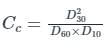
Coefficient of Uniformity / Uniformity Coefficient:
It is defined as the ratio of D60 and D10 sieve sizes in the sieve analysis of granular material.
Higher is the value of Cu larger is the range of the particle size.

For uniformly graded soil, Cu = 1
For well graded sand, Cu > 6
For well graded gravel Cu > 4
Coefficient of Curvature / Curvature Coefficient:

For well graded soil, 1 < Cc < 3
For gap graded soil, 1 < Cc or Cc > 3
where
D60 = size at 60% finer by weight
D30 = size at 30% finer by weight
D10 = size at 10% finer by weight = Effective size

Test: Classification of Soils - Question 3

The standard plasticity chart to classify fine grained soils is shown in the figure below.
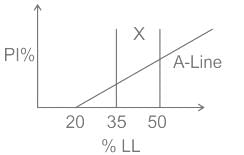
What does the area marked 'X' represent? 
Detailed Solution: Question 3

Plasticity chart:

  • It is a graph between plasticity index (IP) and liquid limit (WL) in percentage which is used for the classification of fine-grained soils as per the Indian Standard Soil Classification System(ISSCS).
  • If more than 50% percent of soil passes through a 75-micron sieve, then it is classified as fine-grained soil.
  • The 'A' line in this chart is expressed as IP = 0.73 (WL - 20), , where IP = plasticity index , WL = liquid limit
  • Depending on the point in the chart, fine soils are divided into clays (C), silts (M), or organic soils (O).
  • The organic content is expressed as a percentage of the mass of organic matter in a given mass of soil to the mass of the dry soil solids.
  • The 'U' line in this chart is expressed as IP = 0.9(WL - 8).

Clays generally plot above the plasticity chart's A-Line, whereas silts generally plot below it.

If the point gets plotted below A-line, then we need to find out whether the soil is organic or inorganic. If it's inorganic below A-line then it is silt (M)

Test: Classification of Soils - Question 4

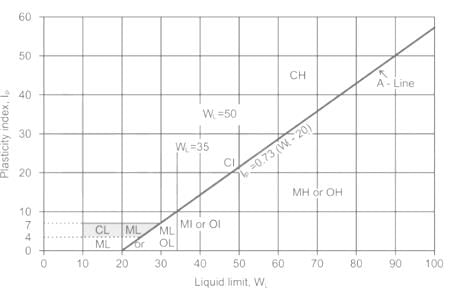
A fine grained soil has liquid limit of 60 and plastic limit of 20 as per plasticity chart. According to IS classification, the soil is represented by which of the following letter symbols?
Detailed Solution: Question 4

Concept:

  • Plasticity index of soil, Ip = WL - Wp
  • Plasticity index of A-line, Ip = 0.73 (WL - 20)

Calculation:
Given,
liquid limit (WL) = 60%
plastic limit (Wp) = 20%

Ip of soil = WL - Wp = 60 - 20 = 40%
Ip of A-line = 0.73 (WL - 20) = 0.73 (60 - 20) = 29.2%
Ip of soil > Ip of A-line, So it will lie above A-line
and also WL > 50%, so soil is CH

Test: Classification of Soils - Question 5

Soils deposits formed by wind transport wind are called:

Detailed Solution: Question 5

Concept:
Soil is also classified based on the mode of deposition or mode of transportation.
Soil deposit formed due to transportation by wind is called Aeolian deposit e.g. Loess

Test: Classification of Soils - Question 6

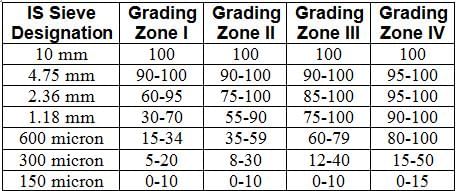
As per IS 383, sand can be graded into _______ zones.
Detailed Solution: Question 6

As per IS 383, Table 4(Clause 4.3)

  • There are 4 types of grading zones for fine aggregates(sand) namely Grading zone I, II, III, IV.
  • All grading zones and their recommended value for different sieve sizes are given below:

Test: Classification of Soils - Question 7

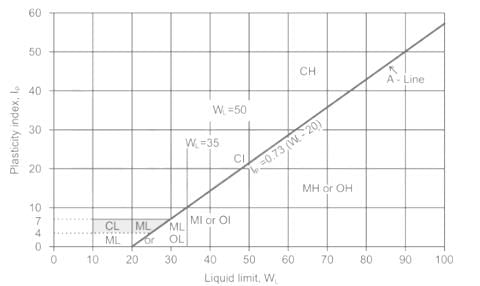
A fine grained soil has liquid limit of 60 and plastic limit of 20. As per the plasticity chart, according to IS classification, the soil is represented by the letter symbols
Detailed Solution: Question 7

Concept:

  • Plasticity index of soil, IP = WL – WP
  • Plasticity index of A-line, IP = 0.73 (WL - 20)

Calculation:

Given,
Liquid limit (WL) = 60%
Plastic limit (Wp) = 20%
IP of soil = WL – WP = 60 - 20 = 40%
IP of A-line = 0.73 (WL - 20) = 0.73 (60 - 20) = 29.2%
IP of soil > IP of A-line, So it will lie above A-line and also WL > 50%,
∴ Soil is CH.

Test: Classification of Soils - Question 8

The soil which is formed by transportation of the weathered rock material by the wind is

Detailed Solution: Question 8

Soil is also classified based on the mode of deposition or mode of transportation.
Soil deposit formed due to transportation by wind is called Aeolian deposit e.g. Loess

Test: Classification of Soils - Question 9

Soil is weathered chemically due to _________.

Detailed Solution: Question 9

Soil:

  • According to soil engineering the unconsolidated material, composed of solid particles, is produced by the disintegration of rocks.
  • The void space between particles may contain air, water, or both.
  • The soil particle may contain organic matter.
  • On the basis of the geological origin of their constituent sediments, soil can be divided into two main groups those which owe their origin to the physical and chemical weathering of the parent rocks, and those which are chiefly of organic origin.

Physical weathering:

  • The agencies responsible for physical weathering are the impact and grinding action of flowing water, ice, wind, and splitting actions of ice, plants, and animals.

Chemical weathering:

  • Chemical weathering or decomposition of rocks is caused mainly by oxidation, hydration, carbonation, and leaching by organic acids and water.
  • Clay and, to some extent, silts are formed by chemical weathering.

Test: Classification of Soils - Question 10

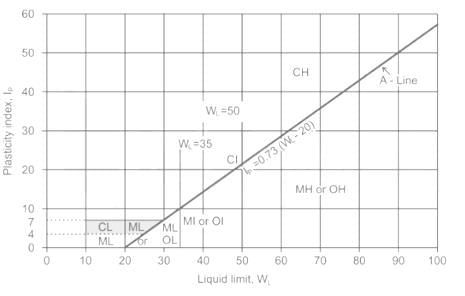
The soils which plot above the A line in a plasticity chart are known as:
Detailed Solution: Question 10

  • Plasticity chart gives the relationship between plasticity index and liquid limit.
  • Equation of A-line, Ip = 0.73 (WL - 20) , where Ip = plasticity index , WL = liquid limit
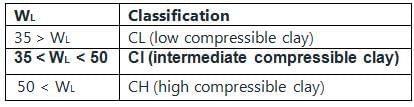
  • If the point gets plotted above A-line, classify soil as clay.
  • Further,
    • If, 35 > WL ; classify as CL (low compressible clay)
    • If, 35 < WL < 50; classify as CI (intermediate compressible clay)
    • If, 50 < WL ; classify as CH (high compressible clay)
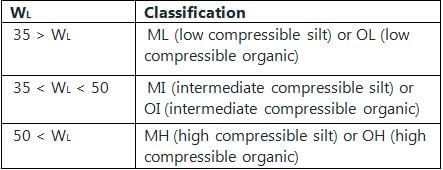
  • If the point gets plotted below A-line, then we need to find out whether the soil is organic or inorganic. If it's inorganic below A-line then it is silt (M)
  • Further,
    • If, 35 > WL ; classify as ML (low compressible silt) or OL (low compressible organic)
    • If, 35 < WL < 50; classify as MI (intermediate compressible silt) or OI (intermediate compressible organic)
    • If, 50 < WL ; classify as MH (high compressible silt) or OH (high compressible organic)

30 videos|129 docs|74 tests
Information about Test: Classification of Soils Page
In this test you can find the Exam questions for Test: Classification of Soils solved & explained in the simplest way possible. Besides giving Questions and answers for Test: Classification of Soils, EduRev gives you an ample number of Online tests for practice
30 videos|129 docs|74 tests
Download as PDF