Civil Engineering (CE) Exam  >  Civil Engineering (CE) Test  >  RCC & Prestressed Concrete  >  Test: Reinforced Concrete Structures - Civil Engineering (CE) MCQ

Reinforced Concrete Structures - Free MCQ Practice Test with solutions,


MCQ Practice Test & Solutions: Test: Reinforced Concrete Structures (10 Questions)

You can prepare effectively for Civil Engineering (CE) RCC & Prestressed Concrete with this dedicated MCQ Practice Test (available with solutions) on the important topic of "Test: Reinforced Concrete Structures". These 10 questions have been designed by the experts with the latest curriculum of Civil Engineering (CE) 2026, to help you master the concept.

Test Highlights:

  • - Format: Multiple Choice Questions (MCQ)
  • - Duration: 30 minutes
  • - Number of Questions: 10

Sign up on EduRev for free to attempt this test and track your preparation progress.

Test: Reinforced Concrete Structures - Question 1

The bars shall NOT be lapped unless the length required exceeds ______ .

Detailed Solution: Question 1

Lapping of Bars:
The lapping of bars is done to increase the height of the column. As the bars come in a specific size, hence to increase the length of the column, 2 or more bars needed to be joined together. Hence only the required length exceeds the available length. This is known as the lapping of bars.
Clause 26.2.5.1 of IS 456:2000 gives clear guidelines regarding the lap splices and their length and diameter.
Lap Length;

  • For bars in flexural tension - Ld or 30 ϕ whichever is greater
  • For bars in direct tension - 2Ld or 30 ϕ whichever is greater
  • For a bar in compression - Ld or 24 ϕ whichever is greater
  • Lap splices shall not be used for bars larger than the diameter of 36 mm
  • For larger diameter bars the bars may be welded.

Additional Information

  • According to 3rd amendment of IS 456: 2000 in 2007, the value was changed from 36 mm to 32 mm. 
  • So, 36 mm is an old provision and 32 mm is a new provision

Test: Reinforced Concrete Structures - Question 2

Maximum stress in concrete by code is restricted to ______.

Detailed Solution: Question 2
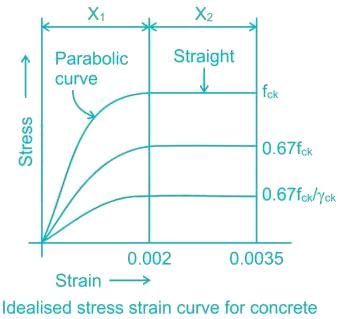
The assumption made according to IS 456 in limit states of collapse are:

  • Plane section normal to the axis remains plane after bending.
  • The maximum strain in the concrete at the outermost compression fiber can be taken as 0.0035 in bending.
  • The tensile strength of the concrete is ignored.
  • The relationship between stress-strain distribution in concrete is assumed to be parabolic.

Hence, Maximum stress in concrete by code is restricted to 0.67fck.

Test: Reinforced Concrete Structures - Question 3

Which method assumes that the structural material behaves in a linearly elastic manner?

Detailed Solution: Question 3

The design methods of reinforced cement concrete structures are as follows:

  • Working stress method
    • This method is based upon linear elastic theory or depends on the classical elastic theory.
    • This method ensured adequate safety by suitably restricting the stress in the materials induced by the expected working leads on the structures.
    • The basic assumption of linear elastic behavior is considered justifiable since the specified permissible stresses are kept well below the ultimate strength of the material.
    • The ratio of the yield stress of the steel reinforcement or the concrete cube strength to the corresponding permissible or working stress value is usually called a factor of safety.
  • Ultimate load method
    • This method is based on the ultimate strength of reinforced concrete at ultimate load is obtained by enhancing the service load by some factor called load factor for giving a desired margin of safety. Hence the method is also referred to as the load factor method or the ultimate strength method.
    • In the ULM, the stress condition at the state of in pending collapse of the structure is analyzed, thus using, the non-linear stress-strain curves of concrete and steel.
    • The safety measure in the design is obtained by the use of the proper load factor.
  • Limit state method
    • Limit states are the acceptable limits for the safety and serviceability requirements of the structure before failure occurs.
    • The design of structures by this method will thus ensure that they will not reach limit states and will not become unfit for the use for which they are intended.
    • It is worth mentioning that structures will not just fail or collapse by violating (exceeding) the limit states. Failure, therefore, implies that clearly defined limit states of structural usefulness have been exceeded.
    • Limit states are two types
      • Limit state of collapse
      • Limit state of serviceability

Kani’s method:
It is the method of structural analysis and its displacement method.

Test: Reinforced Concrete Structures - Question 4

Identify the correct statement/s with respect to spacing of reinforcement:
A. Spacing of stirrups in a RCC rectangular beam is increased at the centre of the beam.
B. Spacing of stirrups in a RCC rectangular beam is increased at the ends of the beam.

Detailed Solution: Question 4
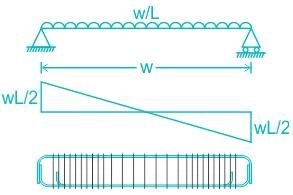
Spacing of stirrups in a RCC beam

  • Assuming a simply supported reinforced concrete beam carrying uniformly distributed load of intensity w kN/m over the span length 'L'.
  • The maximum shear force would be produced at the supports and the shear force at the center of the span is zero.
  • The maximum shear resistance is required at the ends of the supports and the minimum at the center of the span.

Shear reinforcement shall be provided in any of the following forms:
a) Vertical stirrups
b) The bent-up bar along with stirrups
c) Inclined stirrups

Important Points

  • Stirrups are provided to take up the shear stress in the rectangular beam.
  • Spacing is the distance between each consecutive stirrup.
  • And we know from earlier that the shear force acts more near the support
  • So to take up that shear stress, more stirrups need to be present at the support rather than the middle of the beam.

Note that, the shear reinforcement increases as the spacing among the stirrups decreases and vice versa.
As the shear strength requirement is more at the supports than the center, the spacing of stirrups decreases towards the end of the beam.

Test: Reinforced Concrete Structures - Question 5

The recommended imposed load on staircase in residential buildings as per IS 875 is:

Detailed Solution: Question 5
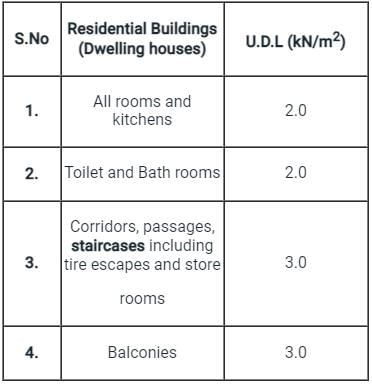
As per IS 875 Part 2, clause 3.1, Imposed Floor load for residential building are:

Test: Reinforced Concrete Structures - Question 6

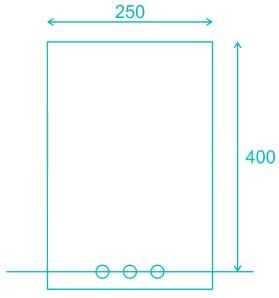
A reinforced concrete beam having width of 250 mm and effective depth of 400 mm, is reinforced with 415 of steel grade (Fe 415). As per the provisions of IS ∶ 456 ∶ 2000, the minimum and maximum amount of tensile reinforcement for the section are respectively

Detailed Solution: Question 6

Minimum tension steel

Where, Ast = Area of steel, b = breadth of beam or web in case of T beam, d = effective depth, fy = characteristic strength of reinforcement in N/mm2
Maximum tension steel
Ast max = 4 % × bd 
Calculation:

Ast( minimum) = 0.85/415 *250*400 = 205 mm2
Ast (maximum)=  = 0.04 × 250 × 400 = 4000 mm2

Test: Reinforced Concrete Structures - Question 7

A RCC column is said to be short if length to diameter ratio is: _____.

Test: Reinforced Concrete Structures - Question 8

The creep strains are

Detailed Solution: Question 8

Creep is the plastic permanent deformation of a structure under constant load for a very long period of time.
It can occur as a result of long-term exposure to high levels of stress that are still below the yield strength of the material. Creep is more severe in materials that are subjected to heat for long periods and generally increases as they near their melting point.
It occurs due to dead load only.
Factors affecting creep
1. Type of loading
2. Magnitude of load
3. Time
4. Temperature
If temperature is more, creep is more and if the temperature reaches to half of melting point temperature the creep is intolerable. Such a temperature is defined as homologous temperature. 

Test: Reinforced Concrete Structures - Question 9

Pick up the correct statement from the following:

Test: Reinforced Concrete Structures - Question 10

The width of the flange of a T-beam should be less than

13 videos|49 docs|34 tests
Information about Test: Reinforced Concrete Structures Page
In this test you can find the Exam questions for Test: Reinforced Concrete Structures solved & explained in the simplest way possible. Besides giving Questions and answers for Test: Reinforced Concrete Structures, EduRev gives you an ample number of Online tests for practice
13 videos|49 docs|34 tests
Download as PDF