NEET Exam  >  NEET Test  >  Biology Class 12  >  Test: Sexual Reproduction in Flowering Plants - 1 - NEET MCQ

Sexual Reproduction in Flowering Plants - 1 - NEET Biology Class 12 Free


MCQ Practice Test & Solutions: Test: Sexual Reproduction in Flowering Plants - 1 (20 Questions)

You can prepare effectively for NEET Biology Class 12 with this dedicated MCQ Practice Test (available with solutions) on the important topic of "Test: Sexual Reproduction in Flowering Plants - 1". These 20 questions have been designed by the experts with the latest curriculum of NEET 2026, to help you master the concept.

Test Highlights:

  • - Format: Multiple Choice Questions (MCQ)
  • - Duration: 20 minutes
  • - Number of Questions: 20

Sign up on EduRev for free to attempt this test and track your preparation progress.

Test: Sexual Reproduction in Flowering Plants - 1 - Question 1

Given below are two statements: one is labelled as Assertion (A) and the other is labelled as Reason (R).
Assertion (A): Apomixis is a form of asexual reproduction that mimics sexual reproduction.
Reason (R): There is no fertilisation in apomictic plants and they do not produce any seeds.

Detailed Solution: Question 1

Option A is correct: (A) is true and (R) is false.

Apomixis is the formation of an embryo from an ovule without fusion of male and female gametes; therefore it is a form of asexual reproduction that results in seed formation without fertilization.

The Assertion is true because apomixis produces seeds and seedlings that resemble those produced by sexual reproduction even though fertilization is absent.

The Reason is incorrect in stating that apomictic plants "do not produce any seeds." In reality, apomictic plants do produce seeds; the distinguishing feature is that these seeds develop without fertilization (for example, embryos may arise from an unfertilised egg cell or from nucellar/sporophytic tissue).

Hence the correct choice is: (A) is True but (R) is False.

Test: Sexual Reproduction in Flowering Plants - 1 - Question 2

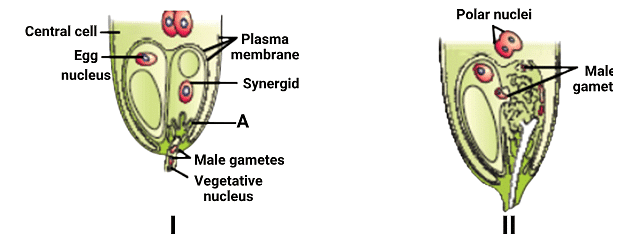
In the given diagram:

Statement I:I shows the entry of the pollen tube into a synergid under the guidance of A.
Statement II:II shows the discharge of male gametes into a synergid.

Detailed Solution: Question 2

(A) To determine the correctness of the statements regarding the given diagram:
- Statement I: The pollen tube enters a synergid under guidance from A, which is correct.
- Statement II: Male gametes are discharged into a synergid, which is correct
Statement I is correct, Statement II is correct SO OPTION (A)
Topic in NCERT: DOUBLE FERTILISATION
Line in NCERT: "the pollen tube releases the two male gametes into the cytoplasm of the synergid."

Test: Sexual Reproduction in Flowering Plants - 1 - Question 3

Endosperm type in which first division of primary endosperm nucleus and few subsequent division are not accompanied by wall formation is called?

Detailed Solution: Question 3

PEN (primary endosperm nucleus) divides into two nuclei and subsequent division of nucleus produce large number of nucleus without cell wall formation. These types of endosperm are called free nuclear type of endosperm.
Topic in NCERT: Endosperm
Line in NCERT: In the most common type of endosperm development, the PEN undergoes successive nuclear divisions to give rise to free nuclei. This stage of endosperm development is called free-nuclear endosperm.

Test: Sexual Reproduction in Flowering Plants - 1 - Question 4

Number of nuclei participating in double fertilisation is?

Detailed Solution: Question 4

Correct answer: B - 5 nuclei.

One pollen tube releases two male gametes (two male nuclei) into the embryo sac.

The female participants are the egg nucleus (one nucleus) and the two polar nuclei in the central cell (two nuclei).

Fusion events: one male gamete fuses with the egg nucleus to form the zygote, and the other male gamete fuses with the two polar nuclei in a triple fusion to form the primary endosperm nucleus.

Therefore the total number of nuclei participating is 2 (male gametes) + 1 (egg nucleus) + 2 (polar nuclei) = 5, so option B is correct.

Test: Sexual Reproduction in Flowering Plants - 1 - Question 5

The anther is a four sided structure consisting of four _________ located at the corner. 

Detailed Solution: Question 5

Anther is bilobed structure at the tips of stamen. Each lobe consists of two theca. Each theca change into microsporangium. Anther forms four sided structure having four microsporangia in which pollen grains are formed.

Topic in NCERT: Anther Structure and Function

Line in NCERT: "The anther is a four-sided (tetragonal) structure consisting of four microsporangia located at the corners, two in each lobe."

Test: Sexual Reproduction in Flowering Plants - 1 - Question 6

Inside the ovary, the ovule is attached to the placenta by means of:

Detailed Solution: Question 6

Ovule/s are located inside the ovary. The point of attachment of the ovule to the ovary is called the funicle. Funicle extends to hilum as stalk.

Topic in NCERT: The Megasporangium (Ovule)

Line in NCERT: "The ovule is a small structure attached to the placenta by means of a stalk called funicle."

Test: Sexual Reproduction in Flowering Plants - 1 - Question 7

While planning for an artificial hybridization programme involving dioecious plants, which of the following steps would not be relevant?

Detailed Solution: Question 7

In an artificial hybridization program with dioecious plants:
- Bagging of the female flower: Relevant to prevent unwanted pollen contamination.
- Dusting of pollen on the stigma: Essential for pollination to occur.
- Emasculation: Not relevant because dioecious plants have separate sexes; emasculation is for monoecious plants.
- Collection of pollen: Necessary for controlled pollination process.
Therefore, in this context, the step that would not be relevant is C: Emasculation.
Topic in NCERT: Artificial Hybridization Techniques
Line in NCERT: "Emasculated flowers have to be covered with a bag of suitable size, generally made up of butter paper, to prevent contamination of its stigma with unwanted pollen."

Test: Sexual Reproduction in Flowering Plants - 1 - Question 8

Pollen grains lose viability within 30 minutes of their release in:-

Detailed Solution: Question 8

(C)

Pollen grains lose viability within 30 minutes of their release in some members of:

  • In some cereals such as rice and wheat, pollen grains lose viability within 30 minutes of their release, and in some members of Rosaceae, Leguminoseae and Solanaceae, they maintain viability for months.

Topic in NCERT: Pollen Viability and Storage

Line in NCERT: "In some cereals such as rice and wheat, pollen grains lose viability within 30 minutes of their release."

Test: Sexual Reproduction in Flowering Plants - 1 - Question 9

In most of the angiosperms, pollen grains are shed at _________.

Detailed Solution: Question 9

About 60% of angiosperms, pollen grains are shed at two celled stage. The larger cell is called vegetative cell and the smaller one is called generative cell. Each generative cell produces two male gametes.

Topic in NCERT: Pollen Grain Development

Line in NCERT: "In over 60 per cent of angiosperms, pollen grains are shed at this 2-celled stage."

Test: Sexual Reproduction in Flowering Plants - 1 - Question 10

The fruits which develops without fertilization are called as?

Detailed Solution: Question 10

Explanation:

Parthenocarpic fruits develop without fertilization of the ovule, resulting in seedless fruits. Examples include banana, seedless grapes, and seedless oranges.

NCERT Reference:

NCERT Class 12 Biology, Chapter 1 – Reproduction in Organisms, under the topic Parthenocarpy:
"In some plants, fruits develop without fertilization and are called parthenocarpic fruits. Such fruits are usually seedless, e.g., banana."

Test: Sexual Reproduction in Flowering Plants - 1 - Question 11

Which among the following statement is incorrect with respect to tapetum?

Detailed Solution: Question 11

The innermost wall layer is the tapetum. It nourishes the developing pollen grains. Cells of the tapetum possess dense cytoplasm and generally have more than one nucleus.

Topic in NCERT: Tapetum

Line in NCERT: "Cells of the tapetum possess dense cytoplasm and generally have more than one nucleus."

Test: Sexual Reproduction in Flowering Plants - 1 - Question 12

Which of the following is an example of false fruit?

Detailed Solution: Question 12

  • True Fruit: A true fruit is one that develops only from the ovary. 
  • Example: Mango, Coconut, Zizyphus etc.
  • False Fruit or Pseudocarp: In some fruits, it is not the ovary that forms the fruit. In fact, some other parts of the flower, like the thalamus, inflorescence, calyx are modified to become a part of the fruit. These types of fruit are called false fruits. 
    Example: Apple, Strawberry etc.

Topic in NCERT: FRUIT DEVELOPMENT AND CLASSIFICATION
Line in NCERT: However, in a few species such as apple, strawberry, cashew, etc., the thalamus also contributes to fruit formation. 
Such fruits are called false fruits

Test: Sexual Reproduction in Flowering Plants - 1 - Question 13

Placenta is located inside the _________.

Detailed Solution: Question 13

Placenta is located inside the ovarian cavity. It help in transport of nutrient to megasporangium or ovule. Ovule is attached to placenta by means of stalk called funicle.

Topic in NCERT: The Pistil, Megasporangium (ovule) and Embryo sac

Line in NCERT: "The placenta is located inside the ovarian cavity."

Test: Sexual Reproduction in Flowering Plants - 1 - Question 14

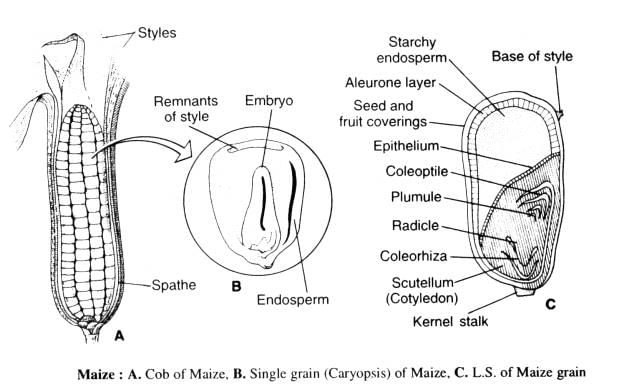
The cotyledon of maize grain is technically called as?  
Detailed Solution: Question 14

Maize grain is monocotyledonous, having a single cotyledon. This cotyledon is also called scutellum.

Examples Of Achene Fruits

Topic in NCERT: Embryo

Line in NCERT: "In the grass family the cotyledon is called scutellum that is situated towards one side (lateral) of the embryonal axis."

Test: Sexual Reproduction in Flowering Plants - 1 - Question 15

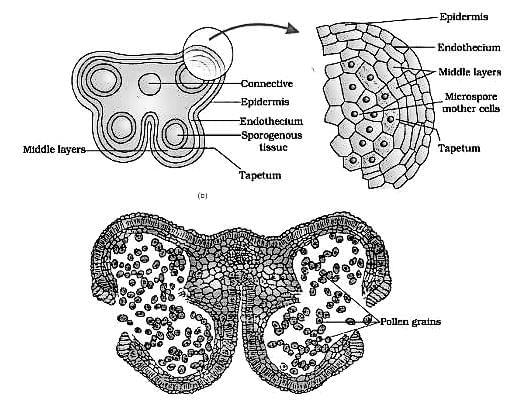
The following is the diagram of T.S. of anther. Identify the parts labelled A, B and C..
Detailed Solution: Question 15


Topic in NCERT: Structure of microsporangium
Line in NCERT: "Four wall layers, the epidermis, endothecium, middle layers and the tapetum surround the microsporangium."

Test: Sexual Reproduction in Flowering Plants - 1 - Question 16

A typical angiosperm embryo sac at maturity is _________.

Detailed Solution: Question 16

Angiospermic embryo sac is 8-nucleate but 7-celled at maturity. This includes 3- celled egg Synergids, 3 antipodal cells and 2 polar nuclei.

Topic in NCERT: Female gametophyte formation

Line in NCERT: "Thus, a typical angiosperm embryo sac, at maturity, though 8-nucleate is 7-celled."

Test: Sexual Reproduction in Flowering Plants - 1 - Question 17

What is the correct sequence of the formation of female gametophyte in angiosperms?

Detailed Solution: Question 17

C is correct.

The process starts in the nucellus, the tissue inside the ovule where the diploid megaspore mother cell (MMC) is formed.

The MMC undergoes meiosis to produce a megasporic tetrad (four haploid megaspores).

Usually, three of these megaspores degenerate and one functional megaspore remains; this functional megaspore undergoes mitotic divisions to form the female gametophyte (embryo sac).

In the common Polygonum type, the functional megaspore undergoes three successive mitotic divisions to produce an 8-nucleate, 7-celled embryo sac (two synergids, one egg cell, three antipodals and a central cell with two polar nuclei).

Therefore the correct order is: nucellus → megaspore mother cell → megaspore tetrad → megaspore → female gametophyte, matching option C.

Test: Sexual Reproduction in Flowering Plants - 1 - Question 18

Which of the following plant is not pollinated by water?

Detailed Solution: Question 18

Some examples of water pollinated plants are Vallisneria and Hydrilla which grow in fresh water and several marine sea-grasses such as Zostera. Not all aquatic plants use water for pollination. In a majority of aquatic plants such as water hyacinth and water lily, the flowers emerge above the level of water and are pollinated by insects or wind as in most of the land plants.

Test: Sexual Reproduction in Flowering Plants - 1 - Question 19

Seed of castor is

Detailed Solution: Question 19

  • Endospermic: Castor seeds contain endosperm, which is the tissue that provides nourishment to the developing embryo.

  • Albuminous: The endosperm in castor seeds remains in the mature seed and is not consumed during seed development, so it is termed albuminous.

Topic in NCERT: Seed

Line in NCERT: "Albuminous seeds retain a part of endosperm as it is not completely used up during embryo development (e.g., wheat, maize, barley, castor)."

Test: Sexual Reproduction in Flowering Plants - 1 - Question 20

A typical anther is
(a) Tetrasporangiate
(b) Tetragonal
(c) Trilobed
(d) Surrounded by four wall layers

Detailed Solution: Question 20

(a) Tetrasporangiate: Correct. A typical anther has four pollen sacs or microsporangia.
(b) Tetragonal: Correct - The anther is a four-sided (tetragonal) structure consisting of four microsporangia located at the corners, two in each lobe.
(c) Trilobed: No, anthers are typically bilobed, not trilobed
(d) Surrounded by four wall layers: Correct. The anther is surrounded by four distinct wall layers: the epidermis, endothecium, middle layer, and tapetum.
Topic in NCERT: Anther Structure and Function
Line in NCERT: "A typical anther is bilobed, dithecous and tetrasporangiate. Four wall layers, the epidermis, endothecium, middle layers and the tapetum surround the microsporangium."

69 videos|305 docs|161 tests
Information about Test: Sexual Reproduction in Flowering Plants - 1 Page
In this test you can find the Exam questions for Test: Sexual Reproduction in Flowering Plants - 1 solved & explained in the simplest way possible. Besides giving Questions and answers for Test: Sexual Reproduction in Flowering Plants - 1, EduRev gives you an ample number of Online tests for practice
69 videos|305 docs|161 tests
Download as PDF