NEET Exam  >  NEET Test  >  Biology Class 12  >  Test: Organisms & Populations - 1 - NEET MCQ

Organisms & Populations - 1 - Free MCQ Practice Test with solutions, NEET


MCQ Practice Test & Solutions: Test: Organisms & Populations - 1 (20 Questions)

You can prepare effectively for NEET Biology Class 12 with this dedicated MCQ Practice Test (available with solutions) on the important topic of "Test: Organisms & Populations - 1". These 20 questions have been designed by the experts with the latest curriculum of NEET 2026, to help you master the concept.

Test Highlights:

  • - Format: Multiple Choice Questions (MCQ)
  • - Duration: 20 minutes
  • - Number of Questions: 20

Sign up on EduRev for free to attempt this test and track your preparation progress.

Test: Organisms & Populations - 1 - Question 1

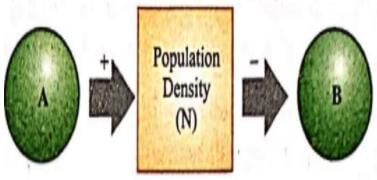
The density of a population in a given habitat during a given period, fluctuates due to changes in certain basic processes. On this basis, fill up boxes A and B in the given flow chart with correct option.
Detailed Solution: Question 1

The population density in a given habitat and at a particular time period, fluctuates due to the changes in four basic processes given below:-

1. Natality- It refers to the number of births take place in a population during a given period.

2. Mortality- It refers to the number of deaths take place in a population during a given period.

3. Immigration- It refers to the number of individuals of the same species have migrated into the habitat from somewhere else during a particular time period.

4. Emigration- It refers to the number of individuals of the same species have migrated out of the habitat during a given time period.

Natality and immigration add to the population density whereas mortality and emigration decrease the population density.

Topic in NCERT: Population Dynamics

Line in NCERT: "the density of a population in a given habitat during a given period, fluctuates due to changes in four basic processes, two of which (natality and immigration) contribute to an increase in population density and two (mortality and emigration) to a decrease."

Test: Organisms & Populations - 1 - Question 2

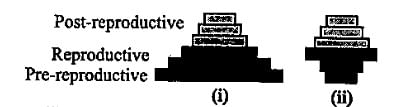
What does the shape of the given age pyramids reflects about the growth status of the related population?
Detailed Solution: Question 2

Triangular age pyramid has high proportion of reproductive individuals, moderate number of reproductive individuals and fewer post-reproductive individuals. It represents young or rapidly growing population.

In urn-shaped age pyramid, the number of reproductive individuals is higher than the number of pre-reproductive individuals. It represents declining or diminishing population with negative growth

In bell-shaped age pyramid, the number of pre-reproductive and reproductive individuals is almost equal. Post reproductive individuals are comparatively fewer. It represents stable or stationary population where growth rate is nearly zero.

Topic in NCERT: Age Pyramids and Population Growth Status

Line in NCERT: "The shape of the pyramids reflects the growth status of the population - (a) whether it is growing, (b) stable or (c) declining."

Test: Organisms & Populations - 1 - Question 3

In a pond, last year there were 30 lotus plants. Through reproduction, 25 new lotus plants were added in one year while 8 plants died. The birth and death rates for the lotus population respectively are ___ and ____ individuals per lotus per year.

Detailed Solution: Question 3

Total number of plants (in the beginning ) = 30
New plants added by reproduction = 25
Birth rate (of a population)
= New plants / Total number of plants = 25/30
=0.83 individuals per lotus per year
Number of plants died =8
Death rate (of a population) = number of deaths /Total number of plants
= 8/30 = 0.26 individuals per lotus per year.

Test: Organisms & Populations - 1 - Question 4

In a given population of 2000 individuals, 80 births and 125 deaths were reported over a given period of time. Which of the following graphs will correspond to it?

Detailed Solution: Question 4

Number of deaths is more than the number of births, showing a declining population.

Test: Organisms & Populations - 1 - Question 5

If N  population density at time t, then population density at time t+1 can be written as

Nt +1=Nt +[(A+B)−(C+D)]
Select the correct option for A, B, C and D in the above equation. 

Detailed Solution: Question 5

A and B are natality and immigration. They add to population density. C and D are mortality and emigration. They decrease population density.

Topic in NCERT: Population Growth Models

Line in NCERT: "Nt+1 = Nt + [(B + I) - (D + E)]"

Test: Organisms & Populations - 1 - Question 6

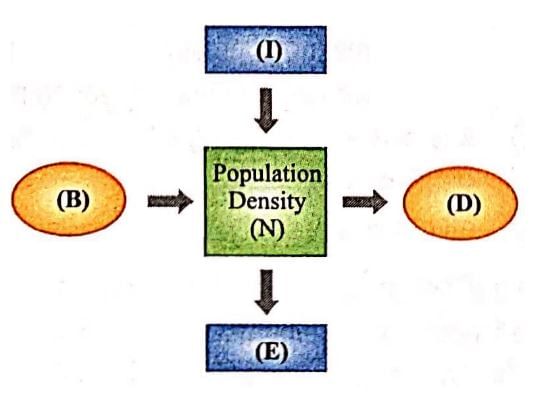
The given figure represents different factors affecting population density (N) If B = nasality, D = mortality, E = emigration and I = immigration; then select the incorrect option regarding these.
Detailed Solution: Question 6

Answer: D. Immigration (I) is not generally equal to emigration (E).

  • Births (B) and deaths (D) are the primary factors determining population density (N) under normal conditions; immigration and emigration become important only in special situations.

  • When a habitat is newly colonised, immigration (I) can be more important than natality (B) because individuals arriving from outside increase the population.

  • B and I both increase N (positive contributions), while D and E decrease N (negative contributions).

  • I equals E only at a dynamic equilibrium or in a perfectly closed and stable population; this is not generally true for most real populations, so the statement I is generally equal to E is incorrect.

Therefore, option D is incorrect.

Test: Organisms & Populations - 1 - Question 7

In a population per capita birth rate is 0.15 and per capita death rate is 0.08 during a unit time period. What is the value of r (intrinsic rate of natural increase) for the given population?

Detailed Solution: Question 7

Intrinsic rate of natural increase (r)

= Birth rate − death rate

=0.15−0.08=0.07

Topic in NCERT: Intrinsic Rate of Natural Increase

Line in NCERT: "The r in this equation is called the ‘intrinsic rate of natural increase' and is a very important parameter chosen for assessing impacts of any biotic or abiotic factor on population growth."

Test: Organisms & Populations - 1 - Question 8

The maximum possible number of individuals that a habitat can support is called its

Detailed Solution: Question 8

In nature, a given habitat has resources to support a certain number of individuals of a population, beyond which no further growth is possible. This limit is called as nature's carrying capacity (K) for that species in that habitat.

Topic in NCERT: Carrying Capacity

Line in NCERT: "In nature, a given habitat has enough resources to support a maximum possible number, beyond which no further growth is possible. Let us call this limit as nature's carrying capacity (K) for that species in that habitat."

Test: Organisms & Populations - 1 - Question 9

Which of the following equations correctly represents verhulst-Pearl logistic growth?

Detailed Solution: Question 9

S-shaped growth curve is also called Verhulst-Pearl logistic curve and is represented by the following equation :

where dN/dt= rate of change in population size, r= intrinsic rate of natural increase, N= population density, K= carrying capacity and 

Topic in NCERT: Logistic Growth

Line in NCERT: "This type of population growth is called Verhulst-Pearl Logistic Growth and is described by the following equation: dN/dt = rN(K-N)"

Test: Organisms & Populations - 1 - Question 10

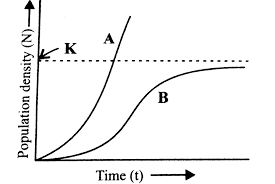
Study the population growth curves (A and B) in the given graph and select the incorrect option
Detailed Solution: Question 10

Since resources of growth for most animal populations are finite and become limiting sooner or later, the logistic growth model is considered as more realistic.

Topic in NCERT: Logistic Growth Model

Line in NCERT: "Since resources for growth for most animal populations are finite and become limiting sooner or later, the logistic growth model is considered a more realistic one."

Test: Organisms & Populations - 1 - Question 11

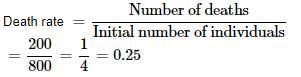
In a life table, the number of individuals alive at the beginning of the 1 st year to 2 nd year interval is 800. During this interval, 200 individuals die. The death rate for this interval is 

Detailed Solution: Question 11
Test: Organisms & Populations - 1 - Question 12

In a laboratory population of fruit flies, if 4 individuals died during a specified time interval and the population had 40 fruit flies, what is the death rate?

Detailed Solution: Question 12

In the given scenario, the laboratory population of fruit flies consists of 40 fruit flies, and during a specified time interval, 4 individuals died. To calculate the death rate, we divide the number of deaths by the total population.

Number of deaths = 4
Total population = 40

Death rate = Number of deaths / Total population
= 4 / 40
= 0.1 individuals per fruitfly per week

Option a) "0.1 individuals per fruitfly per week" is the correct answer because it accurately represents the death rate calculated based on the given information.

Topic in NCERT: Population Dynamics

Line in NCERT: "If 4 individuals in a laboratory population of 40 fruitflies died during a specified time interval, say a week, the death rate in the population during that period is 4/40 = 0.1 individuals per fruitfly per week."

Test: Organisms & Populations - 1 - Question 13

An age pyramid with a wide base and narrow top indicates a population that is:

Detailed Solution: Question 13

An age pyramid with a wide base and narrow top indicates a population that is growing rapidly.

In an age pyramid, the width of each age group represents the proportion or percentage of individuals in that specific age group. A wide base indicates a larger population of young individuals, while a narrow top indicates a smaller population of older individuals.

When the base of an age pyramid is wide and the subsequent age groups gradually decrease in width towards the top, it suggests that there is a higher proportion of young individuals compared to older individuals. This is indicative of a population that is growing rapidly because there is a high birth rate.

Topic in NCERT: Age Pyramids and Population Growth Status

Line in NCERT: "The shape of the pyramids reflects the growth status of the population - (a) whether it is growing, (b) stable or (c) declining."

Test: Organisms & Populations - 1 - Question 14

Which principle states that the superior competitor eliminates the inferior one in competition?

Detailed Solution: Question 14

The principle that states that the superior competitor eliminates the inferior one in competition is the Competitive Exclusion Principle. This principle suggests that when two species compete for the same limited resources in an ecological niche, the species that is better adapted or more efficient at utilizing those resources will eventually outcompete and eliminate the other species from that particular niche.

The correct answer is option d) Competitive exclusion principle. This principle highlights the competitive interactions between species and how competition can lead to the exclusion of one species by another in certain ecological niches.

Topic in NCERT: Competition

Line in NCERT: "Gause's 'Competitive Exclusion Principle' states that two closely related species competing for the same resources cannot co-exist indefinitely and the competitively inferior one will be eliminated eventually."

Test: Organisms & Populations - 1 - Question 15

Exponential growth pattern in a population results into:

Detailed Solution: Question 15

Exponential growth pattern in population results into j-shaped curve. During exponential growth faster growth occurs and j-shaped curve is formed when time v/s growth is drawn.

Topic in NCERT: Population Growth Models

Line in NCERT: "The above equation describes the exponential or geometric growth pattern of a population (Figure 11.3) and results in a J-shaped curve when we plot N in relation to time."

Test: Organisms & Populations - 1 - Question 16

In which of the following interaction/s one species is benefitted while other is harmed?

Detailed Solution: Question 16

In predation and parasitism one species is benefitted while other is harmed. Parasite obtain food from host by harming them.

Topic in NCERT: Predation

Line in NCERT: "In both parasitism and predation only one species benefits (parasite and predator, respectively) and the interaction is detrimental to the other species (host and prey, respectively)."

Test: Organisms & Populations - 1 - Question 17

Which growth pattern occurs when resources become progressively limiting in a population?

Detailed Solution: Question 17

Populations grow through births and immigration and decline through deaths and emigration.

When resources become progressively limiting for a population, the growth pattern turns logistic. This means that initially, the population may experience exponential growth when resources are abundant and unlimited.

However, as resources start to become scarce and limiting, the growth rate of the population slows down and eventually levels off. This pattern is known as logistic growth.

  • Exponential growth (option b) refers to a rapid and unrestricted increase in population size without resource limitations.
  • Constant growth (option c) implies a steady and consistent growth rate over time, regardless of resource availability.
  • Declining growth (option d) suggests a decrease in population size over time, often due to factors like limited resources or environmental disturbances.

Topic in NCERT: Logistic Growth

Line in NCERT: "When resources become progressively limiting, the growth pattern turns logistic."

Test: Organisms & Populations - 1 - Question 18

The birth rate if 7 new plants are added to previous year plant population of 23 Salvinia plants will be:

Detailed Solution: Question 18

The birth rate of a population = new individual added / previous population. Here birth rate= 7/23=0.3043. Hence, birth rate of Salvinia plants is equal to 0.3.

Test: Organisms & Populations - 1 - Question 19

A statement 933 females per 1000 males depict:

Detailed Solution: Question 19

Sex ratio is the no of female available per thousands of male in a population. Sex ratio is decline due to female feticides alarmingly in some part of India.

Topic in NCERT: Population Attributes

Line in NCERT: "Another attribute characteristic of a population is sex ratio."

Test: Organisms & Populations - 1 - Question 20

Which of the following best defines age structure of a population?

Detailed Solution: Question 20

Correct answer: B.

Age structure is the percentage of individuals in different age groups within a population.

These age groups are commonly divided as pre-reproductive, reproductive and post-reproductive classes.

Age structure is often represented graphically as an age pyramid. The shape of this pyramid helps indicate whether the population is growing, stable, or declining.

Option A describes rates (birth rate and death rate), not the age composition. Option C gives the total population size, which is different from age composition. Option D refers to migration rate, which is a measure of movement and not the distribution of ages.

Therefore, the statement that best defines age structure is option B.

69 videos|305 docs|161 tests
Information about Test: Organisms & Populations - 1 Page
In this test you can find the Exam questions for Test: Organisms & Populations - 1 solved & explained in the simplest way possible. Besides giving Questions and answers for Test: Organisms & Populations - 1, EduRev gives you an ample number of Online tests for practice
69 videos|305 docs|161 tests
Download as PDF
