JEE Exam  >  JEE Test  >  Chapter-wise Tests Main & Advanced  >  Test: Polymers (Old NCERT) - JEE MCQ

Polymers (Old NCERT) - Free MCQ Practice Test with solutions, JEE Chapter


MCQ Practice Test & Solutions: Test: Polymers (Old NCERT) (25 Questions)

You can prepare effectively for JEE Chapter-wise Tests for JEE Main & Advanced with this dedicated MCQ Practice Test (available with solutions) on the important topic of "Test: Polymers (Old NCERT)". These 25 questions have been designed by the experts with the latest curriculum of JEE 2026, to help you master the concept.

Test Highlights:

  • - Format: Multiple Choice Questions (MCQ)
  • - Duration: 35 minutes
  • - Number of Questions: 25

Sign up on EduRev for free to attempt this test and track your preparation progress.

Test: Polymers (Old NCERT) - Question 1

For macromolecules to form, one more of the following criteria are essential

Detailed Solution: Question 1

Macromolecule is made by joining smaller molecules(monomers)by covalent bond formation.

Test: Polymers (Old NCERT) - Question 2

One of the statements below is not true for the classification of polymers can be classified on the basis of their

Detailed Solution: Question 2

Polymer cannot be classified on the basis of their resistance to different agents.

Test: Polymers (Old NCERT) - Question 3

Identify the type of polymer. —A—B—B—A—A—A—B—A—

Detailed Solution: Question 3

This is copolymer is polymer made up of different monomers.

Test: Polymers (Old NCERT) - Question 4

Which of the following polymers have tetrafluoroethene monomer units?

Detailed Solution: Question 4

Teflon has CF2=CF2 as monomer unit.

Test: Polymers (Old NCERT) - Question 5

Cellulose acetate (rayon) and cellulose nitrate are __________ polymers

Detailed Solution: Question 5

It is semi synthetic polymer.

Test: Polymers (Old NCERT) - Question 6

One of the following rubbers is used in making oil seals, tank lining, etc.

Detailed Solution: Question 6

Buna N is used in making oil seals , tank linings.

Test: Polymers (Old NCERT) - Question 7

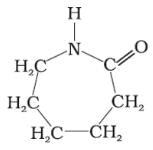
Which of the following polymer can be formed by using the monomer unit represented below?
Detailed Solution: Question 7

Nylon – 6, 6 Caprolactum is monomer of nylon 6.

Test: Polymers (Old NCERT) - Question 8

Which branched chain isomer of the hydrocarbon with molecular mass 72u gives only one isomer of mono substituted alkyl halide?

Detailed Solution: Question 8

Since we are getting monosubstituted alkyl halide so it is neopentane.

Test: Polymers (Old NCERT) - Question 9

Polythene is not one of the following?

Detailed Solution: Question 9

Polymer is not semi synthetic. It is synthetic.

Test: Polymers (Old NCERT) - Question 10

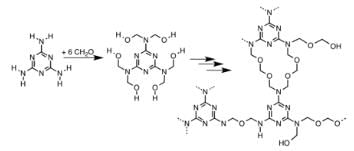
Melamine is

Detailed Solution: Question 10

Test: Polymers (Old NCERT) - Question 11

Nylon – 2 – Nylon – 6 is

Detailed Solution: Question 11

They both are biodegradable polymer.

Test: Polymers (Old NCERT) - Question 12

Which of the following statements about low density polythene is FALSE?

Detailed Solution: Question 12

Low density polythene : It is obtained by the polymerisation of ethene under high presure of 1000-2000 atm. at a temp. of 350 K to 570 K in the pressure of traces of dioxygen or a peroxide initiator (cont). Low density polythene is chemically inert and poor conductor of electricity. It is used for manufacture squeeze bottles. toys and flexible pipes.

Test: Polymers (Old NCERT) - Question 13

One of the following is used in speciality packaging, orthopaedic devices and in controlled release of drugs.

Detailed Solution: Question 13

PHBV [Poly(3-hydroxybutyrate-co-3-hydroxyvalerate)] find its applications in controlled release of drugs, medical implants and repairs, speciality packaging, orthopaedic devices and manufacturing bottles for consumer goods.

Test: Polymers (Old NCERT) - Question 14

Formation of Buna – S, involves polymerization of

Detailed Solution: Question 14

Buna S involves the polymerization of 1, 3 butadiene and styrene.

Test: Polymers (Old NCERT) - Question 15

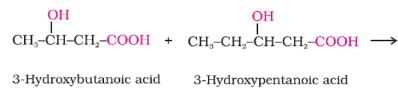
In the following reaction, the polymer formed is ?

Detailed Solution: Question 15

These monomers form PHBV.

Test: Polymers (Old NCERT) - Question 16

Dacron is manufactured by heating a mixture of ethylene glycol and terephthalic acid with one of the Conditions given below.

Detailed Solution: Question 16

Dacron is manufactured by heating a mixture of ethylene glycol and terephthalic acid at 420 to 460K in presence of SnO3 as catalyst.

Test: Polymers (Old NCERT) - Question 17

Painting material among the following is

Detailed Solution: Question 17

Painting material is Gyptal.

Test: Polymers (Old NCERT) - Question 18

Which one of the following is not a condensation polymer?

Detailed Solution: Question 18
The correct answer is Option B.
Neoprene is not a condensation polymer. It is an additional polymer.
Neoprene is made from monomer chloroprene (2-chlorobuta-1,3-diene). 
Dacron, Melamine and Glyptal are condensation polymers.
Dacron ( also known as terylene) is a polyester made by condensation polymerisation of ethylene glycol and dimethyl terephthalate.
Glyptal is a copolymer of ethylene glycol and phthalic acid.
Melamine ( or formaldehyde melamine polymer) is obtained from condensation polymerisation of melamine with formaldehyde.

Test: Polymers (Old NCERT) - Question 19

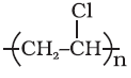
The below molecule is called?

Detailed Solution: Question 19

This polymer is polyvinylchloride.

Test: Polymers (Old NCERT) - Question 20

In vulcanisarion of rubber,

Detailed Solution: Question 20

In vulcanization of rubber sulphur crosslinking is introduced.

Test: Polymers (Old NCERT) - Question 21

Bakelite is used for making

Detailed Solution: Question 21

Bakelite is used in making electrical switches.

Test: Polymers (Old NCERT) - Question 22

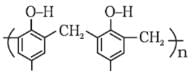
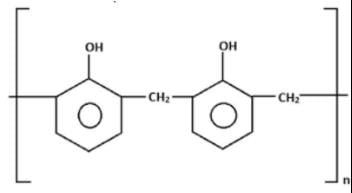
The correct name of the polymer below is: 

Detailed Solution: Question 22

The correct answer is Option B.
Novolac
-> Linear structure formed as a product of condensation reaction between phenol and formaldehyde with excess of phenol.
-> It is used in paints

Test: Polymers (Old NCERT) - Question 23

Rubber tree is found in

Detailed Solution: Question 23

Rubber tree is found in India.

*Multiple options can be correct
Test: Polymers (Old NCERT) - Question 24

Which of the following monomers form biodegradable polymers?

Detailed Solution: Question 24

Poly-β−hydroxybutyrate co-β− valerate (PHBV). It is obtained by the copolymerization of 3−hydroxybutyric acid and 3−hydroxypentanoic acid. PHBV is used in specially packaging orthopedic devices and in controlled release of drugs. PHBV undergoes bacterial degradation in the environment.
Nylon−2−. It is an alternating polyamide copolymer of glycine (H2​N−CH2​−COOH) and aminocaproic acid [NH2​(CH2​)5COOH] and is biodegradable.

Test: Polymers (Old NCERT) - Question 25

Which polymers occur naturally in nature

Detailed Solution: Question 25

Starch and cellulose occur naturally.

446 docs|929 tests
Information about Test: Polymers (Old NCERT) Page
In this test you can find the Exam questions for Test: Polymers (Old NCERT) solved & explained in the simplest way possible. Besides giving Questions and answers for Test: Polymers (Old NCERT), EduRev gives you an ample number of Online tests for practice
Download as PDF