SSC CGL Exam  >  SSC CGL Test  >  Quantitative Aptitude  >  MCQ: Geometric Progressions - 2 - SSC CGL MCQ

Geometric Progressions - 2 - Free MCQ Practice Test with solutions, SSC


MCQ Practice Test & Solutions: MCQ: Geometric Progressions - 2 (15 Questions)

You can prepare effectively for SSC CGL Quantitative Aptitude for SSC CGL with this dedicated MCQ Practice Test (available with solutions) on the important topic of "MCQ: Geometric Progressions - 2". These 15 questions have been designed by the experts with the latest curriculum of SSC CGL 2026, to help you master the concept.

Test Highlights:

  • - Format: Multiple Choice Questions (MCQ)
  • - Duration: 15 minutes
  • - Number of Questions: 15

Sign up on EduRev for free to attempt this test and track your preparation progress.

MCQ: Geometric Progressions - 2 - Question 1

If 4th and 5th term of a G.P. are 2 and 8 respectively, then the product of the 1st 8 terms is

Detailed Solution: Question 1
Concept Used:
if a is the first term and r is the common ratio of the G. P. then nth term, tn = arn-1

Calculation:
let a and r be the first term and common ratio of the required G.P.
Given, 4th term = 2, 5th term = 8
⇒ ar3 = 2      ----(1)
⇒ ar4 = 8      ----(2)
Divide equation 2 by 1
⇒ r = 4
To find: Product of find 8 term = a⋅ar⋅ar2⋅ar3⋅ . . . ar7
⇒ a8r(1+2+3+. . . +7) =  = a8r28
⇒(ar3)4(ar4)4
⇒ 24 × 84
⇒ 16 × 64 × 64
⇒ 48
∴ The product of the 1st 8 terms is 48.

MCQ: Geometric Progressions - 2 - Question 2

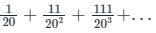
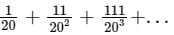
Find the sum of the given series: 

Detailed Solution: Question 2

Given:
The required series: 
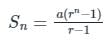
Formula used:
The formula used for summation for G.P: (r < 1 and series is of infinite terms)

Where, 
S, is the summation of G.P
a, is the first term
r, is the common ratio

Calculation:
Let S be the sum of the given series.
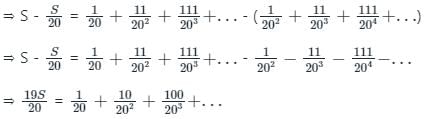
The required series can be written as:

Now, divide the above equation by 20.

Now, subtract equation (2) from equation (1).

Now, the above series becomes Geometric series with a common ratio of 10/20.
The value for the common ratio, r = 10/20 = 1/2
The value of the first term in the series = 1/20
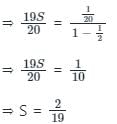
Now, 

∴ The value of the required series is 2/19.

MCQ: Geometric Progressions - 2 - Question 3

There are four numbers forming a GP in which the third term is greater than the first by 9 and the second term is greater than the fourth by 18. What is the first term?

Detailed Solution: Question 3
Given:
The third term is greater than the first by 9.
The second term is greater than the fourth by 18.

Concept:
nth Term of GP whose first term & common ratio are 'a' & 'r', is given by Tn = arn-1

Calculation:
Let a be the first term and r be the common ratio of the G.P.
a1 = a, a2 = ar, a3 = ar2, a4 = ar3
According to the question
a= a1 + 9
⇒ ar2 = a + 9 ....(1)
Now, a2 = a4 + 8
⇒ ar = ar3 + 18 ....(2)
From equation (1) and (2),
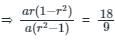
⇒ a(r2 - 1) = 9 ....(3)
⇒ ar(1 - r2) = 18 ...(4)
Dividing (4) and (3), we get

⇒ -r = 2
⇒ r = -2
Substituting the value of r in equation (1), we get
⇒ 4a = a + 9
⇒ 3a = 9
⇒ a = 3
So. the first term of G.P. a1 = a = 3
∴ The required value is 3.

MCQ: Geometric Progressions - 2 - Question 4

If the first term is 125 and the common ratio is 2/5, what will be the 4th term of the GP? 

Detailed Solution: Question 4

Concept:
If a, ar, ar2, ar3,.....,arn-1 are in GP then the nth term of GP is given by
Tn = arn-1

Given:
First term a = 125
Common ratio r = 2/5
Term n = 4 th

Calculation:
⇒ Tn = arn-1
⇒ T4 = 125 × (2/5)4-1
⇒ T4 = 125 × (2/5)3
⇒ T4 = 125 × (8/125)
⇒ T4 = 8
Hence, the 4th term of the G is "8".

MCQ: Geometric Progressions - 2 - Question 5

If (1/21) + (1/22) + (1/23) .... (1/210) = 1 /k, then what is the value of k?

Detailed Solution: Question 5

Given:
(1/21) + (1/22) + (1/23) + ……… + (1/210) = 1/k

Formula used:
Sum of G.P = a(1 – rn)/(1 – r)

Calculation:
(1/21) + (1/22) + (1/23) + ……… + (1/210) = 1/k
Left hand side of the above series in GP and common ratio = ½
∴ Sum of the given series = [1(1 – rn)/(1- r)]
⇒ ½ × [(1 – (½)10]/ (1-1/2)
⇒ ½ × [1 – 1/1024]/ (1/2)
⇒ 1023/1024 = 1/k
⇒ k = 1024/1023
∴ The correct answer is 1024/1023.

MCQ: Geometric Progressions - 2 - Question 6

Find the sum of the series : (20 + 22 + 24 +........+ 28) × 3

Detailed Solution: Question 6

Given:
(20 + 22 + 24 +........+28) × 3

Formula Used:
It is a Geometric Progression. 
a = first term, r = common ratio
Sum of the Geometric Progression = [a(rn - 1)/(r - 1)]

Calculation:
a = 1
r = (22/20) = 4/1 = 4
⇒ Sum of the series = [1 × (45 - 1)/(4 - 1)]  × 3
⇒ Sum of the series = [1 × (210 - 1)/(3)]  × 3
⇒ Sum of the series = [1 × (1024 - 1)]  
⇒ Sum of the series = [1 × (1023)]  
⇒ Sum of the series = 1023
∴ The Sum of the series is 1023.

MCQ: Geometric Progressions - 2 - Question 7

After striking the floor, a ball rebounds to 4/5th of the height from which it has fallen. Find the total distance that it travels before coming to rest if it has been gently dropped from a height of 120 meters.

Detailed Solution: Question 7

Given:
A ball dropped from a height of 120 m

Formula:

Calculation:
After dropping 120 m height the ball bounce = 120 × 4/5 = 96 m
⇒ First term (a) = 120 + 96 = 216 m
⇒ Common ratio (r) = 4/5
∴ Total distance that it travels before coming to rest = 216/(1 – 4/5) = 216/(1/5) = 216 × 5 = 1080 m

MCQ: Geometric Progressions - 2 - Question 8

Find the geometric mean of the numbers 7, 72, 73, _________ 7n.

Detailed Solution: Question 8

Given:
7, 72, 73, _________ 7n

Concept used:
Gm of two no a & b = √ab

Calculation:
GM = n√(a1.an)
​⇒ GM of n√(7, 72 , .....7n)
​⇒ n√7n(n + 1)/2
⇒ (7n(n + 1)/2)1/n
​⇒ 
∴ Required answer is ​​​​​​​

MCQ: Geometric Progressions - 2 - Question 9

The ratio of 10th term to 7th term of a G.P. is 1 ∶ 8. What is the common ratio of the G.P.?

Detailed Solution: Question 9

Given:
The ratio of 10th term to 7th term of a G.P. = 1 ∶ 8.

Calculation:
Let the common ratio of the G.P. be r
Now, According to the question
⇒ 10th term/7th term = 1/8
⇒ 8 × 10th term = 7th term
⇒ 8 × (7th term × r3) = 7th term
⇒ r3 = 18
⇒ r = 1/2
∴ The common ratio is 1/2.

MCQ: Geometric Progressions - 2 - Question 10

The third term of a G.P. is 16. The product of its first five terms is:

Detailed Solution: Question 10

Given:
The third term of a G.P. is 16. 

Concept used:
The general form of G.P. is
a, ar, ar2, ar3, ar4,.....arn-1
Where, a = First term, r = common ratio, arn-1 = nth term

Calculation:
Third term of a GP, ar2 = 16
Product of first five terms, P = a(ar)(ar2)(ar3)(ar4)
⇒ P = a5r10
⇒ P = (ar2)5
⇒ P = 165 = (24)5 = 220
∴  The product of its first five terms is 220.

MCQ: Geometric Progressions - 2 - Question 11

16, 32, 64, 128,...... The sum of first 10 numbers in the series is:

Detailed Solution: Question 11

Given:
A Geometric Progression with first term ‘a’ = 16 and common ratio ‘r’ = 2.

Concept Used:
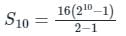
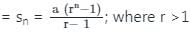
In this type of question, where ‘r’ > 1, then the sum of n terms of a G.P = Sn 

Formula Used:

n = 10

Calculation:
Considering the given series
16, 32, 64, 128, ......

⇒ S10 = 16 × 1023 = 16368
∴ Sum of first 10 terms of given series is 16368

MCQ: Geometric Progressions - 2 - Question 12

If G is the G.M. of the product of r sets of observations. With geometric means G1, G2, G3, ……………, Gr respectively, then find the value of G?

Detailed Solution: Question 12

Concept:
Geometric mean: The value which indicates the central tendency by using the product of the values of a set of numbers.
Formula: GM = (Product of all numbers in the set)1/n
Where, n = total numbers in the set
Example: 2, 3, 4, 5
GM = (2 × 3 × 4 × 5)1/4 = (120)1/4

Calculation:
G = G1 × G2 × G3 ……………….. × Gr

MCQ: Geometric Progressions - 2 - Question 13

The ages of three friends Alpha, Beta and Gamma are in G.P. and the sum of their ages is 57 and the product is 5832. What are their ages? 

Detailed Solution: Question 13

Given
The 3 ages are in G.P. such that their sum is 57 and their product is 5832.

Formula Used
3 terms of a G.P. = a/r, a, ar.

Calculation
Let the ages of Alpha, Beta and Gamma be a/r, a, ar.
Also, Product of their ages = 5832
(a/r) × a × ar = 5832
⇒ a3 = 5832
⇒ a = 18
and Sum = 57
⇒ a/r + a + ar = 57
⇒ a( 1/r + 1 + r) = 57
⇒ 18(1 + r + r2) = 57
⇒ 6 + 6r + 6r2 = 19r
⇒ 6r2 - 13r + 6 = 0
⇒ 6r2 - 9r - 4r + 6 = 0
⇒ (3r - 2) (2r - 3) = 0
⇒ r = 2/3 or r = 3/2
Putting the values of a and r in a/r, a, ar, we find that the required ages are 12, 18, 27 or 27, 18, 12.
∴ The required ages are 12, 18, 27 or 27, 18, 12.

MCQ: Geometric Progressions - 2 - Question 14

If the sum of n numbers in the GP 5, 10, 20, ... is 1275 then n is?

Detailed Solution: Question 14

Concept:
Let us consider sequence a1, a2, a3 …. an is a G.P.

  • Common ratio =
  • nth  term of the G.P. is an = arn−1
  • Sum of n terms of GP =
  • Sum of n terms of GP =
  • Sum of infinite GP = 

Calculation:
Given series is 5, 10, 20, ...
Here, a = 5, r = 2
Sum of n numbers = sn = 1275
As we know that, Sum of n terms of GP 

1275 = 5 × (2n - 1)
⇒ 255 = (2n - 1)
⇒ 2n = 256
⇒ 2n = 28
⇒ n = 8
Thus the correct answer is 8.

MCQ: Geometric Progressions - 2 - Question 15

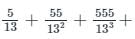
The sum of infinite 

Detailed Solution: Question 15

Given:

Formula used:
Sum of infinite G.P. = a/(1 – r)

Calculation:

Now, multiply both sides by 1/13, we get
⇒ 1/13s = 5/132 + 55/133 ....(2)
Subtracting (2) from (1)
⇒ s – 1/13s = [5/13 + 55/132 + 555/133 + ....] – [5/132 + 55/133 +....]
⇒ 12s/13 = 5/13 + [55/132 – 5/132] + (555/133 – 55/133) + .....
⇒ 12s/13 = 5/13 + 50/132 + 500/133 + ....
Now,
Here R.H.S is an infinite G.P. with first term a = 5/13 and common ratio (r) = 10/13
So,  
⇒ 12s/13 = 5/13/(1 – 10/13)
⇒ 12s/13 = 5/13/(13 – 10)/13
⇒ 12s/13 = (5/13)/(3/13)
⇒ 12s/13 = (5/13 × 13/3)
⇒ 12s/13 = 5/3
⇒ s = (13 × 5)/(12 × 3)
⇒ s = 65/36
∴ The required value is 65/36

319 videos|366 docs|157 tests
Information about MCQ: Geometric Progressions - 2 Page
In this test you can find the Exam questions for MCQ: Geometric Progressions - 2 solved & explained in the simplest way possible. Besides giving Questions and answers for MCQ: Geometric Progressions - 2, EduRev gives you an ample number of Online tests for practice
Download as PDF